8 Powerful Concluding Sentence Starters to Elevate Your Writing in 2025
The way you end a piece of writing—whether it's a blog post, an academic essay, or a business report—is just as crucial as how you begin. A strong conclusion doesn't just summarize; it solidifies your argument, leaves a lasting impression, and prompts the reader to think or act. Finding the right words can be challenging, especially when you're striving for a professional yet approachable tone.
As content creators, we increasingly turn to AI for drafting assistance, making the final, human touch more critical than ever. Research shows that reader engagement drops significantly with content that feels robotic or formulaic, and AI detectors are becoming more adept at spotting these patterns. This is where a well-chosen concluding phrase can make all the difference, signaling a clear, confident, and human-driven finale.
At PureWrite, we believe in leveraging AI as a powerful assistant, not a replacement for your genuine insight. This guide provides a curated list of concluding sentence starters, complete with practical examples and use cases. We'll show you how to choose the perfect phrase to match your purpose, ensuring your final words resonate with your audience and feel authentically you.
1. In conclusion
The phrase “In conclusion” is one of the most classic and widely recognized concluding sentence starters. It functions as a clear, direct signpost, telling your readers that you have reached the final section of your argument. Its primary strength lies in its unambiguous, formal nature.
This traditional opener is a staple in academic and formal writing for good reason. However, in more creative or casual content, like a blog post or marketing email, it can sometimes come across as stiff or overly formulaic.
When to Use "In conclusion"
This phrase excels in contexts where clarity and structure are paramount. It’s a safe and effective choice for:
- Academic Essays and Research Papers: It signals a formal summary of your thesis and findings.
- Formal Business Reports: It provides a clear transition to the final analysis or recommendations.
- Scientific or Technical Documents: It introduces the final interpretation of data or experimental results.
Real-World Example: In a research paper on renewable energy, you might write: "In conclusion, the data demonstrates that solar power is a viable and cost-effective alternative to fossil fuels."
Tips for Effective Implementation
While "In conclusion" is straightforward, you can use it more effectively with a few strategic considerations.
First, avoid simple repetition. Follow the phrase with a synthesis of your main points, not just a restatement. Your goal is to show how your points connect to form a cohesive argument.
Next, pair it with fresh insights. Use the conclusion to offer a final, thought-provoking idea or suggest a direction for future research. This elevates your conclusion from a simple summary to a meaningful final statement.
For less formal content where this phrase feels too rigid, you can use a tool like PureWrite. Paste your concluding sentence into our app, and our humanizer can help you find alternative phrasing that sounds more natural while preserving your core meaning.
2. To summarize
The phrase “To summarize” acts as a powerful tool, directly informing readers that you are about to condense the most important points of your text. This concluding sentence starter is especially effective in longer or more complex pieces where your audience would benefit from a clear recap.

Unlike the more formal “In conclusion,” this phrase is direct and functional, focusing purely on recapping information. Its strength lies in its ability to bring clarity, ensuring your audience leaves with the core message firmly in mind.
When to Use "To summarize"
This phrase is ideal for content that has covered a significant amount of ground and requires a final, clarifying overview. It works best for:
- Long-Form Blog Posts: After exploring multiple subtopics, it helps to bring everything together.
- Business Case Studies: It neatly wraps up client challenges, actions taken, and key outcomes.
- Instructional Guides or Tutorials: It provides a final checklist or recap of a multi-step process.
Real-World Example: For a marketer's guide to social media, you could end with: "To summarize, consistent posting, engaging visuals, and authentic community interaction are the three pillars of a successful strategy."
Tips for Effective Implementation
While "To summarize" is a straightforward concluding sentence starter, its impact can be amplified with a few key strategies.
Your summary should be more than a simple list. Frame it as a synthesis that reinforces the connections between your ideas. For instance, following the phrase with three to five distinct bullet points can make your summary highly scannable and easy to digest.
After summarizing, guide your reader on what to do next. This creates a powerful transition from information to action. Understanding how to write executive summaries for business contexts reinforces the value of concise, impactful concluding statements. For more ideas on connectors, check out our guide on transitional words and phrases.
3. Ultimately
The word “Ultimately” is a powerful concluding sentence starter that signals a shift from intermediate points to the final, most crucial truth. It tells the reader that you are about to reveal the core takeaway, moving beyond surface-level details to uncover the fundamental significance of your topic.

Unlike more neutral phrases, “Ultimately” adds weight and authority to your conclusion. It implies that after careful consideration, you have arrived at the most important outcome. This is particularly effective in persuasive or analytical writing.
When to Use "Ultimately"
This phrase is best reserved for conclusions that present a significant, overarching insight. It is an excellent choice for:
- Persuasive Essays and Opinion Pieces: It drives home the final, most compelling argument.
- Business Strategy and Market Analysis: It presents the final market implication or the most critical factor for success.
- Thought Leadership Articles: It establishes authority by delivering a definitive conclusion on industry trends.
Real-World Example: In a thought leadership piece about AI's impact on marketing, you could state: "Ultimately, AI won't replace creative marketers; it will empower them to focus on strategy and innovation."
Tips for Effective Implementation
Using "Ultimately" requires that your final statement lives up to the weight of the word itself. Here’s how to ensure it lands with impact.
Reserve it for a truly profound realization, not a simple summary. Ensure the body of your text has built a strong case that logically leads to this ultimate conclusion—it should feel earned, not abrupt.
The tone following "Ultimately" should be confident and clear. If you're unsure if your sentence conveys the right authority, paste it into PureWrite. We can help you refine the phrasing to sound both natural and impactful, ensuring your final point resonates with readers.
4. All things considered
The phrase “All things considered” is a sophisticated concluding sentence starter that signals a balanced and thoughtful final judgment. It implies that you have weighed various factors and perspectives before arriving at your conclusion. Its primary strength is conveying nuance and fairness, positioning you as a careful and credible analyst.
This opener is perfect for discussions that are not black and white. It shows respect for complexity but requires that your preceding argument has actually explored these different angles; otherwise, it can feel unearned.
When to Use "All things considered"
This phrase is most effective in scenarios where a multi-faceted analysis is crucial. It’s an excellent choice for:
- Balanced Business Analyses: When comparing competing solutions or strategies.
- Product Comparison Articles: It effectively wraps up a review by considering various features and user experiences.
- Policy Analysis Pieces: It’s ideal for summarizing a stance after examining stakeholder perspectives.
Real-World Example: In a blog post comparing two project management tools, a content creator might conclude: "All things considered, while Tool B offers more advanced features, Tool A's user-friendly interface makes it the better choice for small teams."
Tips for Effective Implementation
While "All things considered" suggests a balanced view, its successful use depends on careful execution.
Only use this phrase if your text genuinely discusses multiple variables. Your conclusion should be the logical result of that comprehensive review. Despite acknowledging complexity, your conclusion must still present a clear, definitive position.
To ensure your balanced tone still sounds confident, you can use our humanizer in PureWrite. We'll help you polish your concluding sentence to be both thoughtful and authoritative, strengthening your final message.
5. In the end
The phrase “In the end” offers a more narrative and conversational alternative to highly formal concluding sentence starters. It implies a resolution that has been reached after a journey or a process of consideration, making it a powerful tool for concluding pieces with a story-like progression.
This phrase excels at creating a sense of finality that feels earned rather than simply declared. It suggests that after all the evidence has been weighed or the story told, a natural outcome or lesson has emerged.
When to Use "In the end"
This concluding phrase is ideal for contexts where you want to signal a final outcome or a reflective summary. It’s an excellent choice for:
- Case Studies and Success Stories: It perfectly frames the final results of a client's journey.
- Blog Posts on Lessons Learned: It provides a natural transition to the key takeaways from a personal or professional experience.
- Marketing Content with a Narrative Arc: It can conclude the story of how a product solved a customer's problem.
Real-World Example: A student reflecting on a challenging group project could write: "In the end, the communication breakdowns taught us more about teamwork than the project itself."
Tips for Effective Implementation
While "In the end" is versatile, its impact can be amplified by using it thoughtfully.
This starter is most effective when your content has a clear narrative arc. Follow the phrase with a reflection on what was learned or discovered. For example: "In the end, what mattered most was not the initial strategy but the team's ability to adapt."
The conversational nature of "In the end" can feel forced if the preceding content is very formal. You can paste your draft into PureWrite to check the flow and ensure the conclusion feels authentic and unforced.
6. Therefore
The word “Therefore” is a logical concluding sentence starter that signals a direct cause-and-effect relationship. It explicitly connects the evidence you have presented to the final statement you are about to make. Using "Therefore" tells your reader your conclusion is a logical deduction.
Its strength lies in its ability to add weight and authority to your final thoughts. It asserts that the conclusion is an inescapable result of the evidence, making it excellent for analytical, scientific, and persuasive writing.
When to Use "Therefore"
This transitional word is most effective when your conclusion is a direct, logical consequence of the points you have argued. It is a top choice for:
- Persuasive Essays or Blog Posts: It links your arguments to your final call to action.
- Scientific and Research Papers: It is ideal for presenting conclusions drawn directly from data.
- Business Proposals and Reports: It strengthens recommendations by showing they are the logical outcome of analysis.
Real-World Example: In a business proposal, a professional might write: "Our market research shows a 30% gap in the service industry. Therefore, launching our new service line is the logical next step for growth."
Tips for Effective Implementation
While "Therefore" is impactful, its power comes from being used correctly.
Only use "Therefore" when your conclusion is a direct and provable result of your evidence. Misusing it can undermine your credibility. To maximize its impact, subtly reference the key data that leads to this conclusion. For example, "Therefore, based on consistent user feedback, the new strategy is validated."
"Therefore" often introduces complex ideas. To ensure your sentences flow well, you can learn more about crafting effective compound and complex sentences. For a final check, paste your paragraph into PureWrite. We can help you ensure your conclusion lands with confidence and clarity.
7. As demonstrated
The phrase “As demonstrated” anchors your conclusion directly to the evidence or data presented in your text. This concluding sentence starter is exceptionally powerful in evidence-based writing, as it shifts the focus from simple assertion to proven fact. It signals that your final thoughts are logical outcomes supported by proof.
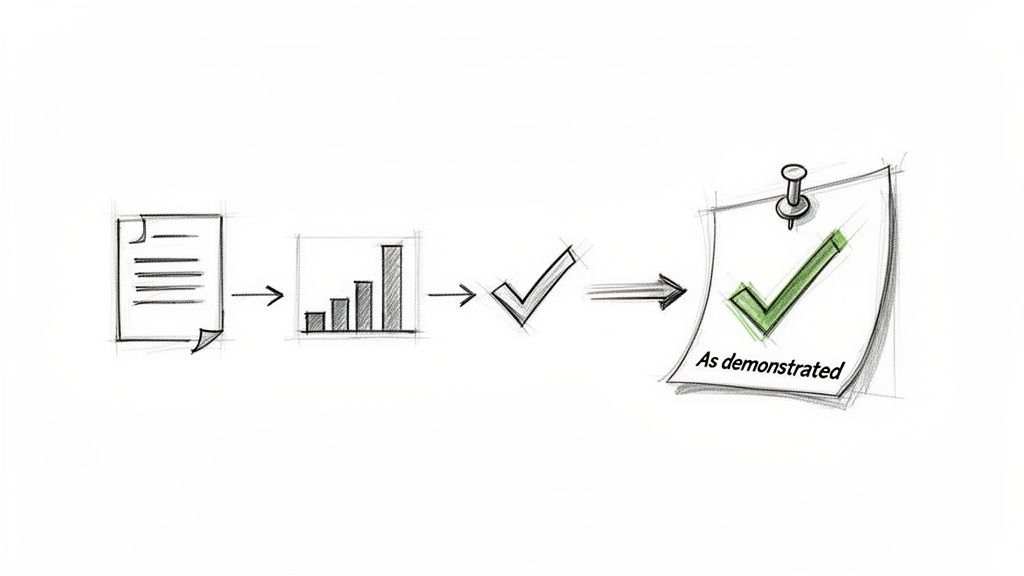
This opener builds credibility by explicitly linking your conclusion to the body of your work. It tells your audience, "We have examined the proof together, and here is the undeniable result." This approach is less about summarizing and more about solidifying your argument's foundation.
When to Use "As demonstrated"
This phrase is ideal for contexts where credibility is built upon tangible proof. It is a strong choice for:
- Research Papers: Use it to connect your conclusion directly to your experimental data.
- Case Studies: It effectively summarizes how a client's transformation was proven with specific metrics.
- Data-Driven Blog Posts: It helps you wrap up by pointing back to the statistics you cited.
- Marketing Whitepapers: It provides a confident transition to recommendations based on presented data.
Real-World Example: In a marketing case study, a creator could write: "As demonstrated by the 45% increase in user engagement and 20% rise in conversions, our new content strategy was a resounding success."
Tips for Effective Implementation
While "As demonstrated" is powerful, its effectiveness depends on the strength of the evidence you have already presented.
Follow the phrase by briefly referencing one or two key data points. This starter loses its impact if the evidence it refers to was weak or unclear. To learn more about crafting compelling arguments, check out our guide on how to vary your sentence structure to emphasize key points.
If your data-driven conclusion feels too clinical, our PureWrite app can help. Paste your sentence and use our humanizer to ensure your evidence-backed statements are presented in a natural and powerful way that connects with your audience.
8. It is clear that
The concluding sentence starter “It is clear that” positions your final statement as the logical and unavoidable outcome of your evidence. It is a phrase built on confidence, designed to underscore the strength of your argument and persuade the reader.
This opener is powerful in persuasive writing where the goal is to leave the reader with a sense of certainty. However, this assertiveness can be its greatest weakness. If your arguments have not been compelling, using “It is clear that” can come across as arrogant or presumptuous.
When to Use "It is clear that"
This phrase is most effective when your argument is supported by strong, undeniable evidence. It is an excellent choice for:
- Business Recommendations: It frames your proposed strategy as the only logical path forward.
- Persuasive Marketing Content: It can emphasize a product's benefits as the obvious solution.
- Research Conclusions: It works well when summarizing findings from strong, unambiguous data sets.
Real-World Example: In a report for stakeholders, you could conclude: "It is clear that investing in customer support training directly correlates with higher client retention rates."
Tips for Effective Implementation
Using this phrase requires careful judgment to ensure your confidence feels earned.
Only use this starter if the points leading up to it genuinely make the conclusion obvious. A discerning reader will reject the claim if the evidence is weak. This phrase works best with professional or analytical audiences who appreciate directness.
The line between confidence and arrogance is thin. To ensure your intended tone lands correctly, you can paste your conclusion into PureWrite. Our tool can help you refine the phrasing so your authority feels earned and credible. For more guidance, explore our insights on mastering tone and voice in writing.
8 Concluding Sentence Starters Compared
| Phrase | 🔄 Implementation complexity | ⚡ Resource requirements | ⭐ Expected outcome (effectiveness) | 💡 Ideal use cases | 📊 Key advantages / impact |
|---|---|---|---|---|---|
| In conclusion | Low — simple, direct transition | Minimal — no extra evidence needed | ⭐⭐⭐ — clear closure for formal texts | Academic essays, formal reports, institutional docs | Signals completion; establishes formal credibility |
| To summarize | Moderate — requires synthesis of main points | Moderate — review and consolidation of content | ⭐⭐⭐⭐ — improves retention and comprehension | Long-form articles, instructional guides, case studies | Condenses complex ideas; aids reader memory |
| Ultimately | Moderate — needs a justified, high-level insight | Low–Moderate — requires strong final reasoning | ⭐⭐⭐⭐ — elevates authority and persuasive weight | Thought leadership, opinion pieces, strategic analyses | Conveys gravitas; highlights the most important conclusion |
| All things considered | High — must address multiple perspectives | Moderate–High — analysis of alternatives required | ⭐⭐⭐ — builds trust through nuance | Policy analysis, comparisons, controversial topics | Shows balance and fairness; reduces perceived bias |
| In the end | Low — conversational wrap-up suited to narratives | Minimal — works with narrative evidence | ⭐⭐⭐ — natural, relatable closure | Case studies, storytelling, marketing narratives | Feels human and approachable; good for journeys or arcs |
| Therefore | Moderate — demands clear logical linkage | Moderate — explicit evidence or premises needed | ⭐⭐⭐⭐ — strengthens logical coherence | Research papers, proposals, persuasive arguments | Connects evidence to conclusion; clarifies causality |
| As demonstrated | Moderate — must anchor to specific examples/data | Moderate–High — requires presented proof points | ⭐⭐⭐⭐ — high credibility when evidence is strong | Research, case studies, data-driven marketing | Explicitly ties conclusion to evidence; bolsters trust |
| It is clear that | Low–Moderate — assertive but risky if unsupported | Moderate — needs convincing support to be persuasive | ⭐⭐⭐ — conveys confidence but can alienate if weak | Persuasive recommendations, leadership pieces | Emphasizes inevitability; projects conviction |
From Robotic to Resonant: Humanizing Your Conclusions with PureWrite
Throughout this guide, we've explored an arsenal of concluding sentence starters, moving from timeless classics like "In conclusion" to more nuanced options such as "As demonstrated." Our goal has been to equip you not just with a list of phrases, but with the strategic understanding needed to select the perfect one for any piece of writing.
Mastering these starters is more than a simple writing hack; it’s about taking control of your message's final impression. A weak or generic conclusion can undermine an otherwise powerful argument, leaving your reader uninspired. Conversely, a well-chosen concluding phrase reinforces your key points and solidifies your authority.
Key Takeaways: From Theory to Application
As you move forward, keep these core principles at the forefront of your writing process:
- Context is King: The best concluding sentence starters match the tone and purpose of your work. An academic paper demands a different closing than a persuasive blog post.
- Variety Prevents Monotony: Over-relying on a single concluding phrase can make your writing feel formulaic. Actively expand your toolkit to keep your content fresh and engaging.
- Authenticity Over Automation: While AI tools can generate drafts, they often default to repetitive conclusions. The true art lies in refining these suggestions to reflect your unique voice. This ethical use of AI—as a partner, not a replacement—is what separates forgettable content from resonant writing.
Your Next Steps: Putting Knowledge into Practice
The journey from understanding to mastery is built on deliberate practice. The next time you write, consciously choose your concluding sentence starter instead of defaulting to habit. Ask yourself: does this phrase truly encapsulate the impact I want to achieve?
Beyond individual sentence choices, it's crucial to have the right support system. To truly make your conclusions resonate, consider which writing platforms best support your craft. Just as professionals compare writing platforms for serious writers, you should seek tools that enhance, rather than replace, your skills.
Ultimately, the power of a great conclusion lies in its ability to transform a piece of writing from a mere collection of facts into a compelling message. By thoughtfully selecting your concluding sentence starters and focusing on authentic, human-like phrasing, you ensure your work not only informs but also inspires action.
Ready to transform your formulaic conclusions into powerful, human-like statements? PureWrite analyzes your text and provides nuanced suggestions to elevate your tone, flow, and authenticity. Stop sounding like an AI and start connecting with your readers. Try our humanizer by visiting PureWrite today.