A Practical Content Development strategy for Real Results

A solid content development strategy isn't just a document—it's the blueprint that guides your team through the entire process of planning, creating, and managing content. It’s what separates a focused, results-driven operation from just... making stuff.
Why Your Content Needs a Real Strategy
Let's be blunt: creating content without a plan is like driving across the country with no map. You might see some interesting things, but you'll probably waste a lot of time and gas, and you'll almost certainly never reach your destination.
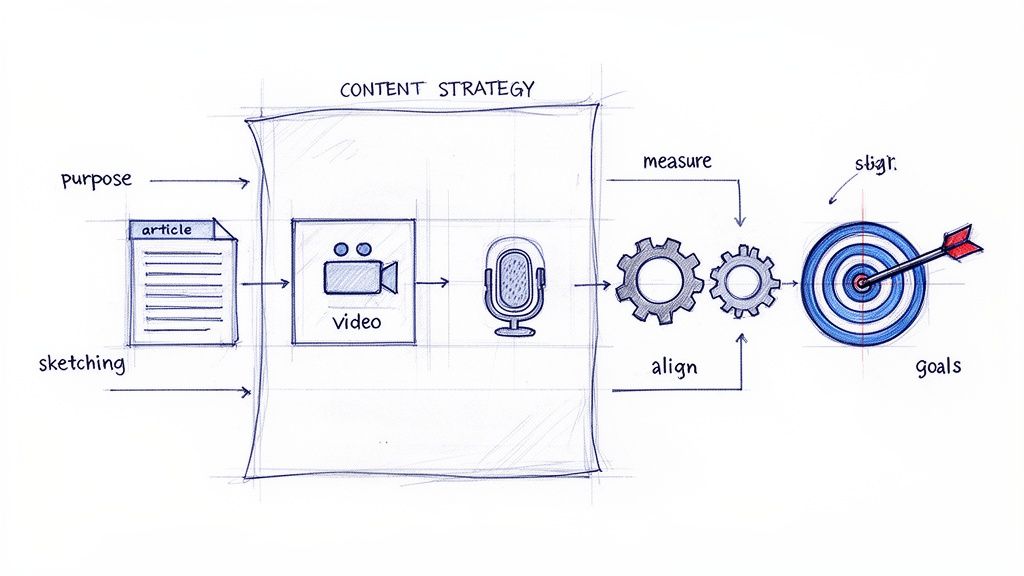
A documented content development strategy is that map. It gets your whole team on the same page, making sure every blog post, video, or social update has a clear purpose. That alignment transforms scattered efforts into a cohesive machine that builds authority and drives real growth.
To lay the groundwork for the detailed steps ahead, here’s a quick look at the core components of any effective content strategy. These are the pillars we'll be building on throughout this guide.
Core Pillars of a Content Development Strategy
| Pillar | What It Achieves | Why It Matters |
|---|---|---|
| Goals & Objectives | Defines what success looks like in clear, measurable terms. | Without goals, your content is just noise. This connects your efforts directly to business outcomes like lead generation or brand awareness. |
| Audience & Keywords | Pinpoints who you're talking to and what they're looking for. | You can't be everything to everyone. This ensures your content resonates with the right people and gets found in search. |
| Content Creation | Establishes a system for producing high-quality, relevant content. | Consistency is key. A solid workflow prevents creative bottlenecks and keeps your publishing schedule on track. |
| Distribution & Promotion | Outlines how your content will reach your target audience. | Great content is useless if no one sees it. This step ensures your hard work gets the visibility it deserves. |
| Measurement & Iteration | Sets up the process for tracking performance and making improvements. | This is how you learn what works. Data-driven insights allow you to double down on successes and fix what's failing. |
Each pillar supports the others, creating a feedback loop that continually refines your approach and improves your results.
From Random Noise to Purposeful Impact
Without a strategy, content creation often becomes a reactive scramble, chasing the latest trend or publishing whatever feels right. That approach rarely delivers, and it can make your brand messaging feel completely disjointed.
A well-defined plan flips the script. It forces you to get serious about answering the big questions before you start writing:
- Who are we really talking to? A strategy demands you go deep on your audience's pain points, questions, and motivations.
- What are we actually trying to achieve? It ties every piece of content back to a business objective, whether that's generating leads or boosting awareness.
- How will we know if it's working? It establishes the key performance indicators (KPIs) you'll use to track performance and justify the investment.
This kind of proactive thinking is what separates the winners from the losers in a crowded market. A deeper look into why content marketing is so important really drives home how essential a solid plan is for getting any meaningful results.
The Financial Case for a Documented Strategy
The numbers don't lie. The content marketing market shot up to $72 billion in 2023 and is on track to more than double by 2026. This isn't just a trend; it's a clear signal that businesses are banking on strategic content as a serious competitive advantage.
A content strategy isn't just a marketing document; it's a business tool. It ensures your investment of time, money, and creativity delivers a tangible return by systematically building trust and authority with your audience.
In an era where AI can churn out content in seconds, having a human-led strategy is more critical than ever. At PureWrite, we're big believers in using AI for efficiency, but it’s the strategic thinking, unique insights, and authentic voice that actually connect with people.
Ultimately, a good strategy gives you the power to create with intention. It’s the foundation for building a loyal audience that doesn’t just consume your content but actively trusts your brand. For a broader view, check out our guide on building a complete digital content strategy.
Know Your "Why" and Your "Who"
Every great piece of content starts by answering two simple questions: Why are we making this? and Who is it for?
If you can’t answer those with absolute clarity, you’re just creating noise. An effective content development strategy isn’t about throwing things at the wall; it’s built on a rock-solid foundation of clear goals and a genuine understanding of your audience.
First, Set Goals That Actually Mean Something
Your goals are what turn content from a creative hobby into a real business driver. Vague ambitions like "increase traffic" are useless. You need sharp, specific objectives that connect directly to what your business is trying to achieve.
This is where the SMART framework isn't just a business school acronym—it's your best friend. It forces you to get real about what you want to accomplish.
- Specific: Don't just "get more leads." Aim to "generate 50 qualified leads per month from our blog content."
- Measurable: How will you know you're winning? Track something like, "increase organic rankings for our top 10 commercial keywords by 15%."
- Achievable: Let’s be honest. A million views next month isn’t happening. A grounded goal might be to "grow our email subscriber list by 500 new contacts this quarter."
- Relevant: Does this even matter? If you sell software, a goal to "increase sign-ups for our free trial by 20% through targeted case studies" is dead-on.
- Time-bound: Every goal needs a finish line. "Publish two in-depth, long-form guides by the end of Q3" creates real urgency and accountability.
This simple exercise turns fuzzy ideas into a concrete action plan. Suddenly, every article, video, or post has a purpose.
Go Deeper Than Demographics: Build Real Personas
Once you know your why, it's time to get laser-focused on your who. This is, without a doubt, the most important part of any content development strategy. Knowing your audience's age is table stakes; you need to understand their world.
Effective content doesn't just answer a question—it speaks directly to the reader's underlying problem, acknowledging their frustrations and offering a solution that feels genuinely helpful and empathetic.
This is where you build an audience persona: a semi-fictional character based on real data about your ideal customer. To do this right, you’ll want to conduct a thorough audience analysis that turns data points into a living profile.
Building these personas takes a little legwork, but it pays off massively. Here’s how you can start digging for insights:
- Talk to actual customers: Pick up the phone. Ask your best clients about their biggest challenges and what kind of content they secretly wish existed.
- Survey your audience: Use a simple tool like Google Forms or SurveyMonkey to ask pointed questions about their pain points and content habits.
- Dig into your own data: Your Google Analytics and social media insights are gold mines. What posts are people reading? Where are they coming from?
- Listen to your sales team: Your sales and support folks are on the front lines. They know the exact words customers use to describe their problems and their biggest objections.
When you blend all of this together, you can build a persona that feels real. This profile will guide every decision you make, from the tone you use to the topics you choose.
Finding Your Content Sweet Spot: Topic Research and Audits
Alright, you’ve got your goals locked in and you know exactly who you’re talking to. Now comes the fun part: figuring out what to talk about. This stage is where we shift from planning to opportunity hunting.
First, you'll look outward to discover what your audience is actively searching for. Then, you'll look inward to see what you've already got and how it's performing.
Think Clusters, Not Just Keywords
Keyword research is still the foundation, but you have to get inside your audience's head and understand the why behind their search. This is what we call user intent.
That's why we always push teams to think in "topic clusters." Instead of targeting a single keyword, you own an entire conversation. You start with a broad "pillar" topic—say, "AI writing tools"—and then map out all the related subtopics.
Think of things like:
- "how to humanize AI text"
- "best AI writing assistant for students"
- "can AI content be detected"
- "ethical use of AI in writing"
This strategy signals to search engines that you're an authority on the entire subject, not just a one-off resource. It also creates a much better user experience, naturally guiding readers from one helpful article to the next.
A well-executed topic cluster strategy doesn't just pull in traffic. It creates a sticky web of content that keeps people on your site longer, proving to Google that you’re the go-to expert.
You’re not just answering one question; you're mapping out their entire learning journey.
Time for a Ruthless Content Audit
Before you write a single new word, you need an honest inventory of what you already have. A content audit is a systematic review of everything—blog posts, videos, landing pages—to see what's working and what's collecting dust.
The Content Marketing Institute found that only 26% of marketers rate their content strategies as "very effective." We'd bet a big reason is that they aren't learning from their own past performance.
Your audit doesn't have to be intimidating. A simple spreadsheet listing your URLs and a few core metrics will do. From there, every piece gets sorted into one of three buckets:
- Keep: These are your all-stars. They're pulling in traffic and doing their job well.
- Update: This content has potential but is falling short. Maybe the data is old or the on-page SEO is weak. These are golden opportunities for a refresh.
- Prune: This is the dead weight. It gets zero traffic and serves no purpose. Getting rid of these pages (by deleting and redirecting them) can actually give your overall site a healthy SEO boost.
This process forces you to be objective and make decisions based on data, not gut feelings. You'll find hidden gems to double down on and finally clear out the clutter. To supercharge your refresh process, check out some of the best content optimization tools.
Building a Sustainable Content Production Workflow
An idea is worthless without a plan to bring it to life. This is where your content development strategy gets real—by building a practical, repeatable system for getting work done. We're talking about creating a well-oiled machine that turns your brilliant ideas into a steady stream of high-quality content.
A solid workflow isn't about micromanagement; it’s about creating clarity. It answers the simple questions that trip up so many content teams: Who’s doing what? When is it due? Is it ready to publish?
From Idea to Published Post
A truly reliable production workflow guides every piece of content through a series of predictable stages. This simple structure ensures nothing gets lost in the shuffle and everyone knows what to do.
Here’s what this typically looks like for a blog post:
- Brief Creation: It all starts here. The content strategist creates a detailed brief outlining the target keyword, audience pain points, and call-to-action.
- Writing & Drafting: The writer takes that brief and runs with it, focusing on delivering genuine value and capturing your brand's unique voice.
- Editing & Review: Next, an editor steps in to review the draft for clarity, grammar, style, and SEO alignment. This is a non-negotiable quality control step.
- Final Approval: The strategist gives it one last look to make sure it hits all the original objectives before publishing.
Following a structured process like this eliminates the last-minute chaos that always leads to mediocre work. It builds in the necessary checks and balances to make sure every article you publish is polished and purposeful.
The Role of AI in Modern Workflows
Let's be honest: artificial intelligence has completely changed the content game. AI adoption among marketers shot up to 87% in less than two years, showing just how powerful these tools are for efficiency.
But here’s the catch: with an estimated 74% of new web content being created with AI, the bar for what stands out is much higher. In fact, 55% of marketing professionals now say that improving content quality is their top priority, according to data from Ahrefs.
Our philosophy at PureWrite is simple: use AI as your first-draft assistant, not the final author. Use it to bust through writer's block or generate an outline, but don't just copy and paste. The real value comes from the human touch—your unique insights, personal stories, and authentic voice.
Your goal is to use AI for speed without sacrificing authenticity. A tool like PureWrite is designed for exactly this purpose—to take a robotic AI draft and help you refine it into something that reads like it was written by a real person.
After you've generated a draft, the next step should always be to humanize it, smoothing out the awkward phrasing that screams "AI-written." This ethical approach lets you stay efficient while making sure your final product feels genuine. We’ve put together some tips on how to write blog posts faster by integrating these tools responsibly.
This diagram shows a simplified three-step process for auditing your existing content—a critical part of any production workflow.
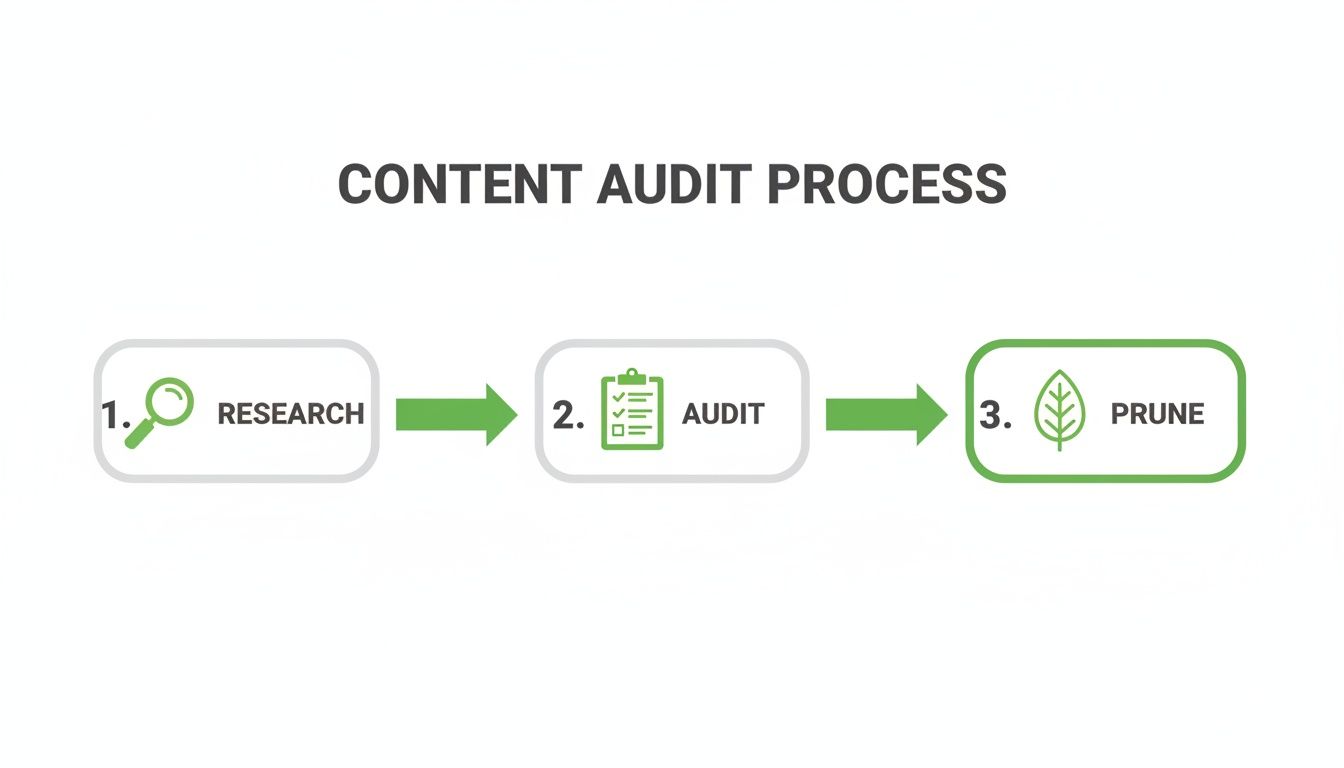
Moving from research to pruning is all about making smart, data-driven decisions to keep your content library fresh and effective.
Your Editorial Calendar: The Command Center
Think of your editorial calendar as the beating heart of your content development strategy. It’s the single source of truth where your workflow, topics, and deadlines all come together. It's a strategic tool that keeps your content perfectly aligned with your bigger business goals.
You don’t need a fancy tool to get started; a simple spreadsheet often works just fine. By mapping out your content weeks ahead, you establish a consistent publishing rhythm and give your team the breathing room they need to do their best work.
Ready to build one? Here are the essential components to include in your editorial calendar to keep everything organized.
Editorial Calendar Template Components
| Field | Purpose | Example |
|---|---|---|
| Publish Date | The target date for the content to go live. | October 28, 2024 |
| Topic/Title | The working title and core topic of the piece. | Guide to Ethical AI Writing |
| Content Owner | The person responsible for seeing the piece to completion. | Sarah K. |
| Current Status | Tracks the content's progress through the workflow. | In Editing |
| Target Keyword | The primary keyword the content is optimized for. | ethical AI usage |
| Target Persona | The specific audience segment the content is for. | University Student |
| CTA | The desired action you want the reader to take. | Try PureWrite Humanizer |
This level of detail is what transforms your workflow from chaotic to controlled, giving you a crystal-clear view of your entire content pipeline.
Promoting and Distributing Your Content for Maximum Impact
Hitting “publish” is the starting gun, not the finish line. An effective content development strategy kicks into high gear after a piece goes live. Without a smart distribution plan, even the most brilliant content will fail to connect with the audience you created it for.
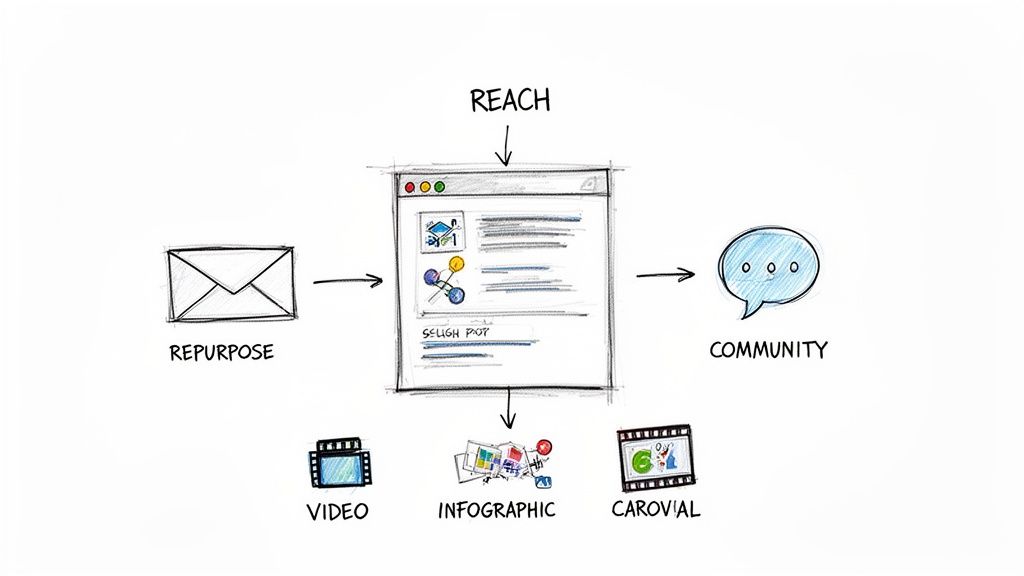
This is where you make your hard work count. The mission is to get your content in front of the right eyeballs at just the right moment, turning your website into a destination, not just a digital library.
Nail Your On-Page SEO First
Before you shout about your new content, you need to make sure your own house is in order. On-page SEO is all about optimizing individual pages so they can rank higher in search results and pull in organic traffic.
This isn’t about trying to trick the algorithm. It's about creating a crystal-clear, user-friendly experience that both search engines and actual humans can easily understand.
A few things you absolutely have to get right:
- Compelling Titles and Meta Descriptions: Your title tag is the first impression you make in search results. It needs to be engaging and contain your primary keyword.
- Logical Header Structure: Use H1, H2, and H3 tags to create a clean, scannable outline. This helps readers and shows search engines the hierarchy of your information.
- Strategic Internal Linking: Weave in links to other relevant articles on your own site. This classic move helps keep visitors on your site longer by guiding them to more helpful content. For a deeper look, our guide on SEO content writing best practices will get you up to speed.
Go Where Your Audience Lives: A Multi-Channel Push
SEO is a marathon, not a sprint. To get eyeballs on your content right away, you need an active promotion strategy that meets your audience where they already are. Don’t just wait for them to find you; go to them.
Think of it as creating multiple doorways into the same room. A few channels that consistently deliver results include:
- Email Marketing: Your email list is gold because you own it. When a new piece is published, send out a newsletter that highlights why it’s a must-read for your subscribers.
- Social Media: Of course, share your content across the platforms your audience uses most. But don't just drop a link. Create custom graphics and start a conversation.
- Online Communities: Dive into relevant groups on Reddit or LinkedIn where your ideal readers hang out. The key is to share your content only when it genuinely helps answer a question or adds to the discussion.
The Art of Working Smarter: Repurpose Everything
The most efficient content marketers don't just create more content; they get more value out of what they’ve already created. Content repurposing is the practice of taking one killer piece of content and slicing it into different formats for different channels.
This tactic dramatically extends the lifespan of your work and allows you to connect with people who might prefer watching a video over reading an article.
Repurposing isn't about being lazy; it's about being strategic. It multiplies the impact of your best work by adapting it to the context of different platforms, ensuring you get the highest possible return on your time investment.
For example, you can transform a single in-depth blog post into an entire campaign's worth of assets:
- A punchy infographic that visualizes the key stats.
- A series of social media carousels perfect for Instagram or LinkedIn.
- A short, snappy video clip for TikTok or YouTube Shorts.
- The talking points for a podcast episode diving into the main ideas.
This approach ensures your core message lands, whether someone prefers to read, watch, or listen. By building promotion and repurposing into your content development strategy, you create a powerful engine that drives traffic and engagement long after you first hit publish.
Measuring Performance to Refine Your Strategy
A great content development strategy isn't something you create once and file away. It's a living plan that should get smarter over time. The only way that happens is by committing to measurement—turning data into insights, and those insights into action.
Honestly, this final step is what separates a decent strategy from a truly game-changing one. It’s all about creating that iterative loop: publish, measure, learn, and then refine. Without this feedback loop, you’re just guessing.
Identifying KPIs That Actually Matter
Before you can measure success, you have to be crystal clear on what it looks like for your business. Your Key Performance Indicators (KPIs) need to tie directly back to the goals you set in the very beginning.
For instance:
- Goal: Brand Awareness? You'll want to track things like organic traffic, keyword rankings, and your overall social media reach.
- Goal: Lead Generation? Then you should be obsessed with conversion rates on your content offers, the number of new email subscribers, and form submissions.
- Goal: Audience Engagement? Pay close attention to metrics like time on page, the number of comments, and how often your content is being shared.
Choosing the right KPIs brings clarity. It helps you cut through the noise and zero in on what truly moves the needle.
From Data Overwhelm to Clear Insights
Once you know what to track, the next hurdle is turning all that raw data into simple, actionable insights. Tools like Google Analytics can feel incredibly intimidating, but you don't need to be a data scientist to get real value from them.
Many marketers find this part challenging. In fact, 66.5% of content marketers say they struggle with resource allocation, and a mere 29% feel their documented strategy is very effective. This gap often boils down to a failure to consistently measure and iterate. You can discover more insights about content marketing effectiveness here.
The purpose of analytics isn't just to report on what happened; it's to inform what you do next. Every data point should prompt a question: "Why did this work?" or "What can we learn from this miss?"
This mindset shifts your entire approach from being reactive to proactive, empowering you to make genuinely smarter decisions.
Making Smart Decisions with Your Data
Your data tells a story about what your audience craves. It's your job to listen and adapt.
Did a particular blog post format drive a ton of engagement? Great, double down on it. Is a specific topic cluster failing to get any traction? It might be time to pivot your approach.
This iterative process is the engine of a successful content development strategy. It’s how you systematically improve, making sure every piece of content you create is more effective than the last. And if you've been using AI to help generate drafts, measuring performance is also a fantastic way to see what resonates. If an AI-assisted post performs well, you can use a tool like PureWrite to refine and humanize similar drafts, ensuring your authentic voice always shines through.
Frequently Asked Questions
Even with a solid plan, a few questions always pop up. Let's tackle some of the most common ones we hear from creators and marketers trying to get their content strategy off the ground.
How Often Should I Revisit My Content Strategy?
Your content strategy should never be a "set it and forget it" document. The digital world just moves too fast for that.
We suggest a light review every quarter to check performance data and react to new keyword opportunities. Then, once a year, block out time for a much deeper dive to reassess your big-picture goals and audience personas.
A content strategy is a living document. Treat it that way. Consistent check-ins are what separate a plan that works from one that just collects dust.
What's the Real Difference Between a Content Strategy and an Editorial Calendar?
It's easy to get these two mixed up, but the distinction is critical.
Your content development strategy is the blueprint—it answers the big "why" and "who." It's where you define your goals, your target audience, and the core themes you'll own. The editorial calendar is the schedule. It answers the "what" and "when," laying out the specific articles and posts that will bring your strategy to life.
We're a Small Team. How Can We Possibly Create Great Content?
Don't fall into the trap of thinking you need to publish content every single day. The key for a small team is to prioritize quality over quantity.
Focus your energy on creating one truly exceptional, in-depth piece of content each week or even every other week. Stick to topics where you have genuine expertise that no one else can replicate.
You can also use AI ethically to get a first draft on the page, but make sure you heavily edit and humanize that output. It needs to sound like you. And don't forget to repurpose everything! Turn that one great blog post into social snippets and a short video to maximize its impact. For more specific questions on this, check out these AI SEO content optimisation FAQs.
When AI gives you a robotic first draft, PureWrite helps you find the human voice within. Transform generic text into engaging, authentic content that connects with your audience. Try PureWrite today and feel the difference.