How to Write Blog Posts Faster Without Losing Quality
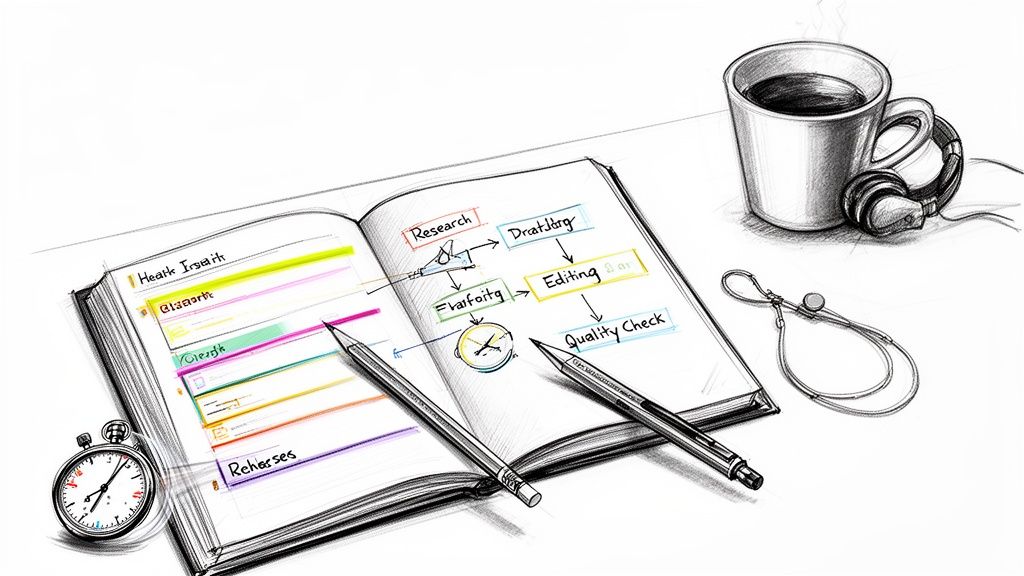
If you want to write blog posts faster, you need a system—a repeatable process that blends smart planning with efficient action. The real secret isn't about typing at lightning speed. It's about putting in the work upfront with a rock-solid outline and using the right tools to fly through drafting and polishing.
This approach eliminates wasted effort and helps you create high-quality content, consistently. Whether you're a professional marketer, a student, or a content creator, this guide will provide practical, actionable advice to streamline your writing.
Escaping the Content Treadmill
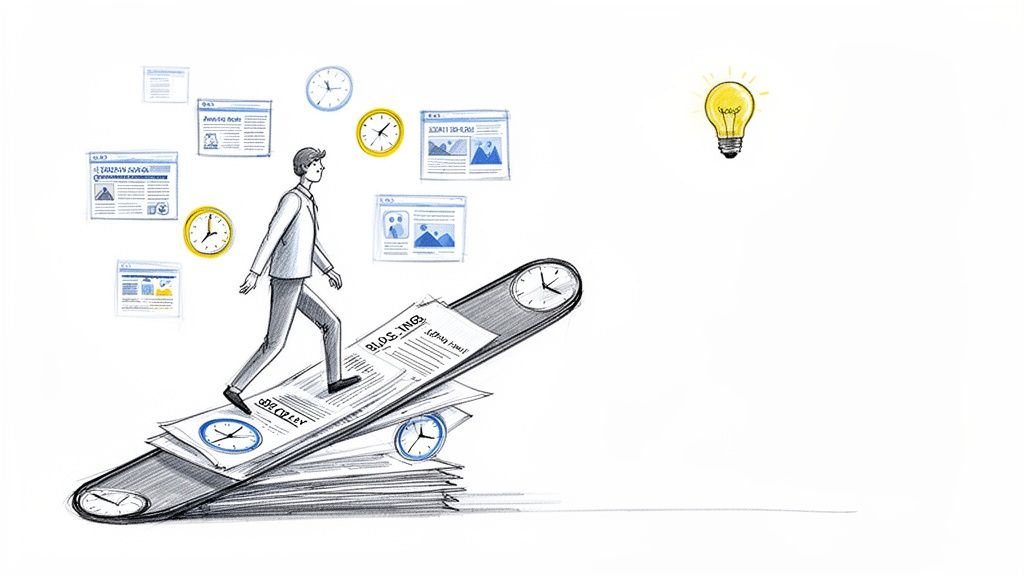
Ever feel like you’re stuck on a content treadmill, running as fast as you can just to stay in the same place? You’re not alone. The pressure to publish high-quality, deep-dive articles is relentless, and the time it takes to create them has exploded.
Consider this: back in 2014, the average blog post took roughly 2 hours and 24 minutes to write. Today, that number has ballooned to nearly 4 hours. That’s a significant increase, driven by a 77% jump in the average word count to over 1,400 words. You can discover more insights about blogging trends on semrush.com.
The takeaway is clear: readers expect more comprehensive content. For writers, learning how to produce that content faster isn't just a nice-to-have skill anymore—it's essential for survival. It’s all about building a smarter workflow to stay consistent and avoid burnout.
A Modern Workflow for Modern Demands
The answer isn't to start cutting corners or sacrificing the quality you're known for. It’s about building a better process—one that marries your creative expertise with the power of modern writing tools, including ethical AI assistance.
Our entire system is built on three core beliefs:
- Planning Prevents Pain: A detailed outline is your roadmap. Every minute you spend here saves you an hour of headaches and rewrites later.
- Momentum is Everything: Keep your writing and editing hats separate. Get the first draft down without constantly second-guessing yourself.
- Tools are Your Allies: Let smart software handle the tedious, time-sucking tasks. This frees you up to focus on what really matters—your ideas and expertise.
For example, once you have a decent first draft, don't waste hours wrestling with clunky sentences. A tool like PureWrite can polish your own writing or humanize AI-generated text in minutes, making sure the final piece sounds clear, engaging, and genuinely you.
When you weave these principles into your work, content creation becomes a reliable, well-oiled machine. A solid workflow is a non-negotiable part of any winning digital content strategy.
Building Your Blueprint for Rapid Writing
The single biggest mistake writers make when trying to speed up is skipping the plan. It feels counterintuitive—why spend 30 minutes outlining when you could be writing? The answer is simple: a solid blueprint kills writer’s block and drastically cuts down your revision time.
Think of it like building furniture from a box. You wouldn't just start hammering pieces together without the instructions. An outline is the instruction manual that ensures you end up with a sturdy, well-structured article, not a wobbly mess that takes hours to fix.
Master the Skeleton Draft Method
A "skeleton draft" is more than just a simple list of topics. It’s a complete map of your article, built before you write a single full sentence. This forces you to think through your arguments and get the logical flow right from the get-go.
The goal is to lay down all the bones of the article, leaving only the prose for the drafting stage. For every section, lock in these elements:
- The Core Argument: What’s the one key takeaway for this section?
- Key Supporting Points: Jot down 2-3 bullet points that prove your core argument.
- Evidence and Data: Note the specific stats, quotes, or examples you’ll plug in.
- Transitions: Add a quick note on how this section will smoothly lead into the next.
This detail turns drafting from a daunting creative challenge into a simple "connect-the-dots" exercise. If you want to go deeper, our guide covers all 5 steps of the writing process in more detail.
Research Smarter, Not Harder
Random, unfocused research is a massive time-waster. Drowning in dozens of open tabs kills your momentum. Instead, get strategic about how you gather information.
Start using advanced search operators to instantly narrow your results. For instance, searching site:.edu "content marketing statistics 2024" filters for credible data from academic sources. Using quotation marks helps you find exact phrases, perfect for tracking down a specific quote.
A real-world example: A marketer researching for a post on SEO trends could use this technique to find university studies, immediately adding credibility to their article and saving time sifting through less reliable sources.
Let AI Assist Your Planning
Modern tools can put your outlining and research on hyperdrive. The key is to use them as a brainstorming partner, not a replacement for your own thinking. They’re fantastic for overcoming inertia and organizing your thoughts.
For instance, you can prompt an AI assistant: "Create a detailed outline for a blog post titled 'How to Write Blog Posts Faster,' targeting professional marketers. Include sections on planning, drafting, and editing with AI tools." This gives you an instant foundation that you can refine with your own expertise.
Exploring the best AI tools for content creation can help you build a much faster workflow. Remember, this stage is about making hard decisions upfront so you can focus purely on crafting compelling sentences later.
Drafting at the Speed of Thought
Once you have a solid blueprint, it’s time to get words on the page. The goal here is pure momentum. We can’t stress this enough: do not stop to edit. This is all about getting a first draft down, often called a "zero-draft."
Switching your brain from "creator" to "critic" mid-sentence is one of the biggest time-wasters. Every time you pause to second-guess a word, you break your flow. The only objective is to get your ideas onto the screen, no matter how messy they are.
Your blueprint is your roadmap. You’ve already done the hard work of research and structuring, so you can just focus on writing.
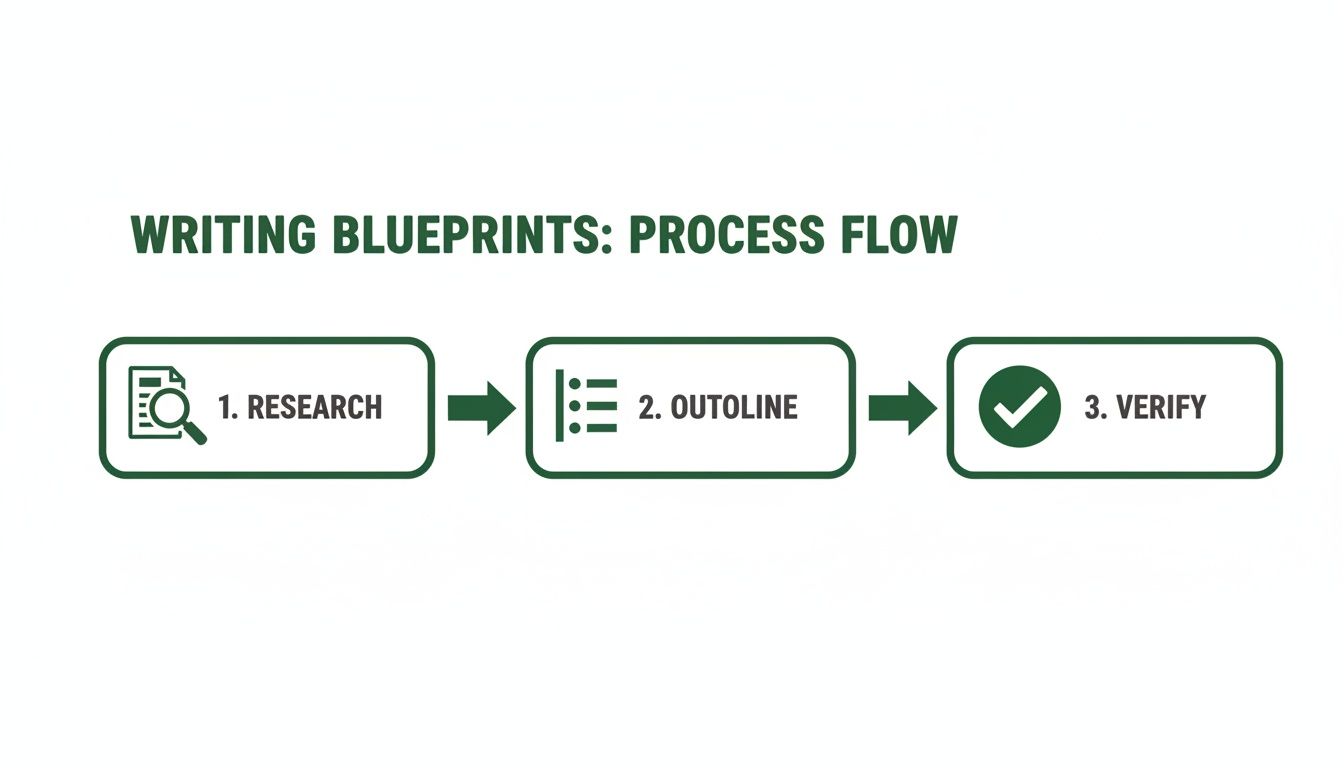
With research and an outline locked in, you can pour all your energy into converting that structure into a full draft without getting sidetracked.
Embrace Time-Boxed Writing Sprints
To build momentum, we swear by time-boxed writing sprints. It’s a beautifully simple technique: set a timer for 25 minutes and just write. No excuses, no distractions, no editing.
When the timer is running, your only job is to flesh out one section of your outline. If you need a specific statistic or a better phrase, just drop in a placeholder like [TK-STAT] or [REWORD] and keep typing. This prevents tiny hurdles from killing your session.
A few tips to make sprints work for you:
- Have a clear goal: Decide ahead of time you're going to draft a specific section.
- Kill all distractions: Close your email, shut down Slack, and put your phone in another room.
- Take a real break: When the timer goes off, step away for 5 minutes to reset.
Using AI as Your Drafting Co-Pilot
Here’s where you can really hit the accelerator. An AI writing assistant can generate a functional first draft from your outline. This can turn hours of grinding out words into just a few minutes of setup.
The trick is to give the AI a detailed, high-quality prompt built from your skeleton draft. Feed it your H2s, H3s, and the core bullet points you want to cover. For example, a student writing a research paper could provide their thesis statement and key supporting arguments to generate a structured draft instantly.
This doesn't replace you; it gives you a solid base to build upon. You can supercharge your initial drafting by exploring some of the best free AI writing assistants available.
Traditional Drafting vs. AI-Assisted Zero-Drafting
| Phase | Traditional Method (Time/Effort) | AI-Assisted Zero-Drafting (Time/Effort) |
|---|---|---|
| Initial Drafting | Hours of typing, rephrasing, and fighting writer's block. High mental load. | Minutes of prompt engineering. AI handles the heavy lifting. Low mental load. |
| Self-Editing | Constant stop-and-start. Blends writing and editing, slowing down both processes. | None during drafting. This phase is reserved for later, allowing for focused, efficient editing. |
| Output | A slowly written first draft that has already been partially edited. | A complete, raw "zero-draft" generated almost instantly, ready for human refinement. |
The takeaway is simple: get the first draft done fast, then shift gears to editing. This two-step process is far more efficient.
The Ethical Path to AI-Assisted Drafting
Using AI to draft quickly is smart. Hitting "publish" on raw AI output is a huge mistake. Readers are getting good at spotting robotic content, which can kill trust. In fact, a 2023 survey found that 63% of consumers are less likely to trust a brand that uses AI without being upfront about it.
Think of AI-generated text as what it is: a starting point. Your expertise, stories, and unique voice are what make your content stand out. The real value is added when you take that raw draft and shape it.
That’s where a tool like PureWrite comes in. Once you have that AI-generated text, you can run it through our humanizer to instantly refine the language. Our platform smooths out the robotic rhythm and makes the final piece sound like it was written by a real person—you. This gives you the speed of AI without sacrificing the authentic quality your audience deserves.
Don't Let Editing Steal Your Speed
Getting that first draft down is a huge relief, but it's not the finish line. The real work, and where most of us get stuck, is in the editing. It's easy to fall into a black hole of endless tweaks, which defeats the purpose of drafting quickly.
The secret is to stop thinking of editing as one massive task. Instead, break it down into a series of focused passes. Each pass has a specific mission, which keeps you from getting lost and helps you produce a polished article in a fraction of the time.
First Pass: The 30,000-Foot View
Before you even think about commas or word choice, take a step back and look at the big picture. This is your "macro" edit, where you check the blueprint of your article to make sure it's solid.
Read through the entire draft without stopping to fix typos. As you go, ask yourself:
- Does my main point come through loud and clear?
- Is the flow logical, or do I jump around?
- Am I repeating myself?
- Does the intro actually hook the reader?
This is where you make the big, bold moves—chopping entire sections or rearranging paragraphs. It feels ruthless, but it saves you from polishing sentences that were destined to be cut anyway.
Second Pass: Getting Into the Nitty-Gritty
Once the structure is sound, it's time to zoom in on the sentences. This is the "micro" edit, focused on clarity, punch, and style. Your goal is to make every single line earn its place.
Our number one tip here? Read your draft out loud. It's the fastest way to catch clunky phrasing and awkward sentences that your eyes will just glide over. You’ll hear exactly where the rhythm feels off.
This is especially critical if you're working with an AI-assisted draft. That robotic, slightly-too-formal tone is a dead giveaway, and research shows that over 60% of consumers are less likely to trust content they suspect is AI-written without disclosure. Manually rephrasing every stiff sentence is a huge time-sink.
This is where the right tool can give you back hours. With PureWrite, for instance, you can paste your draft in, and our AI instantly humanizes the text. It refines the flow and polishes the language to sound like a real person wrote it. Editing becomes a quick quality check, not a chore.
Final Pass: The Last-Minute Polish
Okay, you're almost there. The last step is a final, eagle-eyed proofread. This isn't about creative changes; it's a technical sweep to catch any embarrassing little errors that can chip away at your credibility.
Your checklist for this pass is short and sweet:
- Typos & Grammar: Hunt down any spelling mistakes or punctuation goofs.
- Formatting: Make sure your headings, bold text, and lists are all consistent.
- Broken Links: Click every single link to ensure it goes to the right place.
A pro tip for this stage is to temporarily change the font or text size. It forces your brain to see the words differently, making hidden typos jump right out. For more tricks, check out our deep dive into the process of editing and revising.
Creating a Sustainable Content System
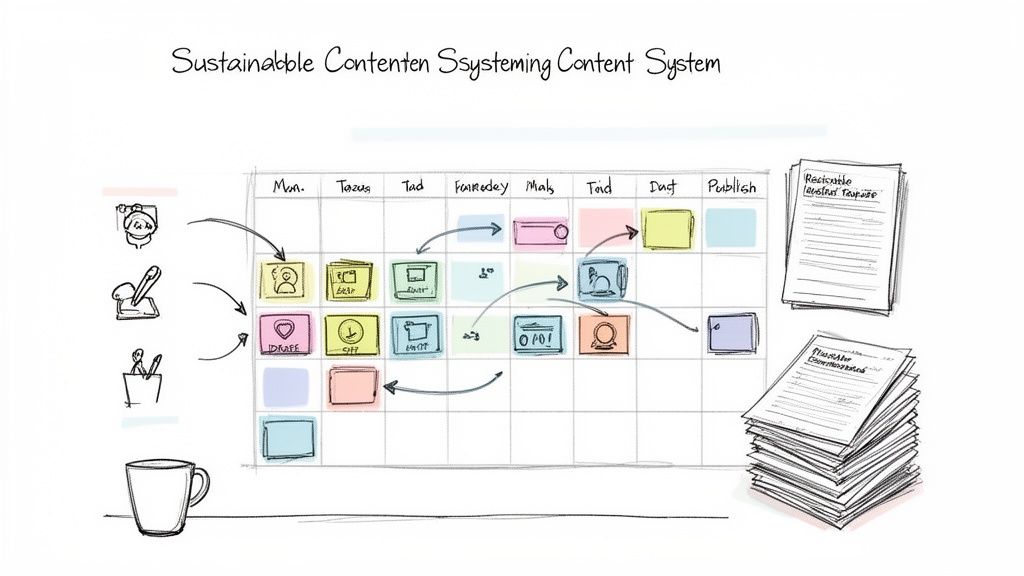
Real speed in content creation doesn't come from a single writing marathon. It comes from building a calm, predictable, and efficient engine that just works. The goal is to move beyond writing one article at a time and start thinking like a publisher.
At its heart, this is about ditching the chaotic "start-from-scratch" mindset. Instead, you adopt a professional workflow that cuts down on mental friction and makes every hour count. This is how you really learn how to write blog posts faster for the long haul.
The Power of Content Batching
One of the best ways to build this engine is with content batching. It’s a simple idea: group similar tasks together and knock them out in dedicated time blocks. Instead of wrestling one post from idea to publication, you break the entire process down by task.
For example, a content creator might dedicate Monday morning solely to outlining four articles for the month. Tuesday could be blocked out for nothing but drafting. This approach dramatically reduces "context switching"—the mental tax you pay when your brain jumps between different types of work.
When you focus on just one thing—research, outlining, or editing—you find your rhythm and operate far more efficiently.
Example Weekly Content Batching Schedule
Here’s what a batching schedule could look like. It turns the often-messy creative process into a predictable assembly line.
| Day | Task Focus (3-4 Hour Block) | Outcome |
|---|---|---|
| Monday | Ideation & Outlining | Four detailed "skeleton drafts" ready for writing. |
| Tuesday | AI-Assisted Drafting | Four complete zero-drafts based on Monday's outlines. |
| Wednesday | Humanizing & Editing | Four polished, reader-ready articles. |
| Thursday | Visuals & Formatting | All articles have images, formatting, and are scheduled. |
| Friday | Promotion & Distribution | Social media content created and queued up for launch. |
With a structure like this, you always know what you need to work on. If you want to take this further, our guide on how to scale content marketing dives into more advanced strategies.
Build Your Own Reusable Templates
Another pillar of a solid content system is creating reusable templates for common post formats. Whether you're publishing listicles, how-to guides, or case studies, having a standardized structure is a game-changer.
A template is more than just headings; it's a pre-built framework for your thinking. For a how-to guide, your template might include:
- An Introduction: A prompt like "[State the common problem] and promise a clear solution."
- A 'What You'll Need' Section: A placeholder for tools or resources.
- Numbered Steps: Standardized
H3formatting already in place. - A Concluding CTA: A reminder to add a specific call-to-action.
By standardizing the structure, you remove the need to reinvent the wheel every time. This frees up your mental energy to focus on creating unique, high-quality content that resonates with your audience.
The Human Touch in a Systematized Workflow
Building an efficient system, especially one that uses AI, doesn't mean your content has to sound robotic. The point of a great system is to handle the repetitive work so you have more time and brainpower for the human elements.
Once you have a draft, the final critical step is making sure it has your authentic voice. This is where you weave in personal stories and unique insights. Doing this by hand can be a bottleneck, which is where your system needs one last efficiency boost.
We built PureWrite to be the perfect final step in a modern content workflow. You can take your efficiently drafted article, run it through our humanizer, and instantly get back a version that reads with the nuance and clarity your audience deserves. It cleans up awkward phrasing and ensures your content sails past AI detection, protecting your credibility.
Ready to humanize your AI-generated content? Try PureWrite for free.
Common Questions About Writing Faster, Answered
Switching up your writing process naturally brings up questions. How do you actually speed things up without sacrificing quality? Let's tackle the most common concerns we hear from writers, marketers, and students.
Can I Really Write Faster Without My Content Sounding Generic?
Yes, absolutely. The secret is to separate the mechanical parts of writing from the creative ones. Use speed-focused tactics like AI-assisted drafting to get your ideas down, but always reserve time for the final polish where your unique voice comes to life.
For example, using an AI assistant to generate a first pass is a massive time-saver. But the refinement stage is non-negotiable. When you run that initial text through a humanizing tool like PureWrite, you put back the nuance and personality that makes your writing sound like you.
How Should I Split My Time Between the Different Writing Stages?
A good starting point for a 2,000-word article is the 20/30/50 rule: 20% on planning, 30% on drafting, and a solid 50% on editing.
An AI-assisted workflow can completely flip those numbers. Your drafting stage might shrink to just 15-20 minutes of prompt engineering. By using PureWrite to handle the heavy lifting of polishing, your total editing time could be slashed by more than half, freeing you up to add expert insights.
What's the Biggest Mistake Writers Make When Trying to Speed Up?
By far, the most common mistake is skipping the outline. It feels like you're saving time by jumping straight into writing, but this is a classic productivity illusion.
Without a clear roadmap, you're practically guaranteed to hit writer's block, wander off-topic, and create a jumbled article. You'll end up spending twice as long in the editing phase trying to fix major structural problems that a simple plan would have prevented.
Are There SEO Risks if I Use AI to Write Faster?
There can be, especially if you publish raw, unedited AI output. Search engines are prioritizing content that shows real E-E-A-T (Experience, Expertise, Authoritativeness, and Trustworthiness), something generic AI text struggles with. Some studies show that over 60% of people are less likely to trust AI-written content.
The fix isn't to avoid AI, but to use it responsibly in a multi-step process:
- Use AI for speed: Generate a foundational draft from your detailed outline.
- Add your human expertise: Weave in your unique insights and original analysis.
- Humanize the output: Use a tool like PureWrite to ensure the final text reads naturally and avoids AI detection.
This approach protects your SEO by layering your authentic expertise on top of an efficiently created draft. To dig deeper, check out our guide on the best content optimization tools to keep your articles ranking well.
Ready to transform your AI drafts into authentic, engaging content? PureWrite helps you refine your writing in seconds, ensuring it sounds natural, bypasses AI detectors, and truly connects with your readers. Try PureWrite for free and experience the difference.