The Ultimate Guide to 10 Types of Essay Transition Words for 2025

In an age where AI writing tools are common, the difference between robotic text and authentic, persuasive writing often comes down to the details. We're talking about the small but mighty connectors that guide your readers: essay transition words. They are the bridges between your ideas, turning disjointed sentences into a seamless, logical argument that flows naturally.
For students, content creators, and professionals, mastering these words is no longer just good practice; it's essential for creating content that feels genuinely human. To truly transform your writing from disconnected sentences into a cohesive masterpiece, understanding why these transitions matter is paramount, contributing to the broader goal of learning how to write better essays.
At PureWrite, we see firsthand how AI can struggle with natural flow. A recent study found that nearly 60% of students use AI for schoolwork, but AI-generated text often lacks the sophisticated connections that signal deep thinking and authenticity. In fact, overused or misplaced transitions are a key giveaway for many AI detection tools, resulting in flat, predictable prose.
This guide provides a comprehensive roundup of the 10 most critical types of transition words, complete with practical examples and ethical AI usage tips. You'll learn not just what these words are, but how to strategically place them to elevate your writing, improve readability, and ensure your unique voice shines through. Whether you're starting from a blank page or refining an AI draft, these insights will help you craft content that connects, persuades, and resonates with your audience.
1. Chronological/Sequential Transitions
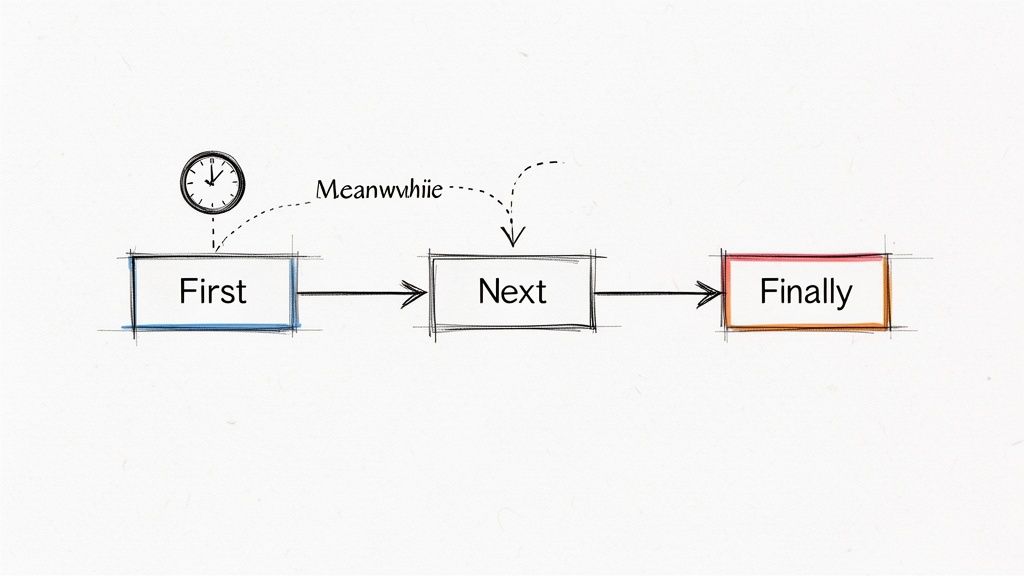
Chronological transitions are the signposts that guide your reader through a sequence of events or steps. These essential essay transition words establish a clear timeline, helping your audience follow the progression of your ideas exactly as you intend. They are the backbone of narrative essays, historical analyses, and step-by-step process explanations, creating a logical and intuitive flow.
For writers, especially those leveraging AI tools, mastering chronological transitions is key to transforming a disjointed draft into a coherent narrative. These words act as the glue that connects events in time, ensuring your story or argument unfolds smoothly.
When to Use Chronological Transitions
You should use these transitions whenever the order of events or ideas is critical to your essay's meaning. This is especially true when you are:
- Telling a Story: Describing events in the order they happened (e.g., initially, then, eventually).
- Explaining a Process: Outlining steps in a procedure (e.g., first, second, next, finally).
- Analyzing History: Discussing historical developments over time (e.g., in 1920, subsequently, after the war).
Examples of Chronological Transitions
| Purpose | Transition Words & Phrases |
|---|---|
| To Begin | First, initially, to start with, in the beginning |
| To Continue the Sequence | Next, then, secondly, subsequently, afterward |
| To Show Time Passing | Meanwhile, concurrently, during this time, simultaneously |
| To Conclude | Finally, lastly, in the end, ultimately |
Real-World Example:
Initially, our marketing team struggled to align on a central goal for the Q3 campaign. Then, after a series of workshops, a clear vision began to emerge. Meanwhile, the product department was developing a preliminary launch strategy. Finally, with a unified objective, the teams were ready to move forward.
Pro Tips for Implementation
- Vary Your Choices: Avoid the repetitive "first, second, third" structure. Mix it up with words like "subsequently," "concurrently," and "ultimately" to keep your writing engaging and natural.
- Be Strategic: In a historical essay, a word like "meanwhile" can powerfully connect two parallel events, adding depth to your analysis and showing a more sophisticated understanding of the topic.
- Humanize AI-Generated Content: AI writers often overuse basic sequential transitions. When you use PureWrite, we help you identify and replace these repetitive phrases with more sophisticated alternatives that add an authentic, human touch.
For more ideas on how to begin your paragraphs with strong, directive language, explore our guide to using effective paragraph starters.
2. Additive Transitions
Additive transitions are the verbal bridges that connect related ideas, signaling to your reader that you are introducing more information. These essay transition words show you're expanding on a point or providing further evidence, building a more comprehensive argument. They are the foundation of strong expository and argumentative essays, ensuring your ideas accumulate logically rather than appearing as a disconnected list.
For writers working with AI-generated drafts, mastering additive transitions is essential for creating a robust and persuasive narrative. These words act as the mortar between the bricks of your argument, reinforcing the connections between your claims and evidence.
When to Use Additive Transitions
You should use these transitions whenever you want to add a related idea, example, or piece of evidence to a point you've already made. This is particularly effective when you are:
- Reinforcing an Argument: Adding more proof to support a claim (e.g., furthermore, additionally, moreover).
- Expanding on a Concept: Providing more detail or another facet of an idea (e.g., in addition, also, on top of that).
- Listing Reasons or Examples: Presenting a series of points that support a central theme (e.g., another reason is, equally important).
Examples of Additive Transitions
| Purpose | Transition Words & Phrases |
|---|---|
| To Add a Similar Idea | Additionally, also, in addition, furthermore, moreover |
| To Emphasize an Addition | Not only... but also, what's more, equally important |
| To Introduce an Example | For example, for instance, to illustrate, specifically |
| To Add Another Point | Another key point, another reason is, on top of that |
Real-World Example:
The company’s new sustainability initiative has significantly reduced its carbon footprint. Furthermore, it has improved employee morale by aligning corporate values with personal ethics. Another key point is the positive brand image it has cultivated among environmentally-conscious consumers.
Pro Tips for Implementation
- Vary Your Choices: Avoid overusing "also." Sophisticated alternatives like "furthermore" and "additionally" elevate your tone and improve readability, creating a more professional feel.
- Use Emphasis Strategically: Employ the "not only... but also" structure to draw attention to a particularly powerful or compelling additional point. This is a great way to add persuasive weight.
- Humanize AI-Generated Content: AI often defaults to basic additive words. At PureWrite, we designed our platform to highlight these repetitive patterns and suggest nuanced alternatives for more engaging and human-like prose.
3. Causal/Explanatory Transitions
Causal transitions are the logical connectors that clarify cause-and-effect relationships. These powerful essay transition words explain why something happens, showing the direct consequences of an action or event. They are indispensable in argumentative and analytical essays where demonstrating your reasoning is paramount to building a convincing case.
For writers using AI tools, these transitions are crucial for adding logical depth and authenticity. Properly used, they transform a series of simple statements into a well-supported argument, ensuring your drafts avoid a disconnected, robotic tone.
When to Use Causal/Explanatory Transitions
You should use these transitions whenever you need to explain the reason behind an event or the result of an action. They are essential for:
- Building an Argument: Justifying a claim by showing its logical foundation (e.g., because of this evidence, therefore this conclusion is valid).
- Analyzing Events: Explaining the factors that led to a particular outcome (e.g., due to the economic downturn, the company's profits fell).
- Presenting Research: Connecting findings to their implications (e.g., the study revealed a correlation, consequently, new guidelines are needed).
Examples of Causal/Explanatory Transitions
| Purpose | Transition Words & Phrases |
|---|---|
| To Show Cause/Reason | Because, since, due to, for this reason, as a result of |
| To Show Effect/Result | Therefore, consequently, as a result, thus, hence, accordingly |
| To Explain a Purpose | In order to, for the purpose of, with this in mind, so that |
| To Draw a Conclusion | It follows that, which leads to, in conclusion |
Real-World Example:
The company invested in new technology in order to streamline its operations. As a result, initial productivity soared. However, because the staff received inadequate training, the long-term efficiency gains were minimal. Therefore, management concluded that future tech rollouts must include comprehensive education.
Pro Tips for Implementation
- Support Your Claims: Ensure your cause-and-effect statements are backed by evidence. Avoid using a word like "therefore" to connect two unrelated ideas; this is a common trap that undermines credibility.
- Strengthen AI Content: AI can sometimes create logical-sounding but unsubstantiated links. When you use a tool like PureWrite to analyze your text, you can ensure every causal claim is clear, well-supported, and sounds authentic.
- Frame Your Paragraphs: Start a paragraph with a transition like "For this reason..." to signal that you are about to explain the significance of a previously mentioned point.
Building strong logical connections often involves crafting well-structured sentences. To master this, explore our guide on how to use compound and complex sentences.
4. Contrasting/Comparative Transitions
Contrasting and comparative transitions are the tools you use to build a sophisticated argument. Contrasting words highlight differences, while comparative words show similarities. These essential essay transition words are critical for compare-and-contrast essays, persuasive arguments, and any writing that requires a balanced examination of multiple viewpoints.
For writers refining AI-generated drafts, mastering these transitions is crucial for demonstrating critical thinking. Using them effectively transforms a simple assertion into a well-rounded analysis, showing you've considered alternative perspectives. This is a key marker of authentic, human writing.

When to Use Contrasting/Comparative Transitions
You should use these transitions whenever you need to weigh ideas against each other. They are particularly powerful when you are:
- Comparing Two Subjects: Highlighting what is similar or different between two theories, characters, or marketing strategies (e.g., similarly, on the other hand).
- Acknowledging Counterarguments: Introducing an opposing viewpoint before refuting it (e.g., while this may be true, however).
- Evaluating Options: Discussing the pros and cons of different solutions or choices (e.g., in contrast, conversely).
Examples of Contrasting/Comparative Transitions
| Purpose | Transition Words & Phrases |
|---|---|
| To Show Contrast | However, on the other hand, in contrast, conversely, nevertheless, yet, but |
| To Show Similarity | Similarly, likewise, in the same way, equally, just as |
| To Concede a Point | Although, while, even though, despite, admittedly |
| To Emphasize a Difference | By contrast, on the contrary, alternatively |
Real-World Example:
The first marketing campaign relied heavily on traditional media, reaching an older demographic effectively. In contrast, the second campaign focused on social media influencers to capture a younger audience. However, only the digital-first approach generated measurable, real-time engagement data.
Pro Tips for Implementation
- Acknowledge and Rebut: Employ contrasting transitions when introducing and addressing counterarguments. This strengthens your position by showing you've considered all sides of an issue.
- Avoid Monotony: Vary your comparative words. Alternate between 'similarly,' 'likewise,' and 'in the same way' to keep your prose fresh and engaging, avoiding a robotic rhythm.
- Humanize AI Drafts: Our PureWrite platform can help you identify weak or false contrasts in AI-generated content that might damage your credibility, ensuring your arguments are logical and sound. This is a critical step in ethical AI usage.
Mastering these transitions is a key component of building a compelling case. To see how they fit into a larger argumentative framework, explore our guide on how to write a persuasive essay.
5. Exemplifying/Illustrative Transitions
Exemplifying transitions are crucial for bridging the gap between abstract claims and concrete understanding. These essay transition words introduce specific examples or evidence that bring your arguments to life. By illustrating a general point with a specific instance, you make your ideas more accessible, persuasive, and memorable for your reader.
For writers using AI to generate drafts, these transitions are vital. AI content can sometimes feel too general; adding specific, well-introduced examples grounds the text in reality, signaling a more human-like and authentic writing style. This is how you show, not just tell.
When to Use Exemplifying Transitions
You should use these transitions whenever you make a general statement that needs to be substantiated or clarified with evidence. This is especially effective when you are:
- Supporting a Claim: Backing up an argument with factual evidence (e.g., for example, followed by a statistic).
- Clarifying a Concept: Explaining a complex idea with a relatable scenario (e.g., to illustrate, followed by an anecdote).
- Making an Abstract Idea Concrete: Demonstrating a principle through a specific case (e.g., a case in point is...).
Examples of Exemplifying Transitions
| Purpose | Transition Words & Phrases |
|---|---|
| To Introduce an Example | For example, for instance, such as, including |
| To Offer a Specific Case | To illustrate, to demonstrate, a case in point, specifically |
| To Emphasize an Instance | In this case, as an illustration, consider the following example |
| To Clarify with Evidence | Namely, that is to say, in other words |
Real-World Example:
Our new customer service protocol yielded significant results. For example, our team reduced average response times by 30%. To illustrate the operational impact, the logistics division optimized its ticketing system, which cut resolution times by 15%. A case in point was a client issue that was resolved in under an hour, leading to a five-star review.
Pro Tips for Implementation
- Ensure Relevance: Always choose examples that directly and powerfully support the specific point you are making. A tangential example can confuse your reader and weaken your argument.
- Vary Your Phrases: Avoid overusing "for example." Mix in alternatives like "to demonstrate" or "specifically" to keep your language fresh and dynamic.
- Humanize AI Content: When editing an AI-generated draft, use exemplifying transitions to insert specific, authentic details that AI models often miss. This is a key step in making your content feel genuinely human. Try PureWrite today to see how easily you can humanize AI text.
6. Concessive Transitions
Concessive transitions are sophisticated tools that allow you to acknowledge counterarguments without weakening your main point. These essay transition words signal that you have considered alternative viewpoints, which adds credibility to your analysis. Using them effectively demonstrates intellectual honesty and strengthens your argument by preemptively addressing potential objections.
For writers aiming to elevate their prose, mastering concessive transitions is crucial. They are particularly valuable in persuasive essays, where showing an awareness of the topic's complexity can be more convincing than presenting a one-sided case.
When to Use Concessive Transitions
You should use these transitions whenever you need to introduce an opposing view or a limitation before reinforcing your primary argument. They are most effective when you are:
- Addressing Counterarguments: Acknowledging an opposing viewpoint before refuting it (e.g., while it is true that, admittedly, of course).
- Presenting Nuanced Claims: Qualifying a statement to make it more precise and defensible (e.g., though, even so, despite this).
- Building a Stronger Rebuttal: Conceding a minor point to make your subsequent rebuttal seem more reasonable and powerful.
Examples of Concessive Transitions
| Purpose | Transition Words & Phrases |
|---|---|
| To Acknowledge an Opposing View | Admittedly, certainly, of course, granted, while it is true that |
| To Introduce a Contrast | Although, though, even though, despite, in spite of |
| To Return to Your Main Point | Nevertheless, nonetheless, however, still, even so, be that as it may |
Real-World Example:
Admittedly, implementing a four-day workweek presents logistical challenges for some industries. Even though scheduling conflicts are a valid concern, proponents argue that the benefits of increased employee productivity outweigh these difficulties. Nevertheless, the data overwhelmingly suggests that with careful planning, most companies can adapt successfully.
Pro Tips for Implementation
- Concede and Rebut: Always follow a concession with a strong rebuttal. Introduce the counterpoint with a word like "granted," then immediately pivot back to your argument with "however" or "nevertheless."
- Strategic Placement: Place concessive phrases at the start of a sentence to immediately frame the point as a counterargument. This prepares the reader for your refutation.
- Balance with Conviction: Acknowledge complexity but maintain a clear, confident position. Overusing concessions can make your argument seem weak, so use them strategically to build credibility.
7. Clarifying/Explanatory Transitions
Clarifying transitions are the linguistic tools you use to ensure your reader fully grasps a complex idea. These essay transition words allow you to restate, expand upon, or simplify a point, preventing confusion and enhancing comprehension. They act as a bridge between a technical concept and a clearer explanation, making your writing more accessible.
For writers using AI to generate initial drafts, these transitions are crucial for refining dense or jargon-heavy text. Integrating phrases like "in other words" helps transform potentially ambiguous AI output into crystal-clear prose that connects with your audience. This promotes ethical AI use by ensuring the final content is clear and authentic.
When to Use Clarifying Transitions
You should use these transitions whenever you need to ensure a key concept is not misunderstood. They are particularly effective when you are:
- Defining Technical Terms: Introducing specialized vocabulary to a non-expert audience (e.g., that is to say, the process involves...).
- Simplifying Complex Ideas: Breaking down an intricate argument or data point into more digestible terms (e.g., in essence, the results show...).
- Emphasizing a Key Point: Rephrasing a critical statement to give it more weight and ensure it is remembered (e.g., to be clear, this was the turning point).
Examples of Clarifying Transitions
| Purpose | Transition Words & Phrases |
|---|---|
| To Rephrase an Idea | In other words, to put it another way, that is to say |
| To Simplify or Summarize | Essentially, in simple terms, to put it simply, basically |
| To Emphasize or Specify | To be clear, specifically, more precisely, in fact |
| To Provide an Example | For instance, for example, to illustrate, such as |
Real-World Example:
The algorithm utilizes heuristic analysis to predict user behavior; in other words, it makes educated guesses based on past actions. To put it simply, if you often read articles on AI, the system will start recommending new content on that topic. To be clear, this process is not foolproof but significantly improves the user experience.
Pro Tips for Implementation
- Know Your Audience: Avoid over-explaining concepts to specialists, as it can sound patronizing. Conversely, be generous with clarifications for a general readership.
- Vary Your Phrases: Don't rely solely on "in other words." Mix in alternatives like "essentially" or "to put it another way" to maintain a natural flow.
- Check for AI Over-Clarification: Sometimes, AI-generated content adds unnecessary explanatory phrases. We created PureWrite to help you spot this "artificial scaffolding" and remove it for more direct and confident writing.
8. Emphatic/Intensifying Transitions
Emphatic transitions are your highlighters in persuasive writing. They signal to your reader that a particular point is not just another detail, but a crucial piece of the argument that demands special attention. These powerful essay transition words add weight and conviction, underscoring the significance of a claim.
For writers aiming to make a strong impression, mastering emphatic transitions is non-negotiable. They are the tools you use to direct your audience's focus. This is especially vital when refining AI-generated drafts, which can present all information with a flat, uniform level of importance.
When to Use Emphatic Transitions
You should use these transitions when you need to elevate a specific idea above the others. They are most effective when you are:
- Highlighting a Key Piece of Evidence: Drawing attention to the most compelling data or support for your claim (e.g., most importantly, significantly).
- Making a Forceful Claim: Asserting a point with strong conviction, backed by solid reasoning (e.g., undoubtedly, certainly, in fact).
- Prioritizing Arguments: Signaling that one point is the most critical in a series (e.g., above all, crucially).
Examples of Emphatic Transitions
| Purpose | Transition Words & Phrases |
|---|---|
| To Emphasize Importance | Most importantly, crucially, significantly, notably, above all |
| To Assert Certainty | Certainly, undoubtedly, without a doubt, indeed, of course |
| To Add Force | In fact, as a matter of fact, to be sure, actually |
| To Clarify or Correct | Specifically, more precisely, in other words, that is to say |
Real-World Example:
The study revealed a consistent correlation between social media use and student anxiety. More precisely, the amount of time spent on image-based platforms was the strongest predictor of negative outcomes. Above all, these findings suggest a need for new digital literacy programs. In fact, several school districts are already piloting initiatives based on this research.
Pro Tips for Implementation
- Use Sparingly for Impact: Overusing emphatic transitions dilutes their power. Reserve them for the moments that truly define your argument to maximize their effect.
- Match to Your Evidence: Employ words like "undoubtedly" only when your supporting evidence is undeniable. Misusing them can undermine your credibility.
- Humanize AI Content: AI tools can overuse emphatic words for minor points, a common sign of artificial writing. At PureWrite, we help you analyze your text to ensure your emphasis is placed strategically and sounds authentic.
9. Summative/Concluding Transitions
Summative transitions are the powerful signals that bring your argument to a satisfying close. These essay transition words indicate that you are summarizing key points, synthesizing information, or concluding a section or the entire piece. They act as the final handshake with your reader, reinforcing your main message.
For writers using AI, which can sometimes produce abrupt or repetitive endings, mastering summative transitions is crucial. These phrases provide the necessary structure to transform a simple restatement into a powerful synthesis, ensuring your conclusion feels earned and impactful.
When to Use Summative Transitions
You should use these transitions to signal the end of a line of reasoning or the entire essay. They are most effective when you are:
- Concluding a Paragraph: Wrapping up a specific point before moving to the next (e.g., in short, as has been shown).
- Summarizing a Section: Condensing the main arguments of a multi-paragraph section (e.g., to sum up, in essence).
- Writing the Essay's Conclusion: Beginning your final paragraph to signal a final summary and synthesis (e.g., in conclusion, ultimately).
Examples of Summative Transitions
| Purpose | Transition Words & Phrases |
|---|---|
| To Summarize | In short, to sum up, in summary, briefly, in essence |
| To Conclude | In conclusion, to conclude, finally, lastly |
| To Show a Result | Therefore, thus, consequently, as a result, accordingly |
| To Synthesize | All things considered, ultimately, on the whole, as demonstrated |
Real-World Example:
The data shows a decline in engagement, user feedback points to a confusing interface, and market analysis reveals a stronger competitor. All things considered, a complete redesign is not just a recommendation; it is a necessity. Ultimately, failing to act on these combined insights would be a critical strategic error.
Pro Tips for Implementation
- Vary Your Choices: Avoid the overused "in conclusion." Opt for more nuanced alternatives like "ultimately" or "as demonstrated" to make your writing sound more sophisticated and less formulaic.
- Go Beyond Repetition: Your conclusion should synthesize, not just repeat. Follow a summative transition with new insights, a reflection on the broader implications, or a call to action.
- Distinguish Scope: Use phrases like "as has been shown" for section summaries and stronger words like "ultimately" for the final essay conclusion.
For a deeper dive into crafting impactful final paragraphs, explore our guide on how to write a conclusion paragraph.
10. Elaborating/Extending Transitions
Elaborating transitions are essay transition words that signal you are about to explore a point in greater depth. Unlike transitions of addition which simply add new information, these words tell your reader to expect a more detailed analysis or explanation. They are crucial for developing complex arguments, showing the reader you are not just listing facts but are thoughtfully expanding upon them.
For writers using AI, these transitions are powerful tools for elevating generated content. AI can sometimes produce surface-level points; using elaborating transitions prompts you to build on those initial ideas, adding the nuance and intellectual depth that define authentic, insightful writing.
When to Use Elaborating Transitions
You should use these transitions when you want to dive deeper into an idea you have just presented. They are most effective when you are:
- Deepening an Analysis: Moving from a general statement to a more specific, detailed examination (e.g., to put it another way, in greater detail).
- Providing Specific Examples: Following up a claim with concrete evidence or illustrations (e.g., more specifically, for instance).
- Clarifying a Complex Idea: Rephrasing or expanding on a point to ensure the reader fully understands (e.g., in other words, to elaborate).
Examples of Elaborating Transitions
| Purpose | Transition Words & Phrases |
|---|---|
| To Deepen or Extend | In fact, furthermore, additionally, moreover |
| To Clarify or Restate | In other words, to put it another way, that is to say |
| To Provide Specificity | Specifically, more specifically, to be more precise, in detail |
| To Reinforce an Idea | Indeed, actually, as a matter of fact, without a doubt |
Real-World Example:
The initial market analysis suggested moderate consumer interest. To elaborate, surveys indicated that while 40% of respondents were aware of the product category, only 15% had a preferred brand. More specifically, our target demographic showed the highest potential for conversion. In other words, a significant opportunity existed, but it required a carefully targeted campaign.
Pro Tips for Implementation
- Ensure Logical Extension: The elaborated point must directly and logically extend the previous one. Avoid using these transitions to introduce a tangential or unrelated thought.
- Vary Your Phrasing: Instead of repeatedly using "in other words," try "to put it another way." This variation keeps your prose from becoming monotonous and robotic.
- Review AI-Generated Elaborations: When using AI to expand on points, check that the connection is coherent. At PureWrite, our platform helps you identify where AI-generated extensions feel forced, allowing you to refine them for genuine intellectual engagement.
10-Point Essay Transition Comparison
| Transition Type | 🔄 Implementation complexity | ⚡ Resource requirements | ⭐ Expected outcomes | 📊 Ideal use cases | 💡 Key advantages / Tips |
|---|---|---|---|---|---|
| Chronological / Sequential | Low — straightforward sequencing | Low — minimal research, needs accurate order | ⭐⭐⭐⭐ — improves flow and readability | Narratives, process guides, historical analysis | Vary terms to avoid monotony; use in process/history contexts |
| Additive | Medium — selection needed to avoid listiness | Low–Medium — supports require evidence | ⭐⭐⭐⭐ — strengthens cumulative arguments | Argumentative and expository essays | Avoid overuse; replace repetitive "also" with varied connectors |
| Causal / Explanatory | Medium — must substantiate links | Medium — requires evidence for claims | ⭐⭐⭐⭐⭐ — clarifies reasoning and persuasiveness | Analytical, scientific, and research writing | Ensure causal claims are supported; balance cause and effect words |
| Contrasting / Comparative | Medium–High — organizes multiple viewpoints | Medium — needs counterevidence and clarity | ⭐⭐⭐⭐ — demonstrates critical analysis | Comparative studies, evaluations, counterargument sections | Use nuanced connectors (however, nevertheless); keep a clear stance |
| Exemplifying / Illustrative | Low–Medium — pick relevant concrete examples | Medium — needs specific cases/data | ⭐⭐⭐⭐⭐ — makes arguments concrete and memorable | Case studies, explanatory pieces, marketing examples | Use specific, directly relevant examples and tie back to thesis |
| Concessive | Medium — balance concession with rebuttal | Medium — requires anticipating objections | ⭐⭐⭐⭐ — increases credibility when used judiciously | Argumentative essays, policy analysis | Concede briefly then rebut; avoid weakening main claim |
| Clarifying / Explanatory | Low — rephrasing and simplification | Low — plain-language skill more than research | ⭐⭐⭐⭐ — improves comprehension and accessibility | Technical docs, mixed-audience content, pedagogy | Gauge audience knowledge; place clarifications immediately after complex statements |
| Emphatic / Intensifying | Low — stylistic choices, use sparingly | Low — stylistic emphasis only | ⭐⭐⭐⭐ — highlights priority points effectively | Persuasive writing, speeches, marketing copy | Reserve for truly important points to preserve impact |
| Summative / Concluding | Low — synthesis skill required | Low — synthesis rather than new research | ⭐⭐⭐⭐ — provides closure and reinforces thesis | Conclusions, executive summaries, section closures | Use for synthesis or implications, not mere repetition |
| Elaborating / Extending | Medium–High — deepen without digression | Medium–High — requires deeper analysis/evidence | ⭐⭐⭐⭐ — demonstrates expertise and depth | In-depth analyses, academic sections, white papers | Ensure elaboration is relevant and logically extends prior point |
Unleash Your Authentic Voice with Smarter Transitions
Mastering essay transition words is fundamentally about seizing control of your narrative. You are no longer just presenting information; you are guiding your reader from one thought to the next with precision, logic, and purpose. The right transitional phrase transforms a disjointed collection of facts into a cohesive, persuasive argument.
As we've explored, the journey from a novice writer to a skilled communicator involves moving beyond basic connectors like 'also' or 'but'. Whether you need to illustrate a point, concede a counterargument, or build to a powerful conclusion, the perfect transition is waiting. This deliberate choice signals to your audience a deeper level of care and critical thought, enhancing your credibility.
Key Takeaways: From Knowledge to Action
To truly embed this skill into your writing process, focus on these core principles:
- Context is King: The most effective transition words are chosen based on the specific logical relationship you want to create between ideas. Don't just pick a word from a list; understand its function.
- Vary Your Vocabulary: Avoid overusing the same few transitions. A varied selection keeps your prose fresh and engaging, preventing the robotic repetition that can bore readers and even trigger AI detection software.
- Placement Matters: Transitions are most powerful at the beginning of sentences and paragraphs, where they act as signposts. However, they can also be used effectively within sentences to link clauses and create a smoother, more sophisticated flow.
Think of these words not as mere grammatical requirements but as strategic tools. They are the subtle yet powerful mechanisms that allow you to manage the pace, tone, and logical progression of your work. By mastering them, you elevate your writing from a simple statement of ideas to a compelling, structured, and authoritative piece.
Beyond the Words: Finding Your Authentic Voice
Ultimately, the goal is to make your writing sound like you. Authenticity is your most valuable asset in an increasingly automated world. While AI writing assistants can generate drafts quickly, they often rely on predictable, formulaic transition patterns. This is where your human touch becomes indispensable.
At PureWrite, we believe in the ethical use of AI as a partner in the creative process, not a replacement for your unique perspective. Our platform is specifically designed to help you bridge the gap between AI-generated text and human-centric prose. It helps you identify and refine the very elements we've discussed, such as clunky or repetitive essay transition words, that make content feel unnatural.
By consciously applying the techniques in this guide and using tools to polish your drafts, you ensure your ideas are communicated with the clarity, nuance, and impact they deserve. This is how you create content that not only informs but also connects with your audience on a genuine level.
Ready to transform your AI-generated drafts into polished, engaging content that flows naturally? PureWrite helps you refine robotic phrasing and clunky transitions, ensuring your writing is both human-like and authoritative. Try PureWrite today and experience the power of human-centric writing.