Good Paragraph Starters: 10 Ways to Spark Compelling Writing

The first sentence of a paragraph does more than just introduce a new idea; it’s a strategic move that sets the tone, guides your reader, and dictates the flow of your entire piece. A weak start can cause confusion, while a strong one pulls your audience in, making complex information digestible and persuasive arguments more compelling. Whether you're a student, a marketer, or a professional, a versatile toolkit of good paragraph starters is essential for effective communication.
This skill creates seamless transitions and maintains momentum from one point to the next. It’s the difference between a disjointed collection of facts and a cohesive, compelling narrative. To truly captivate your readers and move beyond the blank page, mastering how to write engaging content is an indispensable skill, and a powerful paragraph opening is the first step.
In this guide, we'll explore 10 distinct types of paragraph starters with practical, actionable advice. We'll also discuss how AI writing tools can help generate initial ideas and how, at PureWrite, we believe in using tools ethically to refine that output and maintain an authentic, human voice. Our goal is to empower you with the strategies needed to write with confidence and impact.
1. Topic Sentence with Direct Statement
The most direct and foundational of all good paragraph starters is the classic topic sentence. This method involves opening your paragraph with a clear, concise statement that immediately tells the reader what the paragraph will be about. There is no mystery; you present your main point upfront, and the subsequent sentences provide evidence, explanation, or elaboration.

This approach is the backbone of clear, structured writing, especially in academic essays, business reports, and informative articles. By stating the core idea first, you give your readers a roadmap, allowing them to follow your logic easily.
When to Use This Starter
A direct topic sentence is your best choice when clarity and structure are top priorities. It works exceptionally well when you need to present a logical argument, explain a complex concept step-by-step, or ensure your main points are impossible to miss.
Consider this method for:
- Academic Essays: Each body paragraph should begin with a topic sentence that supports your central thesis.
- Business Reports: Clearly state the finding or conclusion of each section at the beginning.
- How-To Guides: Start paragraphs with the step or concept you are about to explain.
Examples in Action
- For a content creator's blog: "Implementing a four-day workweek has been shown to increase employee productivity by nearly 20%." The rest of the paragraph would detail the supporting studies and data.
- For a student's essay: "The Treaty of Versailles contained several punitive clauses that directly contributed to economic instability in post-war Germany." The paragraph then explains those clauses and their effects.
Actionable Tips for Implementation
To make your direct statements effective, focus on precision. Avoid vague language and ensure the sentence is focused enough to be covered within a single paragraph. A strong topic sentence acts as a promise to your reader, and the paragraph must deliver on it.
Even the best writers can benefit from a fresh perspective. If your AI-generated drafts start paragraphs repetitively, use PureWrite to rephrase them, ensuring each topic sentence is sharp and direct.
2. Transitional Phrase Connection
To weave individual paragraphs into a cohesive narrative, use a transitional phrase. This type of paragraph starter acts as a bridge, linking the idea you just finished discussing to the one you are about to introduce. Phrases like 'Furthermore,' 'However,' and 'In addition' signal the logical relationship between your paragraphs, creating a smooth reading experience.
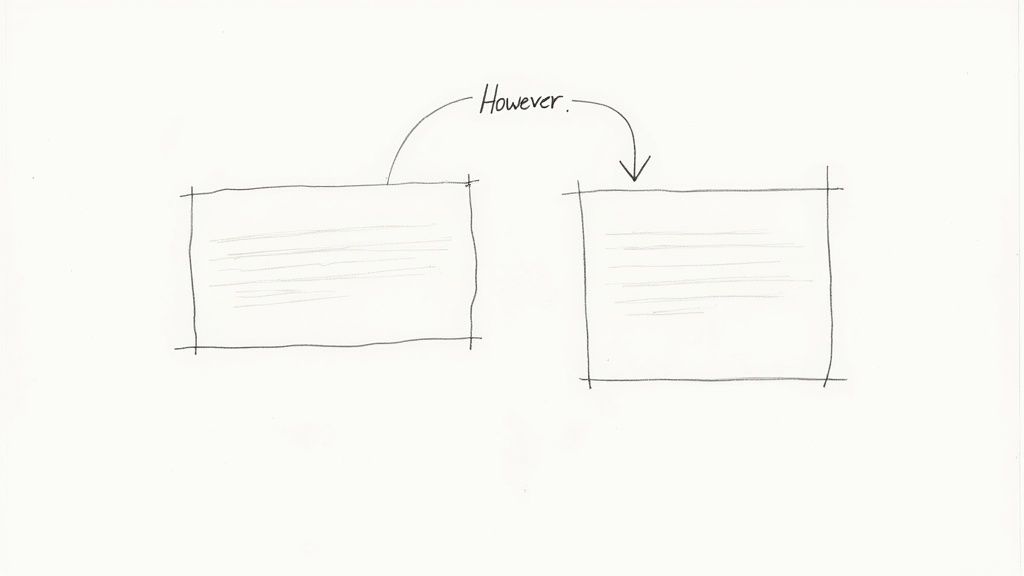
This method moves beyond presenting isolated points and starts building a coherent argument. By explicitly guiding the reader from one thought to the next, you enhance both the clarity and persuasive power of your writing.
When to Use This Starter
A transitional phrase is essential when you need to demonstrate relationships between ideas and ensure logical flow. It’s the key to transforming a collection of paragraphs into a unified piece, making it perfect for building arguments or adding information sequentially.
Consider this method for:
- Persuasive Essays: Use transitions like 'Consequently' or 'However' to link premises to conclusions.
- Compare-and-Contrast Articles: Employ phrases such as 'On the other hand' or 'Similarly' to shift between subjects.
- Informative Blog Posts: Use 'Additionally' or 'Furthermore' to layer new information onto existing points.
Examples in Action
- For a marketer's analysis: "In addition to a strong social media presence, the campaign also leveraged influencer collaborations to reach new demographics." This builds upon a previous paragraph about social media.
- For a student's research paper: "Conversely, the control group showed no significant changes in behavior." This signals a contrast with the results from the experimental group discussed earlier.
Actionable Tips for Implementation
To use transitions effectively, ensure the word you choose accurately reflects the logical connection. Vary your transitional phrases to avoid sounding repetitive; a comprehensive list of transitional words and phrases can be a valuable resource here.
AI writing tools often overuse a small set of common transitions. If your draft feels robotic, use PureWrite to find more sophisticated and natural-sounding alternatives that improve readability and maintain an authentic human voice.
3. Question-Based Opening
Another powerful technique is to pose a question. This method immediately engages your reader's curiosity, transforming them from a passive audience into an active participant. By opening with a rhetorical or genuine question, you create a sense of intrigue and dialogue, prompting readers to consider the answer before you provide it.
This approach is highly effective in blog posts, persuasive essays, and presentations where capturing attention is key. A well-placed question makes your reader feel involved, making the subsequent information more impactful.
When to Use This Starter
A question-based opening is your best choice when you want to stimulate curiosity and encourage critical thinking. It excels in scenarios where you are introducing a new idea, challenging a common assumption, or leading into a complex explanation.
Consider this method for:
- Persuasive Articles: Frame your argument as an answer to a compelling question.
- Blog Posts: Hook readers from the first sentence of a new section.
- Educational Content: Prompt learners to think about a concept before you explain it.
Examples in Action
- For a content marketer: "What if your entire content strategy could be automated without sacrificing quality?" The paragraph would then introduce a tool or methodology that answers this.
- For a student's essay: "Why do societies with abundant resources still struggle with widespread unhappiness?" The paragraph then explores potential philosophical or sociological answers.
Actionable Tips for Implementation
To make your questions effective, ensure they are relevant and thought-provoking. The goal is to open a loop that the rest of your paragraph closes by providing a satisfying answer.
This is a great way to add a human touch. If you notice your AI-generated content feels too declarative, use a tool like PureWrite to rephrase starters into engaging questions. This simple change can transform a dry statement into an inviting conversation.
4. Statistical or Evidence-Based Opening
One of the most powerful good paragraph starters involves leading with a compelling statistic or research finding. This approach immediately grounds your paragraph in concrete evidence, capturing attention while establishing your credibility. By presenting hard data upfront, you signal that your argument is well-researched and reliable.

This method hooks the reader by presenting a surprising or impactful piece of data that demands further explanation. A recent study found that content with specific data can increase credibility by over 30%, making this a highly effective strategy for persuasive writing.
When to Use This Starter
An evidence-based opening is ideal when you need to build a persuasive argument, establish authority, or add weight to your claims. It is particularly effective in white papers, research summaries, and journalistic articles.
Use this starter for:
- Persuasive Essays or Articles: Open a paragraph with data that directly supports your thesis.
- Marketing Content: Use industry statistics to highlight a problem your product or service solves.
- Presentations and Reports: Start key sections with impactful data points to command attention.
Examples in Action
- For a professional marketer: "According to a recent HubSpot report, 70% of marketers are actively investing in content marketing." The rest of the paragraph can connect this trend to the solution you offer.
- For a student's paper: "Studies show that students who use active recall improve long-term retention by over 50% compared to those who rely on passive reading." The paragraph would then elaborate on the science behind active recall.
Actionable Tips for Implementation
To use this starter effectively, always verify your data from a reputable source. Also, make sure the statistic directly supports your paragraph's main idea. Your job is not only to present the data but also to explain why it matters to your reader.
AI writing tools can often generate generic statistics. If your AI draft needs more authority, use PureWrite to rephrase the opening with specific, verified data, transforming a weak claim into a powerful, evidence-backed statement.
5. Anecdotal or Story-Based Opening
To forge an immediate connection with your reader, begin your paragraph with a brief story or anecdote. This narrative approach hooks the reader emotionally, transforming abstract concepts into relatable, human experiences. Instead of stating a fact, you illustrate it through a quick, engaging story.
This method is incredibly effective in blog posts, persuasive essays, and presentations. By sharing a small slice of experience, you build trust and credibility, showing your insights are grounded in real-world observation.
When to Use This Starter
An anecdotal opening is your best choice when you need to humanize your topic or make a complex idea feel more accessible. It excels in content that aims to persuade, inspire, or teach by example, creating an empathetic bridge between you and your audience.
Consider this method for:
- Blog Posts: Grab readers' attention with a relatable story.
- Persuasive Speeches: Use a personal anecdote to illustrate the importance of your argument.
- Case Studies: Open with a short narrative about the client's problem before diving into the solution.
Examples in Action
- For a content creator: "Last week, I watched a colleague struggle to humanize an AI-generated blog post, which drove home just how critical an authentic voice is." The paragraph would then analyze the principles of authentic writing.
- For a student's personal essay: "When I first moved to a new city, I discovered the unexpected power of online communities to combat loneliness." The rest of the paragraph could explore different platforms and their benefits.
Actionable Tips for Implementation
The key to a successful anecdote is brevity and relevance. Your story must serve a clear purpose and connect directly to the main idea of the paragraph. Avoid oversharing or including details that don't support your argument.
AI can sometimes generate stories that feel generic. If your AI-generated draft needs a more authentic touch, PureWrite can help you refine these openings, ensuring they sound like genuine, compelling human experiences.
6. Definition or Clarification Opening
A powerful way to start a paragraph is by defining a key term or clarifying a common misconception. This method establishes a shared understanding from the outset, ensuring your audience is on the same page. By providing a clear definition, you build a solid foundation for the ideas that follow.
This approach is invaluable when discussing technical subjects or nuanced concepts. It prevents ambiguity and positions you as a knowledgeable communicator.
When to Use This Starter
A definition opening is the perfect choice when precision and shared understanding are critical. It's especially effective when your topic involves jargon, abstract ideas, or words with multiple interpretations.
Consider this method for:
- Technical or Scientific Articles: Define specialized terms to make complex information accessible.
- Argumentative Essays: Clarify the specific meaning of a concept you plan to analyze or debate.
- Educational Content: Address common misunderstandings upfront to provide clear, accurate instruction.
Examples in Action
- For a professional writing about AI: "By 'AI humanizer,' we mean a tool designed to refine AI-generated text to reflect human-like nuance, not to deceive AI detectors." The paragraph would then explore the ethical applications of such a tool.
- For a student's paper on sustainability: "The term 'sustainable development' means economic growth that does not compromise environmental resources for future generations." The paragraph can then detail the principles of achieving this.
Actionable Tips for Implementation
To use this starter effectively, focus on relevance and clarity. Only define terms that are central to your argument and could be genuinely confusing. The definition should be concise and serve the immediate purpose of the paragraph.
Understanding the difference between a term's literal and emotional meaning is key. You can learn more about denotative vs. connotative meanings to make your definitions more precise. If your AI drafts assume too much reader knowledge, use PureWrite to add clarifying starters, making your content more accessible.
7. Counterargument or Concession Opening
One of the most powerful persuasive techniques is to begin a paragraph by acknowledging an opposing viewpoint. This approach shows your reader you have considered alternative perspectives, which builds credibility. You present a point from the other side before pivoting to your own argument, making your position appear more balanced.
This strengthens your writing by preemptively addressing potential objections. By fairly stating a counterargument and then systematically refuting it, you guide your reader toward your conclusion with greater authority.
When to Use This Starter
A counterargument opening is ideal when writing persuasive essays, opinion pieces, or any content where you anticipate reader skepticism. It shows confidence in your position and respect for the complexity of the topic.
Consider this method for:
- Argumentative Essays: Address a common counterargument before reinforcing your thesis.
- Sales Copy: Acknowledge a potential customer objection (like cost) before highlighting the value.
- Editorial or Opinion Articles: Show you understand the nuance of an issue before presenting your stance.
Examples in Action
- For a marketer's blog on remote work: "While critics argue that remote work reduces team cohesion, evidence suggests that intentional communication practices can actually strengthen relationships." The paragraph would then detail these practices.
- For a student's analysis of AI: "Some contend that AI writing tools will eliminate jobs; however, historical precedent shows technology typically creates new employment opportunities." The paragraph then explains this pattern.
Actionable Tips for Implementation
To use this starter effectively, you must present the opposing view fairly. Avoid creating a "strawman" argument that is easy to knock down. Use clear transitional words like "however," "yet," or "while" to signal the shift from the concession to your rebuttal.
This nuanced approach adds sophistication to your writing. If you're using an AI tool and find the arguments are too one-sided, prompt it to include a concession or use PureWrite to rephrase a paragraph to start with a counterargument.
8. Vivid Imagery or Descriptive Opening
Instead of stating a fact, you can transport your reader directly into a scene by opening with vivid imagery. This literary technique uses sensory-rich language to paint a picture, engaging your reader's imagination and emotions. It makes abstract ideas feel tangible and complex points more memorable.
This approach transforms your paragraph from a simple container of information into an experience. By appealing to the senses, you create a stronger, more immediate connection with your audience.
When to Use This Starter
A descriptive opening is your best choice when engagement and memorability are paramount. It is particularly effective in narrative writing, persuasive essays, and content marketing where you want to captivate your reader.
Consider this method for:
- Blog Posts & Articles: Hook readers immediately with a relatable or intriguing scene.
- Creative Nonfiction: Set the tone and establish the setting or mood of a story.
- Persuasive Speeches: Create an emotional connection before presenting your core argument.
Examples in Action
- For a content marketer's blog: "The cursor blinked on the blank screen, a rhythmic pulse echoing the writer's mounting anxiety." The paragraph could then discuss overcoming writer's block.
- For a student's travel essay: "Picture a morning in Venice: water lapping against ancient stone, golden sunlight filtering through narrow alleys, the city itself seems to breathe with history." The paragraph then delves into the unique atmosphere of the city.
Actionable Tips for Implementation
To make your descriptive openings effective, ensure the imagery serves a purpose and supports the paragraph's main point. Focus on engaging multiple senses (sight, sound, smell, touch, taste) to create a more immersive experience for your reader.
Using techniques like metaphors and similes can make your descriptions more powerful. You can learn more about the different types of figurative language and how to apply them. If your AI-generated content feels bland, use PureWrite to infuse it with rich, purposeful imagery that captures attention.
9. Thesis-Building or Progressive Revelation Opening
A more sophisticated approach, the thesis-building opening guides your reader from a broad concept down to a specific point. This method creates a funnel effect, starting with a general statement and progressively narrowing the focus. It skillfully builds a foundation of understanding before presenting the main idea.
This technique is excellent for introducing complex topics or connecting a specific point to a larger theme. By leading your reader along a logical path, you ensure they have the necessary context to fully grasp your argument's significance.
When to Use This Starter
Use a progressive revelation opening when you need to situate your paragraph's main point within a broader context. It is particularly effective when the specific idea might seem isolated without the background information.
Consider this method for:
- Persuasive Essays: Establish a shared, general principle before narrowing down to your specific argument.
- Introductions to Complex Topics: Ease the reader into a new subject by starting with what they already know.
- Connecting Theory to Practice: Begin with a broad theory and funnel down to a specific, real-world application.
Examples in Action
- For a professional discussing technology: "Technology continuously evolves. Within education, digital tools have transformed teaching methods. More specifically, artificial intelligence tutoring systems are now personalizing learning in unprecedented ways." The paragraph would then elaborate on AI tutors.
- For a student's sociology paper: "Communication is essential to human societies. Within organizations, effective communication determines success or failure. Specifically, internal communication strategies significantly impact employee engagement." The rest of the paragraph would provide evidence for this claim.
Actionable Tips for Implementation
The key to this method is a logical and seamless transition between each level of specificity. Each sentence must logically connect to the one before it. This approach shares principles with crafting a strong thesis, as both require building a focused point. You can learn more about constructing powerful arguments to strengthen this skill.
If your AI-generated content struggles to build this kind of narrative flow, we can help. Use PureWrite to restructure paragraphs, ensuring they guide readers from the general to the specific in a natural, human-like way.
10. Surprising Statement or Paradox Opening
To immediately capture a reader's attention, begin your paragraph with a surprising statement or a paradox. This method challenges common assumptions by presenting an idea that seems contradictory. The resulting cognitive dissonance makes your reader curious, motivating them to continue reading to understand how the statement can be true.
This technique is a powerful hook, transforming a standard paragraph into an engaging puzzle. By creating a moment of intrigue, you pull your audience into your argument and make your content more memorable.
When to Use This Starter
Use a surprising statement when you want to make a bold point or challenge conventional wisdom. It is especially effective in persuasive essays, thought leadership articles, and marketing content where grabbing attention quickly is essential.
Consider this method for:
- Persuasive Articles: Open a paragraph with a startling claim to make your argument more compelling.
- Introductions and Hooks: Start your entire piece with a paradox to set an engaging tone.
- Thought Leadership Content: Challenge an industry norm to position yourself as an innovative thinker.
Examples in Action
- For a content creator's blog: "Sometimes, the best way to solve a problem is to stop trying to solve it altogether." The paragraph would then explain the concept of taking breaks to gain new perspectives.
- For a professional's business article: "Successful people often fail more than unsuccessful people, and that is precisely why they succeed." The paragraph then elaborates on resilience and learning from mistakes.
Actionable Tips for Implementation
The key to this starter is balancing surprise with credibility. Your paradoxical statement must be defensible and directly relevant to the paragraph's main idea. You must immediately follow it with a clear explanation that resolves the contradiction for your reader.
This is an advanced starter requiring a careful blend of creativity and logic. Finding the right tone and voice in your writing is crucial to pulling it off effectively.
10 Paragraph Starters Comparison
| Opening Type | Implementation Complexity 🔄 | Resource Requirements ⚡ | Expected Outcomes ⭐ | Ideal Use Cases 📊 | Key Advantage 💡 |
|---|---|---|---|---|---|
| Topic Sentence with Direct Statement | Low 🔄 straightforward to write | Minimal ⚡ | High clarity ⭐ | Academic essays, reports 📊 | Immediate focus and clarity 💡 |
| Transitional Phrase Connection | Medium 🔄 requires logical fit | Low ⚡ | Improved coherence ⭐ | Long-form arguments, reports 📊 | Smooth linkage between ideas 💡 |
| Question-Based Opening | Low–Medium 🔄 needs relevance | Low ⚡ | Engagement & curiosity ⭐ | Opinion pieces, magazine writing 📊 | Invites reader involvement 💡 |
| Statistical or Evidence-Based Opening | Medium 🔄 needs accurate sourcing | Moderate ⚡ research/citation | Strong credibility ⭐ | Academic, professional reports 📊 | Grounds claims in data 💡 |
| Anecdotal or Story-Based Opening | Low–Medium 🔄 narrative control needed | Low ⚡ personal or illustrative | Emotional resonance ⭐ | Personal essays, blogs, memoirs 📊 | Makes abstract ideas relatable 💡 |
| Definition or Clarification Opening | Low 🔄 straightforward but precise | Moderate ⚡ may need authoritative cites | Clarity & precision ⭐ | Technical docs, scholarly writing 📊 | Establishes shared terms and limits 💡 |
| Counterargument or Concession Opening | High 🔄 careful balance required | Moderate ⚡ background knowledge | Builds credibility & nuance ⭐ | Argumentative essays, debates 📊 | Demonstrates fairness and depth 💡 |
| Vivid Imagery or Descriptive Opening | Medium 🔄 stylistic skill required | Low ⚡ creative language | High memorability & engagement ⭐ | Creative writing, features, memoirs 📊 | Engages senses and emotion 💡 |
| Thesis-Building or Progressive Revelation Opening | Medium–High 🔄 structured development | Moderate ⚡ planning and linkage | Strong contextual understanding ⭐ | Academic papers, technical reports 📊 | Gradually focuses reader on specifics 💡 |
| Surprising Statement or Paradox Opening | Medium 🔄 must be defensible | Low–Moderate ⚡ supporting evidence | Attention-grabbing & thought-provoking ⭐ | Opinion pieces, marketing, journalism 📊 | Instantly provokes curiosity and tension 💡 |
From Robotic to Remarkable: Humanizing Your Writing
We've explored a comprehensive toolkit of good paragraph starters, from direct statements to surprising statistics. Mastering this variety gives you the power to guide your reader, build compelling arguments, and create an engaging narrative flow. Each type of starter serves a unique strategic purpose, allowing you to signal a shift in topic, introduce evidence, or pose a thought-provoking question.
The true value isn't just knowing what these starters are; it's understanding how to use them to elevate your writing. The difference between forgettable content and an article that leaves a lasting impact often lies in the first few words of each paragraph.
Beyond the Template: Infusing Your Authentic Voice
In today's content landscape, where AI writing tools are common, the challenge has shifted. The goal is no longer just to find a good paragraph starter but to ensure the entire paragraph sounds authentically human. AI can provide a solid foundation, but it often produces prose that feels formulaic or devoid of a distinct personality, which studies show can be flagged by over 85% of AI detection tools.
Your unique perspective and stylistic nuances are what transform a technically correct sentence into a compelling one. Your role as a writer is to ethically use AI as a starting point, then infuse your authentic voice.
- Adapt the Language: Instead of "In conclusion," try a conversational phrase like, "So, what does this all mean for you?"
- Inject Your Style: Take a simple statistical starter and frame it with your own voice. For example, change "Statistics show that..." to "Here's a number that might surprise you..."
- Vary Your Rhythm: Consciously mix short, punchy paragraphs with slightly longer, descriptive ones to keep readers engaged.
The modern writer's skill is in this final, humanizing layer of polish. It's about taking a structured draft and breathing life into it so it connects with your reader on a deeper level.
The Human-AI Partnership: Achieving Quality at Scale
The rise of AI marks the beginning of a new partnership. At PureWrite, we believe the most effective content is created when human creativity is augmented, not replaced, by technology. You can leverage AI to overcome writer's block, but the final product must reflect your expertise to build trust with your audience.
Consider the capabilities of today's technology. Advanced AI tools for generating blog posts can even transform audio into articles, providing an incredible head start. However, this output still requires a human touch to refine its tone and align it with your brand's voice. This is the new workflow for successful content creators: AI generates the draft, and you provide the soul.
By combining AI's efficiency with your own strategic use of good paragraph starters, you can produce high-quality, authentic content that both search engines and human readers will love. This ethical approach ensures you maintain professional integrity while benefiting from technology. You are the final editor, the voice of authority, and the bridge between raw information and true reader connection.
Ready to elevate your drafts from robotic to remarkable? PureWrite helps you refine AI-generated text, improve flow, and ensure your writing sounds genuinely human. Use our platform to apply the principles in this guide and transform your content into polished, engaging, and authentic prose that connects with your audience. Try PureWrite today and experience the power of human-centric writing.