How to Write a Conclusion Paragraph That Leaves a Lasting Impression
When you write a conclusion, you're doing more than just wrapping things up. You’re summarizing your key arguments, rephrasing your thesis with fresh insight, and answering the all-important "So what?" question. This is your final chance to make your work stick in the reader's mind, and we're here to show you how.
Why Your Conclusion Is More Than Just an Ending
Let's be honest. After pouring your energy into a paper or blog post, tacking on a conclusion can feel like a chore. But it’s actually your most strategic move—your final opportunity to drive your point home and leave a real, lasting impact.
Instead of seeing it as a simple summary, view your conclusion as the moment you crystallize the true value of your ideas. A great conclusion shapes how your reader ultimately feels about your entire piece, making it feel satisfying and complete.
The Strategic Importance of a Strong Finish
Your conclusion is where you connect all the dots for your reader. It's the last impression you make, and it often dictates what they remember most. A weak ending can unravel a perfectly good argument, while a powerful one can elevate your entire piece.
This holds true whether you're a student crafting an essay or a content creator hitting "publish" on a blog post. The mission is always the same:
- Reinforce your core message without simply repeating yourself.
- Provide a sense of closure and finality that feels earned.
- Showcase the bigger picture or the wider implications of your topic.
The numbers back this up. A conclusion should make up about 5-10% of your total word count, but its impact is much greater. In fact, one study found that university essays with well-written conclusions scored 27% higher on average, as graders often read the conclusion right before assigning a final mark. You can discover more about these findings on conclusion paragraphs and see why it matters.
Setting the Right Tone
The tone of your conclusion must be consistent with the rest of your writing. A formal research paper requires an authoritative ending, while a personal blog post feels right with a more conversational, reflective tone. Nailing the tone is key to authentic writing, and our guide on what is tone in writing can help you master this skill.
This is especially critical when you're using AI writing tools. AI is great at generating summaries, but it often misses the nuance for a truly memorable final statement. That’s where a human touch is essential. At PureWrite, we help you refine that AI-generated text, ensuring your conclusion sounds authentic and connects with your audience.
The Anatomy of a Powerful Conclusion
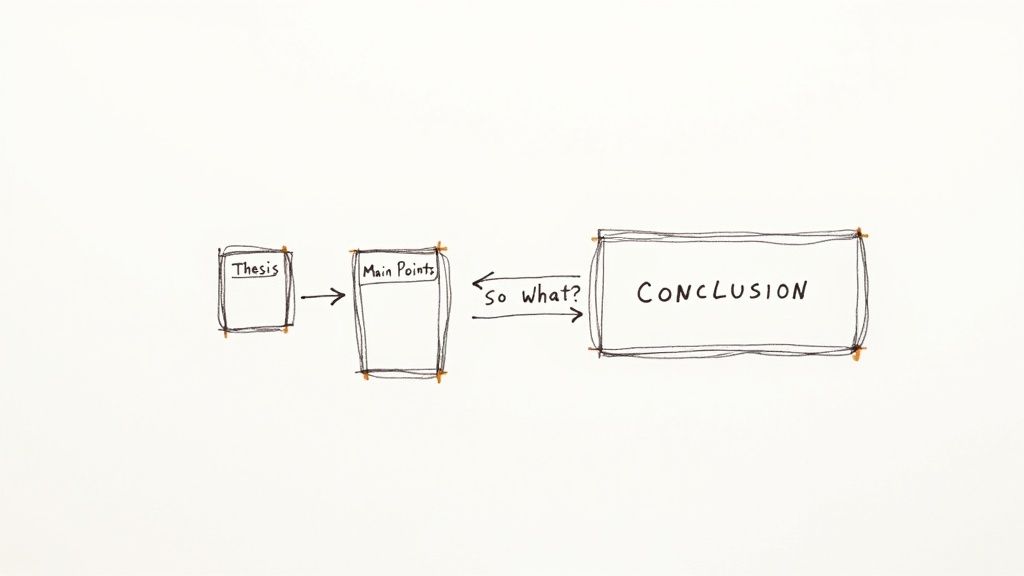
A great conclusion isn't just a jumble of final thoughts; it has a clear, repeatable structure. Once you understand its anatomy, you can build a final paragraph that lands with impact every single time.
Think of your conclusion as having three essential jobs. Each one builds on the last, creating a logical flow that guides your reader toward a satisfying sense of closure. When these elements click, your writing feels polished, complete, and authoritative.
Revisit Your Thesis with Fresh Insight
First, circle back to your main argument or thesis statement. But here’s the crucial part: do not repeat it word-for-word. This is a common trap with first-draft AI content and a dead giveaway of uninspired writing.
Instead, rephrase your core idea using different language to show you’ve mastered the concept. This reinforces your point without sounding repetitive. If you’re struggling to define your core argument, our guide on how to write a thesis statement can help you start strong.
For instance, if your thesis was, "Remote work increases employee productivity by offering flexibility," your conclusion might rephrase it as, "Ultimately, granting employees autonomy over their schedules fosters a more productive and engaged work environment."
Synthesize Your Main Points
Next, tie your key arguments together. This is more than just listing them out again. Synthesis is about showing the relationship between your points and how they collectively prove your thesis. This is where you connect all the dots for your reader.
You’re essentially answering, "What do all these pieces of evidence mean when you put them together?" Honing your ability to how to write an objective summary can seriously level up this skill, allowing you to summarize without losing impact.
A great conclusion doesn't just summarize; it synthesizes. It reveals the bigger picture that emerges when all your arguments are combined, offering a final, powerful insight that sticks with the reader.
Answer the “So What?” Question
This is the part that truly makes a conclusion memorable. After revisiting your thesis and synthesizing your points, you have to explain why any of it matters. Answering the "So what?" question gives your work significance and leaves a lasting impression.
Here are a few actionable ways to tackle this:
- Propose a course of action: Tell your reader what they should do with this new information.
- Suggest broader implications: Discuss how your findings could impact a larger field, community, or future trend.
- End with a compelling thought: Leave your reader with a powerful final idea or a thought-provoking question.
By mastering these three components, you can build a conclusion that does more than just stop the writing—it cements your argument and ensures your message sticks.
Three Essential Elements of a Strong Conclusion
| Component | Purpose | Example Phrase |
|---|---|---|
| Rephrased Thesis | Reinforces the main argument without repetition. | "In essence, the evidence confirms that..." |
| Synthesis of Points | Connects the dots between key arguments. | "By combining these findings, it becomes clear that..." |
| "So What?" Answer | Explains the broader significance or call to action. | "This understanding is critical for future..." |
Thinking about your conclusion in these three parts provides a reliable framework for ending any piece of writing on a high note.
Tailoring Your Conclusion to Different Types of Writing
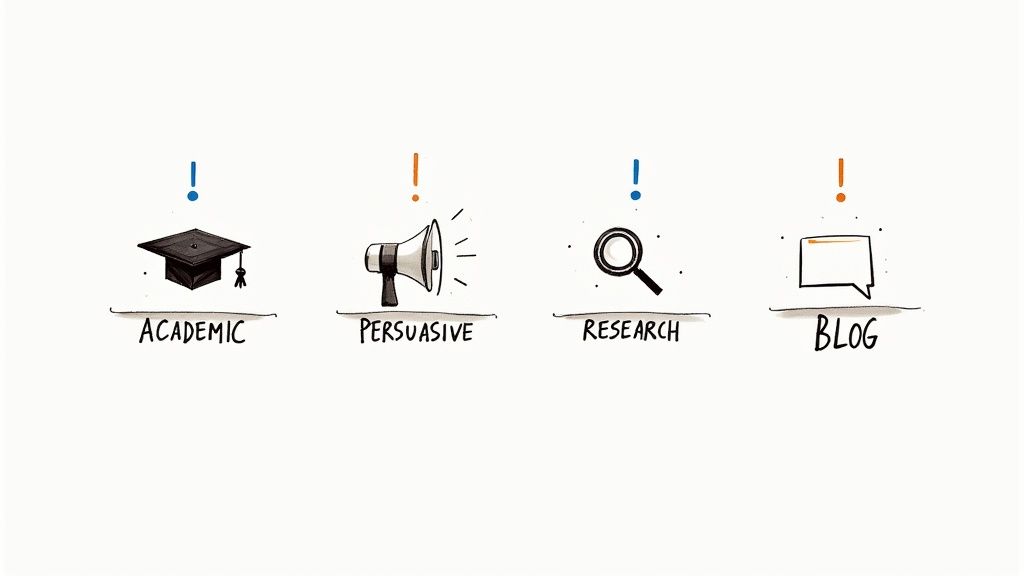
The conclusion for a formal academic essay looks completely different from one for a persuasive blog post. Your goal dictates your strategy. A truly great conclusion is one that’s been shaped for its specific format and audience.
This is what separates seasoned writers from beginners. It’s not just about knowing what to say, but understanding how to say it to achieve your goal—whether that’s proving a complex theory or getting someone to click a "buy now" button.
Academic and Research Papers
When you're writing for an academic audience, your conclusion must be formal, objective, and anchored in evidence. Its main purpose is to summarize your findings, contextualize your work within the larger scholarly conversation, and do it all without injecting personal feelings.
This is where you solidify your research's significance. Following some good research paper writing tips can help. A strong academic conclusion will always:
- Restate your findings concisely and connect them directly to your original research question.
- Acknowledge the limitations of your study. This isn't a weakness; it builds credibility and shows you're thinking ethically.
- Point to areas for future research, showing how your work contributes to the field by opening up new questions.
Think of your academic conclusion as a contribution to an ongoing dialogue. It should leave your peers with a crystal-clear understanding of what you’ve discovered and why it matters.
Persuasive and Argumentative Essays
If your goal is to persuade, your conclusion has to land with impact. This is your final shot to win over your reader. You'll recap your main arguments, but the real focus here is on stirring emotion and motivating your audience to agree with your viewpoint.
Ending with a powerful emotional appeal or a compelling real-life story is incredibly effective. For example, an essay arguing for animal welfare could end with a brief, impactful story of a rescued animal to create a human connection that pure logic often can't.
Blog Posts and Content Marketing
For blogs and content marketing, the conclusion is all about action. You've just spent the whole article giving your reader valuable information; now you have to tell them what to do with it. A conclusion that just trails off is a massive wasted opportunity.
Your job is to keep the engagement going. You can do this by asking a thought-provoking question, linking to another helpful resource, or encouraging them to try a product. For a marketer, this is where you convert interest into action.
Even with AI writing tools, a generic summary won't cut it. It takes a human touch to turn a bland wrap-up into a call to action that converts. That's what we specialize in at PureWrite. Try PureWrite today to humanize your content and ensure every conclusion you write achieves its goal.
Common Conclusion Mistakes and How to Avoid Them
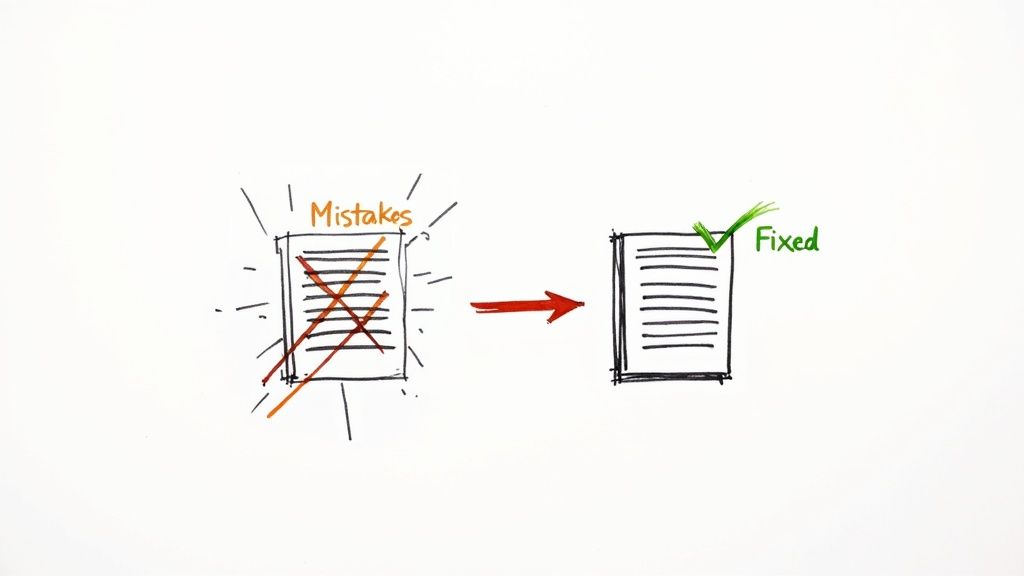
Even the sharpest writers can stumble at the finish line. A shaky conclusion can easily weaken a fantastic piece of writing, leaving your reader more confused than convinced. By sidestepping a few common pitfalls, you can ensure your final paragraph lands with the impact it deserves.
One of the biggest blunders is introducing new information at the very end. The conclusion is for closing arguments, not opening new ones. A last-minute statistic or a surprise claim will only throw your reader off and make your piece feel scattered.
The Trap of Repetition and Clichés
Another common mistake is simply repeating your thesis and main points word-for-word. Yes, you need to revisit these ideas, but do so with fresh phrasing. This shows you've gained a deeper understanding through the process of writing the piece.
It's also tempting to lean on tired phrases. Starting your final paragraph with "In conclusion" or "To summarize" is like putting up a sign that says "generic ending ahead." Your writing should be strong enough to signal the end without them.
Key Takeaway: Your conclusion's job is to synthesize, not just summarize. It’s your chance to connect the dots in a new way, offering a final, insightful perspective that shows the full impact of your argument.
AI writing tools often fall into these traps, producing repetitive summaries and clichéd transitions. At PureWrite, we specialize in refining those generic drafts into something that sounds genuinely human. Try our tool to see how we can elevate your AI content, ensuring it resonates with nuance and authenticity.
Finding the Sweet Spot: Not Too Short, Not Too Long
Getting the length right is a balancing act. A conclusion that’s too brief can feel abrupt, while one that drags on will dilute your core message. The goal is to be both concise and complete.
Your ending should feel satisfying and final, never rushed or rambling. Focusing on powerful, clear language is the key. For a deeper dive, check out our guide on what is concise writing.
Here are three common missteps and how to fix them:
- Mistake #1: Introducing New Ideas. You suddenly bring up a point that wasn't discussed in the body of your text.
- The Fix: Stick to what you've already covered. Use the conclusion to weave your existing arguments together, not to add new threads.
- Mistake #2: Using Cliché Openers. Kicking things off with phrases like "In conclusion" or "To sum up."
- The Fix: Just dive in. Let the content signal the end by rephrasing your thesis in a fresh, compelling way that naturally brings things to a close.
- Mistake #3: Simply Repeating Your Thesis. Copying and pasting the thesis from your introduction.
- The Fix: Rephrase your thesis with the added wisdom of the entire piece. Show your reader how the evidence you've presented has proven that initial claim.
A Quick Checklist for a Polished Conclusion
Before you hit "publish" or "submit," a quick final check can be the difference between a good conclusion and a great one. Think of this as your pre-flight inspection to spot any weaknesses and make sure your final words land with confidence.
Running through these points will ensure your conclusion does its job effectively, leaving your reader with a sense of closure and purpose.
The Foundation: Do You Have the Core Parts?
First, let's make sure the essential building blocks are there. A solid conclusion needs to hit three critical marks without simply repeating what you’ve already said.
Ask yourself:
- Did I restate the thesis in a fresh way? You’re echoing your main argument with new wording, showing a deeper understanding of your own point.
- Did I bring the main points together? Rather than listing arguments, does the conclusion show how they connect and support your thesis? It’s about synthesis, not summary.
- Did I answer the "So what?" question? This is your final chance to give your reader a takeaway, explaining the bigger picture or suggesting what to do next.
The Polish: Is It Smooth and Effective?
Once the structure is solid, it's time to refine the delivery. This is where you smooth out rough edges and ensure the conclusion reads naturally, leaving a lasting positive impression.
A polished conclusion feels seamless. It guides the reader to a natural stopping point, making the end feel both earned and inevitable. It's the final, satisfying click of a well-told story.
Here's what to look for:
- Am I leaning on cliché phrases? Watch out for crutches like "In conclusion" or "To summarize." Ditch them for something more organic.
- Is the tone consistent? Does the feeling of your conclusion match the rest of the piece? An abrupt shift can be jarring.
- Did I introduce anything new? A conclusion is for wrapping up, not opening new doors. Stick to the ideas you've already discussed.
- How's the flow? Smooth transitions are crucial. Our guide on transitional words and phrases has a huge list to help you connect your ideas more effectively.
If you’re using AI to draft your content, this checklist is even more important. AI often gets the basics right but misses the human touch. We help bridge that gap. Try PureWrite to humanize your AI content and ensure every conclusion you write is polished and impactful.
Got Questions? We've Got Answers
When you're staring at the end of a document, a few common questions always seem to pop up. Whether you're a student aiming for a top grade or a content creator aiming for more engagement, getting the conclusion right is a big deal. Let's tackle some of the most frequent sticking points.
This is a quick-reference guide to help you move past common hurdles and write endings that truly stick with your reader.
How Long Should My Conclusion Be?
A good conclusion should feel balanced with the rest of your piece. A helpful rule of thumb is to aim for roughly 5-10% of your total word count.
For a 1,000-word article, you’re looking at about 50-100 words, which usually translates to three to five solid sentences. This gives you enough room to restate your core idea, synthesize your points, and deliver that final "So what?" moment.
Is It Okay to Ask a Question at the End?
Absolutely! Ending with a thoughtful question can be an incredibly effective strategy, especially if your goal is to spark curiosity or persuade. It's a great way to keep your reader thinking about your topic long after they've finished reading.
For example, a blog post about the ethical implications of AI could end with: "As this technology becomes more integrated into our lives, we must ask ourselves: are we shaping it, or is it shaping us?" This nudges the reader to reflect on the article's core theme. Just be sure the question is strategic and doesn't introduce a completely new topic.
Your conclusion is your last chance to make a real connection. A smart question shifts the dynamic from you simply giving information to them actively considering their own place in the conversation.
This is where the human element shines. AI can generate questions, but they often lack strategic nuance. At PureWrite, we help writers refine their AI-assisted drafts by adding these kinds of authentic, engaging touches.
What's the Real Difference Between Summarizing and Synthesizing?
This is a big one, and understanding it is key to writing a great conclusion. They sound similar, but they serve very different purposes.
- Summarizing is a recap. It's restating your main points one by one. Think: "First, we covered A, then B, and finally C."
- Synthesizing is about connecting the dots. It’s showing how A, B, and C work together to support your main argument. It sounds more like: "Because of A and B, the outcome of C becomes not just a possibility, but a certainty."
Synthesis is what gives your reader that satisfying "aha!" moment. It shows the deeper meaning that emerges when all the pieces are brought together.
What Are Some Good Transition Words for a Conclusion?
We all know to avoid the clunky "In conclusion," but you still need a way to signal that you're wrapping things up. The right transition can make your closing feel smooth and intentional.
Here are a few strong options for different contexts:
- Ultimately,
- Therefore,
- Overall,
- In the final analysis,
- Based on this evidence,
- Looking ahead,
Your transition should feel like a natural pivot, not a hard stop. It's all about guiding your reader gently toward your final point.
Crafting a conclusion that feels authentic is a crucial skill, especially if you're working with an AI draft. PureWrite is designed to help you transform robotic text into a final paragraph that truly connects. Try PureWrite today and make sure your writing always ends on a high note.