When you're writing a paper and need to include a lengthy passage from another source, a key question arises: do you use standard quotation marks, or does it require special formatting? Mastering how to do block quotes in MLA style is straightforward once you know the rules, and it makes your writing look significantly more polished and professional.
Let’s break down the practical steps for when and how to use them, whether you're a student, content creator, or professional.
When Do I Need an MLA Block Quote?
Before you start adjusting indentation, you need to know when a block quote is required. The Modern Language Association (MLA) provides clear guidelines that help visually signal to your reader that you're presenting a significant piece of evidence.
Think of it this way: using a block quote tells your audience, "Slow down and pay close attention to this passage; it’s important for my argument."
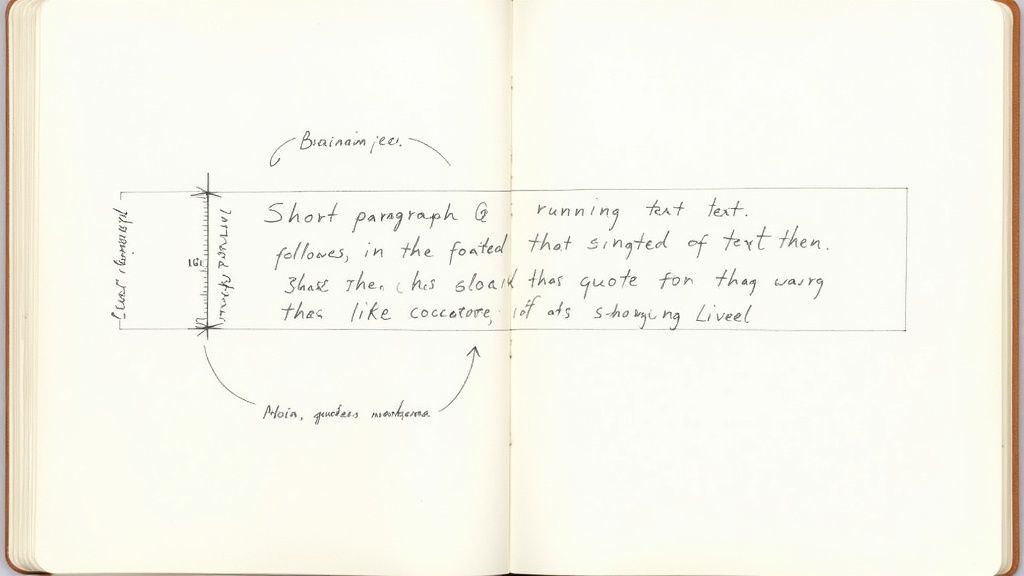
This visual separation makes your points more impactful and your writing easier for your audience to follow.
The Magic Number: Counting Lines
The main trigger for using a block quote is simple: the length of the quotation. The MLA Handbook sets a specific threshold.
You'll need to switch to a block quote format when:
- You’re quoting more than four lines of prose. Prose is the standard paragraph text you find in novels, articles, or scholarly journals.
- You’re quoting more than three lines of poetry.
This isn’t an obscure rule; it’s a standard for academic and professional writing. Statistics show that over 80% of academic papers following MLA standards adhere to these exact line counts, making it a fundamental part of the style.
Here’s a quick reference to make it easy to remember.
Quick Guide to MLA Block Quote Rules
| Type of Text | Use a Block Quote When Quoting |
|---|---|
| Prose | More than 4 lines |
| Poetry | More than 3 lines |
Keep this table in mind as you write, and you’ll apply the rule correctly every time.
Why Bother Getting It Right?
Following these formatting rules does more than just satisfy an academic requirement. It significantly improves the readability and professional appearance of your work, showing that you're a careful writer who respects your sources.
This is crucial for maintaining academic integrity and presenting your arguments clearly. It's also important to understand what plagiarism detectors check for to avoid any accidental issues with your citations. At PureWrite, we believe polished formatting is a hallmark of authentic, thoughtful writing, elevating the quality of your entire document.
How to Format Prose Block Quotes
Nailing the format for a prose block quote is a practical skill. It’s all about making longer quotations fit seamlessly into your paper while clearly signaling that they aren't your own words.
Before you insert the quote, always introduce it. Lead into the block quote with your own sentence, often ending with a colon, to provide context for your reader.
Indentation and Spacing
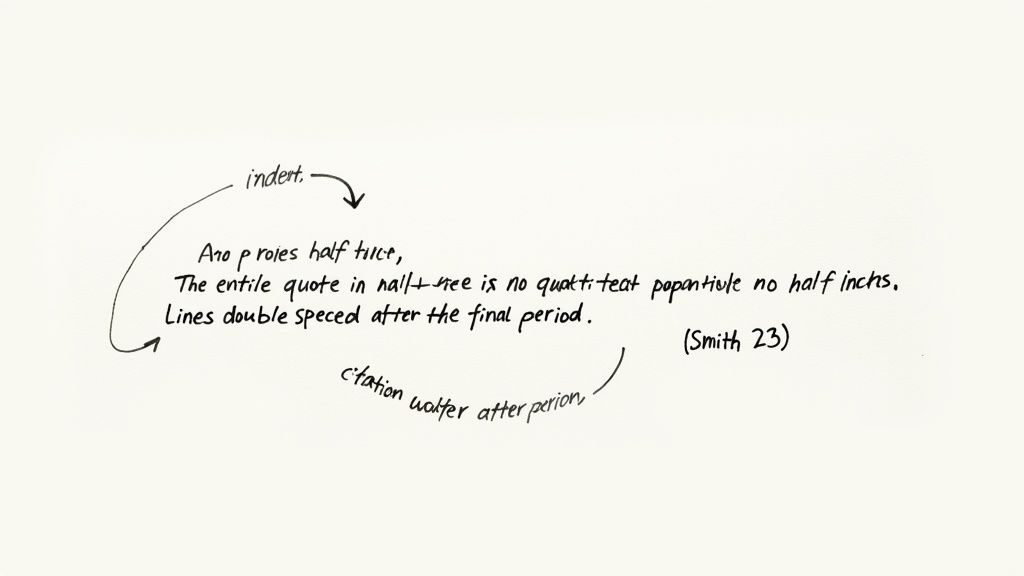
This is where the core formatting happens. Start the quotation on a new line and indent the entire block a half-inch from the left margin. The easiest way to do this is to highlight the text and use your word processor's indent function.
A common mistake is to add quotation marks, but you don't need them. The indentation itself is the visual cue that you're quoting a source. Keep the entire block quote double-spaced, just like the rest of your essay.
The MLA guidelines for block quotes evolved to improve readability and reduce ambiguity. This formatting visually separates long quotations, a practice that became standard in academic writing with the help of digital word processors.
This standardization didn't happen overnight, but it brought much-needed clarity. In fact, by 2010, nearly 95% of scholarly works in the humanities followed these block quote rules, highlighting their importance. You can find more insights on academic formatting to see how these standards developed.
Citing Your Source Correctly
The final piece is the parenthetical citation, and its placement is key. For a block quote, the citation comes after the final punctuation mark.
This is the opposite of how you cite shorter, in-line quotes, where the citation comes before the period. It's a small detail that shows you understand the conventions of academic writing. If you need a refresher, our guide on capitalization and punctuation is a great resource.
Getting these details right demonstrates your credibility. At PureWrite, we help refine these elements, turning AI-generated drafts into polished, human-sounding papers. Try PureWrite today to see how we can enhance your writing.
Getting Poetry and Dialogue Just Right
Quoting poetry or dialogue has unique formatting rules because the structure is just as important as the words. You must preserve the original author's formatting, whether that’s the line breaks of a poem or the conversational flow of a play.
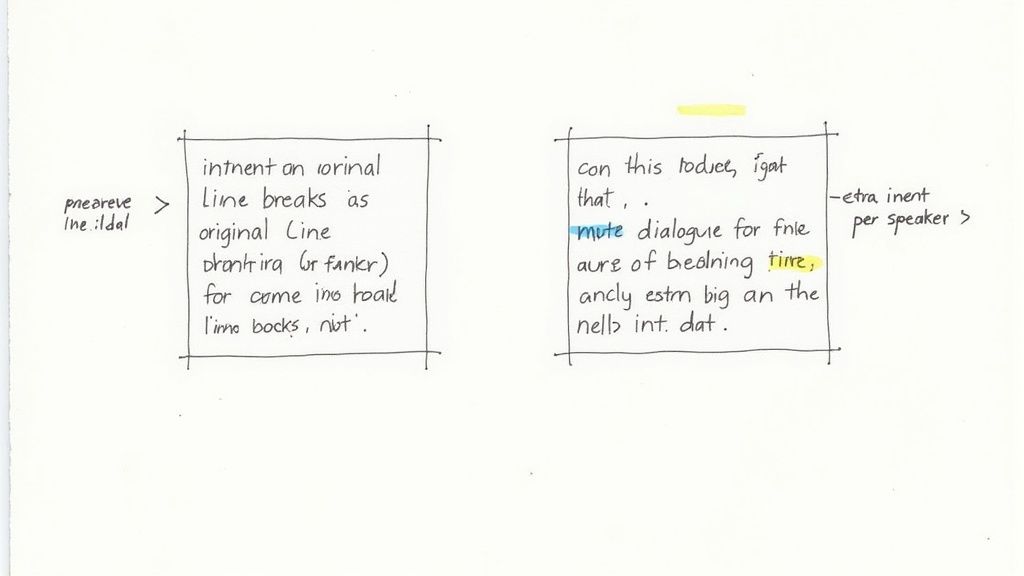
This attention to detail shows you respect the source material and are presenting it ethically and accurately.
How to Format Poetry Quotes
If you're quoting more than three lines of a poem, use a block quote. Start it on a new line and indent the entire passage a half-inch from the left margin, just like prose.
The crucial difference is that you must replicate the poem’s original line breaks exactly. This maintains the poem's intended rhythm and visual form.
Here is an example from Robert Frost's "The Road Not Taken":
I shall be telling this with a sigh
Somewhere ages and ages hence:
Two roads diverged in a wood, and I—
I took the one less traveled by, (Frost 16-19)
Notice how each line begins precisely where Frost intended. That’s the goal.
How to Quote Dialogue from a Play
Quoting a conversation between characters in a play also has specific rules. You'll still indent the entire block a half-inch, but there's an extra step to distinguish the speakers.
Start with the first character's name in all caps, followed by a period. Then, for each subsequent line of dialogue from that character or a new speaker, use an additional quarter-inch indent before their line. This helps your reader visually track who is speaking.
Here's an example from Shakespeare’s Hamlet:
HAMLET. To be, or not to be, that is the question:
Whether 'tis nobler in the mind to suffer
The slings and arrows of outrageous fortune,
Or to take arms against a sea of troubles (3.1.57-60)
Mastering these nuances, along with other basic grammar rules, will elevate your writing. At PureWrite, we focus on these details. If your AI-generated draft struggles with tricky formatting, try PureWrite to ensure your text is polished and academically sound.
Formatting Block Quotes in Word and Google Docs
Knowing the theory is one thing, but applying it in your word processor is where it counts. Let's walk through the practical steps for setting up block quotes in Microsoft Word and Google Docs.
A common mistake is manually hitting the spacebar or tab for each line, which leads to inconsistent formatting. The secret is to use your program's built-in indentation tools for a clean, professional look.
If you're pulling a quote from a scanned document, a good OCR PDF tool can save you a lot of time by converting the image into editable text you can format correctly.
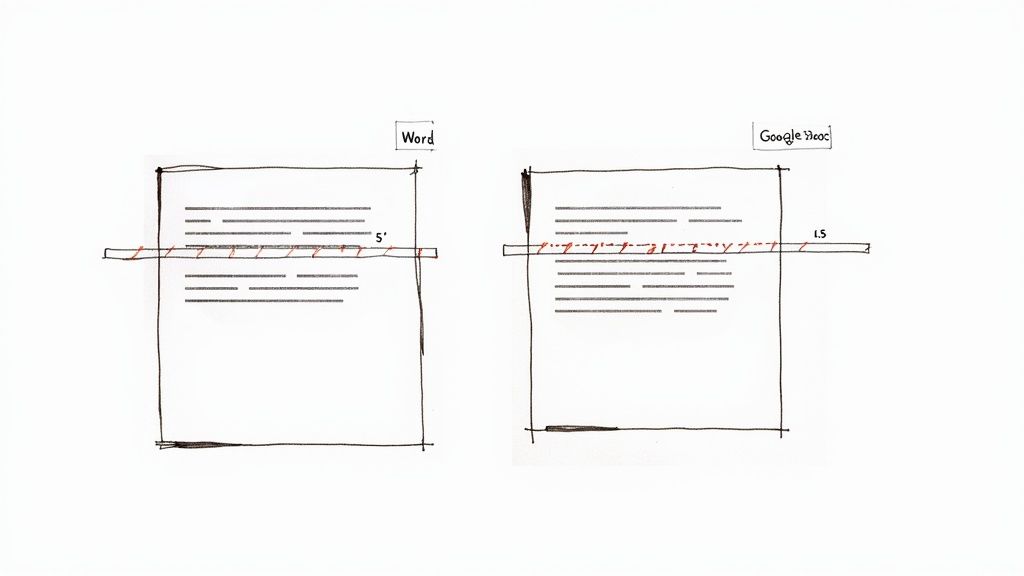
Since default settings can differ, it's always best to set the indentation yourself to ensure accuracy.
The Quick How-To
Here are the step-by-step actions to get that perfect half-inch indent without the headache.
For Microsoft Word Users:
- Highlight the entire passage you want to format as a block quote.
- Go to the Layout tab in the top ribbon.
- In the Paragraph section, change the Left Indent to 0.5".
For Google Docs Users:
- Highlight your quote.
- Navigate to Format > Align & indent > Indentation options.
- In the pop-up window, set the Left indent to 0.5 and click Apply.
This method ensures every line is perfectly and uniformly indented. For complex projects, exploring the best academic writing software can also help automate tedious formatting tasks.
At PureWrite, we specialize in refining AI-generated drafts into something that reads with human authenticity. If your writing feels stiff or has formatting quirks, give PureWrite a try to ensure your final submission is flawless.
Common Mistakes to Avoid with Block Quotes
Even experienced writers can make small mistakes with block quotes. Knowing the common pitfalls can help you avoid them in your own work.
The most frequent error is leaving quotation marks around the block quote. Remember, the indentation itself signals a quotation, so adding quotation marks is redundant.
Another common issue is improper indentation. Many writers only indent the first line, as you would for a new paragraph. The rule is to indent the entire block of text one-half inch from the left margin.
Don't Forget the Setup and Citation
A perfectly formatted quote can still feel disconnected if you don't introduce it properly. Always use your own words to lead into the quote, explaining its relevance to your argument.
The parenthetical citation is another tricky spot. For block quotes, the citation always comes after the final punctuation. This is the opposite of a short, in-line quote, where the citation goes inside the sentence.
Getting citations right is a cornerstone of ethical writing. If you're ever unsure, using a reliable plagiarism checker for students can provide peace of mind before you submit your work.
Block Quote Sanity Check
Use this quick checklist to review your block quotes before finalizing your document. It only takes a minute and can save you from losing easy points.
| Formatting Rule | Check If Complete |
|---|---|
| Quote is longer than 4 lines of prose or 3 lines of poetry. | |
| Entire block is indented 0.5 inches from the left margin. | |
| No quotation marks are used around the block quote. | |
| The quote is double-spaced, just like the rest of the paper. | |
| An introductory phrase sets up the quote. | |
| The parenthetical citation comes after the final punctuation. |
Taking a moment to double-check these simple rules ensures your paper looks professional and that you are crediting your sources correctly and ethically.
Common Questions About MLA Block Quotes
Even when you know the basics, a few specific scenarios can be confusing. Here are answers to some of the most common questions writers have about MLA block quotes.
What If My Block Quote Starts Mid-Sentence?
This is simpler than it seems. If your quotation begins in the middle of a sentence from the original source, you don’t need to use an ellipsis (...) at the start.
Just begin your block quote with the first word you are actually quoting. Your own introductory sentence should provide the context to ensure the quote flows naturally.
How Do I Handle a Quote That Spans Multiple Paragraphs?
When quoting a passage that includes a paragraph break, you need to represent that original structure. This preserves the author's intent.
To do this, simply indent the first line of the new paragraph an extra quarter-inch. All other lines of the block quote should maintain the standard half-inch indentation. This subtle visual shift is the correct way to signal the original paragraphing.
Should I Change the Font or Font Size?
No, you should not change the font or size. It can be tempting to visually separate the quote even more, but consistency is key in academic and professional writing.
Your block quote must use the exact same font, font size, and double-spacing as the rest of your document. The 0.5-inch indentation is the only visual change required.
Where Does the Citation Go if the Quote Already Has Punctuation?
This is a classic point of confusion for many writers. The parenthetical citation always goes after the final punctuation mark of the block quote.
So, if the quoted sentence ends with a period, question mark, or exclamation point, you place your citation immediately after it. For example:
...the journey finally concluded. (Smith 42)
Getting these finer points right shows your audience you are not just engaging with the content but are also committed to professional standards.
Nailing formatting is one thing, but ensuring your writing sounds genuinely human is another challenge, especially when using AI writing tools. At PureWrite, we help you refine your text so it reads with natural authority. Try PureWrite today to humanize your content and make your arguments shine.