Learning how to revise an essay is what turns a messy first draft into a sharp, convincing piece of writing. The real secret? You have to step away from your work. This lets you gain a bit of distance and see the essay as a reader would, not just as its author. This mental break is the bedrock of any good revision.
Get in the Right Mindset: Why "Fresh Eyes" Matter Most
Before you touch a single word, the most important step is to shift your perspective. Revision isn't just about catching typos; it’s about re-seeing your work. After you've spent hours deep in the writing weeds, you're just too close to it. Your brain knows what you intended to say, so it automatically smoothes over awkward phrasing and bridges logical gaps for you.
To break that spell, you need to create some intentional space. Taking a strategic break is non-negotiable. It could be a few hours, a full day, or even a week for a big project like a dissertation. This isn't putting things off; it's a critical part of the writing process that allows your brain to reset. When you return, you're not the writer anymore. You're the reader.
Why Stepping Away Is Your Best Editing Tool
That time away gives your subconscious a chance to chew on the material while you're doing other things. You’ll be shocked at what you find when you come back.
- Logical flaws jump out: An argument that felt rock-solid suddenly seems weak or unsupported. For example, a marketer's blog post might realize their data doesn't actually support their main claim after a day's break.
- Clarity issues become glaring: Sentences you thought were brilliant now feel clunky or confusing.
- Structural weaknesses reveal themselves: You can finally see that a paragraph is in the wrong spot or that the transition between two ideas is rough.
The goal is to switch from being the creator, who is naturally invested, to being the first reader, who is looking for clarity and logic. That mental flip is where the real revision begins.
This simple rhythm—write, take a break, then revise—is the core of any effective writing workflow for students, content creators, and professionals alike.
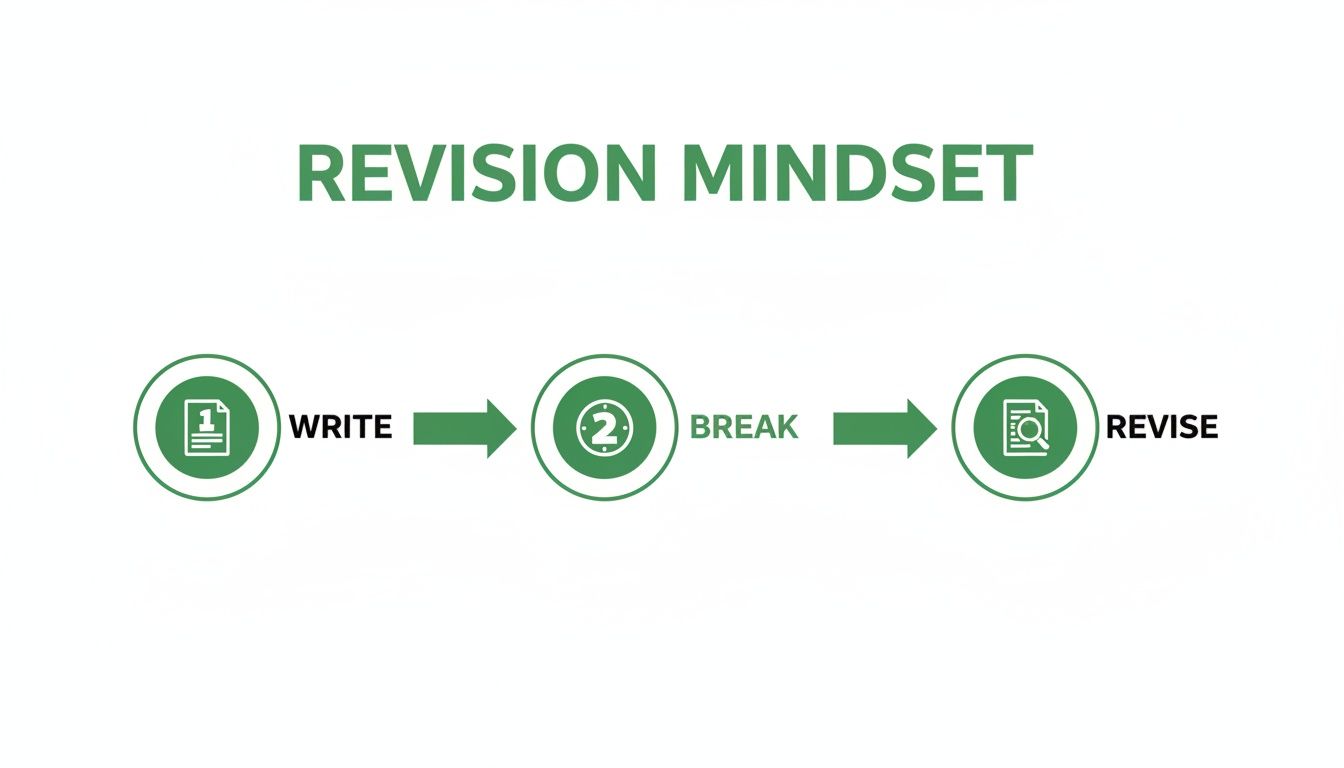
As you can see, the break isn't just a pause; it's an active and essential step. If you skip it, you're not truly revising—you're just proofreading.
A Few Tricks to Force a Fresh Perspective
Getting that objective viewpoint is a skill you can develop. Here are a few simple tricks that work wonders for our team.
Try printing your essay out. Even better, change the font first. These small tweaks trick your brain into treating the document as something new, making it far easier to catch mistakes you’ve been glossing over.
Another of our team's favorites is to read the entire essay aloud. Your ears will catch awkward phrasing, clunky sentences, and rhythmic issues that your eyes might miss. You’ll feel where the flow breaks down.
Strengthen Your Essay’s Foundation with Macro Edits
Alright, you’ve taken a break and can finally look at your draft with fresh eyes. This is the moment to tackle the big-picture issues—the stuff that gives your essay its real strength and substance. We call this stage macro edits, and it’s all about checking the architectural integrity of your work.
For now, we want you to completely ignore the small stuff. Don't even think about grammar mistakes or typos. You're inspecting the foundation, not the paint job.
Getting this structural work right is absolutely crucial. Understanding and avoiding common mistakes in English composition is a huge part of this process.
Start with Your Thesis Statement
Your thesis is the single most important sentence in your entire essay. It's the promise you make to your reader, so the first thing you need to do is put it under a microscope.
Ask yourself honestly: does your thesis accurately reflect the essay you actually wrote? It’s incredibly common for an argument to evolve as you write. That’s a good thing—it means you're thinking deeply. But it also means your original thesis might not fit anymore.
Here’s what to look for:
- Is it specific enough? A vague thesis like "Technology has changed society" is too weak. A much stronger version for a marketing article might be, "The rise of AI-powered personalization has fundamentally altered consumer expectations, demanding a more adaptive approach from brands." See the difference?
- Is it arguable? Your thesis needs to make a claim someone could reasonably disagree with. If it's just a statement of fact, it isn't a thesis—it's just a topic.
- Does it match your evidence? Skim through your body paragraphs. Does everything you wrote directly and consistently support the exact claim you made in your thesis?
If you find your thesis is lacking, don't hesitate to rewrite it completely. For a deeper dive, check out our guide on how to write a strong thesis statement.
Map Your Argument with a Reverse Outline
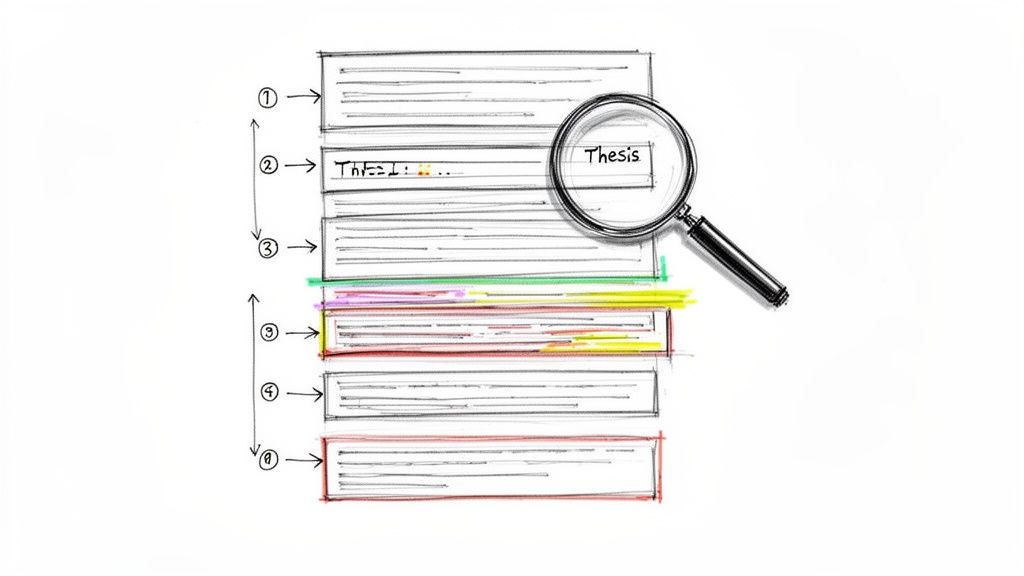
Once your thesis is solid, it's time to zoom out and look at the overall structure and logical flow. The best tool for this is the reverse outline. Instead of creating an outline before you write, you build one from your finished draft.
It’s simple. Just read through your essay and, on a separate doc or in the margins, jot down the single main point of each paragraph. One sentence per paragraph. That's it.
When you're finished, read only your reverse outline. This bird's-eye view instantly reveals the skeleton of your argument, making structural problems glare. You'll immediately spot if your points connect logically, if you're repeating yourself, or if a paragraph is totally out of place.
By summarizing each paragraph's core idea, a reverse outline forces you to see the logical progression—or lack thereof—in your essay. It’s the fastest way to diagnose structural weaknesses.
For example, a content creator might use a reverse outline and see that paragraphs three and five are making a very similar point about SEO. That’s their cue to combine them into a single, more powerful paragraph, which will tighten up the argument and improve the article's flow.
Reorder and Restructure for Impact
Armed with your reverse outline, you can now start moving things around for maximum impact. Think like a film director sequencing scenes. You want to build your case in a way that’s compelling and easy for your reader to follow.
Don't be afraid to make big changes here. This might mean:
- Moving entire paragraphs: You might realize the point you made in paragraph six would hit much harder if it was your second point. Drag and drop.
- Deleting irrelevant sections: Sometimes, you’ll find a paragraph that, while interesting, doesn't actually support your thesis. Be ruthless. Cut it.
- Splitting up long paragraphs: If a single paragraph is trying to do too much, break it into two or more paragraphs to give each point room to breathe.
Once you’ve nailed these macro edits, your essay will have a rock-solid structure. Your core argument will be clear, your logic will be sound, and your evidence will be presented in the most persuasive order. Now, and only now, are you ready to zoom in and work on the finer details.
Refine Paragraphs and Sentences for Clarity and Flow
Okay, you've got the big picture sorted out. The structure is solid, and your argument hangs together. Now it's time to get out the magnifying glass and focus on the details—the individual paragraphs and sentences that do the heavy lifting.
This is where a good essay becomes a great one. It’s the difference between a paper that makes sense and one that’s actually a pleasure to read.
Sharpen Your Topic Sentences
Think of each paragraph's first sentence as a mini-thesis. It’s a promise to your reader, telling them exactly what that chunk of text is about to prove. When a topic sentence is vague, the reader feels lost before they’ve even started.
Your mission is simple: make sure every topic sentence makes a clear, debatable claim that supports your main thesis.
- Weak Topic Sentence: "Social media has many effects on teenagers."
- Strong Topic Sentence: "The constant curation of online personas on platforms like Instagram contributes directly to heightened anxiety among adolescent users."
See the difference? The second one is specific, arguable, and gives the reader a clear roadmap for the paragraph ahead. Go through your draft and put every topic sentence to this test.
Create Seamless Transitions
An essay shouldn't read like a list of disconnected ideas. It needs to flow, guiding the reader smoothly from one point to the next. That’s the job of your transitions.
Good transitions are bridges. They show the relationship between the idea you're leaving and the one you're moving to. Are you adding a similar point? Contrasting two ideas? Showing a cause-and-effect relationship? The right transition word or phrase makes this crystal clear.
If you feel like you're always using "also" or "in addition," check out our guide on using transition words in essays. It’s packed with options to make your writing flow more naturally.
Your reader should never have to ask, "Why am I reading this now?" A strong transition makes the connection between ideas obvious and intentional, preventing jarring shifts in logic.
Instead of just dropping a new paragraph on your reader, build that bridge. A simple "Furthermore," "On the other hand," or "Consequently" can work wonders for making your argument feel like a single, cohesive whole.
Cut the Clutter and Strengthen Your Sentences
Now, let's zoom in even further—to the sentence level. This is where you become a ruthless editor, trimming the fat, fixing awkward phrases, and giving your prose some punch. The goal is to say what you mean as directly and powerfully as possible.
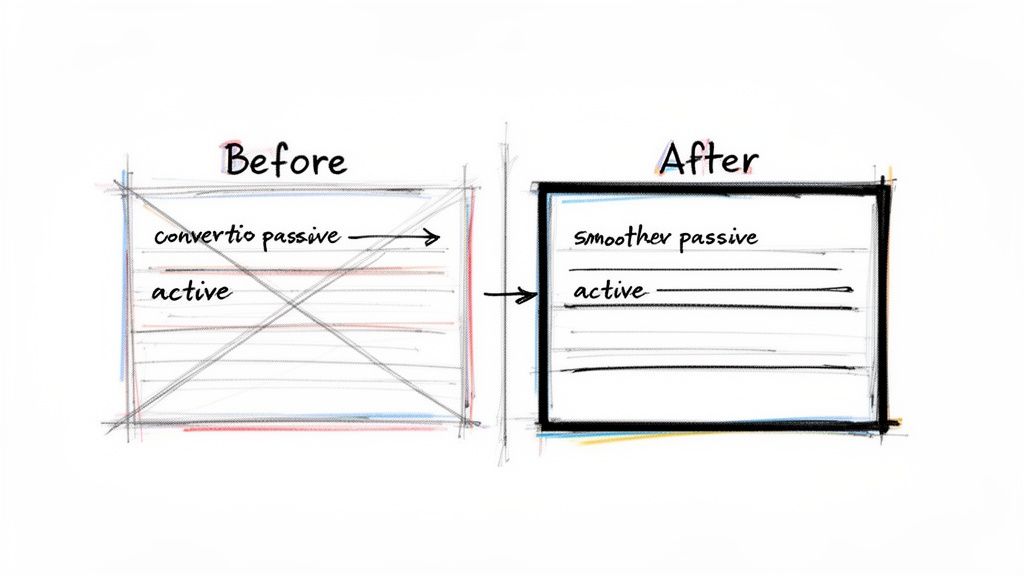
A huge culprit here is passive voice. That’s when the subject of the sentence gets acted upon instead of doing the action. It can make your writing feel timid and indirect.
- Passive (Weak): "The decision was made by the committee."
- Active (Strong): "The committee made the decision."
Another common trap is using filler words. These are the verbal tics that sneak into our writing—words like "really," "very," "just," and "basically" that add length but no meaning. Challenge yourself to delete them. Your sentences will almost always be stronger without them.
Let's look at a quick before-and-after from a business report:
- Before: "It has been found by researchers that the results of the study were actually very significant and basically showed that there is a definite link between sleep and memory."
- After: "Researchers discovered a significant link between sleep and memory."
The second version is 54% shorter and lands with much more impact. Hunt for these opportunities in your own draft. After you’ve stared at a paper for hours, it’s tough to spot these yourself. That’s where a tool like PureWrite can be a lifesaver. It helps you catch that clunky phrasing and polish your sentences until they’re clean, crisp, and sound genuinely human.
The Final Polish: Nailing Grammar, Style, and Tone
You’ve done the heavy lifting. The big structural problems are solved, your argument is solid, and your paragraphs flow logically. Now comes the part that separates a good essay from a truly polished one: the final sweep for grammar, style, and tone.
This isn't just about catching typos. This is about sharpening every sentence until it’s crystal clear and carries the exact right weight. It's the meticulous, detail-oriented work that makes your writing feel professional, authoritative, and a pleasure to read.
Lock Down Your Grammar and Punctuation
Nothing undermines a brilliant argument faster than a spray of grammatical errors. They’re distracting, and frankly, they can make you look careless. At this stage, you need to put on your detective hat and hunt for those tiny mistakes your brain likely glossed over before.
Read through your essay one last time with the sole purpose of finding mechanical errors. Look for those common culprits: subject-verb agreement, misplaced commas, and wonky apostrophes. A word of caution: don't put all your faith in a spell checker. It won't catch you using "their" when you meant "there."
Find Your Voice: Evaluate Tone and Style
The tone of your essay is its personality—the attitude your words convey. Is it supposed to be objective and analytical? Passionate and persuasive? The right tone connects with your reader, while the wrong one can make your argument fall flat.
To get a handle on your tone, ask yourself a few questions:
- Who am I talking to? Writing for a professor requires a different approach than writing a blog post for a general audience of marketers.
- What's my goal here? An essay aiming to persuade needs a more assertive voice than one that's just trying to inform.
- Does it sound consistent? Bouncing between super-formal and overly casual language from one paragraph to the next can be jarring for the reader.
Having a solid grasp of what tone in writing is and how to manage it is a game-changer. This is especially true if you used an AI writing tool to generate your first draft; you'll want to make sure the final piece actually sounds like you and fits the assignment.
Your tone is the personality of your essay. A well-chosen and consistent tone builds trust with your reader and makes your argument more convincing.
If your draft feels a bit robotic or just off, now is the time to fix it. We actually built PureWrite to tackle this exact problem—smoothing out that clunky AI phrasing and injecting a more authentic, human voice into the text.
Sharpen Your Word Choice
With your tone dialed in, you can zoom in on the words themselves. This isn't about cramming in fancy vocabulary. It’s about being precise. The right word makes your writing more vivid and your meaning unmistakable.
Scan your draft for bland, overused words. Where can you swap a weak verb for something with more punch? Can you replace a vague adjective with one that paints a clearer picture?
- Instead of: "The results were very good."
- Try: "The results were compelling." or "The results were groundbreaking."
You can also tighten up your prose instantly by hunting down and eliminating filler words like "really," "just," and "basically." Every single word should earn its keep.
Read It Out Loud (Seriously, Do It)
Here’s one of the simplest but most powerful tricks in the book: read your entire essay out loud. Your ears will catch clumsy phrasing that your eyes completely missed.
When you read aloud, you can't help but notice:
- Awkward sentences that don't flow right.
- Run-on sentences that leave you out of breath.
- Repetitive sentence structures that make your writing sound monotonous.
This simple act forces you to slow down and experience your work as a reader would. It's your final line of defense, ensuring your essay doesn’t just make a strong case, but does so with style and grace.
Humanize and Perfect Your Final Draft with PureWrite
After you’ve wrestled with the big-picture edits and tweaked every last sentence, it's time for the final polish. Whether you started with your own idea or an AI-generated draft, this last step is about making sure your work sounds authentically human. It's crucial for maintaining trust with your audience.
This is exactly where a tool like PureWrite comes in. Think of us less as a replacement for your hard work and more as a final quality check—a smart partner to help you catch the little things your own eyes are probably too tired to see. We believe in using AI ethically to support and enhance your natural writing abilities, not replace them.
Erase Robotic Phrasing and Find Your Voice
Let's be honest, one of the toughest parts of working with AI drafts is getting rid of that stiff, slightly unnatural tone. AI-generated content can often feel a bit hollow, lacking the rhythm and personality of real human writing.
Our Humanize mode was built to fix exactly that. It’s designed to spot awkward phrasing and smooth out those clunky sentences, helping your natural voice shine through. The key is to understand how to use AI for writing without losing your voice, and that's what we help you do—turn sterile, machine-like text into something that truly connects.
Your authentic voice is your greatest asset. Our goal at PureWrite is to enhance it, not overwrite it, by clearing away the robotic artifacts that can get in the way of clear communication.
As you work, you get instant feedback with real-time scores for readability and naturalness. It’s like having an expert editor looking over your shoulder, pointing out exactly where your draft could sound more like you. For a deeper dive, check out our guide on using an AI text enhancer.
Ensure Originality and Academic Integrity
In any academic or professional setting, originality is non-negotiable. Your final review must include a check for plagiarism and unintentional AI patterns. Recent studies show that as many as 75% of college students have used AI tools on their assignments, making it more important than ever for writers to verify their work's authenticity.
We built powerful AI detection and plagiarism checkers right into PureWrite to give you that final peace of mind. This last check confirms your work is 100% yours and ready to go. It's a key step for ethical AI usage.
Our platform helps you finalize your essay by:
- Flagging unoriginal content: The plagiarism scanner highlights any text that matches other sources, so you can cite it correctly or rephrase it.
- Assessing AI probability: Our AI detector helps you find and refine sections that might trigger AI flags, ensuring the final piece is a true reflection of your own thinking and effort.
This tech-powered review is your last line of defense. By humanizing your text and verifying its originality with PureWrite, you can hit "submit" with total confidence, knowing your work is polished, authentic, and ready to make an impact.
Got Questions About Revising Your Essay? We’ve Got Answers.
Getting through the final stretch of writing can be tough, and it’s natural to have questions. You're not alone—even professional writers grapple with these same issues. Here are some straightforward answers to the most common questions we hear about the revision process.
How Much Time Should I Actually Spend Revising?
This is the million-dollar question, and the real answer is, "it depends." But a solid rule of thumb our team follows is to plan on spending at least as much time revising as you did writing the first draft.
For a quick 5-page essay, that might just be an afternoon. For a 30-page research paper? You could be looking at several days of work. The key isn't just the time on the clock; it's how you use that time. We find it’s way more effective to break up the work into focused sessions: one for the big picture stuff, another for sentence-level flow, and a final pass for proofreading.
Is It Okay to Revise and Edit at the Same Time?
It’s so tempting to fix typos as you spot them, but trust us on this one: trying to revise and edit simultaneously usually does more harm than good. Think about it this way: revising is about the architecture of your essay—the argument, the structure, the evidence. Editing is about the paint and polish—grammar, spelling, and word choice.
When you try to do both at once, you can easily waste an hour perfecting a paragraph only to realize later that the entire section needs to be cut. It's like meticulously polishing the windows on a house before you’ve even checked if the foundation is sound.
Our Pro Tip: Always keep revision and editing separate. First, tackle the big structural problems (macro edits). Then, zoom in on paragraphs and sentences (micro edits). Save the final proofread for the very end when everything else is locked in.
This layered approach helps you focus your energy where it’ll have the biggest impact at each stage.
What’s the Real Difference Between Revising and Proofreading?
We like to think of revision as a deep-tissue massage for your essay and proofreading as that final, glossy topcoat on a manicure. Both are essential, but they serve completely different purposes.
Here’s a simple way to look at it:
- Revision is about making significant changes to your essay's content and structure. This is when you might realize your thesis is weak and rewrite it, or you might reorder entire paragraphs to improve your argument's flow. You’re asking big questions like, “Does this all make sense? Is my argument convincing?”
- Proofreading is the final, surface-level check for any mechanical errors. Here, you’re hunting for typos, grammar slip-ups, wonky punctuation, and formatting glitches. The question you’re asking is, “Is this document clean, professional, and error-free?”
One of the biggest mistakes we see writers make is skipping a real revision and jumping straight to proofreading. An essay that's grammatically perfect but has a flimsy argument is still, at its core, a flimsy essay.
My Essay Just Feels… Boring. How Do I Fix That?
If your draft is putting you to sleep, the culprit is often a lack of variety in your sentences and word choice. First drafts are notorious for this—we tend to fall into repetitive patterns just to get the ideas down. The good news? This is one of the most fixable problems.
Try this: read one of your paragraphs out loud. Do all the sentences start the same way ("The study showed..." "The author found..." "This means...")? Are they all about the same length? Make a conscious effort to mix it up. Follow a long, complex sentence with a short, punchy one.
Next, go on a "weak word" hunt. Use your search function to look for crutch words like "very," "really," "good," and "important." Challenge yourself to replace them with more powerful, precise language. Instead of saying a result was "very good," you could say it was "groundbreaking," "compelling," or "definitive." These small tweaks inject life and authority into your writing, pulling your reader in instead of pushing them away.
Feeling confident about your essay's structure but want to ensure it sounds polished and genuinely human? Let PureWrite handle the final quality check. Our platform helps you smooth out awkward phrasing, erase any robotic tone, and verify your work's originality, so you can submit your essay with complete confidence. Try PureWrite and perfect your final draft today.