Master the 5 Steps of the Writing Process: An Actionable Guide
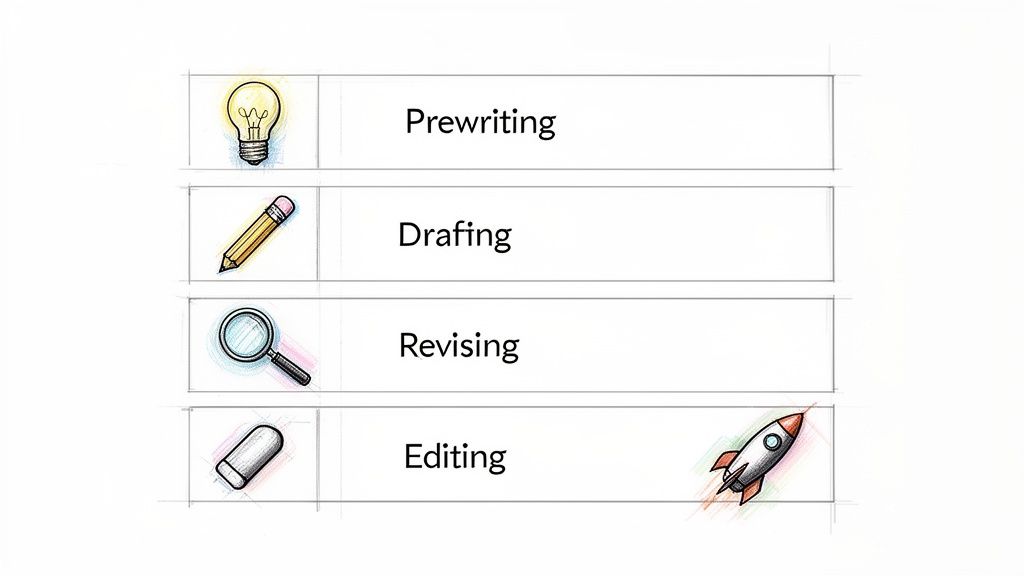
Writing is a journey from a fleeting idea to an impactful piece. Today, that journey often includes a powerful companion: Artificial Intelligence. For content creators, students, and professionals, understanding the classic 5 steps of the writing process is more crucial than ever, especially when leveraging AI tools.
At PureWrite, we believe AI should be a partner in creation, not a substitute for your authentic voice. This guide will walk you through each timeless stage, from planning to publishing, with a modern twist. You'll learn how to ethically integrate AI assistants, ensuring your final product is not just complete, but genuinely human.
Mastering these steps helps you produce higher-quality content that resonates with your audience. Let's explore how to blend classic techniques with modern technology to refine your workflow.
1. Prewriting (Planning & Brainstorming)
Before you write a single sentence, the most critical work begins. Prewriting is the foundational stage where you generate ideas, conduct research, and organize your thoughts. This planning phase builds a solid blueprint for your content, ensuring your message is clear and directed at the right audience.
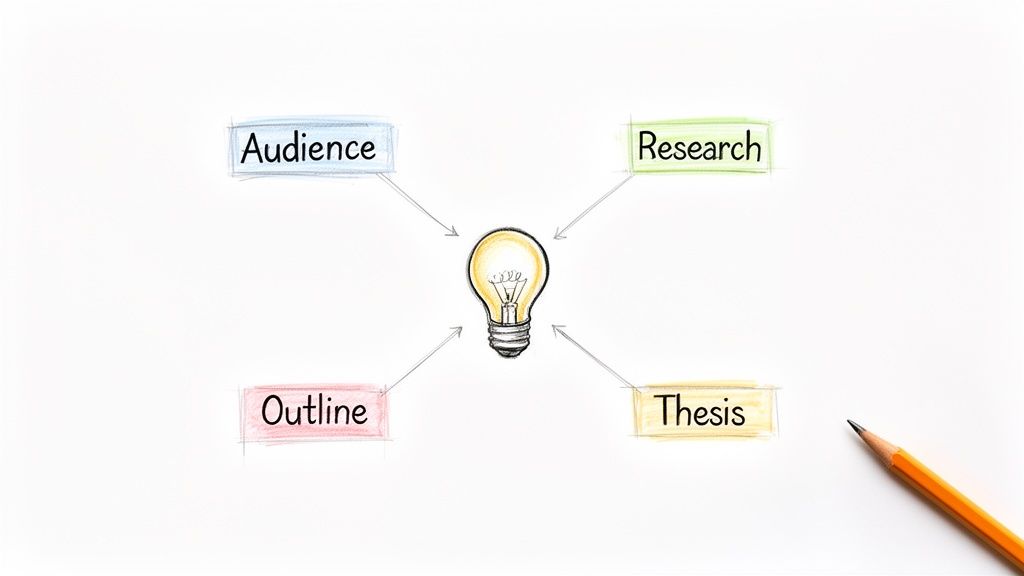
Think of it as an architectural design before construction. A content marketer might create an SEO outline targeting specific keywords, while a student develops a thesis statement. For you, this stage is vital; a strong plan provides a clear framework, making any AI-to-human refinement process smoother and more effective.
How to Implement Prewriting Effectively
To get the most out of this stage, focus on structured thinking. A real-world example is a marketing team using a shared document to outline a campaign blog post, assigning sections and defining the core message before any writing begins. For more strategies on generating ideas, consider these effective brainstorming techniques.
Here are a few actionable tips:
- Define Your Audience and Purpose: Who are you writing for, and what should they know after reading? Answering this aligns your tone, style, and content from the start.
- Create a Detailed Outline: Map out section headings (H2s, H3s), key talking points, and data you plan to include. This structure is invaluable whether you're writing yourself or crafting a prompt for an AI assistant.
- Identify Your Core Message: What is the single most important takeaway? State it clearly, then build your supporting arguments around it. This is a crucial step for academic work; you can learn more about how to structure a research paper with this principle in mind.
- Gather Your Research: Collect statistics, quotes, and source materials beforehand. Research shows that content backed by data is perceived as more trustworthy. This also provides the raw material we at PureWrite can help you weave into a compelling narrative.
Investing time in prewriting significantly reduces the need for extensive revisions later. A strong plan ensures your initial draft has the substance and direction needed for a polished final piece.
2. Drafting (Composing & Getting Ideas Down)
With your plan in place, it's time to create. Drafting is the second of the 5 steps of the writing process, focusing on translating your outline into prose. The primary goal here is momentum, not perfection; get the raw material onto the page without worrying about grammar or polished phrasing.
Think of this as sculpting with a large block of clay—you're shaping the general form first. If you're using an AI writer, this step is often accelerated. You can generate a comprehensive draft quickly, which serves as the perfect foundation for the humanization and refinement we help you achieve with PureWrite.
How to Draft Effectively
To make the most of this phase, shift from a "planner" mindset to a "creator" mindset. A practical use case is using an AI tool to generate a first draft of an email marketing sequence based on your outline. This saves hours, giving you a solid base to personalize and refine.
Here are a few actionable tips for this stage:
- Write Without Editing: Resist the urge to fix typos or rephrase sentences. Focus solely on getting your thoughts down to maintain creative momentum.
- Use Detailed Prompts for AI: If using an AI assistant, provide it with your detailed outline and specific instructions. The better the input, the more relevant the initial draft will be. This is a cornerstone of ethical AI usage—guiding the tool, not just copying it.
- Generate More Than You Need: Create a slightly longer draft than your target word count. This gives you more material to work with, allowing you to cut weaker sections and refine the strongest points.
- Work in Focused Bursts: Set a timer and write without distraction. This technique, known as "sprinting," helps you stay in a state of flow and prevents overthinking.
- Embrace the "Ugly" First Draft: Accept that your initial composition won't be perfect. For students, understanding this is key to overcoming writer's block. For more guidance, you can learn how to create an effective essay rough draft to build upon.
By focusing on flow during drafting, you create a solid base. Your raw text is now ready for the critical refinement that follows.
3. Revising (Substantive Content Improvement)
After the draft is complete, the crucial work of refinement begins. Revision is the third stage in the 5 steps of the writing process, where you assess the big picture. This isn't about fixing commas; it's about strengthening your content's organization, clarity, and overall effectiveness.
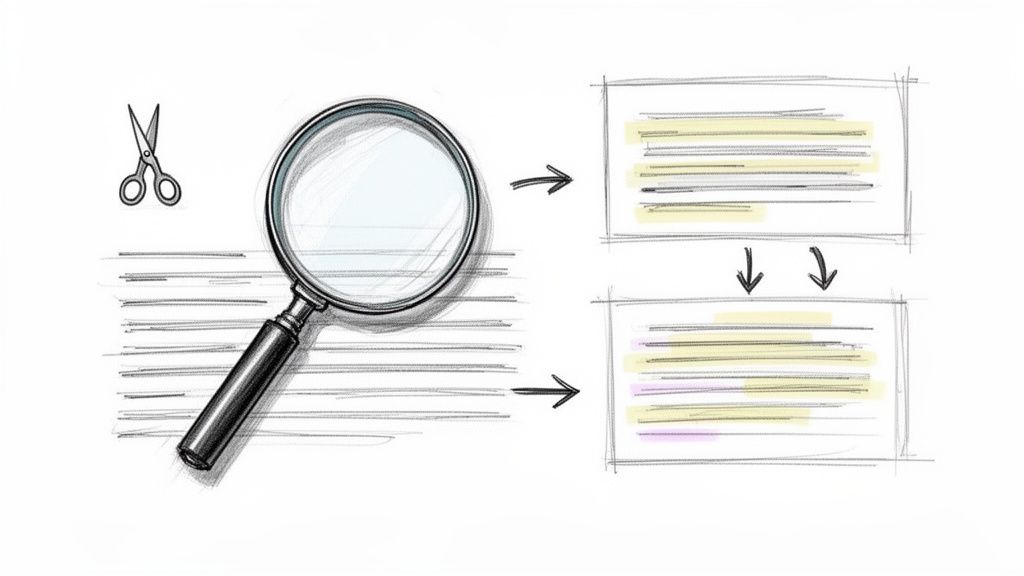
Think of yourself as an editor reviewing a colleague's report—you're looking at flow, logic, and impact. You might rearrange paragraphs, delete redundant sections, or rewrite sentences for clarity. This step is where our humanization process at PureWrite shines, helping you improve prose and align the tone with your audience's expectations.
How to Implement Revising Effectively
To revise with purpose, shift from a writer's mindset to a reader's. Read your work aloud to catch awkward phrasing and focus on macro-level improvements. The goal is to ensure your message is not only present but also powerful.
Here are a few actionable tips:
- Revise in Layers: Don't try to fix everything at once. First, review the overall structure. Next, assess clarity and flow. Finally, refine the tone and style.
- Ask "Does This Serve My Argument?": Scrutinize every paragraph. If a piece of information doesn't support your core message, revise or remove it. This process is key to developing focused content, which you can explore in our guide on what is concise writing.
- Leverage Quality Analysis: If you've used AI, it's essential to ensure the output sounds natural. Statistics show that nearly 60% of consumers distrust content that sounds overly robotic. Use PureWrite to get objective feedback on your draft's readability and human-like quality.
- Check for Consistency: Ensure your voice and terminology are consistent from beginning to end. A student revising an essay, for example, would check that their thesis is supported throughout.
Dedicating time to substantive revision transforms a rough draft into a compelling piece of communication that truly connects with your reader.
4. Editing (Grammar, Style & Mechanics Polish)
After revising the big-picture elements, it's time to zoom in on the details. Editing is the fourth stage where you polish your language at the sentence level. This step focuses on grammar, spelling, punctuation, and style to ensure your writing is clear, professional, and error-free.
Think of it as cleaning the windows after building the house; the structure is sound, but now you need to make the view unobstructed. A real-world case is a professional polishing a final project proposal. Simple typos can undermine credibility, so this stage is non-negotiable for high-stakes documents.
How to Implement Editing Effectively
Effective editing is systematic. It involves moving from a macro view of style to a micro view of punctuation, ensuring every component contributes to the overall quality. This is where you can ethically use AI as a proofreading assistant to catch what the human eye might miss.
Here are a few actionable tips:
- Address Grammar and Spelling Systematically: Use a tool like PureWrite to perform a comprehensive grammar and spell-check. Review suggestions one by one to maintain your intended meaning and authentic voice.
- Improve Clarity and Concision: Eliminate wordiness and redundant phrases. Tightening your sentences makes your message more impactful and easier for your audience to digest.
- Strengthen Your Sentences with Active Voice: Passive voice can make writing feel distant. Review your text for opportunities to shift sentences into the active voice, creating a more direct and engaging tone. For a deeper dive, learn about the difference between passive and active voice here.
- Ensure Style Consistency: Check that terminology, capitalization, and formatting are consistent throughout your document. This is especially important for longer pieces where consistency signals professionalism.
By dedicating time to meticulous editing, you ensure your message is received exactly as intended, without the distraction of errors. This is a critical step before you present your work.
5. Publishing (Distribution & Final Presentation)
After meticulous planning, drafting, and polishing, the final stage is sharing your work. Publishing is where your content meets its intended audience. This involves more than just clicking "post"; it’s about strategic distribution and thoughtful presentation to ensure maximum impact.
Whether you're a student submitting an essay, a marketer scheduling a blog post, or an author preparing a manuscript, this final step is crucial. For you, this is the moment of truth. Having refined your content to sound authentically human, you can publish with confidence, knowing it will connect with readers and avoid being flagged as AI.
How to Implement Publishing Effectively
A successful publishing strategy ensures your hard work gets the reception it deserves. This involves adapting your final piece to the specific medium and audience. For authors reaching this stage, a comprehensive guide to self-publishing on Amazon can provide essential steps for distribution.
Here are a few actionable tips:
- Format for the Platform: Adapt your content for its final destination. Use proper headers for a blog post, or adhere to strict formatting guidelines (like APA or MLA) for an academic paper.
- Optimize for Digital Discovery: If publishing online, your work isn’t finished until it’s optimized. Craft compelling headlines and meta descriptions to improve click-through rates. Explore these SEO content writing best practices for better visibility.
- Run a Final Quality Check: Before your work goes live, perform one last check with PureWrite. Our tool can help you verify its naturalness, ensuring your content presents as authentically human-written—crucial for building trust with your audience.
- Verify All Submission Requirements: Double-check every detail: file format, word count, and any required metadata. Overlooking a small requirement can lead to rejection or a poor first impression.
5-Step Writing Process Comparison
| Stage | 🔄 Implementation complexity | ⚡ Resource requirements & speed | ⭐ Expected outcomes | 📊 Ideal use cases | 💡 Key advantages |
|---|---|---|---|---|---|
| Prewriting (Planning & Brainstorming) | 🔄 Moderate — research and outline work upfront | ⚡ Low–Medium time; research sources, brainstorming tools | ⭐ Clear structure, targeted purpose, fewer major rewrites | 📊 SEO outlines, academic papers, email/report planning, blog scaffolds | 💡 Saves drafting time; guides AI prompts; aligns tone with audience |
| Drafting (Composing & Getting Ideas Down) | 🔄 Low — free-flow composition, minimal process controls | ⚡ High speed with AI; requires writing time or AI tools | ⭐ Abundant raw material and idea variations for refinement | 📊 Rapid blog/email drafts, first-pass essays, non-native writing starts | 💡 Overcomes writer's block; generates multiple approaches quickly |
| Revising (Substantive Content Improvement) | 🔄 High — structural rework, fact-checking, tone alignment | ⚡ Medium time; feedback, analytical tools (e.g., Pure Write) | ⭐ Stronger arguments, improved coherence, more natural prose | 📊 Post-draft improvement, tone correction, humanization of AI text | 💡 Detects logic gaps; improves persuasiveness and naturalness |
| Editing (Grammar, Style & Mechanics Polish) | 🔄 Medium — sentence-level fixes and style compliance | ⚡ Low–Medium time; grammar tools, style guides, careful review | ⭐ Polished, error-free, consistent and publication-ready copy | 📊 Final proofreading for publication, submissions, professional comms | 💡 Eliminates errors, improves readability, enforces style consistency |
| Publishing (Distribution & Final Presentation) | 🔄 Medium — platform-specific formatting and checks | ⚡ Medium effort; formatting, SEO/meta, scheduling tools | ⭐ Correctly formatted, accessible, and audience-ready distribution | 📊 Blogs, academic submissions, email blasts, social media posts | 💡 Ensures compliance and reach; verifies naturalness before release |
Elevate Your Writing Process With Authentic AI
Mastering the 5 steps of the writing process transforms writing into a manageable, creative journey. From the spark of an idea to the final polish, each stage offers an opportunity to refine your message and connect with your audience. This structured approach is a flexible framework designed to bring clarity, coherence, and impact to your work.
In today's digital landscape, this framework's true power lies in its synergy with technology. By thoughtfully integrating AI tools, you can supercharge your workflow. However, the goal is not to replace your voice but to amplify it. Resonant content is born from a blend of efficient technology and irreplaceable human insight.
Ultimately, this process empowers you to produce content that stands out. Whether you are a student, marketer, or professional, embracing these five steps will consistently elevate your writing. It ensures you move beyond just conveying information to creating a genuine connection with your reader, building trust and authority with every word.
Ready to ensure your AI-assisted drafts maintain that crucial human touch? PureWrite is designed to refine and humanize your content, aligning it perfectly with the final, crucial steps of the writing process. Our advanced algorithms polish your text for clarity, style, and authenticity, helping you produce high-quality, undetectable content with confidence. Try Pure Write today and experience the perfect partnership between AI efficiency and human creativity.