How to write a discussion section: Turn Your Findings into Insight
The discussion section is where your research paper truly comes alive. It’s your chance to move beyond just presenting data and start telling the story behind it. This is where you connect the dots for your reader, explaining what your findings mean, why they matter, and how they fit into the bigger picture.
Essentially, you're answering the all-important "so what?" question. It’s a critical part of any content, from a student's thesis to a professional marketing report.
Understanding the Role of Your Discussion Section

Before you start writing, it helps to think about the core mission of this section. It's not a simple rehash of your results. Instead, it’s the critical bridge between your raw data and its real-world significance. Your job is to guide the reader from the "what" (your findings) to the "so what" (their implications).
Think of yourself as a guide leading the reader through your thought process. A strong discussion turns numbers and observations into a persuasive narrative that highlights the value of your work. Getting this perspective right is the first step to crafting a discussion that makes a genuine impact.
The Purpose of a Discussion
A well-executed discussion section performs several crucial jobs. It's much more than a summary; it's a deep, analytical conversation with your reader and your field.
A powerful discussion should always:
- Interpret your findings: Don't just state the results. Explain what they actually mean in the context of your research question.
- Connect to existing literature: How does your work confirm, contradict, or expand upon previous studies? Show you've done your homework.
- Highlight the significance: This is your chance to argue for your work's importance. What new insight does it offer? What are the practical or theoretical implications?
- Acknowledge limitations: Every study has limits. Discussing them openly demonstrates your critical awareness and strengthens your credibility.
This clear separation of results from interpretation isn't a new idea. It was formalized by the American Psychological Association (APA) back in the 1920s to combat a staggering 40% rejection rate in journals, much of it due to muddled analysis. Fast-forward to today, and the principle holds. A 2018 NIH analysis revealed that 72% of papers with clearly integrated interpretations in their discussion section received better peer review scores.
Distilling your research's core message is a key skill, similar to knowing how to write an executive summary.
The best discussion sections do more than just summarize—they synthesize. They weave together your data, existing research, and theoretical frameworks to create a new understanding for the reader.
Ultimately, this section frames your entire research narrative. A well-crafted discussion can elevate a good study into a great one. For a broader look at how this fits into the overall document, see our guide on how to structure a research paper.
To keep these distinct functions clear, here’s a quick-reference table that breaks down what you should be doing—and what you should be avoiding.
Core Components of a Strong Discussion Section
| Component | Primary Function | What to Avoid |
|---|---|---|
| Interpretation | Explain the meaning and significance of your findings. | Simply repeating results without analysis. |
| Implications | Discuss the broader impact of your work (theoretical/practical). | Overstating the importance or making unsupported claims. |
| Limitations | Acknowledge the constraints and weaknesses of your study. | Ignoring obvious flaws or being overly defensive. |
| Future Directions | Suggest new questions or research avenues that arise from your study. | Proposing generic or unfocused future studies. |
Using this table as a mental checklist can help ensure your discussion is comprehensive, balanced, and persuasive.
Structuring Your Discussion for Maximum Impact
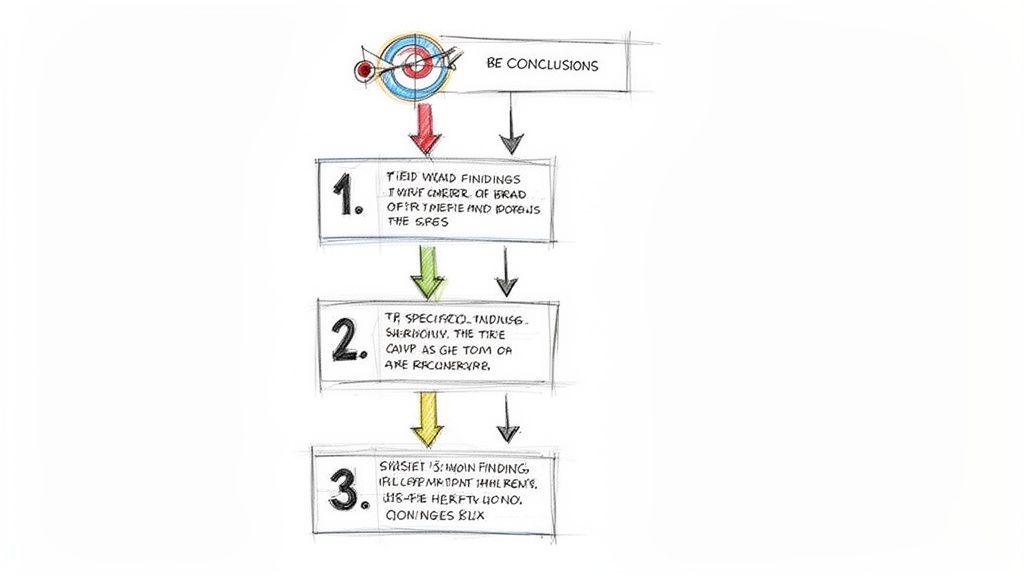
A great discussion section is all about narrative flow. The structure isn’t just a box you put ideas into; it’s the logical path you create to guide your reader from a specific result to a powerful, big-picture conclusion. Without a solid framework, even brilliant insights can get lost.
Let's walk through a proven model you’ll see in high-impact papers and professional reports. This approach helps you build your argument with clarity, crafting a story that’s easy to follow and hard to forget.
Start Strong with Your Key Findings
Jump right in by addressing your main research question. You want to lead with a clean, concise summary of your most important findings. This isn’t the place to re-list every number from your results section. Instead, synthesize the main takeaways into a clear, declarative statement.
For example, if your marketing campaign analysis showed a high return on investment, you could start with: "Our results demonstrate that the new social media strategy drove a 25% increase in conversions, exceeding initial projections." This immediately tells the reader what you found and sets the stage.
Think of this opening as the "thesis statement" for your discussion. Whether you’re writing an academic paper or trying to write content that captivates an audience, grabbing their attention upfront is key.
Interpret Your Findings in Context
Once you've stated your main finding, it's time to explain what it means. This is where you move from just reporting facts to actually building your argument. How do your results answer the questions you set out to explore?
This is your chance to connect your work back to the theories or industry benchmarks you laid out earlier. Do your findings support existing models? Do they challenge them? This is where you showcase your critical thinking.
Let's say you're writing about workplace productivity. An interpretation might sound like this: "The observed 30% increase in team efficiency suggests that decentralized decision-making can be successfully applied outside of software development, challenging traditional top-down management models." See how that places the finding within a broader conversation?
A helpful way to think about your structure is as an inverted pyramid. Start narrow with your most specific finding, then gradually broaden the scope to cover interpretation, how it fits with other research, and its wider implications.
This methodical approach keeps your discussion from feeling like a random collection of thoughts. Using clear headings is also essential for guiding your reader. If you need a refresher, our guide to APA format headings and subheadings can help you get it right.
The Funnel Approach: A Proven Framework
To really nail this structure, many writers rely on the "funnel" approach. This model creates a natural, logical progression from the specific to the general, which makes your arguments far more persuasive.
Here’s a breakdown of how the funnel works:
- Summarize Key Findings: Start at the narrowest point with a direct statement of your main results.
- Provide Interpretations: Broaden out a bit by explaining what these findings mean in the context of your study.
- Discuss Implications: Widen the scope even more by exploring the practical or theoretical implications. What does this mean for the field or business?
- Acknowledge Limitations: Step back to address your study's constraints, showing you have a balanced, critical perspective.
- Conclude with Future Directions: End at the funnel's widest point by suggesting new research questions or next steps.
This structure gives your discussion a satisfying narrative arc. We at PureWrite always recommend mapping this structure out before you write your first sentence—it provides a clear roadmap to a powerful discussion section.
Connecting Your Findings to the Bigger Picture

This is where your work truly joins the ongoing conversation in your field. Simply presenting your results isn't enough; you now have to show how your work fits into the tapestry of existing knowledge. This act of contextualization is what elevates a simple report into a meaningful contribution.
When you effectively link your findings to previous studies or industry trends, you're sending a clear signal. It tells readers you've done your homework, you respect the work that came before you, and you’ve found a genuine gap that your research is helping to fill.
Comparing Your Work with Previous Studies
The heart of this section is a direct, thoughtful comparison between your findings and those of others. This is far more than just a list of who found what. It's about weaving this information together to build a powerful argument for your work's unique place in the field.
You need to show where your results agree, where they diverge, or how they add a completely new layer of understanding. Drawing these lines underscores the relevance of your study and makes its contribution crystal clear.
This isn't just good academic practice; it has a real impact on how your work is received. A 2021 Scopus analysis of 2 million articles revealed that papers with strong discussion sections citing prior literature see 45% higher citation rates over a decade. What’s more, 60% of top-tier papers contextualize their findings against 5-10 prior studies, which can help slash rejection rates by up to 22%. You can read more about these findings on writing strong discussion sections.
Explaining Similarities and Differences
When your results line up with previous research, that’s great—it strengthens your conclusions. Frame this as providing more evidence for an existing theory or confirming a pattern others have seen. It adds another layer of validity to your work.
But what if your findings are different? That’s often where the most exciting part of the discussion begins. Your job is to propose thoughtful, logical explanations for these discrepancies.
Think about the potential reasons for divergent results:
- Methodological Differences: Did you use a different experimental setup, a much larger sample size, or a more precise measurement tool?
- Sample Characteristics: Was your study population different in some key way—age, culture, or professional background?
- Theoretical Nuances: Do your findings hint that an existing theory might only hold true under specific conditions?
Tackling these differences head-on is a sign of a sharp critical thinker. It turns a potential weakness into a major strength by showing you have a deep, nuanced grasp of your topic. This skill is very similar to the synthesis required when you learn how to write a literature review.
Never shy away from unexpected results. These are often the most valuable, as they can challenge long-held assumptions and open up entirely new avenues for research. The key is to explain them logically and confidently.
Handling Unexpected Outcomes
Getting a result you didn't see coming can feel unsettling, but these findings are often the seeds of groundbreaking insights. First, rule out any simple errors in your methodology or data analysis. Once you’re confident the results are solid, address them directly in your discussion.
Resist any temptation to bury them. Instead, treat them as an opportunity. Offer plausible interpretations for why you think these results appeared, grounding your hypotheses in logic and existing theory.
For example, a content creator might write: "While we hypothesized that long-form video would increase engagement, our data revealed a 15% drop. This unexpected outcome may be due to a recent platform algorithm change that favors short-form content, a factor not present in previous analyses." This frames the surprise not as a failure, but as a new, valuable insight.
Demonstrating Your Unique Contribution
Ultimately, the goal here is to carve out a specific, undeniable place for your research. After comparing your work and explaining any surprises, you should be able to make a clear, concise statement about what your study adds.
Does it:
- Fill a specific gap in the literature?
- Introduce a new methodology for others to adopt?
- Challenge a well-established theory?
- Offer a practical solution to a real-world problem?
Defining this contribution is the final, powerful move of your discussion. It's the definitive answer to the "so what?" question. As you draft this part, using AI writing tools ethically is key.
At PureWrite, we see AI as a collaborator, not a replacement. You can generate a first draft to get started, but then use a tool like ours to humanize the text. This crucial step ensures the final product reflects your unique analytical perspective. Try PureWrite today to refine your discussion section and make your voice heard.
Addressing Limitations and Proposing Future Directions
It might feel counterintuitive, but openly discussing your study's limitations is a sign of strength, not weakness. This is where you prove to reviewers and readers that you have a sharp, critical eye for your own work. Being honest builds trust and shows real intellectual integrity.
Think of limitations as guardrails that define the scope of your conclusions, not as fatal flaws. This transparency is crucial—it keeps your readers from overgeneralizing your results and strengthens the credibility of your paper.
Turning Weaknesses into Strengths
Let's be real: every single study has constraints. It could be the sample size, the methodology, or the timeframe. Your job is to talk about them openly without downplaying what you did accomplish.
Get specific. Explain why something was a limitation and how it might have influenced the results.
For instance, don't just write, "The sample size was small." Instead, explain the context: "Our study's participants were a focused group of 50 university students, which means our findings might not directly apply to older adults or non-student populations." See the difference? It’s precise and responsible.
This is your perfect pivot point. You can seamlessly transition from a limitation to a suggestion for future research, turning a potential critique into a launchpad for the next researcher—which might even be you.
Being upfront about your study’s boundaries doesn’t invalidate your findings. It actually reinforces their credibility by showing you understand precisely where they fit. This is a hallmark of strong, ethical scholarship.
Proposing Concrete Future Research
Once you've laid out the limitations, the next logical move is to point the way forward. This isn't just a throwaway sentence; it's your chance to help steer the conversation in your field. The best suggestions come directly from the questions your own study couldn't answer.
Make your proposals specific and actionable. Nobody gets anything from a vague statement like "more research is needed." Instead, offer tangible ideas that build on what you've already done.
Here are a few practical examples:
- Solve a Limitation: "Future work could replicate this study with a larger, cross-cultural sample to see if these findings hold true universally."
- Dig Into a Surprise: "We found an unexpected correlation between variables X and Y. The next step should be to investigate the causal mechanisms behind this relationship."
- Add a New Angle: "A follow-up study could add a longitudinal element, tracking how these effects evolve over a five-year period."
By tying future directions directly to your study's results and limitations, you position yourself as a forward-thinker. This kind of thinking is also essential when you're learning how to write a research proposal for your next big project.
Polishing Your Discussion From Draft to Submission
You’ve done the heavy lifting with your analysis. Now it's time to make sure your insights land with the impact they deserve. A discussion muddled by dense jargon or awkward phrasing can completely bury your message. This final polishing step is where your hard work truly comes to life.
We're shifting gears from structure to the actual craft of writing. This is about making your arguments feel convincing by using strong, active, and clear language. Whether you wrote the first draft yourself or used an AI assistant, this refinement stage is non-negotiable.
Sharpening Your Language for Maximum Clarity
The whole point of your discussion is to communicate complex ideas in a clear, persuasive way. First drafts are often riddled with passive or generic language that can make your arguments sound weak. This is especially true of raw AI-generated text.
For instance, a draft might say, "It was found that the treatment had a positive effect." A simple switch to active voice makes it much stronger: "The treatment produced a significant positive effect." That small edit projects confidence and is a core skill when learning how to write a discussion section that gets noticed.
This principle isn't unique to academic writing; it's just good communication. For a deeper dive, our guide on editing and revising your work offers more detailed strategies.
Your goal isn’t to sound complicated; it's to make complex ideas sound simple. Strong, clear language builds trust with your reader and demonstrates a true command of your subject matter.
By trading vague terminology for active verbs and precise phrasing, you ensure your unique insights don't get lost. This final polish is what separates a decent discussion from an exceptional one.
Turning an AI Draft Into Human-Ready Prose
AI tools can be incredibly helpful for getting a "discussion draft" on the page. They can outline your main ideas and give you a starting point. In fact, a 2023 study showed researchers using AI could produce first drafts up to 40% faster. But that raw output often lacks the nuance and authentic voice of a human expert.
This is where a tool like PureWrite can be a game-changer. You can take that functional but robotic draft and use our 'Humanize' mode to refine its tone and readability. We help you transform the text so it genuinely reflects your authentic voice, making sure the final submission feels natural and engaging.
Let's look at some common phrasing pitfalls that can drag down your discussion. The table below shows a few examples of weaker, often AI-generated phrases and how to elevate them.
Common Phrases to Elevate in Your Discussion
The right phrasing can make a world of difference. Here’s a look at how to swap out common weak phrases for alternatives that carry more authority.
| Weaker Phrase (Often AI-Generated) | Stronger Alternative (More Human & Academic) |
|---|---|
| "The results of the study seem to indicate..." | "The results indicate..." or "Our findings suggest..." |
| "It is interesting to note that..." | "Notably, the data reveals..." or "A key observation is..." |
| "This study aimed to investigate..." | "This study investigated..." or "We investigated..." |
| "In conclusion, this paper has shown..." | "In summary, our findings demonstrate..." |
See the difference? The stronger options are direct and active. They cut out hedging words that can unintentionally undermine your interpretation, making your analysis sound more confident.
The PureWrite Advantage for Your Academic Work
When you’re polishing something as critical as your discussion section, authenticity is everything. AI detection tools are becoming the norm. Recent studies show that up to 73% of educators now use some form of AI detection in their workflow, and this is expanding into professional and content creation spaces.
This is exactly why we built PureWrite to support ethical AI use. Our platform isn't designed to write for you; it’s designed to help you write better. You provide the critical thinking and the core analysis. We provide the tools to ensure your language is polished, clear, and unmistakably human.
By refining your discussion with PureWrite, you can:
- Improve Readability: Our tool helps simplify complex sentences and swaps jargon for clearer terms, making your work more accessible without dumbing it down.
- Enhance Your Voice: We keep your core message intact while adjusting the tone and style to sound more natural and authoritative.
- Ensure Authenticity: With our built-in checks, you can be confident your final submission is both original and human-sounding, bypassing detectors with ease.
Ready to turn your draft into a polished, submission-ready discussion? Try PureWrite today and see how simple it is to humanize your content while keeping your unique voice front and center.
Common Questions About Writing the Discussion Section
Even with a solid plan, you're bound to hit a few snags when writing the discussion. This section is tricky because it’s less about reporting facts and more about deep, critical thinking. It’s where your expertise truly comes into play.
Let's walk through some of the most common questions we hear from students, writers, and professionals. Getting these details right is what separates a good paper from a great one.
How Is the Discussion Different from the Conclusion?
This is a classic point of confusion, but the distinction is actually pretty simple. Think of it like a courtroom drama: the discussion is where the lawyer argues the case, and the conclusion is the final verdict.
Your discussion is the deep dive where you unpack your results, connect them to other studies, and explore what it all means. The conclusion, on the other hand, is a brief, powerful wrap-up. It restates your single most important finding and its significance, leaving the reader with a clear takeaway.
The discussion argues the case, presenting all the evidence and context. The conclusion delivers the final verdict, leaving the reader with a clear understanding of your research's overall contribution.
Some journals or reports ask you to combine them into a single "Discussion and Conclusion" section. Even then, the two functions remain distinct: the discussion provides the "why" and "how," and the conclusion delivers the final "what."
Can I Use AI to Write My Discussion Section?
AI can be a fantastic co-pilot, especially for getting past writer's block. AI writing tools can help summarize findings or generate a rough first draft. This can significantly speed up the initial drafting process, giving you more time for analysis.
But—and this is a big but—you should never let AI write the whole thing for you ethically. The real heart of the discussion—the critical interpretation, the nuanced comparisons, and the honest acknowledgment of limitations—has to come from you. That's the stuff that requires your unique expertise and insight.
Here at PureWrite, we champion ethical partnership with AI. Use it to build the scaffolding, but you need to be the architect. A tool like ours can then help you humanize that initial draft, refining the tone and ensuring your authentic voice shines through. It's about blending AI's efficiency with your irreplaceable human intellect.
What Should I Do If My Results Contradict My Hypothesis?
First things first: don't panic. An unexpected result isn't a failure. Honestly, it’s often far more interesting because it challenges what we thought we knew. A finding that goes against your hypothesis is still a valid finding, and you must tackle it head-on.
Start by double-checking that the result is statistically sound and not just a fluke. Once you're sure it's real, dedicate a part of your discussion to exploring why this might have happened.
You could explore a few possibilities:
- Is the original theory incomplete? Maybe your results have uncovered a specific context where the theory doesn't hold up.
- Were there methodological factors? Could something about your study's design have influenced the outcome in an unexpected way?
- Is there a new variable at play? Perhaps your work has stumbled upon an influential factor that nobody has considered before.
Framing contradictory results as an opportunity for new learning shows incredible intellectual maturity. It proves you're genuinely engaged with the science, not just trying to confirm your own biases.
How Much Should I Repeat from My Results Section?
This is a balancing act. You definitely need to remind the reader of your key findings at the start of the discussion, but you should avoid simply copy-pasting raw data or statistics.
The results section gives the "what." For example, "Group A scored 15% higher than Group B."
The discussion section explains the "so what." Instead of repeating the number, you interpret its meaning: "The 15% performance gap observed between the groups strongly suggests that our intervention was effective." See the difference? The focus shifts from the data point itself to what that data point actually means.
Crafting a compelling discussion takes practice. You're blending rigorous analysis with clear, persuasive storytelling. As you get to the polishing stage, making sure it sounds natural and authoritative is key. PureWrite can help close that gap between a clunky draft and a polished, human-sounding paper.
Ready to perfect your paper? Try PureWrite today to elevate your writing.