Mastering Persuasive Techniques in Writing: A Guide for Modern Creators

When you hear "persuasive techniques in writing," you might picture a slick salesperson or a fiery courtroom lawyer. But it's really a set of skills we can all use to make a message land—to make people listen, think, or even act. At its core, it's about building credibility (ethos), stirring emotions (pathos), and using solid logic (logos) to make your point stick.
The Real Power of Persuasive Writing Today
In an ocean of digital content, persuasive writing is your superpower. The ability to connect with people through words is what makes you stand out from the noise. This skill isn't just theory; it's about practical applications like mastering persuasive descriptions that truly sell your products and services.
Whether you're crafting a crucial email, a college paper, or a viral blog post, persuasion is what makes it work. Research shows that content sparking an emotional reaction is shared far more often. This guide isn't about dry definitions—it’s about showing you how these classic ideas are more vital than ever for content creators, students, and marketers.
Why Persuasion Is Your Most Valuable Skill
Let's be honest: almost everything you write has a goal. Persuasion is the engine that gets you there, turning it from a "nice-to-have" into an essential tool.
- For Marketers: A great landing page doesn't just list features. It uses persuasive techniques in writing to convince visitors that this product is the solution to their problems.
- For Students: An essay is more than a list of facts. It's a carefully constructed argument meant to persuade your professor that your thesis holds up.
- For Professionals: A project proposal must do more than outline a plan. It needs to convince stakeholders that their time and money will be well spent.
The goal is to create a genuine connection, not to manipulate. With AI writing tools becoming commonplace, that authentic human touch is what truly persuades. A solid digital content strategy is your roadmap for applying these principles effectively.
Persuasion is not about tricking someone into agreement. It’s about building a bridge of understanding so compelling that the reader is happy to walk across it on their own.
Here at PureWrite, our mission is to help you build that bridge. As you'll discover, AI can provide a starting point—the raw materials—but it’s your human insight that transforms words into something truly convincing. We'll show you how to use our tool to polish your drafts, ensuring your writing is not just correct, but compelling.
Understanding the Three Pillars of Persuasion
To truly master persuasive techniques in writing, we need to travel back over 2,000 years. The Greek philosopher Aristotle identified three fundamental ways to persuade an audience: ethos, pathos, and logos. They are just as powerful today as they were then.
Don't let the Greek names intimidate you. Think of them as the three legs of a stool. If one is missing, your whole argument falls flat. When you use them together, you create a solid, compelling message that's tough to knock over.
This powerful trio isn't just for academic essays. It’s the engine behind everything from a game-changing business proposal to a simple tweet that gets everyone talking.
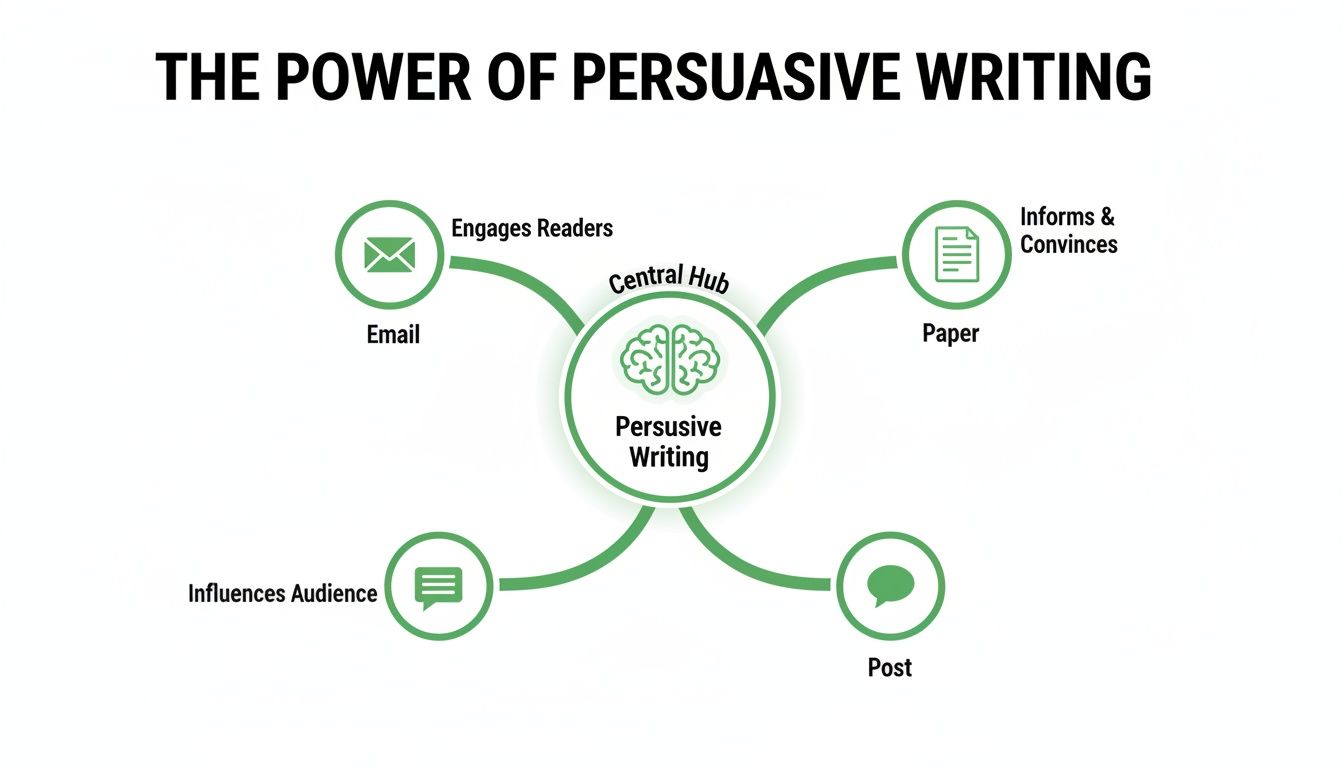
Whether you’re writing an email, a report, or a social media post, your goal is to connect with your reader and influence them. Let’s break down exactly how each of these pillars helps you do just that.
Ethos: The Appeal to Authority
Ethos is all about credibility. It's the silent reason your reader decides to listen, answering their unspoken question: "Why should I trust you?" You build ethos by showing you know your stuff, proving you're a person of good character, and making it clear you have your audience's best interests at heart.
Imagine you're researching a new investment strategy. You find two articles. One is by a certified financial planner with 20 years of experience; the other is from an anonymous blog. Who will you trust? The expert, of course. Their ethos is rock-solid.
Here’s how you can build ethos in your own writing:
- Cite credible sources: Show your reader you've done the homework.
- Mention your qualifications: Let them know why you're qualified to speak on the topic.
- Write with a confident tone: It shows you're knowledgeable in your subject area.
Building ethos is like a digital handshake. It’s your first chance to signal to the reader that they’re in good hands.
This is where many AI writing tools stumble; they can string words together but can't manufacture genuine authority. That's why we always recommend using AI as a starting point, not the final drafter. You must ethically layer your own human expertise on top to build that crucial trust. A tool like Pure Write can help refine an AI draft's tone from generic to confident, giving your credibility an instant boost.
Pathos: The Appeal to Emotion
If ethos is the head, pathos is the heart. This is your emotional bridge to the reader. While facts are essential, research consistently shows that our feelings are what truly drive our decisions. Pathos makes your audience feel why your message matters.
Think about those heart-wrenching commercials for animal shelters. They could list statistics about abandoned pets, but that rarely moves people to act. Instead, they tell the story of one lonely dog finding a home. That emotional hook inspires you to donate.
You can weave pathos into your writing by:
- Telling stories: Anecdotes make abstract ideas feel real and relatable.
- Using vivid language: Help your reader see, hear, and feel what you’re describing.
- Asking thoughtful questions: Prompt your audience to reflect on their own experiences.
One of the biggest giveaways of AI-generated text is its emotional flatness. It often sounds cold because it can't replicate human empathy. If your writing feels robotic, running it through a humanizer can inject the warmth and authenticity needed to make a real connection.
Logos: The Appeal to Logic
Finally, we have logos—the logical skeleton that holds your argument together. It’s your appeal to reason, built on a foundation of facts, evidence, and clear thinking. If ethos says "trust me" and pathos says "feel this," logos says "here’s the proof."
You strengthen logos by presenting a well-structured argument and backing up every claim with hard evidence. For instance, a marketing team pitching a new campaign wouldn't just say, "We have a good feeling about this." They'd arrive with market research, survey data showing a 30% increase in consumer interest, and case studies from successful campaigns. That’s logos in action.
Ethos, Pathos, and Logos At a Glance
To tie it all together, here’s a quick reference guide for keeping these three appeals straight and knowing when to use them.
| Appeal | What It Is | How to Use It in Writing | Example Snippet |
|---|---|---|---|
| Ethos | The appeal to credibility and trust. | Cite experts, share your credentials, use a professional tone, and show you understand the audience's needs. | "As a certified project manager with over a decade of experience in the tech industry..." |
| Pathos | The appeal to emotion. | Tell compelling stories, use vivid and sensory language, and share anecdotes that create an emotional connection. | "Imagine the relief of finally closing the last browser tab after a long day, knowing your work is truly done." |
| Logos | The appeal to logic and reason. | Present facts, use statistics and data, reference studies, and build a clear, well-structured argument. | "Our internal data shows that teams using this software complete projects 25% faster on average." |
The best persuasive writing doesn't lean too heavily on one appeal. An argument based only on emotion can feel manipulative, while one that's pure logic can come off as dry. The magic happens when you weave ethos, pathos, and logos together, creating a message that's not just convincing, but truly resonant.
Building Unshakable Trust with Ethos
In a world drowning in information, trust is everything. Before anyone listens to what you have to say, they first have to believe in you. This is the heart of ethos, one of the most foundational persuasive techniques in writing. It’s all about building your credibility so your audience feels they’re in good hands.
Think of ethos as the answer to your reader's unspoken question: "Why should I listen to you?" It’s your digital handshake. Without that initial trust, even the most brilliant arguments can miss the mark.
How to Establish Your Authority
Building ethos doesn't mean you need a Ph.D. or a corner office. It's about strategically showing your audience that you're a knowledgeable and trustworthy guide. If you’re familiar with Google's E-E-A-T (Experience, Expertise, Authoritativeness, and Trustworthiness) principles, it’s the same idea—you have to prove you're a reliable source.
One of the quickest ways to do this is by weaving in your own relevant experiences or citing trusted sources. This simple step can turn a generic statement into a solid piece of advice.
For example, take this typical AI-generated sentence:
"It is important for businesses to adopt new technologies to stay competitive."
It's true, but it's bland and has zero authority. Now, let's inject some real-world ethos to make it authentic.
Here’s the humanized, trustworthy version:
"Drawing from my 15 years as a marketing strategist, I’ve seen that companies failing to adopt CRM technology are consistently outpaced by their competitors within just two years."
See the difference? The second version is instantly persuasive because it grounds the claim in specific experience. It builds immediate trust.
A Masterclass in Ethos from History
History is filled with fantastic examples of ethos in action. Queen Elizabeth I's 'Speech to the Troops at Tilbury' in 1588 is a perfect case study. As a queen in a deeply patriarchal world, she had to build military credibility from scratch against the terrifying Spanish Armada.
She did it brilliantly. By declaring, "I have the heart and stomach of a king," she promised to stand with her soldiers. She turned her perceived weaknesses into strengths, inspiring just 4,000 troops against a massive force of 30,000 invaders. It's a powerful lesson you can read more about on Moxie Institute.
Practical Ways to Build Ethos in Your Writing
You don't need to be a queen facing an armada to use these principles. Here are three simple, actionable strategies to start building unshakable trust with your audience right now:
- Share a Relevant Personal Story: Ground your advice in the real world. Writing about project management? Share a quick anecdote about a project you led through a tough spot.
- Cite Credible Sources and Data: Don't just make claims—back them up. Linking to respected industry reports, studies, or expert opinions shows you’ve done your homework.
- Maintain a Consistent and Confident Tone: The way you write says a lot about you. A clear, steady voice signals that you're comfortable with your subject. To nail this, check out our guide on how to develop your unique tone and voice in writing.
Ethos is earned, not claimed. It’s the cumulative effect of demonstrating your knowledge, showing your character, and respecting your audience’s intelligence.
While AI tools can churn out factually correct content, they almost always fail at creating genuine ethos. They can't share personal stories or project authentic confidence. This is where you, the human writer, are irreplaceable. At PureWrite, we built our platform to help you bridge that gap. You can ethically start with an AI draft and use our tools to add your unique insights. Try PureWrite to transform your AI content into writing that people actually trust.
Tapping into Emotion: How Pathos Connects and Persuades
While credibility (ethos) lays the groundwork, facts alone rarely move people to act. This is where pathos comes in. It’s all about creating an authentic emotional connection, turning a message from something your audience understands into something they feel.
Logic informs, but emotion is what truly drives our decisions. By tapping into your reader's hopes, fears, or dreams, your words become personal and memorable. You're not just presenting data; you're inviting them into an experience.

A Perfect Example of Pathos in Action
Few speeches in history demonstrate the power of emotion like Martin Luther King Jr.'s "I Have a Dream." It wasn't just what he said that made it unforgettable; it was how he said it.
King repeated the phrase "I have a dream..." eight times. This created a powerful, rhythmic pulse that transformed abstract ideas of freedom into a shared, deeply emotional vision. This technique is incredibly effective—research shows that people are 22 times more likely to remember information when it's wrapped in a story.
How to Use Pathos Without Being Manipulative
Using emotion isn't about pulling heartstrings for the sake of it. It’s about building a genuine bridge through shared human experience. Here’s how you can do it ethically.
- Tell a good story: Stories are a shortcut to the heart. Instead of saying, "Our software increases efficiency," tell the story of Sarah, a project manager who was drowning in deadlines until our tool helped her reclaim her evenings.
- Paint a picture with your words: Use vivid, sensory details that help your reader see, hear, and feel what you’re describing. This makes abstract concepts feel real.
- Ask thoughtful questions: Rhetorical questions invite your reader to reflect. "Remember that feeling of finally solving a problem you've been stuck on for weeks?" creates an instant, personal connection.
Figurative language is another fantastic tool for creating an emotional spark. To dig deeper, take a look at our guide covering the different types of figurative language and how they work.
"People will forget what you said, people will forget what you did, but people will never forget how you made them feel." - Maya Angelou
That quote perfectly captures the essence of pathos. A research paper is more compelling with a moving anecdote, and a sales page is more effective when it speaks to a customer's real-world frustrations.
This is often where AI-generated text falls flat—it can’t replicate genuine human emotion. We built PureWrite’s Humanize mode to fix exactly that. It helps you weave in the subtle language that turns a sterile AI draft into a piece of writing that truly connects. If your words feel lifeless, give PureWrite a try and see how it helps you build a real bond with your readers.
Strengthening Your Argument with Logos
You’ve built credibility with ethos and tapped into your audience's feelings with pathos. Now it's time to deliver the knockout punch with logos—the appeal to cold, hard reason. This is the logical backbone of your message.
Without logos, even the most passionate claims can feel like hot air. It’s the proof that tells your audience, "This isn't just my opinion; this is a well-supported reality."
Building Your Case with Evidence
Weaving logic into your writing doesn't mean you have to sound like a textbook. The art is presenting evidence in a way that’s not just convincing but also easy to digest. It’s about arming your argument with indisputable proof.
Here are the key tools in your logical toolkit:
- Verifiable Facts: These are the objective, provable truths.
- Relevant Statistics: Numbers speak volumes. Backing up a claim with a 25% increase in conversions is highly persuasive.
- Expert Testimony: Leaning on recognized authorities adds instant weight.
A powerful historical example comes from William Wilberforce's 1789 speech to abolish the slave trade. He didn't just make a moral appeal; he presented horrifying data, noting that of the 12 million Africans forced onto ships, a staggering 1.8 million died during the Middle Passage. By pairing brutal statistics with human stories, his logical argument became undeniable. You can dive deeper into how he blended facts with story at Lessonbucket.
Structuring a Logical Argument
A strong argument isn't a random pile of facts. It's a carefully constructed path that leads your reader directly to your conclusion. Tossing a jumble of data at someone is just as confusing as having no data at all.
Think of yourself as a lawyer building a case, presenting each piece of evidence in a deliberate order. Smooth transitions are everything here. If you need inspiration, check out our comprehensive list of transitional words and phrases to help guide your reader.
A logical argument is a journey you take your reader on. Each piece of evidence is a stepping stone, and if they are placed correctly, the reader will arrive at your conclusion without stumbling.
Let's say you're writing a proposal for a new marketing tool. A solid logical structure would look like this:
- Claim: Our team needs this new software to work more efficiently.
- Evidence: Our internal data shows each employee spends 10 hours a week on this process. Case studies for the new tool show it cuts that time by 40%.
- Warrant (The Connection): That time saved means our team can focus on high-value strategic projects.
- Conclusion: Therefore, investing in this tool is a direct investment in our team's productivity and overall impact.
This simple flow makes your argument difficult to refute. AI can be great at pulling facts but often fumbles when weaving them into a convincing narrative.
That's where your human element is critical. We built PureWrite to help you nail that logical flow. You can start with an AI draft, then use our tools to arrange the evidence, sharpen your claims, and make sure your reasoning is crystal clear. Try PureWrite today and see how it feels to build an argument that’s not just sound, but truly unshakeable.
Advanced Persuasive Writing Techniques
Once you’ve got a solid handle on ethos, pathos, and logos, it’s time to level up. Think of those as the foundation. Now we’re going to build the rest of the house with more advanced tools that take your writing from good to truly persuasive.
We're moving beyond what you say and digging into how you say it. These subtle strategies grab a reader's attention, make your arguments stick, and give your writing a natural, compelling rhythm.

Making Your Message Memorable
Ever wonder why some phrases just stick in your head? It’s often because they use patterns our brains are wired to find satisfying. Sprinkling these into your writing is a surefire way to make your message more memorable.
Here are a few of the most effective ones:
- The Rule of Three: There’s a reason we have phrases like "life, liberty, and the pursuit of happiness." Presenting ideas in threes feels complete and memorable. Studies show that grouping points in threes can boost content recall by up to 20%.
- Analogies and Metaphors: These are your secret weapons for making complex ideas simple. Comparing logos to a "logical backbone" instantly makes the concept clearer.
- Parallelism: This just means using the same grammatical structure for related ideas. It creates a smooth rhythm that makes your writing feel polished.
Persuasive writing isn't just about dropping facts on a page. It's about framing those facts in a way that the human mind can easily process, remember, and ultimately, accept.
Let's look at a quick example. A clunky, AI-generated sentence might sound like this: "Our new software assists with project management, budget tracking is another feature, and it also improves team communication."
See how disjointed that is? By applying the rule of three and parallelism, you can make it punchy and clear: "Our new software helps you manage projects, track budgets, and streamline communication." Much better, right?
Strategic Stylistic Choices
Beyond specific literary devices, your overall writing style is a massive part of persuasion. Small tweaks can completely change how your audience feels. If you want to dive deeper into how this works in practice, exploring a comprehensive copywriting framework can give you a structured approach.
One of the most powerful stylistic choices you can make is to favor the active voice. It’s direct, confident, and clear—all things that naturally build your credibility (ethos).
Just feel the difference:
- Passive (Weak): "Mistakes were made in the budget planning."
- Active (Strong): "Our team made mistakes in the budget planning."
The active voice takes responsibility and sounds far more authoritative. AI writing tools often lean on a passive or overly formal tone, but you know how to choose the right voice for the right situation. You can find more tips on this in our other posts about persuasive writing techniques.
This is exactly where we built PureWrite to shine. Our platform is designed to catch those sneaky bits of weak phrasing and passive voice. With our Humanize mode, you can instantly transform a flat, robotic draft into something that sounds clear, confident, and genuinely human.
Got Questions? We've Got Answers
Even after you get the hang of persuasive writing, a few questions always seem to pop up. Let's tackle some of the most common ones so you can use these techniques with confidence and integrity, whether you're a student, marketer, or professional.
Is Persuasive Writing Just a Nicer Word for Manipulation?
This is a really important question, and it all comes down to intent.
Think of it this way: ethical persuasion is about building a bridge. You're using solid facts, genuine emotion, and your credibility to guide your audience to a conclusion that helps them. Manipulation, on the other hand, is about setting a trap that relies on half-truths or emotional exploitation.
Authentic persuasion aims to create understanding and connection, not to force someone's hand. At PureWrite, we're big believers in using these powerful tools responsibly and ethically to forge real relationships.
So, Which Appeal Is the Best: Ethos, Pathos, or Logos?
That’s like asking which leg of a three-legged stool is the most important. The truth is, they're designed to work together.
An argument running on pure emotion (pathos) might get attention, but it can crumble under scrutiny. One built only on cold, hard logic (logos) might be correct, but it won’t inspire anyone. And if your audience doesn't trust you (ethos), they won't even bother listening in the first place.
The real magic happens when you weave all three together. You build trust, make a rock-solid case, and connect with your reader on a human level.
A balanced approach is what makes your message not just sound, but truly resonant.
How Can I Be Persuasive Without Coming Off as Pushy?
The secret here is to shift your focus from your goal to their problem. Instead of barking orders, you want to show them how your idea naturally solves a pain point they're already experiencing.
Here are a few practical ways to strike that balance:
- Use collaborative words like "we" and "us" to foster a sense of teamwork.
- Acknowledge the other side. Addressing counterarguments shows you're thoughtful, not just dogmatic.
- Offer invitations, not demands. Frame your points as opportunities or helpful suggestions.
AI-generated text can often feel robotic and overly direct, which can easily be misread as aggressive. An AI humanizer can sand down those rough edges, making your tone confident but still approachable. It’s worth noting that 73% of consumers say they prefer content that feels like a real conversation, so that final polish is more important than ever.
Ready to turn your AI drafts into content that truly connects and persuades? PureWrite helps you dial in your tone, sharpen your arguments, and build a genuine bond with your audience. Try PureWrite for free and feel the difference.