8 Essential Structure Essay Examples to Master Your Writing
Whether you're a student facing a tough deadline, a content creator building an audience, or a professional crafting a persuasive report, the right structure is your secret weapon. Without a solid framework, even the most brilliant ideas can get lost in a confusing narrative. With a clear plan, your writing becomes coherent, compelling, and authoritative, guiding your reader from one point to the next with ease.
At PureWrite, we believe that great writing starts with a great plan. This guide is your blueprint, walking you through eight foundational structure essay examples that can transform your process. Unlike storytelling, which often relies on a flexible story structure template, academic and professional writing demands more rigid and logical frameworks. Each example here includes a strategic breakdown, practical tips, and real-world applications to help you build your writing toolkit.
We'll also explore how to use AI tools ethically to draft your initial ideas faster without sacrificing quality. AI can be a powerful assistant, but studies show that over 60% of educators are concerned about its impact on critical thinking. We'll show you how to take a robotic AI draft and, with a tool like PureWrite, humanize it into something that truly connects with your reader. Forget the blank page anxiety; let's start building essays that make an impact.
1. The Five-Paragraph Essay Structure
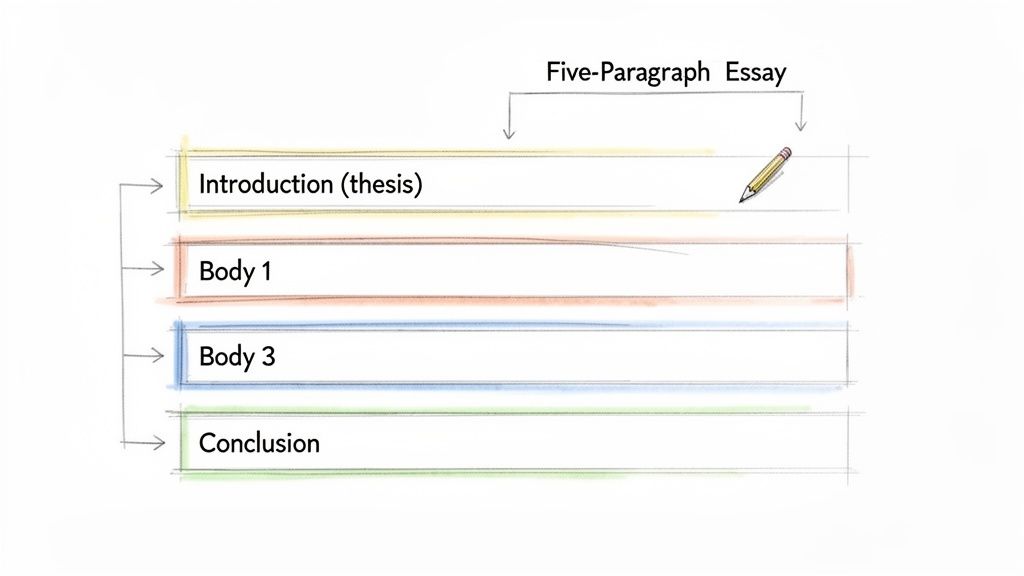
The five-paragraph essay is a classic for a reason. It's the foundational framework many of us learned in school, providing a clear, logical path for presenting an argument. This structure includes an introduction with a thesis, three distinct body paragraphs (each developing a single point), and a conclusion that summarizes the argument.
This format excels at organizing thoughts and ensuring every part of your argument is supported. For a student, this is the go-to for timed writing assignments, such as SAT or ACT essays. For a content creator, it serves as an excellent starting point for a simple, clear blog post. The rigidity of this structure ensures your main points are clear, supported, and easy for the reader to follow.
Strategic Breakdown
- Introduction: Begin with a hook to grab the reader's attention, provide brief background context, and end with a clear, one-sentence thesis statement that outlines your main argument.
- Body Paragraphs (x3): Each paragraph should start with a topic sentence that introduces one of your thesis's supporting points. Follow this with 2-4 sentences of evidence, examples, or analysis to prove that point.
- Conclusion: Restate your thesis in new words, briefly summarize your three main points, and end with a final thought or broader implication.
Actionable Tips for Implementation
One common pitfall of the five-paragraph essay is its tendency to sound robotic or formulaic. To avoid this, focus on creating smooth connections between your paragraphs. Using varied and effective transition words is crucial for maintaining flow and showing the relationship between your ideas. For an in-depth guide, explore our list of essay transition words.
When using AI to draft an essay with this structure, the output can be generic. We encourage you to use AI ethically as a starting point, not a final product. Use PureWrite to humanize the text, injecting a more natural voice and ensuring your writing is both structured and engaging.
2. The Problem-Solution Essay Structure
The problem-solution essay is a highly persuasive framework designed to address a specific issue and advocate for a course of action. This structure first identifies and details a significant problem, exploring its causes and impacts, before proposing a clear, well-supported solution.
This format is exceptionally effective in persuasive and proposal-based writing. A marketer might use it to create a case study showing how their product solved a customer's pain point. A professional might write a proposal to management outlining an inefficiency and suggesting a new workflow. It's one of the most practical structure essay examples for real-world applications.
Strategic Breakdown
- Introduction: Hook the reader by introducing a pressing problem. Provide essential context on its significance and conclude with a thesis statement that briefly outlines both the problem and the proposed solution.
- Problem Section: Dedicate one or more paragraphs to fully exploring the problem. Detail its causes, who is affected, and the negative consequences if it remains unsolved. Use data and specific examples to establish its severity.
- Solution Section: Present your proposed solution clearly and concisely. Explain step-by-step how it works and directly addresses the causes of the problem identified earlier. Provide evidence, such as case studies or expert opinions, to prove its effectiveness.
- Conclusion: Summarize the problem-solution relationship, restating why your proposed solution is the best course of action. End with a strong concluding thought or a call to action that encourages the reader to adopt your recommendation.
Actionable Tips for Implementation
The biggest challenge in a problem-solution essay is ensuring your proposed solution appears credible and achievable, not idealistic. Use concrete evidence, data, and logical reasoning to support your claims. Vague assertions will undermine your entire argument.
When using an AI writer, the tone can sometimes feel cold or overly academic. We recommend using PureWrite to adjust the problem statement, ensuring it sounds empathetic and relatable. This helps you build trust with your audience and present your solution in a confident, professional, and authentic voice.
3. The Compare-and-Contrast Essay Structure
The compare-and-contrast structure is a powerful tool for systematically examining the similarities and differences between two or more subjects. This analytical framework helps readers make informed decisions by placing key information side-by-side, making it a staple for everything from academic papers to product reviews.
This structure is highly effective for content where a direct evaluation is needed. For example, a content marketer could write a "vs." article comparing two competing software tools. A student might analyze two different literary theories. This format provides clarity and depth, guiding the reader through a logical evaluation for a balanced, comprehensive analysis.
Strategic Breakdown
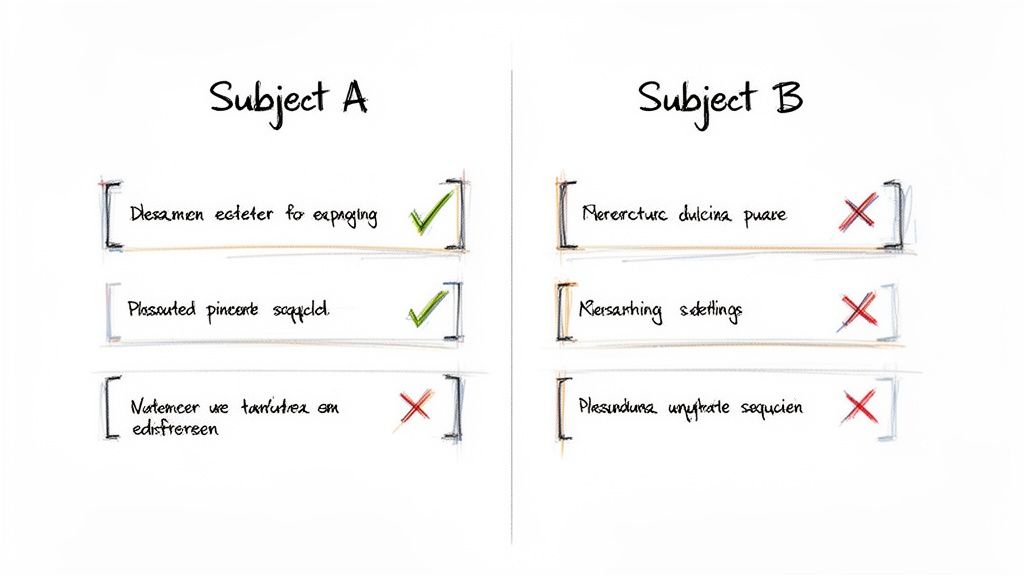
- Block Method: Dedicate separate sections to each subject, discussing all relevant points for one before moving to the next. For example, discuss all features of Product A, then all features of Product B, followed by an analysis.
- Point-by-Point Method: Organize your essay by the criteria of comparison. Each paragraph focuses on a single point (like price or performance) and discusses both subjects within that paragraph.
- Thesis Statement: Your introduction should clearly state which subjects you are comparing and what your overall conclusion is about their relationship (e.g., one is superior, they have surprising similarities, etc.).
Actionable Tips for Implementation
A common issue with compare-and-contrast essays, especially those drafted with AI, is the repetitive use of phrases like "on the one hand" and "in contrast." This can make your writing feel clunky. The key is to vary your transitional language to create a more natural flow between points.
When you use an AI writer, the output can often feel robotic. An authentic piece requires your unique perspective. Try PureWrite to refine these transitions and adjust the tone, ensuring your comparison feels fair, well-rounded, and genuinely helpful.
4. The Chronological Essay Structure
The chronological essay structure organizes information according to time, presenting events sequentially as they occurred. This linear approach is perfect for telling a story, explaining a historical event, or detailing a step-by-step process. By following a natural timeline, it guides the reader from a clear beginning to a logical end, making complex information easy to digest.
This format is essential for narrative essays, historical analyses, and case studies where understanding the progression of events is key. For marketers, telling a brand's origin story using this structure builds a strong connection. For a technical writer creating a how-to guide, this structure is invaluable for clarity and user success.
Strategic Breakdown
- Introduction: Set the scene by introducing the topic, establishing the time period or starting point, and providing a thesis that previews the sequence of events or the outcome of the process.
- Body Paragraphs: Dedicate each paragraph (or group of paragraphs) to a specific time period or step in the sequence. Start with a topic sentence that anchors the reader in time, then detail the key events or actions that occurred during that phase.
- Conclusion: Summarize the entire sequence of events, reinforcing the main takeaways or the final outcome. Conclude by reflecting on the significance of the progression or its broader implications.
Actionable Tips for Implementation
A major challenge with chronological essays is making them feel like more than just a list of events. Repetitive transitions like "then," "next," and "after that" can make the writing feel monotonous. To combat this, use a variety of transitional phrases that show the passage of time in a more sophisticated way.
When you use AI to generate a timeline, the output can be robotic. We recommend using PureWrite to vary sentence structures and enhance the narrative voice. This ensures your reader stays engaged from start to finish, following your story with genuine interest.
5. The Cause-and-Effect Essay Structure
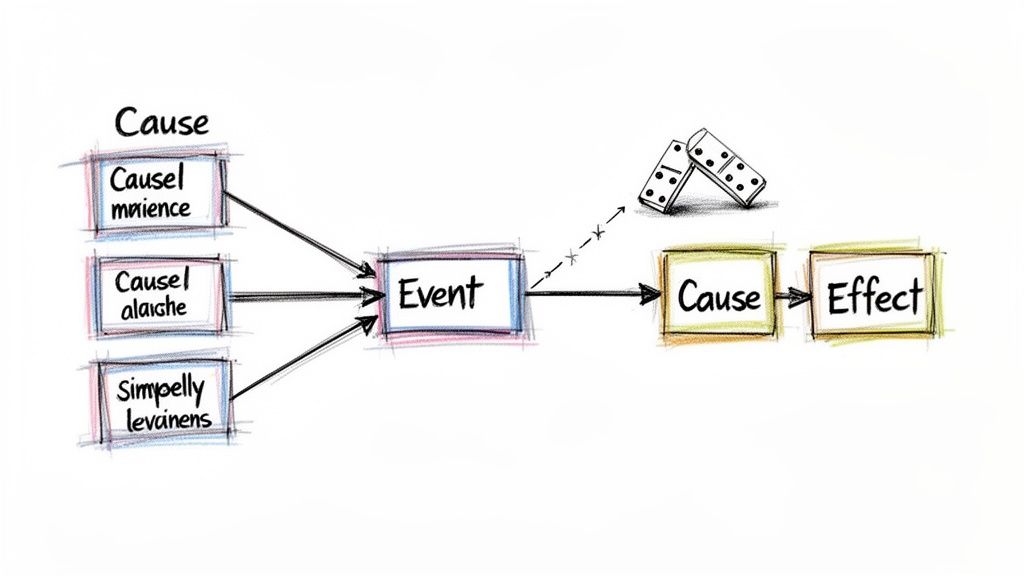
The cause-and-effect structure explores the reasons why something happens (the causes) and the results that follow (the effects). This powerful framework is essential for analytical writing where understanding relationships between events is key. You can structure your essay to examine multiple causes leading to a single effect, one cause creating multiple effects, or a complex chain reaction.
This format is a cornerstone of academic, business, and scientific writing. For example, a business analyst might use it in a report detailing how a new marketing campaign (cause) led to a 20% increase in sales (effect). It provides a logical, evidence-based way to explain complex phenomena, making it one of the most valuable structure essay examples for demonstrating critical thinking.
Strategic Breakdown
- Introduction: Hook the reader by introducing the central event or phenomenon. Provide necessary background context and conclude with a thesis statement that clearly outlines the causal relationship you intend to explore.
- Body Paragraphs (Cause-Focused): Dedicate each paragraph to a specific cause. Start with a topic sentence identifying the cause, then provide evidence, data, or logical reasoning to demonstrate how it contributed to the central event.
- Body Paragraphs (Effect-Focused): Similarly, each paragraph can explore a different effect. Introduce the effect in the topic sentence and then detail its impact, providing specific examples or analysis to illustrate the consequences.
- Conclusion: Summarize the main cause-and-effect relationships you have discussed. Restate your thesis in a new way and offer a final thought on the broader implications or future outlook of these connections.
Actionable Tips for Implementation
The biggest challenge in a cause-and-effect essay is proving a direct causal link rather than just a correlation. Avoid definitive and overstated language like "this proves." Instead, use more nuanced and authoritative phrases such as "a significant contributing factor" or "this likely led to."
When using AI to analyze complex relationships, the output can become dense with technical jargon. We encourage you to use PureWrite to simplify these causal explanations into clear, natural language. This helps ensure your complex analysis remains accessible and engaging for your audience.
6. The Definition Essay Structure
The definition essay structure provides a comprehensive explanation of a term, concept, or idea that goes far beyond a simple dictionary entry. It methodically explores a concept's multiple dimensions—including its origins, various interpretations, and real-world examples—to give the reader a deep and nuanced understanding.
This format is invaluable for clarifying complex or contested topics. A content creator might use this for an SEO-driven article targeting a "what is" search query, like "What is machine learning?" By dedicating an entire piece to defining a single term, you establish authority and provide significant value to readers seeking clarity.
Strategic Breakdown
- Introduction: Start by introducing the term in a general sense. You can use a standard definition as a jumping-off point before presenting your thesis, which should state the more complex or personal definition you intend to explore.
- Body Paragraphs: Dedicate each paragraph to a different method of definition. You might explore the term's origin (etymology), its function (what it does), its structure (what it's made of), or analyze it by comparing and contrasting it with other concepts.
- Conclusion: Your conclusion should bring all the different facets of your definition together. Summarize the key definitional points and offer a final, synthesized understanding of the term. You can learn more about how to effectively synthesize your main points by reading our guide on writing conclusion paragraphs.
Actionable Tips for Implementation
The biggest challenge with definition essays is keeping them engaging while explaining abstract information. The goal is to avoid sounding like a dry textbook. Use concrete examples and analogies to make the concept relatable to your audience's experience.
When using AI to draft a definition, the output can be dense with jargon. Remember, ethical AI use means adding your own expertise. Use PureWrite to translate technical language into clear, accessible explanations without losing nuance, ensuring your definition is perfectly tailored for your audience.
7. The Argument/Persuasion Essay Structure
The argument/persuasion essay structure is designed to do one thing: convince the reader. It moves beyond simple explanation to advocate for a specific viewpoint on a debatable topic, using a strategic blend of evidence, logical reasoning, and rhetorical appeals to win the audience over.
This framework is the backbone of opinion editorials, marketing copy, and any writing that aims to change minds or drive action. For a marketer, this could be a landing page convincing a visitor to sign up. Its power lies in its directness and its structured approach to dismantling opposition. By presenting a strong thesis and backing it with solid evidence, you create a compelling case.
Strategic Breakdown
- Introduction: Start with a compelling hook related to the debate. Provide necessary background on the issue and present a clear, assertive thesis statement that declares your position.
- Body Paragraphs (x3-5): Dedicate each paragraph to a distinct argument supporting your thesis. Begin with a topic sentence, then provide evidence like statistics, expert quotes, or logical reasoning.
- Counterargument & Refutation (x1): Dedicate a paragraph to acknowledging a valid opposing viewpoint. Then, systematically refute it with evidence or logic, demonstrating why your position remains stronger.
- Conclusion: Reiterate your thesis in a new, powerful way. Summarize your main arguments and end with a strong call to action or a final persuasive thought that leaves a lasting impression.
Actionable Tips for Implementation
The biggest risk in persuasive writing is sounding biased or overly aggressive, which can alienate your reader. The key is to build credibility by acknowledging and fairly refuting counterarguments. For a comprehensive look at building a balanced yet forceful argument, learn how to write a persuasive essay.
When you use an AI to help draft your arguments, it can sometimes produce a robotic or overly formal tone. Use PureWrite to inject an authentic, compelling voice into your claims. This ensures you sound credible and confident, not demanding or unreasonable, which is critical for effective persuasion.
8. The Analytical Essay Structure
The analytical essay structure moves beyond simple description to examine a subject in depth. It requires you to break a topic into its essential components, analyze how each part contributes to the whole, and synthesize your findings to draw a well-reasoned conclusion. This framework is essential for literary analysis, research papers, and any content that demands critical evaluation.
This structure excels at demonstrating original interpretation and deep thinking. For instance, a professional might use it to analyze a competitor's strategy, breaking down their marketing, sales, and product development to understand their success. Instead of just persuading, your goal is to illuminate the subject for the reader by uncovering its underlying meaning or mechanisms.
Strategic Breakdown
- Introduction: Start with a hook that introduces the subject (e.g., a text, theory, or film). Provide necessary context and present a nuanced, interpretive thesis statement that states your central argument or claim about the subject.
- Body Paragraphs: Dedicate each paragraph to a specific component of your analysis. Begin with a topic sentence that presents an analytical point supporting your thesis. Follow with specific evidence from the subject (quotes, data, examples) and provide 2-3 sentences of analysis explaining how that evidence supports your point.
- Conclusion: Reframe your thesis based on the analysis presented. Summarize the key analytical points you made and conclude with a broader insight or the significance of your findings.
Actionable Tips for Implementation
The biggest challenge in an analytical essay is ensuring your claims are authoritative and well-supported, not just opinion. Your analysis must clearly connect your evidence back to your central thesis in every paragraph. This requires a logical progression of ideas to build a convincing interpretation.
When using AI to generate initial analysis, it can often produce dense and overly academic prose. Use PureWrite to refine the text, giving it a more natural and authoritative voice. This makes your sophisticated arguments clear and accessible to your audience, demonstrating true expertise.
8 Essay Structures Compared
| Structure | 🔄 Implementation complexity | ⚡ Resource / speed | ⭐ Expected effectiveness | 📊 Expected outcomes | 💡 Ideal use cases / tips |
|---|---|---|---|---|---|
| The Five-Paragraph Essay Structure | Low — formulaic and templated | High speed; low research needs | ⭐⭐⭐ — clear but limited depth | Organized, exam-ready arguments; limited nuance | Classroom essays, timed tests; humanize to avoid robotic tone |
| The Problem-Solution Essay Structure | Medium — requires problem analysis and solution design | Moderate to high research; medium drafting time | ⭐⭐⭐⭐ — persuasive when solutions are credible | Action-oriented proposals and calls to action; depends on evidence quality | Business proposals, policy briefs, marketing; ensure realistic solutions |
| The Compare-and-Contrast Essay Structure | Medium — needs balanced organization (block or point-by-point) | Moderate research on multiple subjects | ⭐⭐⭐⭐ — strong for evaluation and decision support | Nuanced comparisons for informed choices and reviews | Product reviews, academic comparisons; keep balance and transitions |
| The Chronological Essay Structure | Low to medium — straightforward sequencing | Low research for narrative; fast to outline | ⭐⭐⭐ — intuitive for stories and processes | Clear timelines/tutorials; may sacrifice thematic depth | Tutorials, histories, case studies; vary sentence structure to avoid monotony |
| The Cause-and-Effect Essay Structure | Medium to high — must establish logical links, avoid false causality | High research and evidence requirements | ⭐⭐⭐⭐ — powerful for explaining relationships if supported | Insightful analyses of impacts and consequences; risk of oversimplification | Research papers, impact reports, strategic analyses; verify causation carefully |
| The Definition Essay Structure | Medium — requires depth, etymology, and examples | Medium research; expert knowledge often needed | ⭐⭐⭐ — clarifies concepts and builds authority | Clear explanations and improved SEO for definitional queries | Explainers, glossaries, concept-heavy blogs; simplify jargon for audiences |
| The Argument/Persuasion Essay Structure | High — evidence, counterarguments, and tone management needed | High research and rhetorical planning | ⭐⭐⭐⭐ — highly persuasive when well-supported | Influences opinions and drives action; risk of bias if weak | Opinion pieces, marketing copy, advocacy; address counterarguments fairly |
| The Analytical Essay Structure | High — deep breakdown, synthesis, and critical reasoning | High research and close reading | ⭐⭐⭐⭐ — strong for scholarly insight and authority | Original interpretations and rigorous conclusions; can be dense | Literary criticism, research papers, market analysis; prioritize clear synthesis |
Structure Is Your Strategy for Authentic, High-Impact Writing
We've explored a range of powerful frameworks, from the foundational Five-Paragraph model to the nuanced Analytical essay. Each of these structure essay examples demonstrates a core principle: organization is not a constraint on creativity but a catalyst for clarity. These structures are your strategic blueprints for guiding a reader from a compelling introduction to a satisfying conclusion.
Think of them as proven pathways for your ideas. Whether you are building a persuasive argument, comparing complex subjects, or explaining a cause-and-effect relationship, the right structure ensures your message lands with precision and impact. It transforms a collection of thoughts into a cohesive, logical, and persuasive narrative.
From Blueprint to Authentic Voice
Mastering these structures provides a significant strategic advantage, especially in an era where AI writing tools are increasingly common. An AI can generate text that follows a template, but it often lacks the nuanced transitions, authentic voice, and strategic depth that connect with a human reader. Your ability to select the right framework and then infuse it with your unique perspective is what elevates your writing from competent to compelling.
This principle of strategic organization extends far beyond academic essays. For professionals in business, understanding how to develop an effective pitch deck structure) follows the same logic of leading an audience through a clear, persuasive journey. The underlying skill is universal: structuring information to achieve a specific goal.
Your Actionable Next Steps
To truly internalize these concepts, you must move from theory to practice. Here are your next steps to turn these examples into applied skills:
- Reverse-Engineer: Take a piece of writing you admire—an article, a report, or a paper. Try to identify its underlying structure. Was it a Problem-Solution? A Compare-and-Contrast? This practice sharpens your analytical eye.
- Mix and Match: Don't be afraid to combine elements. You might use a chronological structure within a single paragraph of a larger Cause-and-Effect essay. Experimentation is key to developing a flexible and adaptive writing style.
- Outline Everything: Before you write your next piece, dedicate five minutes to creating a simple outline based on one of the structures we've discussed. This small investment pays huge dividends in clarity and focus, saving you from extensive revisions later.
Ultimately, these structure essay examples are tools in your writer's toolkit. They provide the foundation, but you provide the insight, the empathy, and the authentic voice that makes writing truly impactful. Use them not as rigid formulas but as starting points for creating clear, engaging, and genuinely human communication.
Ready to ensure your structured essays sound authentically human? PureWrite helps you refine AI-generated drafts, checking for robotic phrasing and improving flow to match your natural voice. Transform your AI content into polished, engaging writing that connects with your readers by trying PureWrite today.