How to Write a 600 Words Essay That Actually Scores
You've opened a document, typed a title, and somehow reached only 50 words. The cursor keeps blinking while the 600-word limit starts to feel less like guidance and more like a trap. The usual response is to add background, repeat the point, and hope the word counter eventually turns reassuringly green.
That approach rarely works. A 600-word essay is an argument-design exercise: every paragraph needs a job, every source needs interpretation, and every sentence must earn its space. The strongest short essays don't try to sound expansive. They make one defensible claim, support it selectively, and stop before repetition weakens the reasoning.
Why a 600-Word Essay Feels Harder Than It Looks
A short essay exposes structural problems quickly. In a longer assignment, an unclear introduction may be rescued by later explanation. In 600 words, a vague thesis consumes space that the body paragraphs need, while an oversized background section leaves too little room for evidence and analysis.
Markers also read short essays in dense batches. They're looking for a clear response to the prompt, relevant evidence, logical progression, and explanation of why that evidence matters. Decorative language doesn't compensate for a missing link between a source and your conclusion.
Practical rule: Cut background before you cut analysis.
The temptation to pad usually appears in three forms:
- A broad opening: General statements about society, history, or human nature delay the actual argument.
- Source summary: You describe what an article says without showing how it supports your thesis.
- A repeated conclusion: You restate the introduction instead of explaining what the argument establishes.
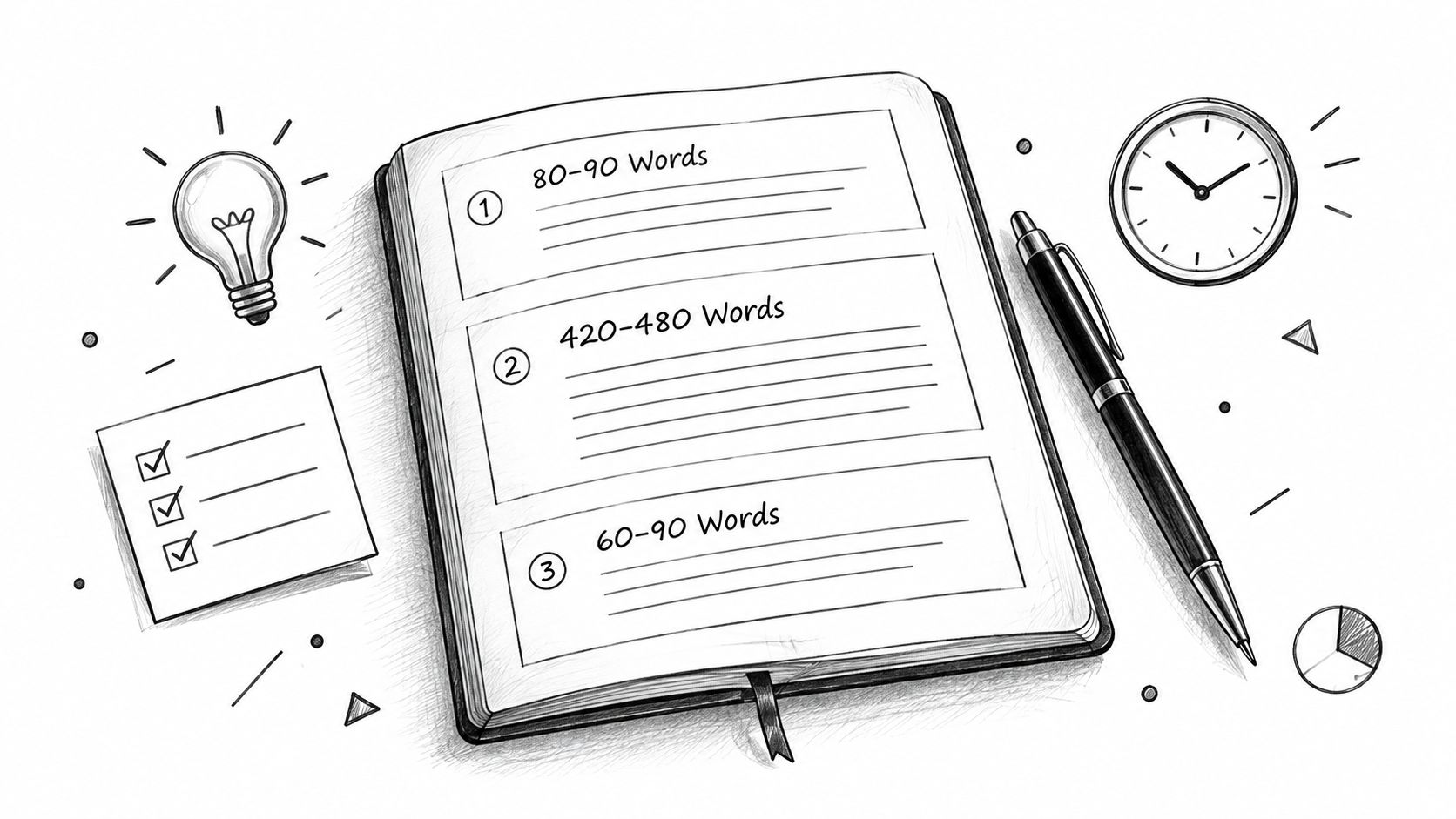
The word limit is better treated as a budget than a punishment. Before drafting, decide how much space the introduction, body paragraphs, and conclusion deserve. Then assign each paragraph one function, such as defining a problem, presenting evidence, addressing a qualification, or drawing an implication.
Research on automated and holistic essay scoring illustrates why raw length isn't enough. Under a 25-minute time limit, essay length explained approximately 40–60% of score variance, but that relationship fell to roughly 10% or less when writers had 72 hours. In one untimed first-year psychology task capped at 1,250 words, length explained only 1.7% of grade variation. These findings are reported in research on essay scoring and length, and they support a practical conclusion: when you have time to plan and revise, argument quality matters far more than filling space.
Start with a narrow answer to the question. If the prompt asks whether a policy is effective, don't attempt to explain the entire policy area. State the condition under which it works, the evidence that supports that judgment, and the limitation that keeps your claim credible.
The Word Budget That Fits a 600-Word Essay
A useful default budget gives the body most of the available space. Cambridge Assessment found that the median response from the highest-performing A* candidates was 694 words, compared with 450 words for grade E candidates. The relationship between length and marks flattened beyond roughly 700 words, while some concise responses below 500 words still achieved top marks, as explained in the Cambridge Assessment analysis of essay length and marks.
That doesn't mean you should target 694 words when the assignment asks for 600. It means that strong answers need enough room for reasoning, but extra sentences stop helping when they add no new evidence or interpretation.
Start with the assignment's actual counting rules
Institutions set their own requirements. A stated word count is commonly treated as a target with a tolerance of approximately 10% above or below, which makes a nominal 600-word assignment roughly 540–660 words when that tolerance is permitted. Check whether headings, quotations, citations, footnotes, and reference material count before you draft. The assignment brief overrides general online advice.
For a conventional analytical essay, use this starting point:
| Section | Word range | Purpose |
|---|---|---|
| Introduction | 60–90 | Context, focused thesis, route through the argument |
| Body paragraphs | 420–480 | Claims, evidence, interpretation, qualification |
| Conclusion | 60–90 | Answer the prompt, synthesize the reasoning, identify the implication |
The body can contain two substantial paragraphs or three tighter ones. An argumentative prompt may need a counterargument, while a reflective prompt may spend more words on personal interpretation. Don't force every assignment into a five-paragraph template.
Adapt the budget to the task
For an argumentative essay, reserve one body paragraph for the main reason, one for supporting evidence, and one for a limitation or opposing view. For an analytical essay, organize paragraphs around features of the text, method, or evidence rather than around sources. For a reflective essay, reduce scene-setting and spend words connecting experience to the question or learning outcome.
Use a word counter for your essay during drafting, not only at the end. If you need to present the argument aloud, a quick presentation timing guide can also help you estimate whether your written explanation is concise enough to communicate clearly.
A Workflow That Actually Finishes on Time
A reliable process isn't a straight line. Research can reveal that your thesis is too broad, and drafting can show that your second paragraph belongs before your first. Build in enough flexibility to reorder the argument instead of defending a weak outline.
Academic writing guidance separates higher-order revision, such as thesis, evidence, paragraph purpose, and coherence, from lower-order editing, such as word choice and punctuation. It recommends roughly 80–100 words for the introduction, 400–440 words for three body paragraphs, and 60–80 words for the conclusion in a 600-word essay, as outlined in academic guidance on planning and revising writing.
Use five deliberate passes
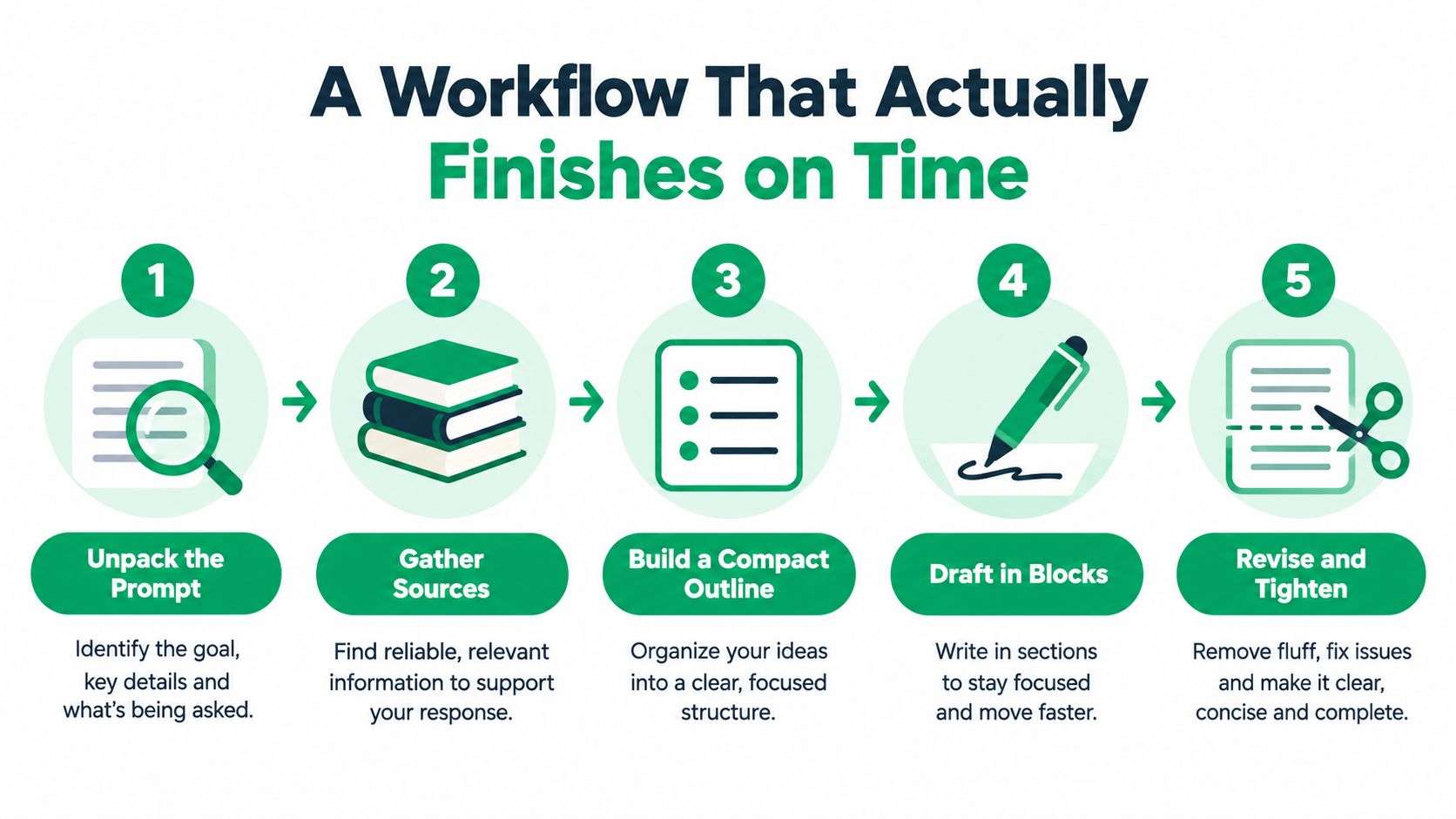
- Unpack the prompt. Identify the task verb, subject, required judgment, audience, evidence expectations, and formatting constraints. “Evaluate” requires a judgment, while “describe” may not.
- Gather only relevant sources. Select material that can support a sentence in your thesis or body plan. A large source pile creates reading debt.
- Build a compact outline. Write the thesis, then give each paragraph one claim and one purpose. Note the evidence you'll use and the interpretation it requires.
- Draft in blocks. Write the argument first, without stopping to perfect every sentence. Leave a marker where a citation or example needs checking.
- Revise and tighten. Test the logic before correcting grammar. Reorder paragraphs, replace weak evidence, and remove repetition before polishing style.
For a prompt such as “Should cities restrict private car use to reduce urban pollution?”, a compact outline might look like this:
- Introduction: Restrictions are defensible when paired with reliable public transport, because they reduce dependence without shifting unreasonable costs onto residents.
- Body paragraph one: Explain how car restrictions can influence travel behavior, using one relevant policy source.
- Body paragraph two: Address the condition that makes the policy workable, such as accessible alternatives.
- Body paragraph three: Consider equity and implementation, then qualify the thesis.
- Conclusion: Return to the conditional judgment rather than claiming that every restriction works everywhere.
After drafting, try the five-step writing process as a practical reference for separating planning, drafting, and revision. Keep your outline flexible. If the evidence doesn't support your first claim, change the claim rather than forcing the source to say more than it does.
Drafting Faster With a Tight Topic Sentence in Every Paragraph
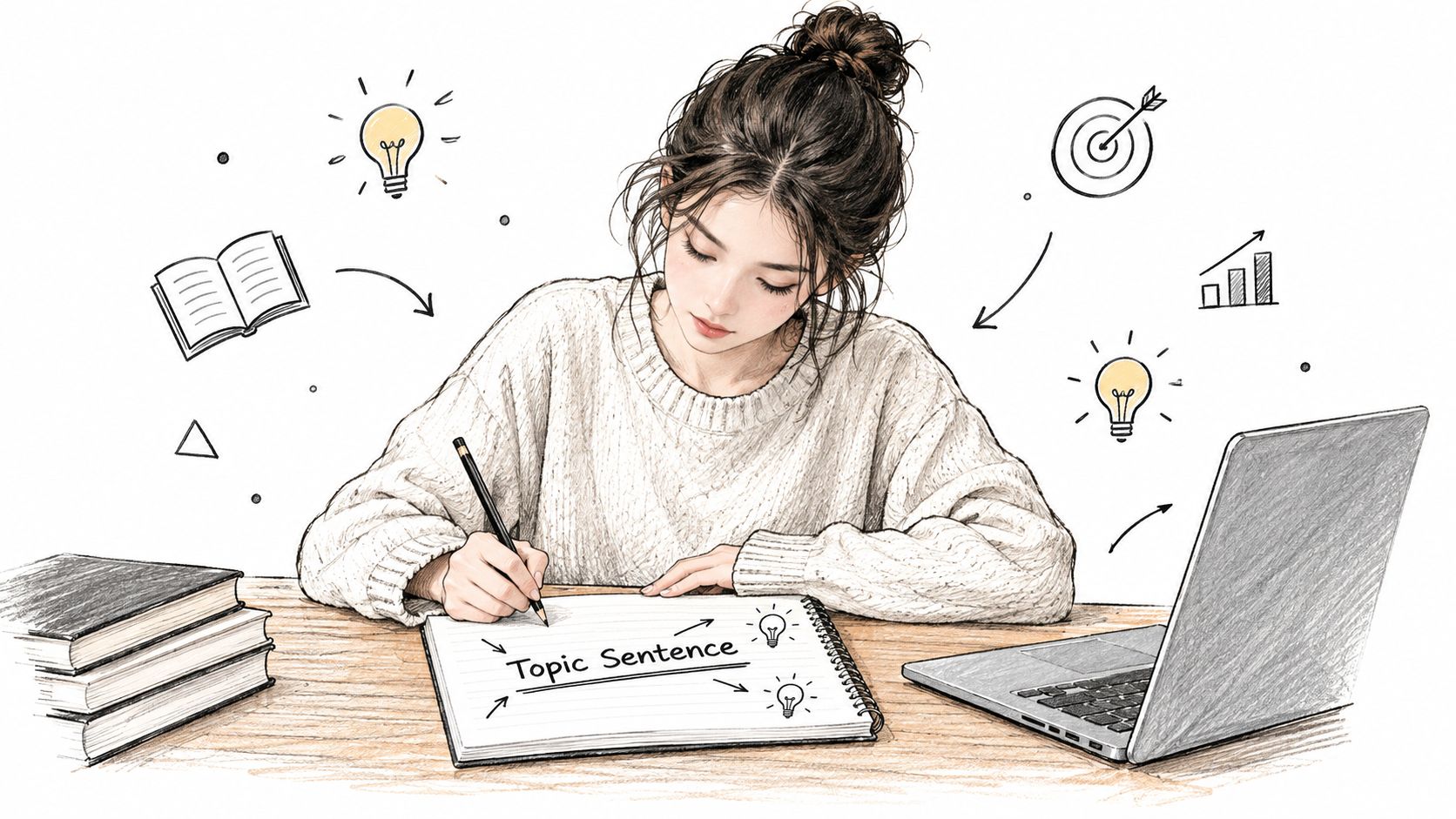
A topic sentence should make a claim that the paragraph can prove. “There are many arguments about public transport” announces a subject. “Public transport is the condition that makes car restrictions politically workable” gives the paragraph a direction.
The difference matters because evidence isn't self-explanatory. A source may provide a definition, finding, example, or counterargument, but you still need to state how it advances your thesis. The common short-essay failure isn't grammar. Writers summarize sources without interpreting them, spend words on background, or edit individual sentences before fixing the structure, as described in guidance on revising evidence integration.
Compress without flattening the reasoning
A cluttered paragraph might begin with several sentences explaining that transport affects cities, residents have different needs, governments make difficult decisions, and public debate continues. It may sound polished, but it postpones the claim.
A tighter version could work like this:
Claim: Car restrictions are more defensible when residents have a practical alternative to driving.
Evidence: A transport source identifies reliable public transit as a factor in travel behavior.
Interpretation: This matters because a restriction without an alternative can transfer the burden to people who cannot change their commute easily.
Qualification: The policy therefore needs to be assessed alongside access, not in isolation.
The shorter version isn't better because it uses fewer words. It is better because each sentence moves from claim to evidence to meaning. Don't remove a qualification merely to meet the count. Remove repeated context, decorative transitions, and examples that don't change the analysis.
Non-native English writers should prioritize clarity over imitation. A simple sentence with a precise verb is stronger than an elaborate sentence assembled to sound academic. Language tools can help with fluency, but they shouldn't replace your choice of evidence or your interpretation of it.
After drafting, write a five-line scratch outline:
- The thesis.
- The function of paragraph one.
- The function of paragraph two.
- The function of paragraph three.
- The conclusion's answer to the prompt.
If you can't summarize a paragraph in one precise sentence, it probably contains competing ideas. Use good paragraph starters for momentum, but make sure the sentence that follows advances the argument.
Using AI to Polish a 600-Word Essay Without Crossing the Line
“Humanize it” isn't an ethical shortcut. If an AI tool generates the analysis, selects unverifiable references, and produces the final argument, changing the phrasing afterward doesn't turn the work into independent authorship.
Policies differ by assessment. Higher-education guidance increasingly calls for rules that are specific to each assessment rather than broad institutional statements. College Board reporting found that 92% of surveyed faculty were concerned about plagiarism or dishonesty enabled by AI, according to guidance on student generative AI use.
Keep the writer responsible
Permitted support may include brainstorming, outlining, language correction, or feedback, but only when the assignment allows it. The risk rises when a student submits generated analysis, relies on citations they haven't checked, or uses a polished draft to conceal that they don't understand the argument.
A defensible workflow looks like this:
- Write the thesis and evidence plan yourself.
- Use AI for a targeted task, such as identifying repetition or suggesting clearer phrasing.
- Verify every factual claim and citation against the original academic or primary source.
- Keep drafts, prompts, source checks, and revision notes.
- Disclose assistance when the course or institution requires it.
The University of Iowa policy allows some uses with attribution and may permit brainstorming or outlining with prior instructor approval, while prohibiting unauthorized AI use for work requiring independent analysis or reflection. The University of Oklahoma's 2025–2026 policy examples show that some courses prohibit AI for any part of an assignment, while others require a written statement identifying platforms, prompts, verification, and revision work. Read the specific policy before using a tool.
If you're comparing different options for outlining, feedback, or language improvement, you can compare AI essay assistants, then judge each tool by its permitted role rather than by how convincingly it produces a finished essay.
Place the editor after authorship, not before it. For example, a student can write and fact-check a paragraph about transport policy, then use Pure Write to improve naturalness and readability while preserving the intended meaning. The student still owns the claim, evidence selection, and final wording. The AI humanizing workflow should be a polishing process, not a method for laundering generated work.
The Final Pass Checklist and How Pure Write Helps You Finish
The last pass should move from reasoning to mechanics. Editing sentences first feels productive, but it can leave you polishing paragraphs that don't answer the question.
Check the argument before the grammar
Run these checks in order:
- Prompt alignment: Does every paragraph answer the task rather than merely discuss the subject?
- Thesis strength: Does the introduction make a specific, supportable judgment?
- Topic sentences: Can each body paragraph's main claim be challenged or defended?
- Evidence integration: Does every source have an explanation beside it?
- Order: Does each paragraph prepare the reader for the next one?
- Word count: Have you confirmed what the institution includes and whether a tolerance applies?
- Sentence clarity: Are pronouns, verbs, references, and transitions unambiguous?
- Source accuracy: Does each citation support the claim it follows?
- Final sound: Have you read the essay aloud to catch awkward or overloaded sentences?
Read the conclusion separately. It should answer the prompt with the benefit of the completed reasoning, not introduce a new source or argument.
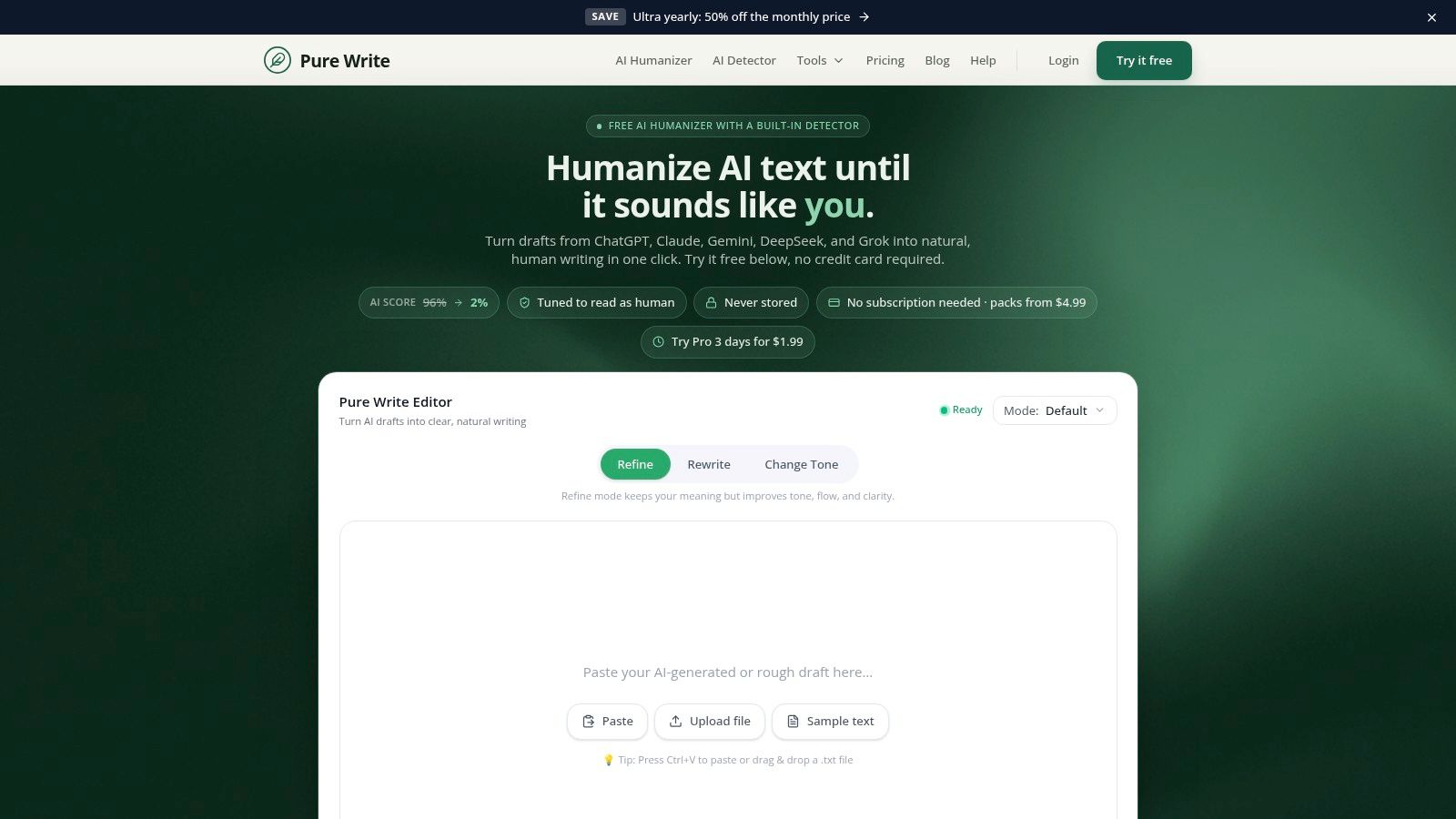
A tool can support the final language pass, but it can't verify your intellectual responsibility for you. Pure Write offers naturalness and readability analysis, Humanize mode for stylistic refinement, and integrated AI detection and plagiarism checking. Use those features to spot awkward phrasing, repetition, or originality concerns after you've confirmed the argument and sources yourself.
The same standard applies to marketing content. Google Search Central advises publishers to manually fact-check AI-generated content for accuracy, quality, and trustworthiness, and warns that producing many low-value pages primarily to manipulate rankings may violate its scaled-content-abuse policy, as explained in Google's guidance on generative AI content. For another perspective on structured review, a writing feedback tool can help you identify clarity and organization issues, but human judgment remains the final filter. The editing and revising workflow belongs after the reasoning pass, not instead of it.
Pure Write helps you refine a fact-checked 600-word essay by improving clarity, flow, naturalness, and readability while keeping responsibility for the ideas with you. Visit Pure Write to polish your draft ethically, review its originality, and finish with wording you can defend.