APA Footnote Example: A Guide to Perfect Citations
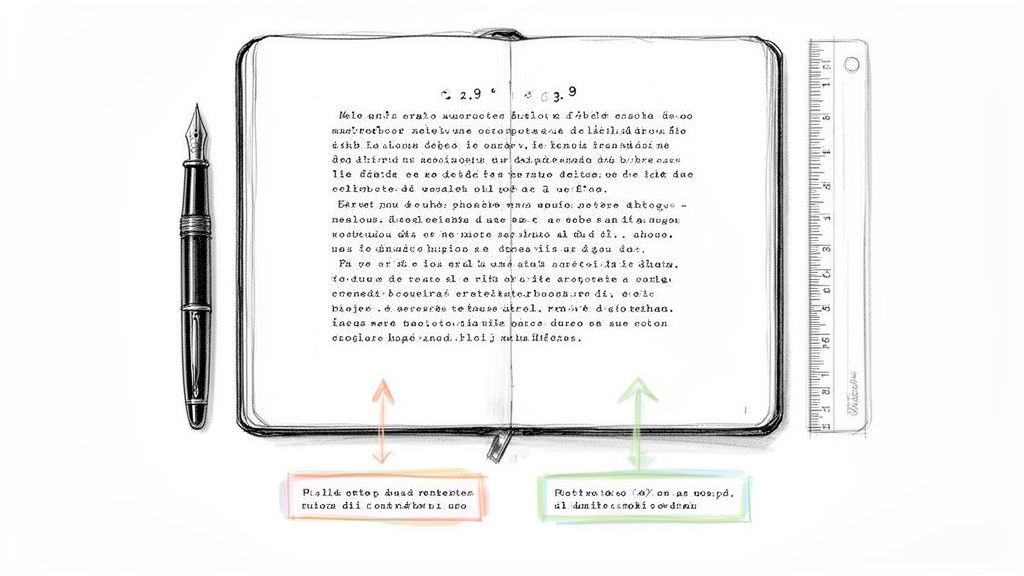
An APA footnote example falls into one of two categories. It could be a content footnote offering a little extra context (like, ¹For a more detailed history, see Smith, 2020.) or a copyright footnote giving credit for a reprinted image (for instance, ¹From Title of Work, by A. Author, 2023, Publisher. Copyright 2023 by Copyright Holder. Reprinted with permission.).
No matter the type, they’re always signaled by a tiny superscript number in your text, with the note itself sitting at the bottom of that same page.
When and Why You Should Use APA Footnotes
Let's clear up a common misconception right away. In the world of APA style, the go-to method for citing sources is the clean, simple parenthetical in-text citation. Footnotes aren't a replacement for those; instead, they serve two very specific and powerful purposes.
Think of them as a discreet whisper to your reader. They let you offer extra insight or necessary credit without cluttering up your main argument. We’ll break down the only two situations where you'll need to use them. Getting this right is a hallmark of polished, professional academic writing.
The Two Main Uses for Footnotes
The APA 7th Edition guidelines are pretty strict here—footnotes are reserved for just two scenarios. This keeps them from becoming a dumping ground for information that should be in the text or the reference list.
Content Footnotes: Use these to add brief, supplemental information that’s interesting but would interrupt the flow if you put it in the main paragraph. They're perfect for defining a highly technical term, offering a quick aside, or pointing a reader toward further resources.
Copyright Attribution: This is the big one. If you reproduce a long quotation, a table, or a figure from another published work, this type of footnote isn't just good practice—it's mandatory. It’s the formal way you acknowledge the source and provide the required copyright details.
For bigger projects like writing literature reviews, knowing exactly when and how to deploy these footnotes is crucial. It's a cornerstone of giving proper credit and upholding what is academic integrity.
This decision guide makes it easy to see which path to take.
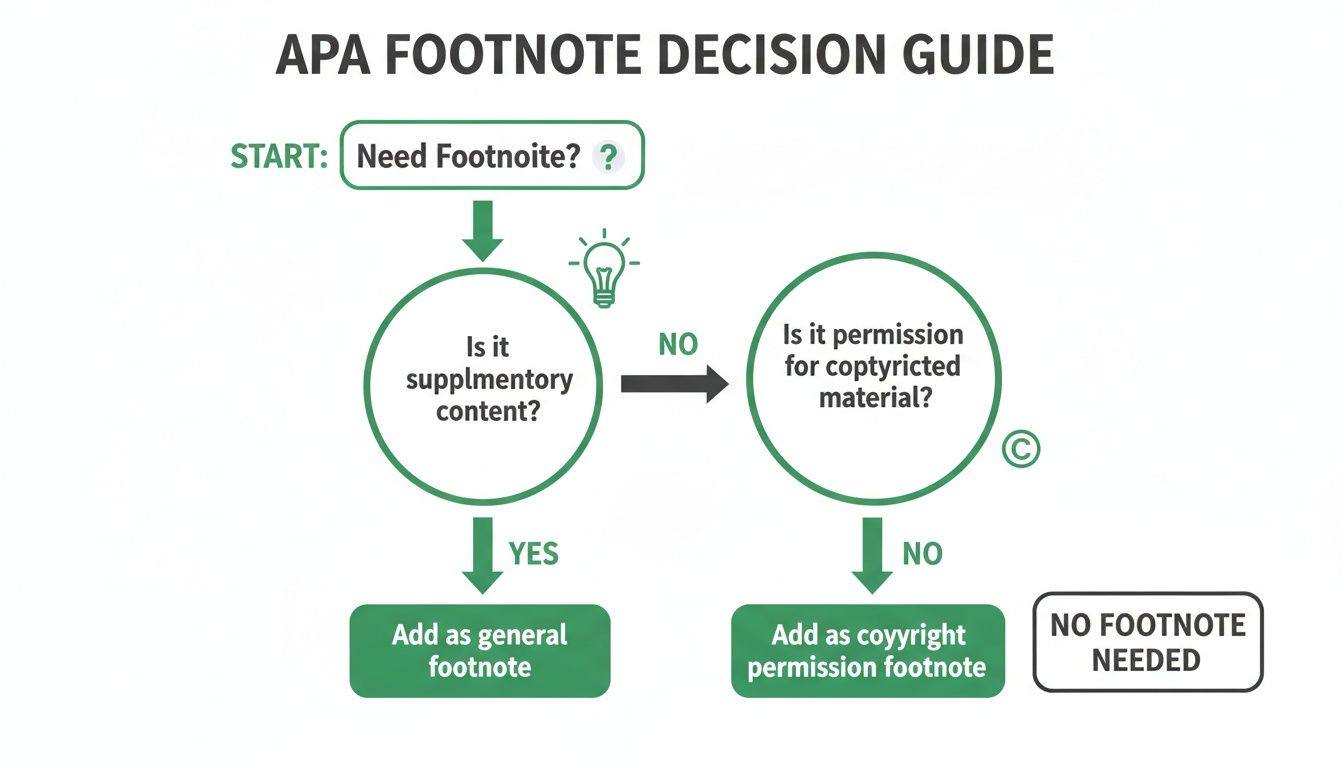
As you can see, the flowchart gives you a clear choice: are you adding extra info (content) or giving required credit for borrowed material (copyright)?
Footnote vs In-Text Citation Quick Guide
Sometimes it's tricky to decide whether a piece of information belongs in a footnote or a standard parenthetical citation. This quick table should help you make the right call in most situations.
| Situation | Use Footnote | Use In-Text Citation |
|---|---|---|
| Citing a direct quote or paraphrased idea. | No | Yes |
| Providing a brief, non-essential clarification. | Yes | No |
| Acknowledging permission to reprint a table. | Yes | No |
| Pointing to a source for a specific fact. | No | Yes |
| Defining a niche term without disrupting the text. | Yes | No |
| Listing an author and year for a source. | No | Yes |
This isn't an exhaustive list, but it covers the most common scenarios you'll encounter. When in doubt, remember that the in-text citation is for crediting sources, while the footnote is for adding supplemental context.
Why APA Prefers Limited Footnote Use
Here’s a bit of background that helps explain things. The American Psychological Association's style guide, which first appeared way back in 1929, has become a titan in academic writing. By the time the seventh edition was released in 2020, APA style was used in over 60% of social science publications across the globe.
A key reason for its popularity is its emphasis on clarity and reader-friendliness. The guide strongly favors parenthetical citations because they keep the reader focused on the main text. In fact, it's estimated that only about 15% of APA-compliant papers use content footnotes at all. The message is clear: use them, but use them sparingly and with purpose.
Explaining the Two Types of APA Footnotes
Think of APA footnotes as specialized tools in your writing kit. You wouldn't use a hammer to turn a screw, and similarly, you need to use the right kind of footnote for the right job. APA style uses two distinct types, and knowing which one to grab is crucial for a polished, professional paper.
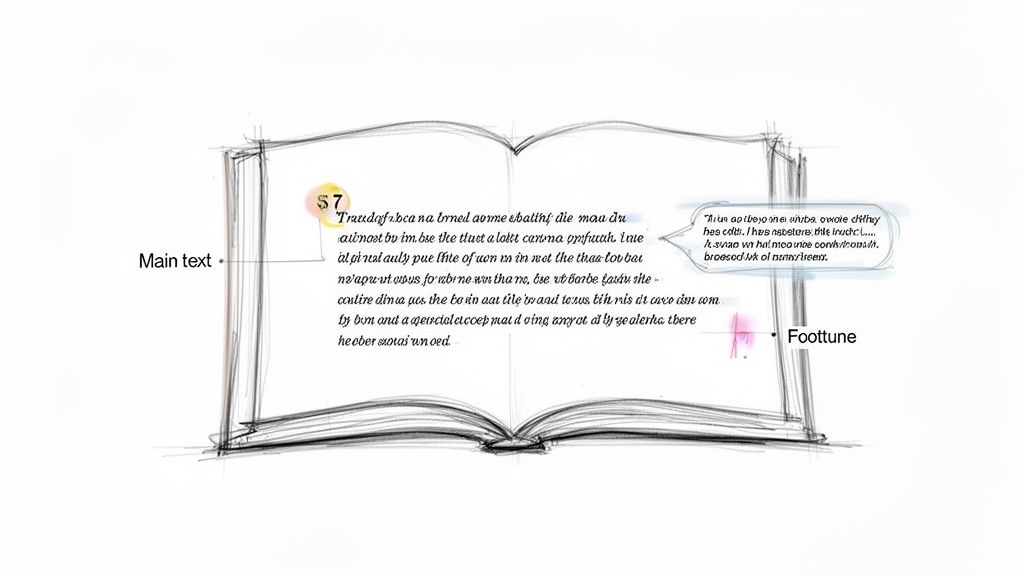
The first is the content footnote. This is for adding brief, enriching details that would otherwise trip up the flow of your sentence. The second is the copyright attribution footnote, which is an absolute must-have when you're reproducing certain materials.
Content Footnotes for Supplemental Information
Content footnotes are your secret weapon for giving readers extra value without cluttering your main argument. They're like a helpful aside in a conversation, offering a bit more context or pointing to related information without derailing the main point.
You'd use a content footnote to:
- Define a niche term: If you’re using a technical term only specialists would recognize, a footnote can offer a quick definition.¹
- Provide a short aside: Maybe you want to mention a related concept or an alternative viewpoint that isn't central enough for the main text.²
- Suggest further reading: A footnote can point readers to another great source if they want to dive deeper into a topic.³
Let's say an AI writing assistant you used drafted a sentence with a complex term. You could manually add a footnote to clarify it. Afterward, a humanizing tool like PureWrite can help you smooth out the phrasing, making sure the main text and its footnote sound authentic and thoughtful.
Key Takeaway: The golden rule for content footnotes is brevity. If your explanation runs longer than a few sentences, it's a sign that the information probably belongs in an appendix or right in the main body of your text.
Copyright Attribution Footnotes for Borrowed Material
The second type, the copyright attribution footnote, is all about academic integrity. It's not optional—it's a requirement whenever you reproduce substantial copyrighted material directly in your paper.
This most often comes up when you include:
- A long block quote (usually over 40 words)
- A table or figure from another source
- A test item or a psychological scale
This footnote is the formal credit that publishers and copyright holders require. It typically contains the source information followed by a statement like "Reprinted with permission." Skipping this is a serious academic misstep and can be considered a form of plagiarism.
Mastering both footnote types shows you have a sophisticated command of APA style. Whether you're writing a research paper or a detailed guide, using them correctly elevates the credibility of your work. When using AI to speed up your drafting process, we suggest using PureWrite to humanize the final output, ensuring your prose and citations are both flawless and natural.
How to Format Your APA Footnotes Correctly
Getting the formatting right is what separates a clean, professional paper from a confusing one. When it comes to APA footnotes, a few simple rules make all the difference in ensuring they’re clear and easy for your reader to follow. Let's break down exactly how you can do it.
It all starts in your main text. Whenever you need to add a footnote, you’ll place a superscript number right after the word or phrase it connects to, with no space in between.¹ If it’s at the end of a sentence, the number always comes after the punctuation, like a comma or period.²
These numbers need to be sequential, starting with ¹ and continuing throughout your paper. Don’t restart the numbering on each page or for new sections—it’s one continuous count from start to finish.
Placement and Styling of the Footnote
So, where does the footnote text actually go? The corresponding note always appears at the bottom of the very same page where you placed the superscript number. Thankfully, most word processors like Microsoft Word or Google Docs handle this automatically if you use their built-in footnote feature.
Here are the key styling rules to get right:
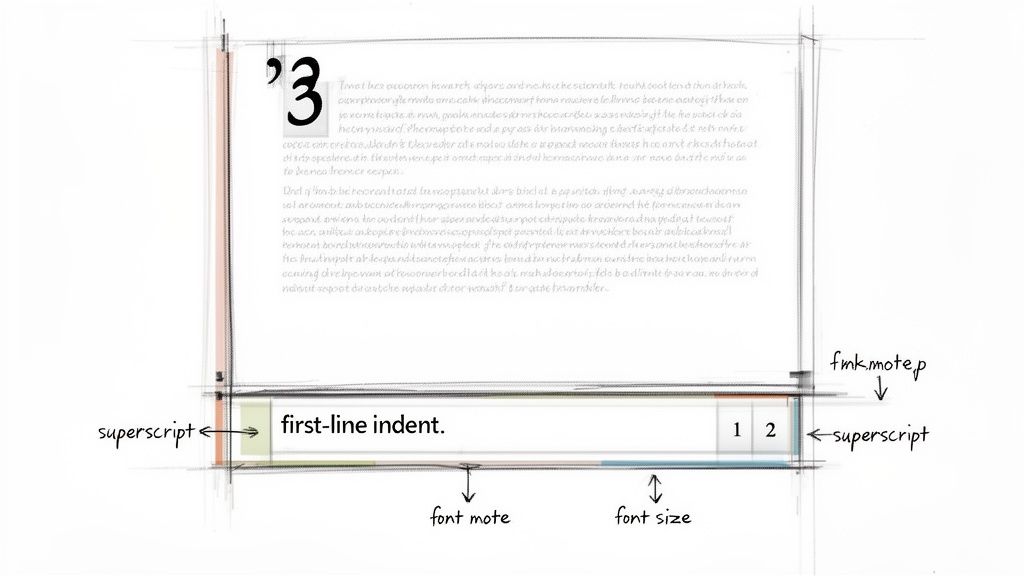
- Indentation: The first line of every footnote must be indented 0.5 inches, just like a new paragraph in your main text.
- Numbering: Begin the note with the matching superscript number, followed by a single space before you start writing.
- Font Size: Keep the font the same as your main body text (e.g., 12-point Times New Roman). Some instructors might allow a slightly smaller font, but it's always best to check your specific guidelines first.
Adhering to these small details is a hallmark of strong academic writing. Since the APA Publication Manual, 7th edition, was released in October 2019, its adoption has been massive. Sales hit 500,000 copies by 2023, and digital access soared 150% during the shift to remote learning. For you, this means that nailing the little things—like that first-line indent—shows you're serious about your work.
Formatting Templates for Quick Reference
To make it even clearer, here's a simple template you can follow. It's a great little checklist to make sure you have every piece in the right place.
In-Text Reference:
The study's results were inconclusive,¹ which led to further debate.
Footnote at Bottom of Page:
¹ The term "inconclusive" here refers specifically to the lack of statistical significance in the primary outcome measure.
If you’re using AI tools to help with drafting, be aware that they often get these formatting details wrong. Once your content is in place, it's a good idea to run a final check. You want to ensure everything from your footnotes to your in-text citations and even your APA format headings and subheadings is perfectly aligned. That final polish is what can turn a good paper into a great one.
Practical APA Footnote Examples for Any Source
Theory is great, but seeing how the rules work in a real document is where you'll have that "aha!" moment. Let's move from the abstract to the practical.
To help you get comfortable, we've put together a few common scenarios you'll likely run into. Each example shows you the full picture: the sentence in your text, the corresponding footnote at the bottom of the page, and the final entry in your reference list. It's a simple way to see how all the pieces fit together.
Content Footnote Clarifying a Concept
First up, a classic content footnote. Imagine you’re writing about a specific psychological term but don't want to clutter your main paragraph with a long-winded definition. A footnote is the perfect tool for this.
In-Text Example:
Early research into cognitive dissonance¹ explored the mental discomfort experienced when holding conflicting beliefs.
Footnote Example:
¹ It's worth noting that cognitive dissonance is distinct from cognitive bias, which refers to systematic patterns of deviation from norm or rationality in judgment.
See how that works? The footnote adds a helpful layer of detail for the curious reader without disrupting the flow of your argument. It’s clean, efficient, and shows you’re thinking about your reader's experience.
Content Footnote Suggesting Further Reading
Another great use for a content footnote is to point readers toward more resources. This is especially handy in a literature review or any paper where you want to show the breadth of your research without listing every single source in the main text.
In-Text Example:
This particular methodology has been critiqued for its limited applicability in cross-cultural contexts.²
Footnote Example:
² For a thorough analysis of cross-cultural research methods, see Henrich, Heine, and Norenzayan (2010).
Reference List Entry:
Henrich, J., Heine, S. J., & Norenzayan, A. (2010). The weirdest people in the world? Behavioral and Brain Sciences, 33(2–3), 61–83. https://doi.org/10.1017/S0140525X0999152X
This little note acts as a friendly signpost, guiding anyone interested in that specific critique to a foundational text on the subject.
Copyright Footnote for a Republished Figure
Now let's switch gears to copyright footnotes. These aren't optional—they're required anytime you reuse a figure, table, or a long quotation from another source. Here’s how you give proper credit for a visual you've included in your work.
In-Text Example:
The model illustrates the cyclical nature of reflective practice (see Figure 1).³
Footnote Example:
³ From The Reflective Practitioner: How Professionals Think in Action (p. 56), by D. A. Schön, 1983, Basic Books. Copyright 1983 by Basic Books. Reprinted with permission.
Reference List Entry:
Schön, D. A. (1983). The reflective practitioner: How professionals think in action. Basic Books.
This format provides all the necessary information to acknowledge the original creator and publisher, keeping your work ethically sound.
Quick Templates at a Glance
To make this even easier, here's a quick reference table. Think of it as a cheat sheet for building your own footnotes based on the type of note and the source you're citing.
APA Footnote Example Templates
| Footnote Type | Source Type | Example Footnote Structure |
|---|---|---|
| Content | Clarification | ¹ A brief explanation or definition to add context. |
| Content | Further Reading | ² See [Author, Year] for a more detailed discussion. |
| Copyright | Book Chapter/Figure | ³ From Title (p. xx), by A. Author, Year, Publisher. Copyright [Year] by [Copyright Holder]. |
| Copyright | Journal Article | ⁴ From "Article Title," by A. Author, Year, Journal Title, Volume(Issue), p. xx. Copyright [Year] by [Copyright Holder]. |
This table should help you quickly structure the most common footnotes you'll need, taking the guesswork out of the process.
Pro Tip: If you're working with qualitative data from interviews or focus groups, getting an accurate transcript is your first step. Before you even think about APA formatting, you need a clean document to work from. Finding one of the best academic transcription services can save you a ton of time and ensure your data is sound.
Common Footnote Mistakes and How to Avoid Them
Even seasoned writers can get tripped up by the tiny details of APA footnotes. Think of this section as your final proofreading checklist. We'll walk you through the most common slip-ups, so you can spot and fix them before anyone else does. Getting these right is what separates a good paper from a great one.
One of the biggest blunders is thinking a footnote can replace a reference list entry. It can't. While a content note might point a reader toward an interesting source, that source must also be fully cited in your reference list. Footnotes are supplements, never substitutes.
Using Footnotes for the Wrong Reasons
It’s easy to get carried away and stuff your footnotes with way too much information. If you find yourself writing a mini-essay at the bottom of the page, that's a red flag. That material is either important enough to belong in your main text or should be moved to an appendix.
Here’s a simple rule of thumb:
- Don't use a footnote just to provide a standard citation like (Smith, 2023). That's what in-text citations are for.
- Don't write a multi-paragraph explanation in a single footnote. Keep your content notes brief and focused.
Another critical error is forgetting the copyright notice. If you’re reproducing a table, a figure, or even a lengthy quote from another source, you absolutely must include a copyright attribution footnote. Skipping this is a serious oversight. While knowing how to paraphrase without plagiarizing is a crucial skill, for direct reproductions, the copyright footnote is non-negotiable.
Overlooking Formatting Details
Lastly, it's the small formatting mistakes that can undermine your credibility. Always double-check that your footnotes have a first-line indent. Another classic mistake is placement—the superscript number in your text should always come after punctuation, not before it.
Final Check: Do a quick scan of your paper to ensure the footnotes are numbered consecutively from the beginning to the end. The numbering should not restart on each new page.
After all the hard work you've put into your research and writing, you deserve for your final paper to sound polished and authoritative. If you've used AI to help with early drafts, your text might feel a bit stiff or unnatural. We built PureWrite to bridge that gap, helping you refine your writing so both your main arguments and your footnotes read with human clarity. Turning AI text into authentic prose lets you submit your work with confidence, knowing it reflects the highest standards of academic integrity.
Frequently Asked Questions About APA Footnotes
Alright, let's wrap this up by tackling some of the most common questions that pop up when dealing with APA footnotes. Think of this as a quick-fire round to clear up any last-minute uncertainties you might have.
Can I Use Footnotes Instead of In-Text Citations in APA 7?
That’s a definite no. In APA style, footnotes are not a substitute for the standard parenthetical in-text citations you see, like (Smith, 2023). That method is non-negotiable for citing sources within the main body of your text.
Footnotes have a very specific, limited role: they either provide extra tidbits of information (content footnotes) or handle copyright permissions. Your main citations must always live in the text itself and point the reader to a full entry in your reference list.
How Should I Number Footnotes in a Long Document Like a Thesis?
Good question, especially for larger projects. The rule is simple: number your footnotes consecutively from the beginning of the document to the end. You'll start with ¹ and just keep going.
There's no need to restart the numbering for each new chapter or section. A single, continuous sequence makes it much easier for your reader to track everything without getting confused.
If I Cite a Source in a Footnote, Does It Also Need to Be in My Reference List?
This is a tricky one, and the answer is a classic "it depends." If your footnote is just a simple comment or a quick definition, you don't need to add anything to your reference list.
But, if that footnote mentions another source to back up its point—for instance, "¹For a different perspective, see Miller (2021)..."—then yes, the Miller (2021) source must have a full entry in your reference list. The golden rule is that every source you formally cite, whether in the main text or in a footnote, needs a corresponding entry. Managing all these moving parts can be a headache, which is why tools reviewed in our guide to the best academic writing software can be a huge help.
What's the Real Difference Between a Footnote and an Endnote in APA?
Honestly, the only difference is where they live in your paper. It's all about placement.
- Footnotes: These appear at the bottom of the page where the reference number appears. They keep the extra info right where the reader needs it.
- Endnotes: These are grouped together on a separate page at the end of your document, right before the reference list.
The APA 7th Edition gives you the choice, but footnotes are often preferred because they're more convenient for the reader. When in doubt, always ask your professor or publisher what they prefer.
Crafting clear, compelling academic work takes more than just getting the facts right—it's about making your writing flow naturally. If you've used AI to help with your first draft, the final text can often feel a bit stiff or robotic. PureWrite is designed to smooth out those rough edges, humanizing your content so that every part of your paper, right down to the last footnote, sounds authentic and polished. Try PureWrite today and turn your AI drafts into work that truly connects with your reader.