Cover Letter for Graphic Designer That Gets Interviews

You've shaped your résumé, polished your portfolio, and applied for the role. Then the automated rejection arrives before anyone appears to have looked at your work. A strong cover letter for a graphic designer can't repair a weak portfolio, but it can explain the thinking, constraints, and outcomes that a collection of images can't show.
The practical standard is simple: connect one employer's design problem to one or two relevant portfolio pieces, then prove what you contributed. Your letter should sound like a designer who understands communication, business context, collaboration, and accessibility, not someone copying software names into a template.
What a Graphic Designer Cover Letter Is Actually For
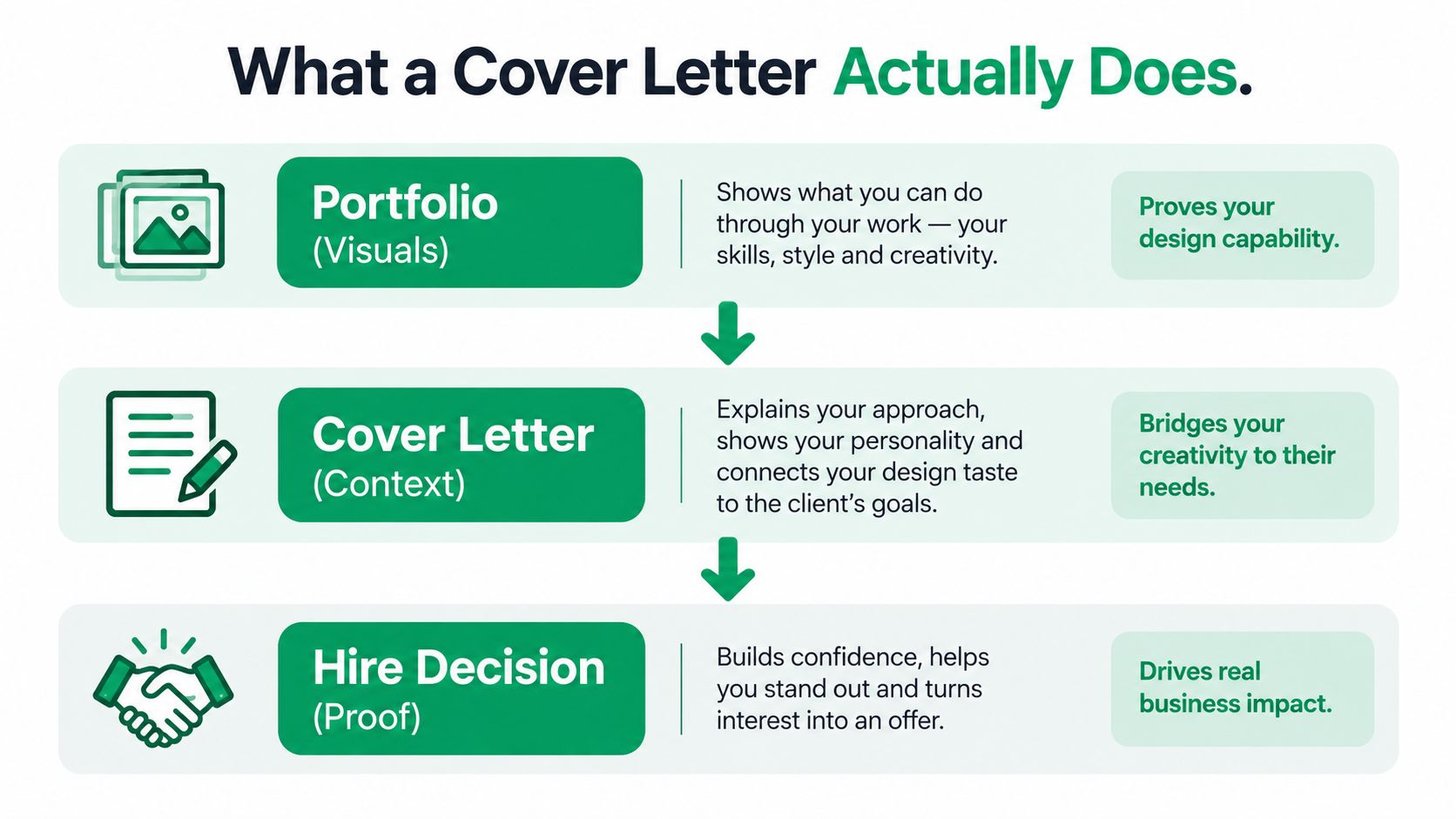
Employers use portfolios to judge completed work, visual judgment, range, and craft. The letter has a different job. It tells the reader why you selected those projects, what problem you solved, how you worked with others, and what changed because of the design.
The U.S. Bureau of Labor Statistics reported approximately 253,100 graphic-design jobs in 2025 and notes that a portfolio is essential for many designers because it demonstrates completed work, style, and ability to employers. (U.S. Bureau of Labor Statistics) That makes duplication especially wasteful. Your letter shouldn't describe every project already visible in your portfolio or list every application you've opened.
Build a four-part evidence chain
Use four concise paragraphs, each with a distinct hiring purpose.
- Open with value. Name the role and connect your strongest relevant capability to the company's stated need. “I'm excited to apply” is harmless, but it isn't evidence.
- Frame the employer's problem. Show that you understand the audience, product, brand system, campaign, or communication challenge behind the vacancy.
- Prove fit with one or two projects. State the deliverable, your role, the process or constraint, and a measurable result when you have one. If you don't have a metric, describe a verifiable outcome such as adoption, delivery scope, improved clarity, or successful collaboration.
- Point to the portfolio and invite a conversation. Tell the reader which project best demonstrates the relevant skill and offer a specific discussion, such as a case-study walkthrough or critique of the role's design challenge.
Hiring-side rule: The portfolio shows what you made. The letter explains why you made it and what it accomplished.
A useful resource on how to pair your portfolio with your cover letter reinforces this division of labor. Keep the document scannable, use plain language, and make the portfolio link easy to find. For broader structure and wording, compare your draft with this guide to how to write a cover letter.
The rest of your work is selection. Choose evidence that matches the job, write it in your own voice, and remove every sentence that could be sent unchanged to another employer.
A Practical Workflow for Writing the Letter
“Tailor it to the job” is good advice, but it's too vague to use under deadline. A repeatable workflow starts with the posting and ends with a short letter whose claims can be checked against your work.
Extract and map before drafting
Read the job description once for context, then return to it with a simple five-row worksheet. Pull out five concrete requirements, not broad qualities such as “creative” or “passionate.” Look for deliverables, audiences, tools, collaboration points, production constraints, and business objectives.
For each requirement, record three matching items:
- Portfolio artifact: the project that gives you credible evidence.
- Outcome: a metric, delivery result, audience response, or observable improvement.
- Reusable sentence: one plain sentence connecting your action to the employer's need.
For example, if the posting emphasizes brand consistency across channels, your row might identify a brand-system project, the number of templates you led if you have that information, and a sentence explaining how you created reusable rules for marketing and product teams. If the role prioritizes accessibility, select work where you improved hierarchy, contrast, navigation, captions, or readable information structure.
Write an opening with a reason
Your first two sentences should answer why this company and why this design problem. Replace “I'm thrilled to apply for the graphic designer position” with a specific observation about the organization's audience, product, identity, campaign, or communication need.
A useful pattern is:
“Your focus on [specific audience or challenge] matches my experience solving [related design problem]. In [project], I [action] so that [audience or business outcome].”
Only include a company observation you can support. A recent campaign, a visible product change, or a stated responsibility in the posting is stronger than invented praise about a "bold and cutting-edge culture."
Give the evidence paragraph one center
Choose the strongest project first. Explain the problem, your role, the key decision, and the result. Mention tools only when they clarify how you delivered the work or match a genuine requirement. A software inventory without judgment reads like résumé repetition.
Keep the complete letter around 250 to 350 words when the application gives no other direction. Research on cover-letter quality found that improving both the résumé and cover letter by one rating point was estimated to produce 7% more interviews relative to applications, while cover-letter quality alone had a positive association with interview rate, r = 0.37, p < 0.001. (International Journal of Selection and Assessment) Treat that finding as directional, not as a promise. Specificity and organization are still the controllable parts.
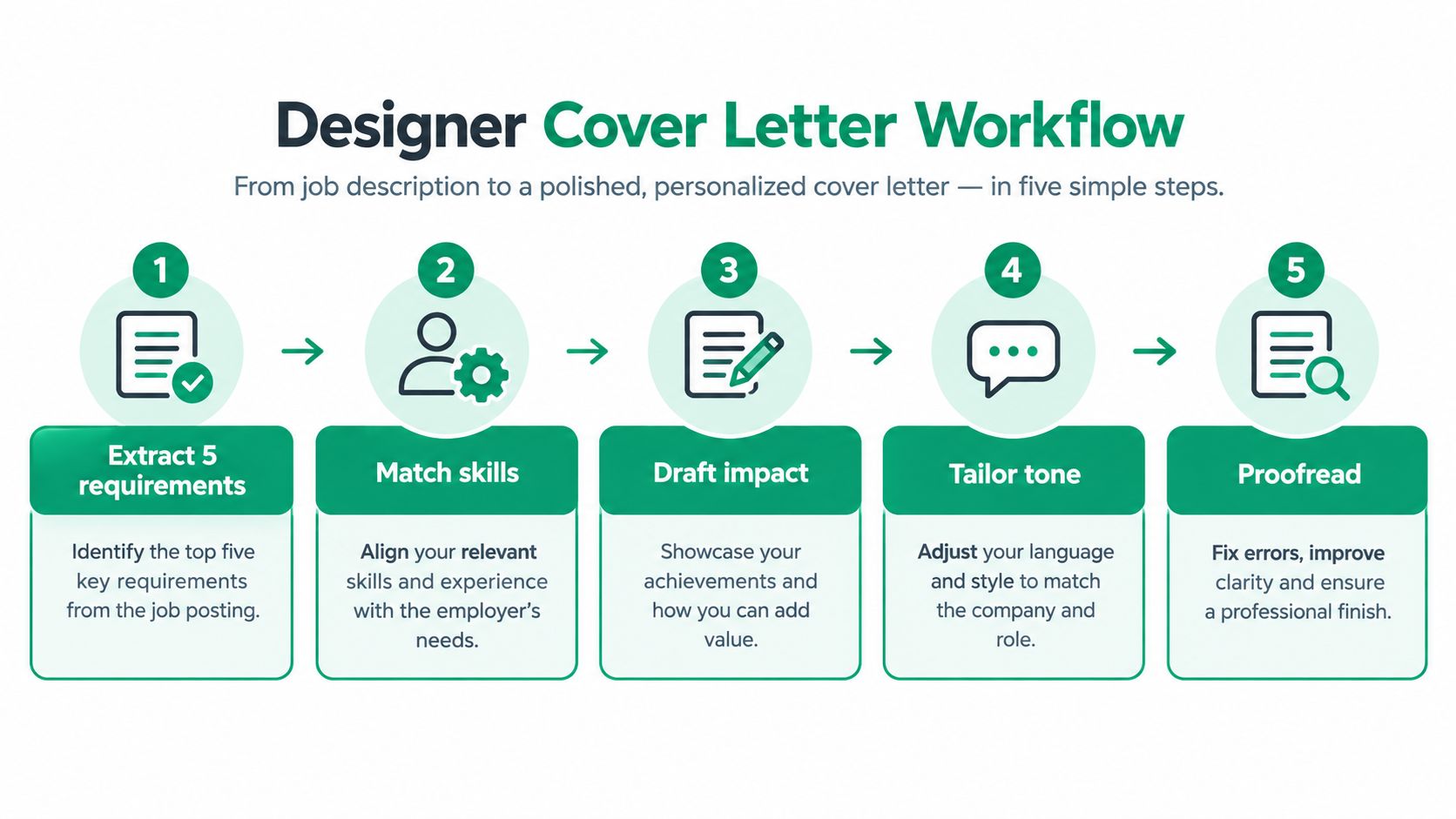
If you're exploring early-stage opportunities, researching how to find startup roles in NYC can help you identify the kinds of fast-moving environments where evidence about systems, iteration, and collaboration matters. Before sending, use a structured 5-step writing process to check that each paragraph has one job.
End with a portfolio pointer, not a vague request. “I'd welcome the chance to walk through the packaging system and explain how the decisions translated across digital and print” gives the reader a reason to reply.
Sample Letters for Junior, Senior, Freelance, and In-House Designers
The same evidence chain changes with context. A junior designer needs to make selected projects feel relevant despite limited employment history. A senior designer must show leadership and decision quality. A freelancer needs to reduce commercial risk, while an in-house designer moving into product should translate marketing experience into product-relevant outcomes.
| Sample | Length | Primary Proof | Tone Cue |
|---|---|---|---|
| Junior agency designer | 250–300 words | Internship, student, or self-directed project | Curious and evidence-led |
| Senior lead designer | 300–400 words | Direction, systems, decisions, and team outcomes | Strategic and accountable |
| Freelance identity pitch | 200–300 words | Scope, milestones, reliability, and fit | Commercial and specific |
| In-house marketing to product | 250–350 words | Transferable workflows and user-focused outcomes | Adaptable and collaborative |
One source recommends keeping a graphic-design cover letter approximately 200–400 words, no longer than one page, and selecting only the strongest two or three achievements. (CareerKit) These are models, not scripts. Replace every bracketed idea with evidence you can defend.
Junior designer applying to an agency
Opener: “Northbrook Studio's work for hospitality and consumer brands matches the intersection of identity and editorial design I explored during my internship and final-year project. I'm applying for the junior graphic designer role because I can contribute strong typography, organized files, and a portfolio built around real briefs.”
Evidence paragraph: “During my internship, I developed logo explorations and campaign assets for a local bookshop, working through feedback from the account and copy teams. I also created a self-directed identity system for an independent publisher, including typographic rules, color decisions, and adaptable social layouts. The projects in my portfolio show the iterations, not only the polished final screens.”
Closing: “The bookshop campaign and publishing identity are the closest match to your current work. I'd welcome a portfolio conversation about how I approach critique, revision, and production handoff.”
Swap the industry references, project names, and deliverables for each agency. Don't apologize for being junior. Show how you think.
Senior designer interviewing for a lead role
Opener: “Your expansion from a single product brand into a broader digital platform creates the kind of consistency problem I've handled through identity systems and cross-functional design direction. I'm applying for the lead role because my experience combines hands-on craft with the critique, prioritization, and stakeholder alignment needed to scale quality.”
Evidence paragraph: “In my most recent role, I led a brand refresh from early positioning through launch assets, coordinating designers, marketing partners, and external specialists. I established shared rules for typography, imagery, and layout, then used recurring critiques to improve consistency without blocking delivery. My portfolio includes the system rationale, rejected directions, and final applications so you can assess both the decisions and the output.”
Closing: “I'd be glad to walk through the system case study and discuss how I'd assess your current brand workflow during the first phase of the role.”
Replace “platform,” “system,” and “workflow” with the employer's actual challenge. Seniority is not a reason to write more. It's a reason to make the consequences of your decisions clearer.
Freelancer pitching a brand identity engagement
Opener: “Your current identity works across the core product, but the expanding content range calls for a system that can be used consistently by internal marketers and external partners. I help growing teams turn positioning into practical identity rules, templates, and production guidance.”
Evidence paragraph: “For a previous client, I defined the identity direction, created the core visual elements, and built reusable templates for campaign production. I organized the work into agreed milestones, documented open decisions, and supplied files that could move cleanly between design and marketing. The relevant portfolio case study shows the scope, review points, and final system rather than only selected mockups.”
Closing: “I'd welcome a scoping call to discuss the audiences, existing assets, and first milestone. I can also outline which parts of the system should be solved first and which can wait.”
Change the proof to match the buyer's concern. A contract client wants confidence about scope, communication, and delivery, not a paragraph of employee-style enthusiasm.
In-house designer moving from marketing to product
Opener: “My marketing design background has centered on making complex offers easier to understand across campaigns, landing pages, and sales materials. I'm applying for the product designer role because that same communication discipline can support clearer user flows and more consistent interface decisions.”
Evidence paragraph: “I've worked with marketers, writers, and subject specialists to turn complicated information into structured visual systems. In my selected case study, I developed a hierarchy that helped audiences find the relevant message across multiple formats, then documented the rules so other teams could use them. I'm now extending that practice into product discovery, interface critique, and collaboration with engineering.”
Closing: “I'd value a conversation about how your product team handles content hierarchy, visual consistency, and handoff. My portfolio includes the campaign system that best demonstrates this transition.”
Use honest transfer language. Don't claim product experience you don't have. Show the design behaviors that carry across contexts.
For formatting decisions that need to remain professional and readable, you can also consult guidance on business letter format in Word.
Writing for AI-Screened Applications, Accommodations, and Career Transitions
Automated screening changes the wording problem, but it doesn't change the evidence standard. A parser may recognize role terminology, while a recruiter or design lead still needs to understand whether the claim is yours, whether the project is real, and whether your decisions show judgment.
In a 2025 Gartner survey of 2,918 job candidates, 32% worried that AI could incorrectly reject their applications, while only 26% trusted AI to evaluate candidates fairly. Separate recruitment research reported that 32.1% of employers using AI screened applicants or résumés in 2025, up from 11.6% in 2024. (Gartner)
Make the language machine-readable and human-verifiable
Use the exact role terminology when it accurately describes your experience. If the posting asks for Figma, brand systems, campaign development, accessibility, or cross-functional collaboration, those terms can appear naturally in a sentence about a real project.
Then add the detail an automated system can't invent for you:
- Constraint: What limitation shaped the design?
- Iteration: What changed after critique, testing, or stakeholder review?
- Trade-off: What did you prioritize, simplify, or reject?
- Outcome: What improved, shipped, scaled, or became easier to use?
“Created engaging visual assets” is smooth but empty. “Built a reusable campaign system after the first round of assets produced inconsistent layouts across channels” gives a reviewer something to investigate.
AI writing tools can help with proofreading, structure, and awkward repetition. They shouldn't manufacture metrics, portfolio stories, or a personality you can't sustain in an interview. Pure Write's AI detection guidance is useful as a reminder that reducing robotic phrasing isn't the same as proving authorship.
Request access without oversharing
Applicants with disabilities shouldn't have to disclose private medical information to explain an access need. If an assessment conflicts with assistive technology or measures something unrelated to the essential design work, request an accessible alternative in a short, practical sentence.
Research from the American Foundation for the Blind describes how automated assessments and AI-led interviews can disadvantage applicants with disabilities when systems conflict with assistive technology or demand tasks unrelated to essential job functions. (American Foundation for the Blind) You might write: “I'm happy to complete the assessment and would appreciate an accessible alternative to the timed visual interaction, or confirmation that it supports my screen reader.”
That keeps the focus on participation and the required job function. You can discuss accommodations with the appropriate contact rather than placing personal history in the cover letter.
Reframe non-linear experience
A student campaign, open-source contribution, community project, or speculative redesign can demonstrate process when formal job titles are limited. State the brief, audience, constraints, decisions, and outcome. “Designed a speculative redesign” is stronger when followed by what you investigated, what you changed, and what the portfolio case study documents.
Career transitions also benefit from precise translation. A marketer moving into product design might emphasize information architecture, content hierarchy, research collaboration, and iterative critique. An international applicant might clarify the contexts in which they've worked and keep the language direct rather than apologizing for difference.
The letter should give the reviewer enough context to understand your strengths without turning into a personal explanation. Authorship becomes visible through specific choices.
Common Mistakes That Get a Cover Letter Rejected
Hiring managers do read these documents. One survey of 625 hiring managers reported that 83% read most cover letters, 45% read the letter before the résumé, and 49% said a strong letter could persuade them to interview an otherwise uncertain candidate. (Resume Genius) That attention is conditional. A generic letter spends it badly.
Use this diagnostic table before you send:
| Mistake | Diagnostic | One-line fix |
|---|---|---|
| Generic opening | Could the first paragraph go to any studio? | Name the employer's audience, product, or design problem. |
| Résumé repetition | Does the letter restate titles and dates without explaining choices? | Replace one duty with one project decision and outcome. |
| Aesthetic description only | Does it say “bold,” “clean,” or “beautiful” without purpose? | Explain what the design clarified, enabled, or improved. |
| Unsupported adjectives | Are “creative” and “detail-oriented” doing the work? | Demonstrate those traits through process and evidence. |
| Inconsistent typography | Do spacing, capitalization, file names, and URLs conflict with the résumé? | Apply one hierarchy and proof both documents together. |
| Overdesigned format | Would icons, columns, or decorative elements confuse a parser? | Keep the letter accessible and let the portfolio carry visual personality. |
A useful rejection test: If a paragraph could be sent to another employer unchanged, remove it or rewrite it.
Customization is the highest-value intervention. A 2020 field experiment involving 7,287 fictitious applications found that letters customized to the specific vacancy generated a 53% higher interview-callback rate than applications without a cover letter. (International Journal of Selection and Assessment) That's a directional benchmark, not a guarantee. Portfolio quality, seniority, market conditions, and role fit still matter.
The practical takeaway is narrower and more useful. Don't chase a clever format or a perfect phrase. Make the connection between the employer's stated need and your strongest evidence impossible to miss.
Pre-Send Checklist and Your 14-Day Letter Practice Plan
A polished letter can still fail on a broken link, vague opening, or mismatched file. Before sending, check each point in order:
- Specific opener: Does the first paragraph name the employer and connect your experience to its design problem?
- Correct addressee: Are the employer and hiring manager names spelled correctly?
- Evidence: Does the body include one defensible outcome when one is available?
- Portfolio link: Does the link open from the submitted file and lead to the relevant case study?
- Consistent presentation: Do spacing, typography, contact details, and file naming match the résumé?
- Clear close: Does the sign-off invite a specific conversation rather than just expressing hope?
Save and submit the document in the format the employer requests. If you need a refresher on how to send a PDF, confirm that the final file preserves selectable text, working links, and readable spacing.
A 14-day practice plan
Days 1 and 2: Audit two portfolio pieces. For each, record the problem, audience, your role, one important decision, and the strongest outcome you can defend.
Days 3 and 4: Extract five requirements from a real posting. Map each requirement to a project, then remove any claim you cannot support.
Days 5 and 6: Draft two openings for the same role. Keep the version that connects the employer's problem to your evidence fastest.
Days 7 and 8: Write the evidence paragraph and closing. Point to one relevant portfolio project instead of sending the reader to a general gallery.
Day 9: Use a quality analysis tool to identify robotic phrasing, repetition, and vague claims. Apply these writing revision strategies to tighten the evidence chain. If you use Pure Write for refinement, remain responsible for every example, design decision, and metric.
Days 10 and 11: Ask a peer to identify the employer's problem, your strongest proof, and the portfolio project you want them to open. Revise any point they cannot find quickly.
Days 12 and 13: Adapt the letter to a second role without copying the first company's language. Keep the evidence, but change the connection to the new employer's needs.
Day 14: Complete the checklist and send the strongest version.
Frequently asked questions
Should the portfolio link appear in the letter? Yes. Make it easy to find, then point to one relevant project in the body or closing. A link alone does not prove fit.
What if I have no measurable result? Describe a concrete outcome you can verify, such as a system delivered across formats, a successful review process, improved information hierarchy, or assets adopted by another team. Never invent a percentage to strengthen the paragraph.
Should every application include a cover letter? If the employer requests one, send a letter written for that role. If it is optional, decide whether your evidence adds context that the résumé and portfolio cannot provide. A generic attachment usually adds little.
Pure Write can refine a graphic-design cover letter for clarity, tone, grammar, concision, and natural phrasing while you retain control of the evidence. Use Pure Write after drafting to catch template-like language, then verify every project detail and metric before submitting.