10 Essential Writing Revision Strategies for Flawless Content
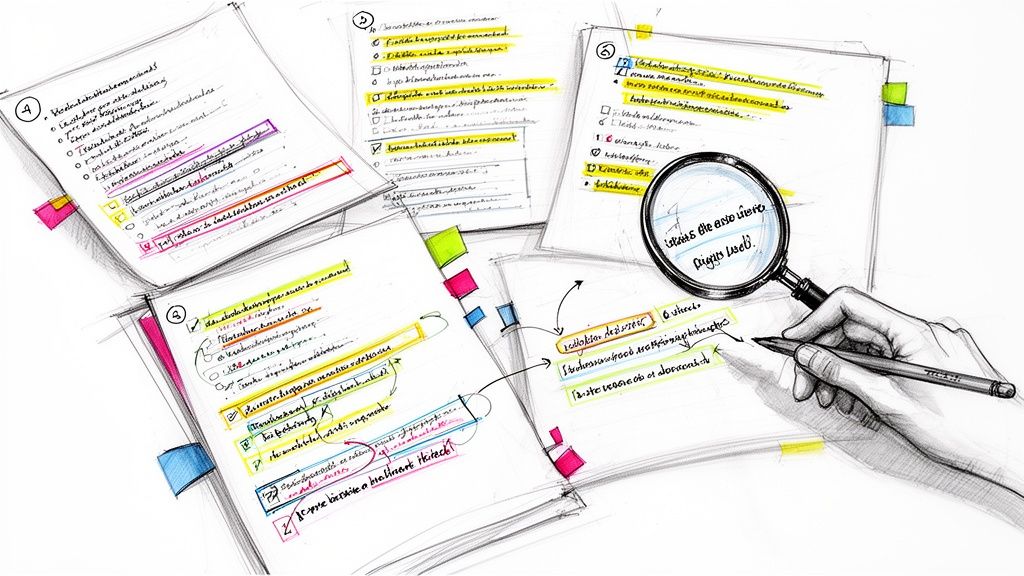
Welcome to the new era of writing, where AI writing tools can generate drafts in seconds. But creating content that truly connects, persuades, and engages requires a human touch. This is where powerful writing revision strategies become your most valuable asset.
The journey from a functional first draft to a compelling final piece is paved with intentional, strategic editing. Whether you're a content creator battling AI detection, a student aiming for authenticity, or a marketer polishing a critical campaign, mastering revision is no longer optional—it's essential.
This guide moves beyond generic advice to provide actionable techniques designed for today's writer. We will explore 10 distinct revision strategies that help you transform good writing into great writing. Let's dive in and elevate your work from algorithmically generated to authentically human. For additional insights, explore our resources on editing and revising.
1. The Hemingway Editor Approach
Named after Ernest Hemingway's legendary economy of language, this revision strategy focuses on achieving powerful prose through simplicity and directness. The core principle is to eliminate unnecessary words, simplify complex sentences, and remove redundancy. By stripping away jargon, you create punchy, readable content that gets straight to the point.
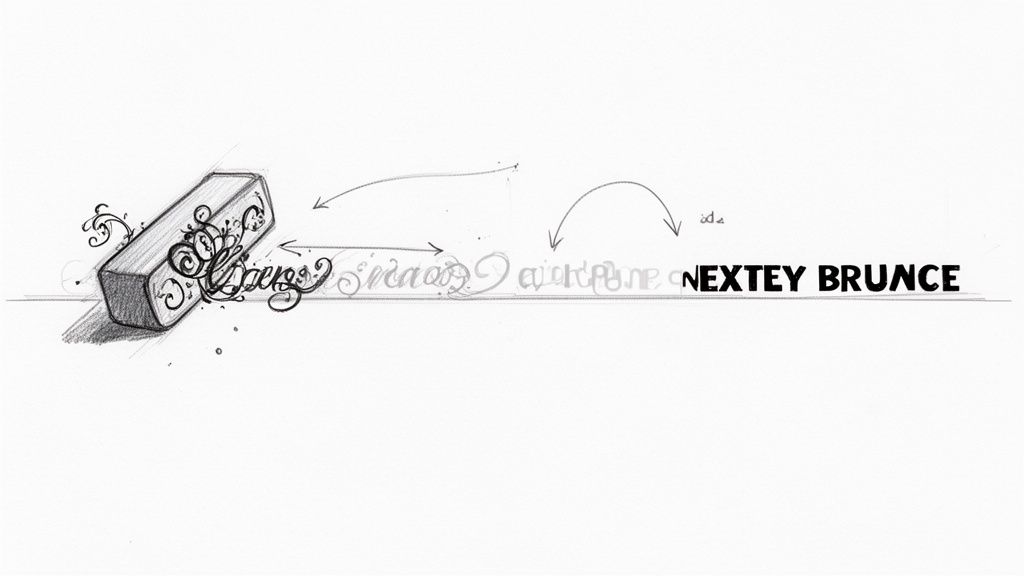
This approach is one of the most effective writing revision strategies for transforming dense, AI-generated text into natural, conversational content. It forces you to scrutinize every word, ensuring each one serves a purpose.
When to Use This Strategy
The Hemingway approach is invaluable when your draft feels verbose, academic, or clunky. It's perfect for marketers aiming to boost engagement, students refining essays for argumentative strength, and professionals who need clear, scannable emails and reports.
How to Apply It
- Identify Long, Complex Sentences: Scan your document for sentences that are difficult to read in a single breath. If a sentence is over 25 words, it's a candidate for revision.
- Cut Extraneous Words: Look for filler words like "very," "really," and "just." Remove them to make your statements stronger.
- Strengthen Your Verbs: Replace weak verb-adverb combinations (e.g., "walked slowly") with strong, precise verbs (e.g., "shuffled" or "ambled").
- Eliminate Redundancy: Search for phrases that say the same thing twice, like "completely finished" or "unexpected surprise," and remove the repetitive term.
Pro Tip: As an example, change "The report was an indication of the fact that sales were down" to "The report indicated that sales were down." This simple edit cuts the word count and boosts clarity.
Using PureWrite for This Strategy
Our Humanize mode is built on the principles of the Hemingway approach. Instead of spending hours manually trimming your text, you can paste an AI-generated draft into PureWrite. We automatically identify overly complex sentences and weak phrasing, rewriting them for clarity and impact, helping you ethically refine your content.
2. Read-Aloud Revision Method
This technique involves reading your written work aloud to catch errors, awkward phrasing, and inconsistencies that silent reading often misses. Your ears can detect problems your eyes skim over, like clunky rhythm, unnatural word choices, and repetitive sentence structures. It bridges the gap between words on a page and how a reader actually processes them.
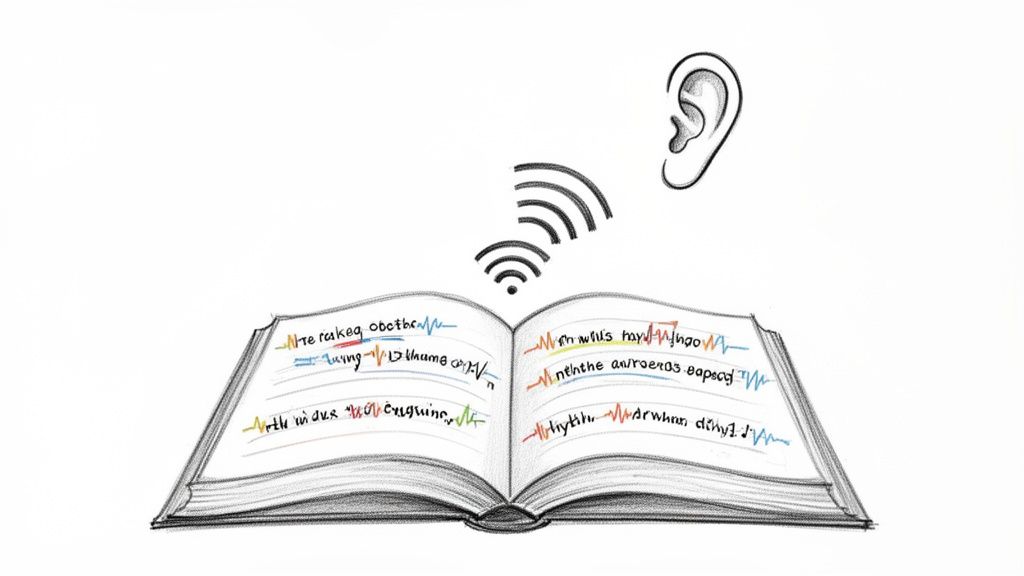
The read-aloud method is one of the most powerful writing revision strategies for identifying robotic patterns in AI-generated text. If a sentence feels awkward to say, it will almost certainly feel awkward to read.
When to Use This Strategy
This strategy is essential when you want your writing to have a natural, conversational flow. It’s perfect for content creators trying to humanize an AI draft, students catching errors in an essay, and professionals ensuring an important email sounds both professional and approachable.
How to Apply It
- Read Slowly and Deliberately: Don't rush. Pronounce each word clearly to catch typos, missed words, and grammatical mistakes.
- Listen for Rhythm and Flow: Pay attention to how the sentences sound together. Do they flow smoothly, or are the transitions jarring?
- Identify Awkward Phrasing: If you stumble over a sentence, that's a clear signal it needs to be revised for clarity. For example, you might notice an overused phrase you didn't see before.
- Record Yourself: Use your phone to record yourself reading. Listening back provides a more objective perspective, allowing you to hear your work as an audience member would.
Pro Tip: Use your computer's text-to-speech function to have your work read to you. A dispassionate, automated voice is excellent at revealing clunky sentences your mind might automatically correct.
Using PureWrite for This Strategy
After you’ve read your text aloud and made initial changes, paste it into PureWrite. Our Humanize mode can spot subtle, leftover AI patterns that even the human ear might miss. We refine the text further, ensuring it not only sounds human but also maintains its authentic core message. Ready to give it a try?
3. The Reverse Outline Technique
Instead of outlining before you write, this strategy flips the script: you create an outline from your finished draft. The reverse outline technique is a powerful diagnostic tool that reveals the true structure of your writing. By summarizing each paragraph's core point, you get a bird's-eye view of your content's logical flow.
This method is one of the most effective writing revision strategies for untangling AI-generated text, which often presents well-written sentences in a confusing order. It exposes the "skeleton" of your argument so you can rebuild it for maximum impact.
When to Use This Strategy
The reverse outline technique is essential when your draft feels disjointed or your argument isn't landing. It's ideal for a marketer ensuring a blog post stays focused or a student confirming their essay flows logically from introduction to conclusion.
How to Apply It
- Summarize Each Paragraph: Read through your draft and write a single sentence that captures the main idea of each paragraph.
- Create Your Outline: List these summary sentences in order. This is your reverse outline.
- Analyze the Flow: Read only the outline. Does each point logically follow the last? Are there any jarring jumps in logic?
- Identify and Merge: Look for summary sentences that are nearly identical. These paragraphs are likely redundant and can be combined or deleted.
- Reorganize and Refine: Use the outline to reorder paragraphs to create a more compelling and coherent narrative.
Pro Tip: Use this technique to check if your thesis is consistently supported. For example, if you're writing about "The Benefits of Remote Work" and a paragraph summary is "Office snack choices," that section is a prime candidate for cutting.
Using PureWrite for This Strategy
After you've used a reverse outline to fix your document's structure, the next step is polishing the language. Once your paragraphs are in the correct order, paste the reorganized text into PureWrite. Our Humanize mode will then refine sentence flow and ensure the tone is consistent, seamlessly bridging the gaps between your rearranged sections.
4. Multi-Pass Revision Approach
Rather than trying to fix everything at once, this strategy breaks the revision process into multiple, focused passes. Each pass targets a specific element, such as structure, clarity, tone, or grammar. This systematic approach prevents you from becoming overwhelmed and ensures that no detail is overlooked.
This method is particularly effective for transforming AI-generated drafts, which often require improvements on multiple levels. By isolating each layer of editing, you can methodically refine the content from a rough draft into a polished, professional piece.
When to Use This Strategy
The Multi-Pass Revision Approach is ideal for complex documents like in-depth blog posts or important business proposals. Content teams use it to ensure brand consistency, while students can use it to first strengthen their argument and then polish the prose.
How to Apply It
- Pass 1: Big Picture (Structure & Flow): Read through to assess the overall organization. Does the argument flow logically? Are your main points well-supported and in the right order?
- Pass 2: Clarity & Argument: Focus on the sentence and paragraph level. Are your ideas clear? Can you rephrase confusing statements?
- Pass 3: Tone & Voice: Evaluate the draft for its tone. Does it match your brand voice? Adjust word choice to sound more natural and authentic.
- Pass 4: Grammar & Polish: Finally, proofread for spelling, grammar, punctuation, and formatting errors. This should always be the last step.
Pro Tip: Take short breaks between each pass. Stepping away allows you to return with a fresh perspective, making it easier to spot issues you might have missed when you were too close to the text.
Using PureWrite for This Strategy
PureWrite is a powerful ally for your tone and voice pass (Pass 3). After you’ve handled the structural edits, paste your draft into our Humanize mode. We will automatically refine the text to sound more natural and engaging, correcting the robotic phrasing common in AI drafts. To further sharpen your skills, explore some general writing guidance.
5. Sentence-Level Simplification Strategy
This revision method focuses on a granular level, breaking down complex sentences into shorter, simpler ones to communicate ideas more effectively. The strategy involves analyzing each sentence for multiple ideas and unnecessary complexity, then restructuring for maximum clarity. This is one of the most powerful writing revision strategies for improving readability.
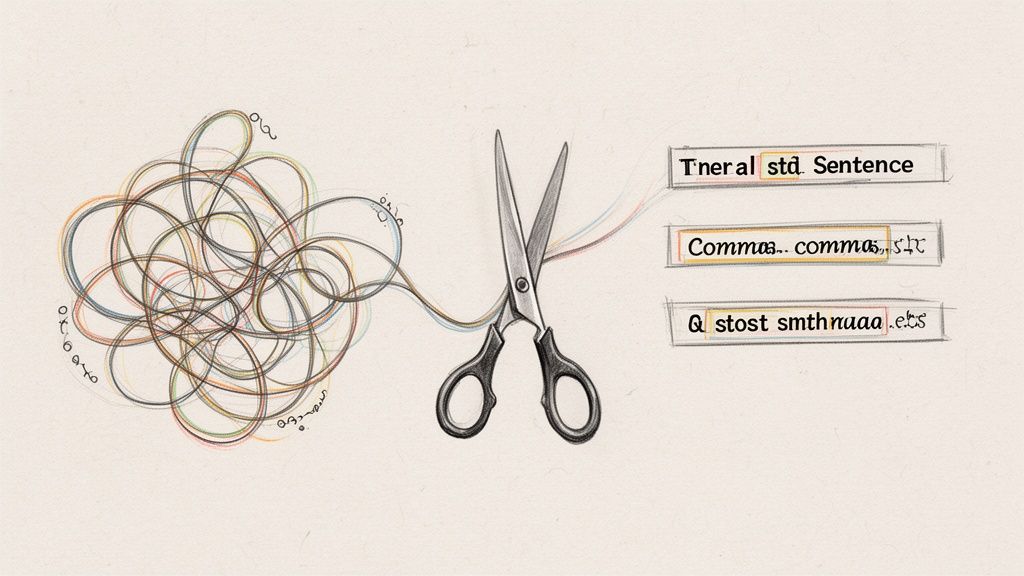
AI-generated content often contains convoluted sentences that hurt user engagement, with studies showing that readers lose attention when text is too dense. Simplifying sentences makes your writing more scannable and accessible. You can learn more about how to achieve this with concise writing.
When to Use This Strategy
This strategy is essential when your draft feels dense or difficult to follow. It's invaluable for marketers needing scannable landing page copy or professionals aiming to reduce misunderstandings in emails. If your readability score is low, this method is your fix.
How to Apply It
- Target Long Sentences: Actively search for sentences over 20-25 words. These are prime candidates for simplification.
- Hunt for Multiple Ideas: Look for sentences containing multiple commas or conjunctions like "and" or "but." They often signal several ideas crammed into one sentence.
- Apply the 'One Idea' Rule: Rewrite long sentences by giving each core idea its own sentence. This immediately boosts clarity.
- Split Dependent Clauses: Use words like "which" and "because" as flags. For instance, "The system failed, which caused a delay" becomes "The system failed. This caused a delay."
Pro Tip: Read your sentences aloud. If you find yourself running out of breath before you reach the period, the sentence is too long and needs to be simplified.
Using PureWrite for This Strategy
Our Humanize mode excels at sentence-level simplification. Instead of manually untangling every complex sentence, paste your text into PureWrite. We automatically detect convoluted structures and rewrite them into clear, simple sentences, helping you develop an instinct for concise phrasing.
6. The Peer Review/Fresh Eyes Method
This strategy leverages a simple truth: you are often the worst editor of your own work. After spending hours writing, you develop "familiarity blindness," making it nearly impossible to spot your own typos or logical gaps. The Fresh Eyes Method involves having another person review your writing to catch issues you've become blind to.
A peer reviewer acts as your first real audience, identifying unclear passages or whether the writing reads naturally. For AI-humanized content, this is one of the most critical writing revision strategies to confirm that the text sounds genuinely human.
When to Use This Strategy
Use this method after you've completed your own revisions but before you publish. It's essential for content agencies validating the naturalness of AI-humanized articles and marketing teams testing the clarity of a campaign message on someone outside their department.
How to Apply It
- Choose the Right Reviewer: Select someone who represents your target audience. A non-expert can be invaluable for spotting jargon.
- Provide Specific Questions: Instead of asking for "general feedback," guide them. Ask: "Does this sound natural?" or "What is the main takeaway you got from this section?"
- Let the Work Speak for Itself: Avoid explaining your intentions beforehand. Allow the reviewer to experience the text just as a real reader would.
- Collect Written Feedback: Ask your reviewer to leave comments or highlight specific phrases that feel robotic or artificial. This provides actionable points to address.
Pro Tip: For validating AI-humanized text, ask your reviewer to specifically look for phrases that "sound like a computer wrote them." This targeted feedback is crucial for achieving truly authentic prose.
Using PureWrite for This Strategy
The Peer Review Method is the ultimate quality check after using our tool. First, run your AI-generated draft through PureWrite's Humanize mode to instantly refine its structure and tone. Then, share the humanized version with a colleague. This streamlines your workflow, allowing your peer reviewer to focus on high-level feedback rather than getting bogged down by awkward AI language.
7. The SCRAP Method (Style, Clarity, Readability, Accuracy, Presentation)
The SCRAP Method is a comprehensive revision framework that breaks down the editing process into five distinct stages. Instead of trying to fix everything at once, this strategy allows you to focus on one dimension of writing quality at a time. This systematic approach ensures no detail is overlooked.
This method is one of the most powerful writing revision strategies for transforming raw AI-generated drafts into polished, professional content. It provides a complete workflow for content teams to ensure consistency and quality across all publications.
When to Use This Strategy
The SCRAP Method is ideal for important documents or when you need to enforce a consistent quality standard. It's perfect for content marketing teams vetting AI-generated blog posts and businesses ensuring all client-facing reports are flawless.
How to Apply It
- Style Pass: Check for consistent voice and tone. Does the writing sound like your brand or personal style?
- Clarity Pass: Ensure every sentence is unambiguous and easy to understand. For instance, change "customer pain points" to "customer challenges."
- Readability Pass: Assess the document's structure and flow. Break up long, dense paragraphs into shorter, 2-3 sentence chunks.
- Accuracy & Presentation Pass: Verify all facts, figures, and citations. Proofread for grammar and check for consistent formatting.
Pro Tip: Perform each pass separately. Trying to check for style and grammar at the same time is inefficient and leads to mistakes. Focus on one element at a time for a more thorough revision.
Using PureWrite for This Strategy
Our platform is a powerful ally for the first two stages of the SCRAP method. During your Style and Clarity passes, paste your text into PureWrite. The Humanize mode will instantly refine robotic AI patterns into a consistent, natural voice and rephrase convoluted sentences for maximum clarity. This allows you to complete the most challenging passes in a fraction of the time.
8. Tone and Voice Consistency Audit
This revision strategy focuses on maintaining a uniform authorial voice and emotional register from the first sentence to the last. The core principle is to analyze the personality and tone of your writing, ensuring it doesn't shift unexpectedly. This audit is one of the most critical writing revision strategies for content drafted with AI, as jarring shifts in voice can signal artificial origins.
This method ensures your writing feels authentic and builds trust with your audience. A consistent voice makes the content feel like it was crafted by a single, credible human author.
When to Use This Strategy
A Tone and Voice Consistency Audit is crucial when you've used AI to generate different sections of a draft. It's perfect for bloggers maintaining a distinctive brand personality and business teams ensuring formal reports don't become too casual.
How to Apply It
- Define Your Target Voice: Before you start, write down 3-5 adjectives that describe your ideal voice (e.g., "authoritative, witty, and helpful"). Find a few sentences in your draft that perfectly embody this voice to use as a benchmark.
- Read Out of Order: Review your paragraphs in a random sequence. This breaks the narrative flow and makes it easier to spot sections where the tone feels "off."
- Check Vocabulary and Phrasing: Look for word choices that feel inconsistent. For instance, using corporate jargon in one paragraph and casual slang in the next creates a jarring experience.
- Align Deviant Sections: When you find a section that deviates, rewrite it to match your benchmark sentences, adjusting vocabulary and sentence structure.
Pro Tip: Your writing voice is your brand's personality. Protecting its consistency is just as important as using the right logo. For a deeper dive, learn more about tone and voice in writing.
Using PureWrite for This Strategy
Inconsistencies often arise when blending AI-generated text with your own writing. Our Humanize mode is designed to solve this. Paste your entire draft into PureWrite, and we will analyze it for jarring shifts in tone, rewriting sections to create a single, cohesive voice that feels authentic.
9. Grammar and Mechanics Deep-Dive Review
This fundamental revision pass isolates your focus on the technical nuts and bolts of writing: grammar, spelling, punctuation, and syntax. By dedicating a specific review stage to these mechanics, you ensure that distracting errors don't undermine your message or credibility. It's the final polish that transforms a well-structured draft into a professional piece.
This strategy is one of the most crucial writing revision strategies for maintaining professionalism. After making significant stylistic edits, such as humanizing AI content, it's easy to introduce small mistakes. A dedicated mechanics pass catches these issues before your audience does.
When to Use This Strategy
A grammar and mechanics review is an essential final step before publication. It’s a non-negotiable step for students submitting essays, professionals sending important emails, and content teams publishing blog posts. It is especially critical after major rewrites.
How to Apply It
- Use a Digital First Pass: Start with a grammar checker like Grammarly to catch the most obvious errors quickly.
- Read Backwards: To trick your brain into focusing on mechanics instead of meaning, read your text from the last sentence to the first. This makes typos and grammatical mistakes stand out.
- Focus on One Error Type at a Time: Do one pass just for comma usage and another for subject-verb agreement. This focused approach is more effective than trying to catch everything at once.
- Create a Personal Checklist: Keep a running list of your common mistakes (e.g., its/it's, their/they're/there). Use this list to do a targeted final check.
Pro Tip: Don't blindly accept every suggestion from a grammar tool. Sometimes, a "grammatically incorrect" sentence fragment is an intentional stylistic choice for impact. Always consider the context.
Using PureWrite for This Strategy
After you’ve used PureWrite’s Humanize mode to enhance the style of your AI-generated text, a final mechanics check is a vital quality control step. While our tool focuses on naturalizing language, we always recommend running the output through a dedicated grammar checker. This two-step process ensures your content is not only engaging and human-like but also technically flawless. For a refresher, review some basic grammar rules.
10. Readability Metrics and Testing Strategy
This data-driven approach moves revision from a subjective art to an objective science. The core principle is to use established readability formulas, like the Flesch-Kincaid Grade Level, to measure how easy your text is to understand. By analyzing metrics such as sentence length and word complexity, you can systematically refine your writing to match your target audience's comprehension level.
This method is one of the most powerful writing revision strategies for ensuring your content is not just well-written but also perfectly calibrated for its intended readers. It provides concrete data to guide your edits and confirm that your revisions are effective.
When to Use This Strategy
This strategy is essential when accessibility is non-negotiable. It's a cornerstone for content marketers aiming for a broad audience (typically a 7th-8th grade reading level) and UX writers creating clear, intuitive interface copy.
How to Apply It
- Establish Your Benchmark: First, determine the ideal readability score for your audience. A blog for a general audience might aim for a score around 8, while a technical paper might target a higher level.
- Analyze Your Draft: Use a readability tool to score your current text. Note the grade level, average sentence length, and use of complex words.
- Simplify Sentences: Break down long sentences into shorter, more direct ones. Mastering how to vary sentence structure is key to improving flow without sacrificing sophistication.
- Substitute Complex Words: Replace jargon with simpler alternatives where possible without losing meaning. For example, change "utilize" to "use."
Pro Tip: Readability scores measure mechanical simplicity, not the quality of your ideas. Use them as a guide, not a rigid rule, and always combine metric analysis with a final human read-through.
Using PureWrite for This Strategy
Our platform integrates readability analysis directly into the revision process. When you use PureWrite to humanize AI text, our Quality Score feature provides instant feedback on metrics like Flesch-Kincaid Grade Level. This allows you to see how our revisions improve clarity and ensures the final text not only sounds human but also meets your audience's needs.
10 Revision Strategies: Side-by-Side Comparison
| Method | Implementation Complexity 🔄 | Resource Requirements ⚡ | Expected Outcomes ⭐📊 | Ideal Use Cases 💡 | Key Advantages ⭐ |
|---|---|---|---|---|---|
| The Hemingway Editor Approach | 🔄 Low–Medium — sentence-level edits; requires judgment | ⚡ Low — readability tools and manual time | ⭐⭐⭐⭐ — concise, punchy prose; 📊 higher readability & engagement | 💡 Converting dense AI output; blogs, emails, marketing | ⭐ Improves clarity and reduces verbosity |
| Read-Aloud Revision Method | 🔄 Low — single-pass auditory review but can be time-consuming | ⚡ Low — voice, quiet space or TTS/recorder | ⭐⭐⭐ — exposes awkward phrasing; 📊 better rhythm and flow | 💡 Dialogue, narrative, short–medium AI drafts | ⭐ Reveals pacing and unnatural wording missed visually |
| Reverse Outline Technique | 🔄 Medium — summarize paragraphs and rework structure | ⚡ Medium — time and analytical effort | ⭐⭐⭐⭐ — clearer organization; 📊 removes redundancy and logical gaps | 💡 Long articles, academic papers, repetitive AI content | ⭐ Exposes structural issues and guides reorganization |
| Multi-Pass Revision Approach | 🔄 High — multiple focused passes requiring coordination | ⚡ High — time, discipline, possible team/tools | ⭐⭐⭐⭐⭐ — layered, thorough improvements; 📊 fewer missed issues | 💡 High-stakes content, large-scale AI output, team workflows | ⭐ Systematic, comprehensive, reduces oversight |
| Sentence-Level Simplification Strategy | 🔄 Low–Medium — break complex sentences into simpler ones | ⚡ Low — time and sentence-guidelines | ⭐⭐⭐⭐ — improved readability and accessibility; 📊 shorter, clearer sentences | 💡 UX copy, e‑commerce, general-audience AI drafts | ⭐ Directly increases comprehension and engagement |
| Peer Review / Fresh Eyes Method | 🔄 Medium — coordinate reviewers and synthesize feedback | ⚡ Medium — reviewers' time and relevant expertise | ⭐⭐⭐⭐ — objective feedback; 📊 catches blind spots and tone issues | 💡 Academic teams, agency content, validating humanization | ⭐ External perspective uncovers unseen problems |
| The SCRAP Method | 🔄 High — five-dimension framework (Style, Clarity, Readability, Accuracy, Presentation) | ⚡ High — editorial knowledge, time, team alignment | ⭐⭐⭐⭐⭐ — comprehensive quality across dimensions; 📊 consistent professional output | 💡 Large-scale publishing, professional reports, final AI polish | ⭐ Holistic coverage prevents overlooked issues |
| Tone and Voice Consistency Audit | 🔄 Medium — define target voice then audit whole text | ⚡ Medium — reference samples, peers or tools | ⭐⭐⭐⭐ — cohesive voice; 📊 stronger authenticity and reader trust | 💡 Brand content, blogs, AI-humanized articles | ⭐ Strengthens authenticity and reader connection |
| Grammar and Mechanics Deep-Dive Review | 🔄 Medium — detail-oriented mechanical pass | ⚡ Low–Medium — grammar tools plus manual proofing | ⭐⭐⭐⭐ — error-free mechanics; 📊 professional polish and credibility | 💡 Final proofing, academic/professional publications | ⭐ Ensures correctness and maintains credibility |
| Readability Metrics and Testing Strategy | 🔄 Medium — analyze metrics and interpret results | ⚡ Medium — readability tools, analytics and time | ⭐⭐⭐ — measurable readability gains; 📊 data-driven improvement tracking | 💡 Audience-targeted content, healthcare, SEO-focused copy | ⭐ Provides objective benchmarks to guide edits |
Elevate Your Writing with Smarter Revision
You have just explored a toolkit of ten powerful writing revision strategies, moving far beyond a simple spell-check. From the structural clarity revealed by the Reverse Outline Technique to the flow discovered through the Read-Aloud Method, each strategy offers a unique lens through which to refine your work. The journey from a first draft to a polished final piece is a transformative process of elevating your ideas to connect with your audience.
The true strength of these techniques lies in their combined application. A Multi-Pass Revision Approach allows you to systematically address different aspects of your writing, while a Tone and Voice Consistency Audit ensures your message feels authentic. Mastering this layered approach is what separates good writing from truly great, impactful content.
The Modern Writer's Advantage
In today's content-driven world, the pressure to produce high-quality work quickly is immense. This is where a strategic approach to revision becomes a critical advantage. By internalizing methods like the SCRAP Method, you develop an editor’s mindset and make your entire writing process more efficient.
This is particularly relevant for those who use AI writing tools. While tools like AI writing software for novelists can offer new efficiencies, the human touch remains irreplaceable. The strategies discussed here are the very skills that ensure AI-assisted content maintains a genuine, human connection, always emphasizing ethical and authentic writing.
From Strategy to Habit: Your Next Steps
The goal is to integrate these writing revision strategies into your regular workflow until they become second nature. Diagnose your draft’s needs and select the most appropriate tools for the job.
Here are some actionable next steps to turn these concepts into habits:
- Start Small: Choose one or two new strategies to apply to your next writing project. The Read-Aloud method is a simple yet incredibly insightful place to begin.
- Create a Checklist: Based on these strategies, build a personal revision checklist that you can reference before publishing any piece of content.
- Schedule Revision Time: Treat revision as a distinct phase of the writing process. Block out dedicated time on your calendar specifically for editing, separate from your drafting time.
Ultimately, embracing a robust revision process is an investment in your credibility and impact as a writer. By making these powerful writing revision strategies a core part of your craft, you empower yourself to produce work that not only informs but also engages and inspires.
Ready to accelerate your revision process and ensure your AI-assisted content feels genuinely human? PureWrite uses advanced algorithms to help you polish your drafts into clear, engaging, and authentic prose. Transform your writing workflow and try Pure Write today to see the difference.