How to Write a Cover Letter That Gets You Hired in the AI Era
A great cover letter has three jobs: it needs to be laser-focused on the specific role, tell a story your resume can’t, and draw a straight line from your skills to the company’s biggest needs. It’s your one real chance to let your personality and genuine enthusiasm shine through, moving you from a name on a list to a candidate they need to meet.
For content creators and writers in today's market, this is your first and best portfolio piece.
Why Your Cover Letter Still Matters in Modern Hiring
With one-click applications and AI assistants, it's easy to dismiss the cover letter as a relic. Many applicants skip it, thinking their resume is enough. That's precisely why writing a thoughtful one gives you an immediate edge. It’s your best shot at making a human connection.
Your resume lists what you’ve done. Your cover letter explains why it matters to this company, right now. It's a direct conversation with the hiring manager, proving you’ve done your homework and are genuinely excited about this specific opportunity.
For example, a content creator’s resume might list "SEO writing." A powerful cover letter, however, explains how you drove a 45% increase in blog traffic for a company in a similar industry by creating a pillar content strategy. See the difference?
Bridging the Gap Between Your Resume and the Job
We like to think of a resume as the skeleton—the essential facts. The cover letter is the personality that brings it all to life. It gives you the space to:
- Tell a Story: You can finally connect the dots between different roles and projects, weaving a clear narrative that shows you’re a perfect fit for the company's mission.
- Showcase Communication Skills: Clear and confident writing is a skill every employer wants, especially for content roles. Your letter is a live demonstration of your ability to communicate with a professional, yet approachable, tone. Our guide on what is formal writing can help you nail that balance.
- Address Potential Concerns: Have a gap in your employment history? Making a career change from another field? The cover letter is the perfect place to frame these situations positively and proactively.
The stats on cover letters can be confusing. While some applicants may feel they're obsolete, data shows 26% of recruiters still read them and consider them critical to their decision. That means for about one in four recruiters, a tailored letter can be the tiebreaker that lands you an interview.
Shifting Your Mindset from Chore to Opportunity
Stop thinking of the cover letter as just another box to tick. See it for what it is: your single best opportunity to make an impression. AI writing assistants can be a great starting point for a first draft, but the magic happens when you infuse it with your own voice. That's our whole philosophy at PureWrite—ethically blending AI's efficiency with genuine, human authenticity.
A well-crafted cover letter doesn’t just repeat your resume; it amplifies your most relevant accomplishments and frames them within the context of what the employer needs right now.
At the end of the day, sending a thoughtful cover letter shows you're willing to go the extra mile—a quality every hiring manager is looking for. This detailed guide on how to write a cover letter that gets you hired is a fantastic resource for mastering this skill. Your goal is to transform your application from just another file in a system to a compelling argument for why you are the right person for the job.
The Anatomy of a Winning Cover Letter
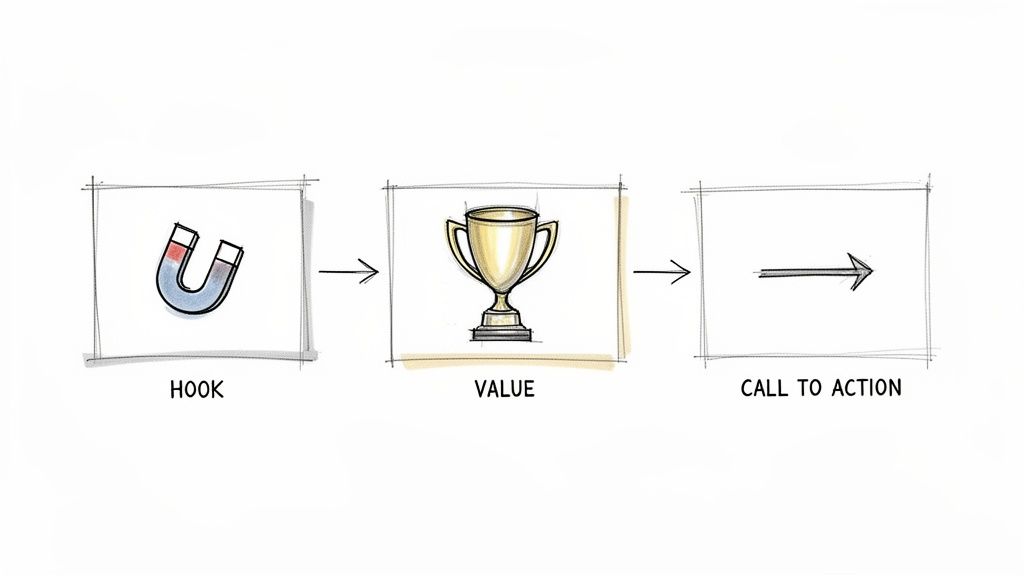
Think of your cover letter less like a formal document and more like a great marketing pitch. It has a clear beginning, middle, and end, each designed to pull the reader in and convince them you're the right person for the job.
Forget the stuffy, old-fashioned templates. A modern cover letter is punchy, scannable, and gets straight to the point. We'll break down a simple framework: hook the reader, prove your value, and confidently ask for the interview.
Don't underestimate its power. Adding a thoughtful cover letter really can set you apart. In fact, 26% of recruiters say a good one is a major factor in their hiring decisions because it shows genuine interest—something your resume alone can’t always convey. For more on hiring trends, Flair.hr has some eye-opening stats.
Let's break down the essential pieces of a modern cover letter that gets results.
Key Components of a Modern Cover Letter
| Section | Purpose | Key Elements to Include |
|---|---|---|
| Contact Info Header | Professionalism & easy access | Your name, phone, email, LinkedIn URL, date, and the recipient's details. |
| Opening Hook | Grab immediate attention | An engaging opening that bypasses clichés and connects your skills to the company's needs. |
| Body Paragraphs | Provide proof of your value | 2-3 short paragraphs with specific, quantified achievements that align with the job description. |
| Closing & CTA | End confidently and prompt action | A brief summary of your enthusiasm, a clear call to action (CTA), and a professional sign-off. |
Each part plays a crucial role in telling a cohesive and compelling story about why you are the ideal candidate.
The Essential Contact Information Block
First things first, get the header right. This isn't just about looking professional; it ensures the recruiter can easily see who you are and how to get in touch.
This block should sit right at the top of the page. Make sure it includes:
- Your Full Name: Clear and easy to read.
- Your Phone Number: The best one to reach you on.
- Your Professional Email Address: Something simple, like
[email protected]. - LinkedIn Profile URL (Optional but Recommended): This adds another layer of credibility.
- The Date: The day you’re sending your application.
After your information, add the recipient's details. It’s always best to address the letter to a specific person. A quick search on LinkedIn will often tell you exactly who the hiring manager is for the role.
Act One: The Powerful Opening Hook
You have about six seconds to make an impression. Your opening paragraph is your hook, and it needs to be sharp. Ditch the tired "I am writing to apply for the..."—everyone uses it, and it puts recruiters to sleep.
Start with something that shows you've done your homework and are genuinely excited. Mention a recent company win you admire or a specific problem in the job description you know you can solve.
Pro Tip: Your opening should read like a great headline. For instance: "When I saw the Content Creator opening at [Company Name], I was immediately drawn to its focus on building brand authority—a goal I helped my last client achieve by driving a 20% increase in organic search traffic."
An opener like that immediately frames you as a results-oriented problem-solver, not just another applicant in the pile.
Act Two: The Compelling Body Paragraphs
This is where you back up your claims. In two or three short paragraphs, you'll connect your past successes directly to the company's needs. The key is to show, not just tell.
Use the job description as your roadmap. Zero in on two or three key requirements and tell a quick story for each one, explaining how you tackled a similar challenge.
- Quantify your achievements: Don't just say you "wrote blog posts." Instead, say you "grew our blog subscribers by 300% in six months by launching a new interview-based content series." Numbers grab attention.
- Use strong action verbs: Words like "led," "created," "optimized," and "launched" have far more impact than passive language.
- Connect the dots for them: Clearly explain how your experience will help them solve their problems and hit their goals.
This is also your chance to let your personality come through. If you used an AI tool like ChatGPT for a first draft, this is the section to focus on humanizing. At PureWrite, we specialize in refining that robotic AI text into an authentic story that sounds like you. Ready to make your AI draft sound more human? Try PureWrite for free.
Act Three: The Confident Closing and Call to Action
Your final paragraph should wrap everything up with confidence. Briefly restate your excitement for the position and your conviction that you’d be a great addition to their team.
Then, finish with a clear, proactive call to action. Don't just say you "look forward to hearing from them." Take the lead. State that you're eager to discuss how your skills can specifically benefit the company. For more guidance on finishing touches, our article on the proper business letter format in Word is a great resource.
Sign off professionally with "Sincerely" or "Best regards," followed by your typed full name. A strong, confident close leaves a lasting impression and makes it easy for the hiring manager to take the next step.
How to Tailor Your Cover Letter for Any Role
Sending out a generic cover letter is like sending a "Dear Resident" flyer in the mail. It's impersonal, lazy, and almost always ends up in the trash. When you customize your letter, you’re signaling that you’ve done your homework and aren't just firing off applications to any company with an opening.
The goal here is simple: stop summarizing your resume and start responding directly to the company's needs. You need to show them you're not just qualified—you're the solution to a problem they're facing right now. This approach turns your application from just another one in the pile to one they have to read.
Deconstruct the Job Description
Before you write a single word, put on your detective hat. The job description is a treasure map, loaded with clues about what the company is truly looking for. We always recommend pulling it into a separate document so you can mark it up.
Start by highlighting the keywords and core responsibilities. But don't stop there. Pay close attention to the language they use. Are they looking for a “collaborative team player” or a “self-starting innovator”? Those aren't just buzzwords; they’re a window into the company's culture.
As you go, sort the requirements into two buckets:
- Must-Haves: These are the deal-breakers—proficiency in a specific software, a certain number of years of experience, a required certification. You absolutely have to address these.
- Nice-to-Haves: These are the bonus points—things like public speaking skills or experience in a related industry that would make you an even better fit.
This quick exercise gives you a perfect blueprint. Your cover letter should hammer home how you nail the "must-haves" and then sprinkle in a few examples of the "nice-to-haves" to really seal the deal.
Go Beyond the Job Posting
A good applicant reads the job description. A great applicant digs deeper. The posting tells you what they want, but a little research tells you why they want it. Just 15-20 minutes of online sleuthing can give you an incredible edge.
Try to find answers to a few key questions:
- What are their most recent product launches or company achievements?
- What major challenges is their industry facing?
- Who are the leaders on the team you'd be joining? What do they post about on LinkedIn?
This isn't about being a stalker; it's about being prepared. Referencing a recent company blog post or a quote from the CEO shows a level of genuine interest that very few other candidates will bother to demonstrate. This is just smart audience analysis at work. To learn more, we have a helpful guide on what is audience analysis and how you can apply it.
Connecting Your Experience to Their Needs
Okay, now it’s time to connect the dots. You have their list of needs and you have your experience. The magic happens when you build a bridge between the two. For every key responsibility you highlighted, come up with a concrete story or metric from your past that proves you can deliver.
Instead of the generic, "I have strong project management skills," try something with teeth: "At my last company, I led a cross-functional team to launch a new software feature two weeks ahead of schedule, managing the project from initial concept all the way through rollout."
See the difference? The second example provides undeniable proof. This is where you really need to step in, even if you’re using an AI writer to get started. An AI can list your skills, but it can’t tell your stories. Only you can provide the specific, compelling anecdotes that bring your qualifications to life.
If your AI-generated draft feels a bit flat or robotic, that's exactly where PureWrite comes in. We take that functional first draft and help you refine it into natural, persuasive writing that sounds like you. Ready to make your story shine? Try PureWrite for free.
Turning Your AI Draft into a Standout Application
Let's be honest: AI writing tools are a huge help for getting started on a cover letter. They can beat writer's block and give you a solid foundation. But that's all it is—a foundation. An unedited AI draft often feels flat and impersonal, filled with buzzwords and phrasing that a hiring manager can spot a mile away.
This is a bigger deal than you might think. A recent report on AI in the job search from Coversentry.com found that while 70% of job seekers use AI in their search, recruiters have become much better at spotting unedited AI content. Using AI ethically means using it as a co-pilot, not an autopilot.
The trick isn't to avoid AI, but to use it smartly. The real key to getting noticed is blending AI’s speed with your own human touch to create something that actually connects with a real person.
From Robotic to Relatable: A Quick Makeover
Let’s walk through a real-world example. You feed an AI your resume and the job description for a content creator role, and it spits out something like this:
The AI-Generated Draft:
"Utilizing my extensive experience in digital marketing and content creation, I am well-equipped to enhance your company’s online presence. My background includes the successful execution of multiple campaigns that increased key performance indicators. I am proficient in SEO best practices and social media management, which I am confident will be beneficial."
It’s not wrong, but it has zero personality. It's generic, passive, and sounds like a template because, well, it is. A hiring manager has read this exact paragraph hundreds of times.
Now, let's see what happens when we refine it. The goal isn't just to fix grammar; it's to weave in your unique voice and hard-won achievements to make it sound like you. We built PureWrite to do exactly that.
Here’s a glimpse of how our platform can instantly polish that robotic text, making it sound natural and engaging enough to fly past any AI detection.
See the difference? The "after" version feels so much more authentic and compelling. It shows how a few thoughtful tweaks can completely change the impact of your message.
The PureWrite Difference
Here’s that humanized text again, now infused with concrete details and a confident, natural tone:
Humanized with PureWrite:
"I was excited to see your focus on growing your online presence, as it aligns perfectly with my background. In my last role, I drove a 45% increase in organic blog traffic by overhauling our SEO strategy and launching a targeted content series. I believe I can bring that same data-driven creativity to your team and deliver similar results."
This version lands so much better, and here’s why:
- It Quantifies Achievements: "A 45% increase in organic blog traffic" is concrete and impressive. "Increased key performance indicators" is vague and forgettable.
- It Shows Real Enthusiasm: Starting with "I was excited to see" adds a personal touch and genuine interest that AI struggles to replicate.
- It's Confident and Direct: It clearly links a past win to the company's future needs, showing you've thought about how you can contribute.
This is exactly how you should be using AI ethically and effectively. Start with the draft AI gives you, then use a tool like PureWrite to layer in the human elements—your stories, your metrics, your personality. That’s what makes a cover letter truly yours.
For a deeper look into this process, check out our guide on how to humanize AI text without losing your voice. Ready to see how much better your AI draft can be? Try PureWrite for free and feel the difference a human touch makes.
Real-World Cover Letter Examples: From Graduate to VP
Theory is one thing, but seeing it in action is another. We've walked through the what and why of a great cover letter, so now let's look at the how. We've put together three examples from different career stages to show you how these principles come to life.
Think of these less as rigid templates and more as a source of inspiration for telling your own story.
Before we dive in, take a look at the image below. It perfectly illustrates the difference between a flat, robotic AI draft and a letter that's been polished with a human touch. This is exactly what we're aiming for.
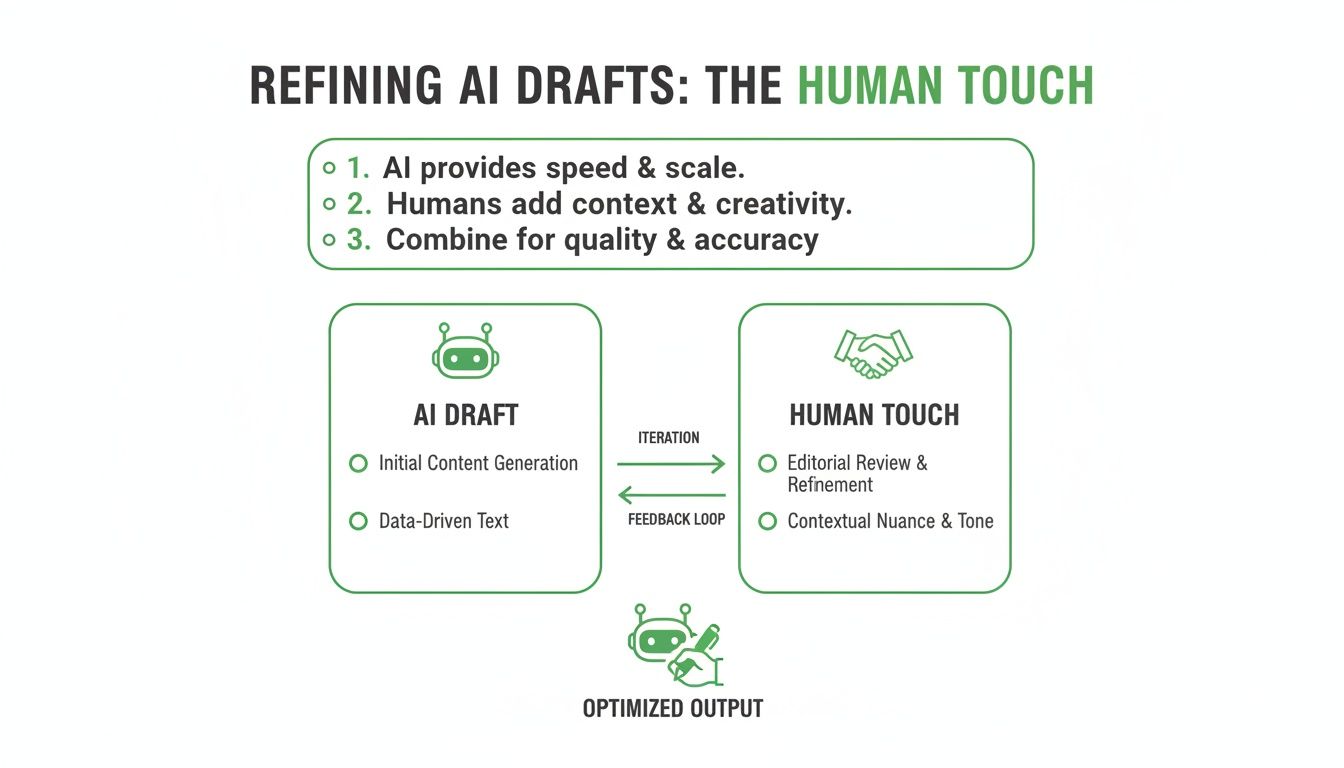
As you can see, the magic happens when you swap generic phrases for specific metrics, a personal voice, and a clear connection to the company’s mission.
The way you present yourself in a cover letter should evolve with your career. A recent graduate will naturally focus on different strengths than a senior director. This table breaks down the subtle but critical shifts in tone and focus.
Tone and Focus by Career Level
| Career Level | Primary Focus | Recommended Tone |
|---|---|---|
| Entry-Level | Potential, enthusiasm, transferable skills, and academic projects. | Eager, proactive, and coachable. |
| Career Changer | Bridging past experiences to new roles, transferable skills, and a unique perspective. | Confident, strategic, and adaptable. |
| Senior-Level | Strategic impact, leadership, major achievements, and solving high-level business problems. | Authoritative, peer-to-peer, and results-oriented. |
Understanding these nuances helps you frame your experience in the most relevant way for the hiring manager.
Example 1: The Entry-Level Professional
If you're just starting out, your cover letter is where you sell your potential. Your resume might look a bit thin, but your cover letter can be packed with passion, drive, and examples of how your academic work translates into real-world skills.
Here’s how an entry-level content creator can make a strong impression:
Dear Mr. Harrison,
I was thrilled to see the opening for a Junior Marketing Coordinator on Innovate Inc.'s LinkedIn page. As a recent magna cum laude graduate with a B.A. in Communications, my coursework in digital analytics and my hands-on experience managing social media for a university club have prepared me to contribute to your team from day one.
During my senior capstone project, I developed a comprehensive digital marketing plan for a local nonprofit that led to a 25% increase in online donations over three months. This involved everything from content creation to SEO keyword research, and it cemented my passion for using data-driven stories to build community. I'm eager to bring this same energy and proactive approach to help grow Innovate Inc.'s brand presence.
Thank you for considering my application. I am very enthusiastic about the opportunity to discuss how my skills in content strategy and audience engagement can support your team's goals.
Sincerely,
Jane Doe
Why This Works: Jane doesn't just say she's skilled; she proves it with a specific, quantified win from a college project. She shows genuine excitement and makes a direct link between her experience and the company's needs.
Example 2: The Career Changer
Pivoting into a new field? Your cover letter is your best tool for connecting the dots. Your job is to show the hiring manager that your seemingly unrelated background is actually a unique asset.
Take a look at how a teacher might reframe their experience for a corporate training role:
Dear Ms. Chen,
For the past eight years as a high school English teacher, my daily mission was to make complex information engaging and accessible for diverse audiences. When I saw the Learning and Development Specialist role at TechCorp, I recognized an opportunity to apply my expertise in curriculum design and public speaking to empower your employees.
I recently designed and implemented a new professional development curriculum for 40+ faculty members, which led to a 15% improvement in student engagement metrics. This required assessing skill gaps, creating targeted training modules, and leading workshops—all skills directly applicable to the responsibilities you've outlined. My passion is helping people learn and grow, and I'm excited by the prospect of doing so within a dynamic corporate environment like TechCorp's.
I am confident that my unique background in education provides a strong foundation for creating effective training programs. I look forward to discussing how I can contribute to your team.
Best regards,
John Smith
Why This Works: John tackles his career change head-on, positioning his teaching background as a major advantage. He cleverly uses corporate language ("skill gaps," "training modules") and backs it up with numbers, proving his skills are not just relevant but transferable.
Example 3: The Senior-Level Expert
When you're applying for a senior role, the game changes. Your cover letter should be sharp, confident, and laser-focused on high-level business impact. Forget rehashing your resume—pick one or two massive wins that show you can solve the company's biggest problems.
Here’s an example from an experienced sales director aiming for a VP role:
Dear Hiring Committee,
Having followed Apex Solutions' impressive market growth for the past several years, I was particularly interested to see the opening for a VP of Sales. In my current role as Sales Director at Global Tech, I expanded our team into three new international markets and drove a $10M increase in annual recurring revenue—a strategic accomplishment that aligns with the growth trajectory I see for Apex.
My leadership style is built on data-driven strategy and mentorship. I recently spearheaded the adoption of a new CRM platform that boosted team productivity by 30% and improved our sales forecasting accuracy. I am confident I can bring this same strategic vision and operational excellence to lead your sales division through its next phase of expansion.
I am eager to discuss how my experience in scaling sales teams and penetrating new markets can deliver immediate value to Apex Solutions.
Sincerely,
Maria Garcia
Why This Works: Maria comes in strong. She leads with a huge, C-suite-level number ($10M in ARR) and speaks the language of strategy and leadership. She isn't just applying for a job; she's positioning herself as a peer who can solve their most significant challenges.
These examples show how your story and tone should shift based on where you are in your career. While an AI tool can give you a starting point, it's the personal stories and hard numbers that grab a reader's attention.
If your own draft is feeling a little generic, we at PureWrite can help you find those compelling details and craft a letter that truly stands out. Try PureWrite for free and make sure your story gets the attention it deserves.
Common Mistakes That Get Applications Rejected
You’ve spent hours crafting the perfect story, tweaking every sentence to align with the job description. The last thing you want is a simple, avoidable mistake to torpedo all that effort. Your cover letter is often the final hurdle before a hiring manager decides to give you a call.
Even the sharpest candidates fall into these common traps. From a tiny typo to a generic greeting, these blunders can signal carelessness—and that’s a quality no employer is looking for. Let’s walk through the most frequent pitfalls so you can hit "send" with total confidence.
Overlooking the Small Stuff
Typos and grammatical errors are the fastest way to the "no" pile. It might seem trivial, but to a hiring manager, it suggests you didn't care enough to proofread, or your writing skills aren't up to snuff. Neither is a good look.
Here are a few tried-and-true tricks to catch every mistake:
- Read it aloud. Seriously, do it. Hearing the words forces you to slow down, and you'll catch awkward phrases and typos your brain would otherwise skip over.
- Print it out. Staring at a screen for hours can cause you to miss things. A physical copy often makes errors jump off the page.
- Ask for a second opinion. Grab a friend, a former colleague, or a mentor and ask for a quick once-over. A fresh set of eyes is your best defense.
A flawless document screams professionalism. This final check isn’t just a good idea—it’s non-negotiable.
The Sin of Being Generic
Recruiters can spot a generic, copy-pasted cover letter from a mile away. Phrases like "I'm a hardworking team player" mean nothing. Worse, forgetting to swap out the company name from your last application is an instant rejection. It shows you aren't truly interested in this specific opportunity.
Your cover letter must feel like it was written for one person and one person only—the hiring manager for the job you want. Generic applications show a lack of effort and respect for their time.
Simply rehashing your resume is another classic mistake. Your cover letter isn’t just a list of your past duties. It’s your chance to connect the dots and explain how your experience directly solves the company’s problems.
Striking the Wrong Tone
Finding that perfect tone is a balancing act. You want to be confident but not arrogant, and enthusiastic without sounding desperate. Language that’s overly formal can come across as stiff and robotic, while being too casual can feel unprofessional.
A common pitfall is using passive voice, which can really water down your accomplishments. Instead of "The project was managed by me," write "I managed the project." Owning your achievements with strong, active language makes a much bigger impression. For a deeper dive, check out our guide on passive vs. active voice examples.
This goes beyond just your cover letter, of course. To truly stand out, you need to master your communication skills for every stage of the hiring process.
Even if you use an AI tool for a first draft, the final tone is on you. At PureWrite, we specialize in helping you refine that initial output into something that sounds polished, natural, and perfectly balanced. Try PureWrite for free and make sure your tone lands just right.
Answering Your Top Cover Letter Questions
Even after you've got the basics down, a few tricky questions always seem to pop up. Let's tackle some of the most common ones we hear from job seekers.
How Long Should a Cover Letter Be?
Keep it short and punchy. The ideal length is somewhere between 250 and 400 words. This gets you about three or four solid paragraphs, which is more than enough to make your case without overwhelming a busy hiring manager.
Think of it this way: you want your letter to fit comfortably on a single page with plenty of white space. A wall of text is an instant turn-off. Sticking to this word count forces you to be clear, concise, and respectful of their time—all great qualities to demonstrate upfront.
Do I Really Need a New Cover Letter for Every Single Job?
Yes. One hundred percent, yes. Sending out a generic, one-size-fits-all cover letter is the fastest way to get your application tossed. Recruiters have seen it all, and they can spot a form letter in seconds. It just screams, "I'm not that interested in this job."
Every single cover letter you send needs to be written specifically for that role and that company. This is your single biggest opportunity to stand out.
Customizing your letter means you're doing more than just swapping out the company name. You should be echoing the specific language from the job description, highlighting the skills they are asking for, and mentioning something unique about the company that caught your eye. It shows you’ve done your research and you're genuinely excited about the possibility of working there.
Who Should I Address the Cover Letter To?
Your goal should always be to find a specific name. An opening like "Dear Ms. Chen" hits so much harder than the painfully outdated "To Whom It May Concern." It shows you took the initiative and creates an instant personal connection.
Spend a few minutes on LinkedIn or the company’s "About Us" page. Look for the head of the department you're applying to. If you absolutely can't find a name, your next best bet is to use their title, like "Dear Hiring Manager" or "Dear Director of Marketing." It's still far better than a generic greeting.
Feeling better about your draft? If you want to make sure your writing sounds polished, authentic, and genuinely human, give PureWrite a try. We help you transform your text—whether it started with AI or your own brain—into a compelling story that connects with real people. Stop worrying about sounding like a robot and start humanizing your content for free at https://purewrite.io.