What Is Formal Writing and Why Does It Matter Today?

Formal writing is less about following rigid rules and more about adopting a professional mindset. Think of it as the "dress code" for your words—a style you choose to convey authority, seriousness, and respect in contexts where it matters most.
This guide provides practical, actionable advice for content creators, students, and professionals looking to master this essential skill, especially when using AI writing tools.
Decoding Formal Writing in the Modern World
At its heart, formal writing is about building credibility with your reader. It's a conscious choice to prioritize objectivity over personal opinion, precision over casual language, and logical structure over conversational flow. When you need your ideas taken seriously—whether in a research paper or a business proposal—this is the style you use.
This approach isn't new. Formal writing was standardized in the 19th century as professional institutions required clear, unbiased communication. Core principles like an impersonal tone and meticulous grammar still inform the 95% of academic and business documents that rely on these standards today. To see how these standards have evolved, check out our guide to the best writing style guides.
The Purpose of a Formal Tone
So, why does this structured style matter so much? The main goal is to present information clearly and without bias. By intentionally avoiding contractions, slang, and first-person pronouns like "I," you create professional distance.
This allows your argument to stand on the strength of its evidence, not your personal feelings. That objective stance signals to your reader that you’ve approached the topic with intellectual rigor and care.
When to Use Formal Writing
You encounter formal writing more often than you might think. It is the foundation of high-stakes communication where clarity and professionalism are non-negotiable.
- Academic Settings: This is the language of essays, research papers, and dissertations, where structured arguments and solid evidence are everything.
- Professional Communication: Think of business plans, official company reports, legal contracts, and important emails to clients or upper management.
- Official Correspondence: This covers everything from government documents and cover letters to formal complaints and public statements.
While the contexts differ, the goal is always the same: to communicate serious information in a clear, respectful, and authoritative way. Getting this right is a critical skill for success.
The Four Pillars of Effective Formal Writing
To truly understand what formal writing is, you need to look past surface-level rules to its core structure. Effective formal writing rests on four pillars: an objective tone, precise vocabulary, complex sentence structure, and logical organization.
Getting these elements right makes your writing sharp and impactful. It’s not about sounding robotic; it’s about creating a framework that gives your ideas the credibility they deserve.
Pillar 1: Objective Tone
The first pillar is maintaining an objective tone. This means removing your personal feelings, biases, and opinions from the text. The easiest way to achieve this is by using a third-person perspective and avoiding personal pronouns like "I" or "we" unless the context demands it.
For instance, instead of writing, "I think the data shows a significant trend," a more objective phrasing is, "The data indicates a significant trend." This small change shifts the focus from your belief to the evidence itself, strengthening your argument.
Pillar 2: Precise Vocabulary
Next is using precise vocabulary. Formal writing leaves no room for confusion, so you must choose words with specific, unambiguous meanings. This means swapping vague words like "good" or "stuff" for exact terms like "effective" or "materials."
This isn't about using big words to sound smart; it's about eliminating any chance of misinterpretation. A strong vocabulary, combined with flawless grammar, is essential. For a quick tune-up, you might find our guide on basic grammar rules useful.
Formal writing is fundamentally a set of behaviors designed to convey a message with maximum authority and minimum ambiguity. It guides the reader through a logical sequence, ensuring the core ideas are both respected and understood.
Pillar 3: Complex Sentence Structure
The third pillar is the use of complex sentence structures. Unlike the short sentences of casual writing, formal prose often weaves ideas together using clauses and conjunctions. This allows you to articulate sophisticated relationships between concepts, like cause and effect or comparison.
The numbers back this up: formal writing is the standard in professional settings, making up 78% of all business communications. One of its defining traits is longer sentences—averaging 24 words compared to 14 in informal styles—which allows for the careful explanation of complex ideas. You can dive deeper into these stylistic differences in Grammarly's comprehensive analysis.
Pillar 4: Logical Organization
Finally, logical organization holds everything together. Every paragraph must flow seamlessly into the next, leading the reader down a clear path. This is usually achieved with a strong thesis statement, clear topic sentences, and smooth transitions.
This infographic summarizes the core principles formal writing is built to achieve.
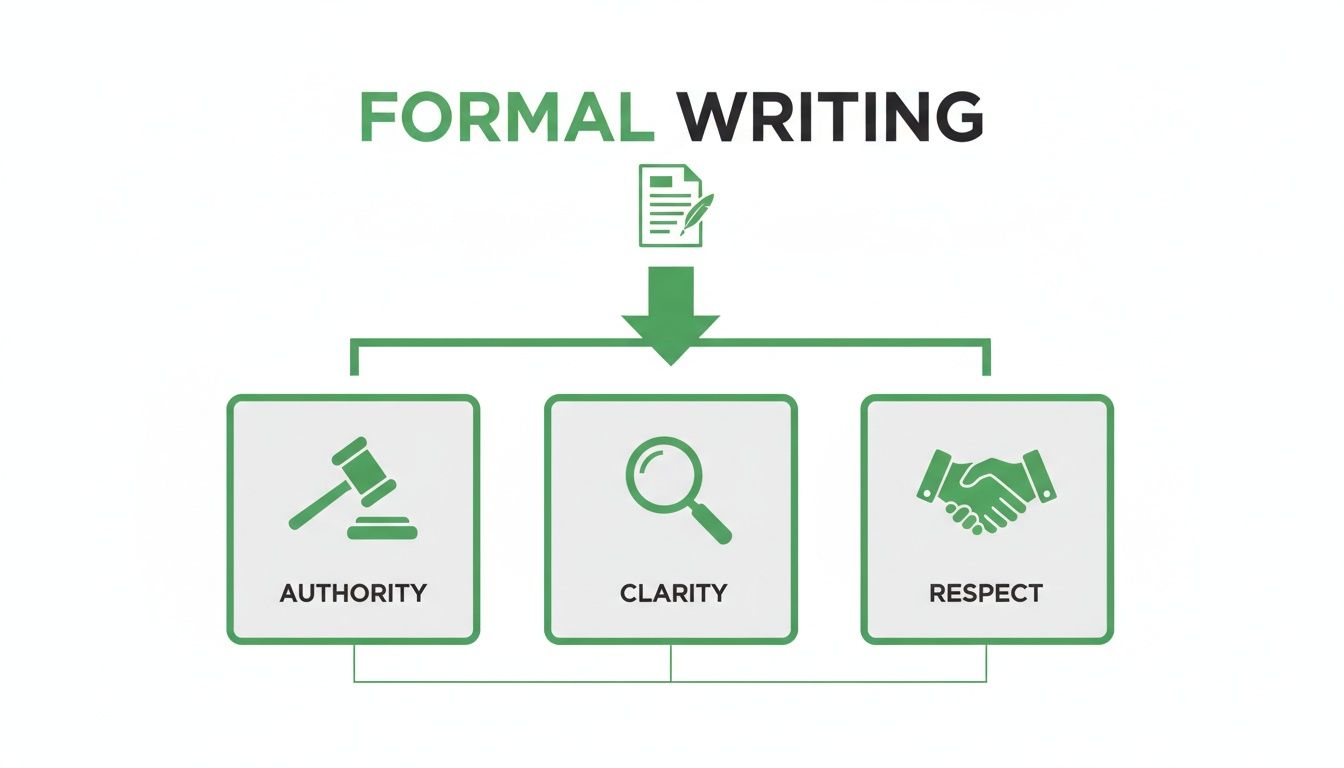
As you can see, the goals are always to establish authority, guarantee clarity, and show respect. By mastering these four pillars, you build a foundation for powerful, persuasive communication.
Seeing Formal Writing in Action with Real-World Examples
It’s one thing to discuss the rules of formal writing, but it's another to see how they work in practice. Let's look at some real-world examples from different professional fields to see what makes them effective.
This hands-on analysis helps connect principles to real documents, giving you a clear blueprint for your own work. By seeing how successful writers balance objectivity with a persuasive edge, you’ll get a better feel for structuring your own communications.
The Business Proposal
A great business proposal must be convincing without sounding biased. The goal is to build trust by presenting a solution in a logical, professional, and data-driven way.
Example: "Based on the Q3 performance analysis, implementing the proposed automated workflow is projected to increase operational efficiency by approximately 18%. This initiative will reduce manual data entry errors and reallocate team resources to higher-value strategic tasks."
This works because it uses a third-person perspective and specific data (18%) to ground its claims. The language is confident and direct, focusing entirely on measurable outcomes. This objective style is crucial for documents like those we cover in our guide on how to write compelling business reports.
The Academic Paper
In academia, precision is everything. Formal writing demands meticulous language and a rigid structure built to support arguments with verifiable evidence.
Example: "The study's findings indicate a statistically significant correlation between prolonged exposure to blue light and disruptions in circadian rhythms. Subsequent research should investigate the long-term neurological impacts, as the preliminary data suggests a potential for broader physiological consequences."
Notice the precise terminology like "statistically significant correlation." The passage avoids casual phrasing and uses an objective, third-person viewpoint, keeping the focus on the research and its implications.
The Formal Email
Even a routine email needs a formal tone to establish professionalism and respect, especially when communicating with new clients or senior leadership.
Example: "Dear Mr. Chen, Thank you for your inquiry regarding our content marketing services. I have attached our detailed service catalog for your review. Please let me know if you are available for a brief call next week to discuss your specific needs."
This email is polite, concise, and direct. It avoids contractions and informal greetings, clearly stating its purpose and outlining the next step. For more examples in a professional context, a guide on creating better user manuals and documentation is a great resource.
AI tools can generate a first draft, but they often miss these critical nuances. PureWrite helps you ethically refine that raw text into polished prose, turning generic output into a document that sounds authentically human.
Avoiding Common Formal Writing Mistakes
Even seasoned writers can fall into common traps when aiming for a formal tone. A big part of mastering this style is knowing what not to do. By avoiding these missteps, you ensure your message is powerful and professional.

It's tempting to use complex jargon to sound more intelligent, but this often backfires by confusing your audience. True formal writing always chooses clarity over needless complexity.
Overusing the Passive Voice
The passive voice is one of the quickest ways to weaken your writing. While it has its place in scientific reports, overusing it makes your sentences feel stuffy and evasive.
For instance, "The decision was made by the committee" is passive. Flipping it to the active voice, "The committee made the decision," is more direct. For a closer look, our guide on passive voice vs. active voice examples breaks it down.
Letting a Conversational Tone Slip In
Informal habits can easily creep into formal documents. This includes using contractions like "don't" or adopting a chatty style when objectivity is required.
An overly casual tone can sink your credibility faster than almost any other mistake. The goal is to sound authoritative and respectful, not like you're texting a friend.
Keep an eye out for these slip-ups during revision:
- Contractions: Always write out the full words, like "do not" instead of "don't."
- Slang and Colloquialisms: Stick to language that is universally understood in a professional setting.
- Improper Citations: Failing to credit sources is a serious breach of academic and professional integrity.
These are precisely the kinds of mistakes that often appear in AI-generated drafts. At PureWrite, we designed our tools to help you spot these issues, transforming a robotic draft into a document that meets the highest standards.
How to Refine AI Drafts into Polished Formal Prose
AI writing assistants are fantastic for creating a first draft, but that output rarely meets formal communication standards. This is where a partnership between you and the right tool comes in. At PureWrite, we see AI as a way to enhance your skills, not replace them, helping you transform raw text into sophisticated, human prose.
The reality is, AI-generated content often misses the subtle rules of formal writing. Research shows that AI text fails formal benchmarks 73% of the time, usually due to simple mistakes like using contractions or an overly casual tone. PureWrite is designed to catch and correct these exact issues, helping you produce polished writing. You can learn more about the expectations for formal writing styles and see why these details matter.
Humanize AI Text While Keeping Your Voice
Our main goal at PureWrite is to help you sound like yourself—only more polished. Our 'Humanize' feature refines tone, removes casual language, and suggests stronger vocabulary, all while keeping your core message intact. We help you ethically turn that robotic-sounding first draft into a finished piece that truly reflects your authentic voice.
Formal writing isn’t about losing your voice; it's about presenting it with authority and clarity. PureWrite ensures your unique perspective shines through, even after refining AI-generated text for a professional audience.
This is critical in professional environments. For example, when using tools to create AI-generated LinkedIn posts, a generic draft can be transformed into engaging, authoritative content that reflects your expertise.
It's about taking a good start and making it great. Here’s how PureWrite bridges the gap between a standard AI draft and polished formal writing.
Transforming AI Drafts with PureWrite
| Challenge in AI Draft | Before PureWrite | After PureWrite |
|---|---|---|
| Overly Casual Tone | The study’s results are pretty interesting and show a lot. | The study's findings are significant and reveal several key trends. |
| Use of Contractions | We can't proceed without the board’s approval. | We cannot proceed without the board’s approval. |
| Robotic Phrasing | The utilization of this methodology will result in enhanced outcomes. | This methodology will produce superior outcomes. |
| Weak Vocabulary | The new software is a good way to fix our problems. | The new software presents a robust solution to our challenges. |
This table shows how a few careful adjustments can elevate your writing from a rough AI draft to something that meets professional and academic expectations.
Ensure Integrity with Built-In Checks
In any formal setting, professional integrity is the top priority. That’s why PureWrite comes with built-in AI detection and plagiarism checks. These features give you peace of mind to submit your work confidently, knowing it meets the highest standards of originality. We give you the tools to use AI responsibly and ethically.
Ready to see how you can elevate your own writing? To dive deeper into this process, check out our detailed guide on how to rewrite AI text to human.
Try PureWrite today and discover how simple it is to turn a basic AI draft into an impressive, polished, and authentically human piece of formal writing.
Your Formal Writing Questions Answered
Let's tackle some of the most common questions people have about formal writing. Think of this as a quick FAQ to clear up those situations where the rules feel a bit gray. Sometimes, a straightforward answer is all you need.
Getting the hang of formal writing is often about understanding the difference between a hard rule and a flexible guideline. When in doubt, always return to your core goals: clarity, credibility, and respect for your reader.
Can I Use 'I' in Formal Writing?
This is a common question, and the short answer is: it depends. While the third-person perspective is standard for objective writing like research papers, there are times when using "I" is necessary.
For instance, in a personal reflection, a statement of purpose, or a cover letter, you have to speak from your own perspective. The key is to consider your audience and the document's purpose. For a formal business report or scientific paper, sticking to the third person is your safest bet.
Are Long Sentences Always Better?
There's a myth that formal writing must use long, complicated sentences to sound intelligent. While formal prose often uses complex structures, the goal isn't length—it's clarity. The aim is to build sentences that are logical and show how ideas connect.
A paper filled with only long sentences is exhausting to read. The best formal writing varies sentence length. A short, punchy sentence can have a huge impact, so focus on crafting strong, precise sentences, not just long ones.
Can Formal Writing Be Engaging?
Absolutely. It's a huge misconception that "formal" means "boring." Engaging writing isn’t about adding emojis; it’s about presenting ideas with such conviction and clarity that your reader is drawn in.
How do you make formal writing compelling?
- Use strong, precise verbs: Active verbs breathe life into your writing and make your points feel more dynamic.
- Build a solid argument: A well-supported argument that flows logically is naturally engaging.
- Write with a confident tone: When you write with authority, you earn the reader’s attention and trust.
Engagement comes from the power of your ideas, not from trying to sound casual. This is where a lot of AI-generated text misses the mark—it can copy the formal structure but often lacks the genuine, persuasive energy of a human writer. And that's a gap we help you close.
At PureWrite, we know that real engagement comes from letting your authentic voice shine through while meeting the high standards of formal communication. Our tools are built to help you ethically refine AI-generated drafts, polishing your tone and strengthening your arguments so your final document is both professional and powerful. Ready to turn your drafts into something truly compelling? Try PureWrite today and feel the difference.