How to Write Executive Summaries That Persuade and Inspire Action

Writing an executive summary is an art. It's about boiling down a massive report into a single, hard-hitting page that spells out the problem, your key findings, and what you recommend doing about it. The goal is simple: give a busy stakeholder everything they need to make a decision, even if they never read another word.
As content creators, marketers, or students, mastering this skill is crucial. Whether you're using AI to help draft your report or writing from scratch, the summary is your moment to shine.
Why Your Executive Summary Is the Most Important Page
Picture this: your CEO has exactly five minutes before a board meeting to understand your 50-page report. They're not going to read it. They're going to read the executive summary. That one page is often the make-or-break moment that decides if your project gets the green light or gets buried.
The real job of a summary is to deliver a high-level overview that makes smart, quick decisions possible. Your audience—executives, investors, key stakeholders—is always short on time. They need clarity, they need it to be brief, and they need to know what to do next, fast. A great summary isn't just a shorter version of your report; it’s a standalone document built to convince.
The Decisive First Impression
Think of your executive summary as the handshake for your entire report. It's the first and, frankly, often the only impression you'll make. It sets the tone and frames the entire conversation. If it's confusing, messy, or buries the lede, your reader will likely assume the rest of the report isn't worth their time.
For instance, a marketing team might have a killer proposal for a new campaign, backed by dozens of pages of solid data. But the executive summary has to lead with the expected ROI, the impact on the target market, and the core strategy. That’s what grabs an executive's attention and secures their approval.
A well-crafted executive summary bridges the gap between comprehensive data and decisive action. It respects the reader's time by delivering the most critical information upfront, making their job easier and your proposal more likely to succeed.
Understanding Its Strategic Role
This single page is more than just a formality; it's a strategic tool. Its importance is rooted in how decision-makers actually work. A recent Databox survey found that over 80% of business professionals make decisions based primarily on the executive summary.
This means learning how to write a killer executive summary isn't just a nice-to-have skill—it's essential for anyone who wants to make a real impact. It’s the cornerstone of effective business communication. To sharpen your skills even further, take a look at our complete guide on how to write business reports.
Many of you are using AI tools to get a first draft on the page, and they can be a helpful starting point. However, it's your expertise and authentic voice that will make the summary truly persuasive. At PureWrite, we specialize in refining that AI-generated text. We help you add the human touch that makes your summary compelling and clear. Try PureWrite to humanize your next draft.
How to Actually Write the Summary: A Practical Framework
Crafting a compelling executive summary can feel daunting, but it doesn't have to be. With a solid game plan, you can break it down into manageable steps. But first, remember this crucial rule: write the executive summary after you’ve finished the entire report.
We've seen so many people try to write it first, and it's a recipe for disaster. You end up guessing, making inaccurate claims, and then having to rewrite it all anyway. Writing it last means you're working from a complete, polished document. You're not trying to predict what the report will say; you're strategically pulling out its most powerful, proven points.
This is the whole point—the summary acts as the critical bridge between all your hard work and an executive's final decision.
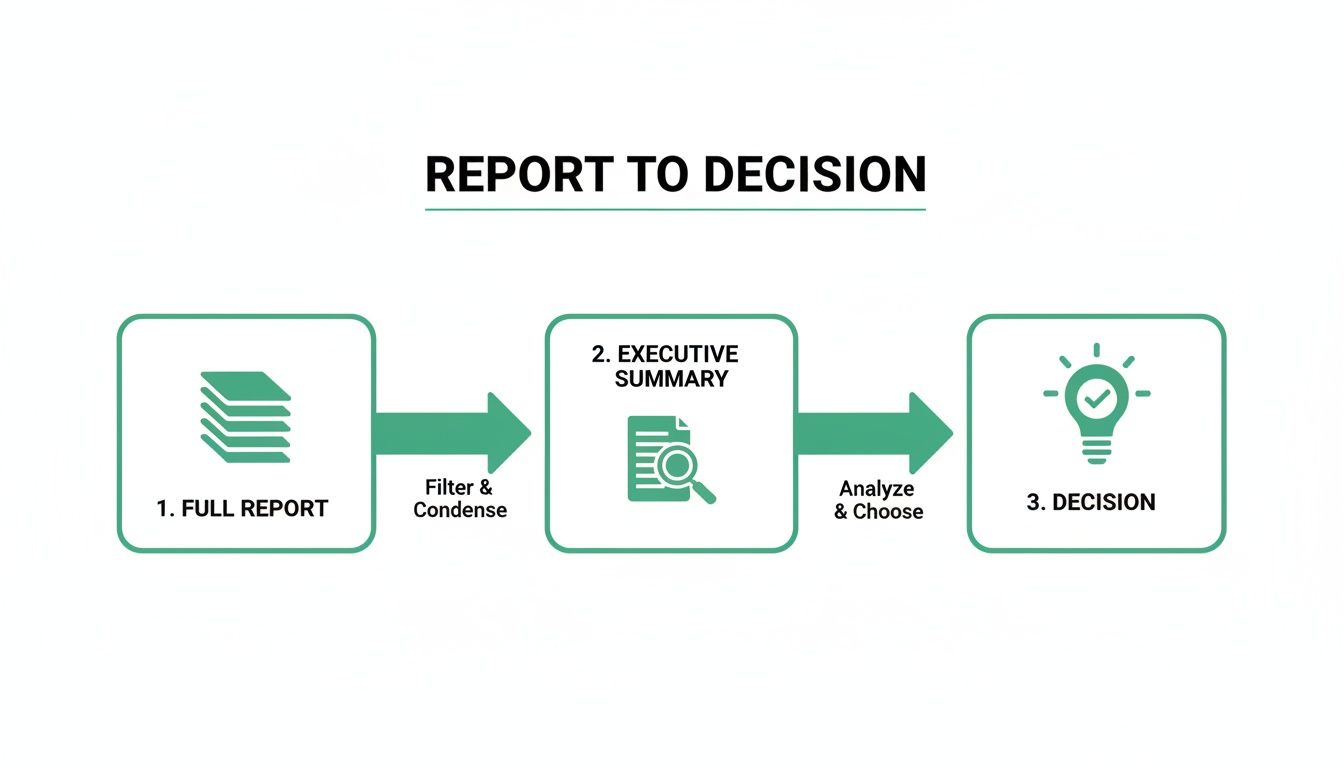
As you can see, it’s not just about making the report shorter. It’s a tool designed from the ground up to enable quick, confident action.
Start by Finding Your Core Message
Before you type a single word of the summary, take a step back and ask one simple question: "What is the one thing my reader absolutely must know?" This isn’t about listing every single finding. It's about nailing the central theme or the most urgent takeaway. This "core message" becomes the North Star for your entire summary.
For instance, say your report analyzes a rough quarter. Your core message might be: "Despite a 15% drop in overall sales, our new subscription model shows 30% month-over-month growth, pointing to a clear path for recovery." See how that immediately frames both the problem and the solution?
Once you have that core message locked in, you can start pulling in the key details from your report to back it up. Think of it like a lawyer's closing argument—you've stated your conclusion, and now you're presenting the most irrefutable evidence. This kind of planning is a crucial part of the overall 5 steps of the writing process.
A Simple Structure for Maximum Impact
A logical flow is non-negotiable. A disorganized, rambling summary just confuses people and torpedoes your credibility before they even get to the main report. We've found a simple, five-part structure works for almost any situation.
Here’s a breakdown you can adapt:
- The Problem or Opportunity: Kick things off by stating why this report exists. What's the issue you're tackling or the opportunity you're exploring? Be direct.
- Key Findings: This is the "what we found" part. Present the most critical data and insights from your analysis. Use bullet points or bold text to make specific numbers pop.
- Analysis/Interpretation: Don't just dump data—explain what it means. Connect the dots for the reader and show them why these findings are significant.
- Recommendations: This is arguably the most important section. Based on everything you've presented, what specific actions are you proposing? Make them clear and actionable.
- Conclusion/Expected Outcome: End on a strong note by summarizing the potential payoff. If your reader follows your advice, what's the positive outcome they can expect?
Anatomy of an Irresistible Executive Summary
What’s the difference between an executive summary that gets tossed aside and one that sparks immediate action? It all comes down to a few key ingredients and some persuasive wording. You need to craft an opening that hooks your reader instantly and then structure your findings to make the biggest possible splash.
Your opening sentence is your one shot to grab a decision-maker's attention. Forget the slow, formal wind-ups. State the report's purpose and its single most important takeaway in the very first line. This directness respects their time and shows you mean business.
Crafting a Powerful Opening
A strong opening sets the stage for everything that follows. It needs to be sharp, clear, and immediately signal why the full report is worth their time. Think of it as the headline for your entire project—it has to be compelling enough to make them want to read on.
Let's walk through a real-world example. Imagine you’ve just wrapped up a market analysis for a new product launch.
- Before: "This report provides an analysis of the market research conducted for the upcoming 'Project Sparrow' initiative."
- After: "Our market research for 'Project Sparrow' reveals a significant opportunity to capture 15% of the underserved millennial market within the first year, contingent on a Q3 launch."
The "after" version doesn't just say what the report is; it declares what it means. It immediately serves up the opportunity, a hard number (15% market share), and a clear condition (a Q3 launch). This is the kind of practical, results-oriented writing that gets noticed.
Presenting Key Findings with Clarity
Once you've hooked them, it's time to deliver the goods. This is where you lay out your most critical findings and data points. The biggest mistake you can make here is burying key stats in long, dense paragraphs. You have to make the important stuff impossible to miss.
Bullet points are your best friend. They break up the wall of text and let you spotlight specific, measurable results without overwhelming your reader.
For example, instead of writing a long-winded sentence about your campaign results, try this:
- Target Audience Engagement: Our A/B testing showed the video-first ad campaign generated a 42% higher click-through rate than static image ads.
- Competitive Landscape: Key competitors are seriously underusing TikTok, creating a first-mover advantage for our brand.
- Projected ROI: The proposed strategy is projected to deliver a 3:1 return on investment within the first six months, based on our financial modeling.
This format is easy to scan, direct, and puts the focus squarely on the numbers that matter. Each point is a powerful, standalone piece of evidence that builds the case for your final recommendation. To get a feel for how this fits into a full document, it's helpful to look at some solid examples of market research reports.
From Data Recitation to Actionable Recommendations
Just presenting data isn't enough. A truly great executive summary goes a step further by providing clear, actionable recommendations. This is your moment to guide the reader and tell them exactly what you believe they should do next based on the evidence.
This is where persuasion really comes into play. According to a Forbes survey, reports with clear recommendations are 50% more likely to be implemented. This highlights the need to not just inform but to actively persuade.
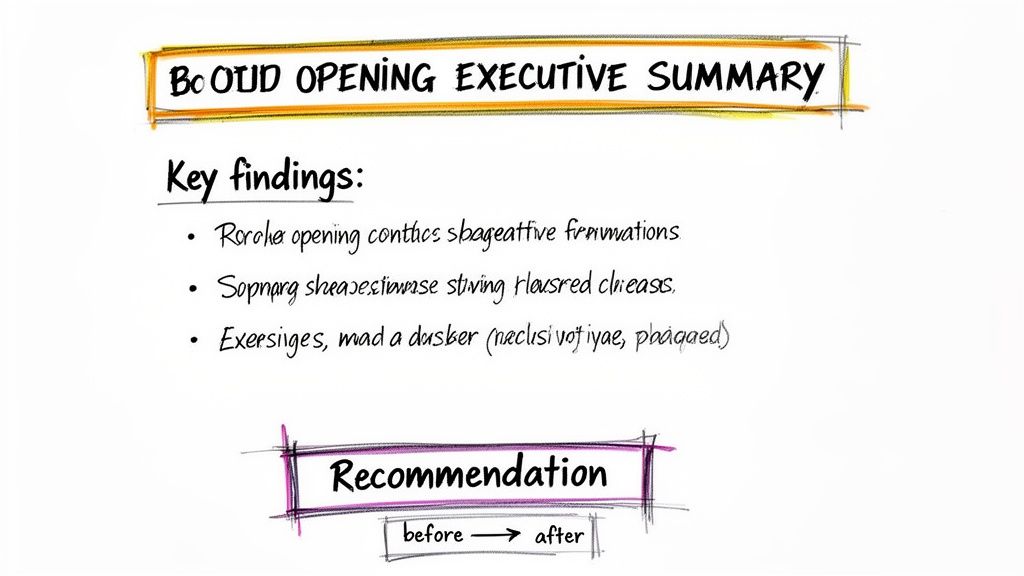
Don't make your reader connect the dots. Your job is to draw the line from your findings directly to a proposed course of action. Be explicit, confident, and clear about the next steps.
For instance, following the findings above, your recommendation should be specific: "We recommend allocating 75% of the Q3 digital marketing budget to a video-first campaign on TikTok and Instagram Reels to capitalize on the identified market gap." This tells them what to do, where to do it, and why it’s the right move.
Want to really sharpen your persuasive edge? This is a skill you can learn. Check out these 10 powerful persuasive writing techniques to make your words more convincing.
Before and After: Language That Makes an Impact
See how small changes in wording can transform a passive summary into a powerful, action-oriented document. This table showcases specific examples of how to make your language work for you.
| Generic Phrasing (Before) | Impactful Phrasing (After) |
|---|---|
| "This report will discuss the findings of our research." | "Our research pinpoints a critical 25% gap in the market." |
| "There are some potential areas for improvement." | "We've identified three key areas to boost efficiency by 15%." |
| "The data suggests a possible trend." | "The data confirms a strong upward trend in customer demand." |
| "A new marketing strategy could be beneficial." | "We recommend launching a targeted digital campaign to capture new leads." |
| "The project experienced some budget overages." | "The project exceeded its budget by 8%, and we've identified the root cause." |
Simple tweaks like these add confidence and clarity, making it much easier for a busy executive to grasp the situation and feel compelled to act on your recommendation.
Tailoring Your Summary for Different Audiences
An executive summary should never be a one-size-fits-all document. The language that gets a venture capitalist excited is the same language that will likely fall flat in a university setting. Customizing your summary for your specific audience isn't just a nice touch; it's a strategic move that shows you've done your homework and respect their time.
The key is to get inside your reader's head and understand what they value most. This means you'll need to shift your focus, adjust your tone, and even change which data points you decide to highlight. It’s a foundational part of effective communication, and you can get a deeper understanding of this in our guide on what is audience analysis.
For Business Professionals and Investors
When you're writing for executives, marketers, or potential investors, their focus is almost always laser-sharp on the bottom line. They want to see results, returns, and a clear path to making money. Your summary needs to speak their language—the language of numbers.
This means leading with the metrics that truly matter to them:
- Return on Investment (ROI): State the expected financial returns in no uncertain terms.
- Market Share: Show them how you'll capture a bigger piece of the pie.
- Financial Projections: Offer concise, data-backed forecasts for revenue and growth.
For example, don't just say, "Our new software improves team collaboration." Frame it in a way they can't ignore: "Our new software is projected to boost team productivity by 20%, leading to annual operational savings of $500,000." That translates a feature into a powerful financial benefit.
When you're trying to win over investors, you have to play by their rules. This fantastic guide on how to write an executive summary VCs will read has some great, real-world advice for tailoring your pitch to what VCs are actually looking for.
For Students and Academics
In the academic world, the currency is different. Your audience—be it professors, a thesis committee, or peer reviewers—is far less concerned with profit. They care about the rigor of your research and its contribution to the field.
Here, your summary must reflect scholarly precision. You'll want to pivot your focus to the intellectual heart of your work.
- Research Problem: Start by clearly defining the gap or question your study tackles.
- Methodology: Briefly explain the methods you used to get your results.
- Key Findings: What were your most important discoveries? Summarize them clearly.
- Contribution to the Field: Explain how your work pushes the conversation forward.
The tone should be formal, objective, and analytical. You aren't selling a product; you're presenting a carefully constructed argument backed by solid evidence. Your goal is for your summary to stand on its own as a crisp, concise representation of your academic work.
Tips for AI-Assisted Writing
If you use AI writing tools, finding that perfect tone and authentic phrasing can be tough. The last thing you want is for your message to sound robotic or awkward, as it can create an unintentional barrier between you and your reader. You have to maintain your unique voice.
AI assistants can give you a decent starting point, but they often miss the subtle, human nuances that make writing feel authentic. This is where a tool designed specifically for refinement can make all the difference. We built PureWrite to help writers close that gap.
You can use PureWrite to polish your draft, making sure it not only reads fluently but also hits the right stylistic notes for your intended audience. We help you keep your unique voice while giving your summary the professional edge it needs to make a great impression. Give PureWrite a try and see how it can help you write with more confidence.
Common Mistakes and How to Avoid Them
Even expert writers can miss the mark when putting together an executive summary. Knowing where the common traps are is the best way to avoid them and create something truly effective. And make no mistake, these summaries matter. Research from executive summary report findings shows that a staggering 94% of Fortune 500 decisions are influenced by them. That stat alone should tell you how crucial it is to get this right.
Let's walk through the most common blunders we see and, more importantly, how you can sidestep them to make sure your summary has the impact it deserves.
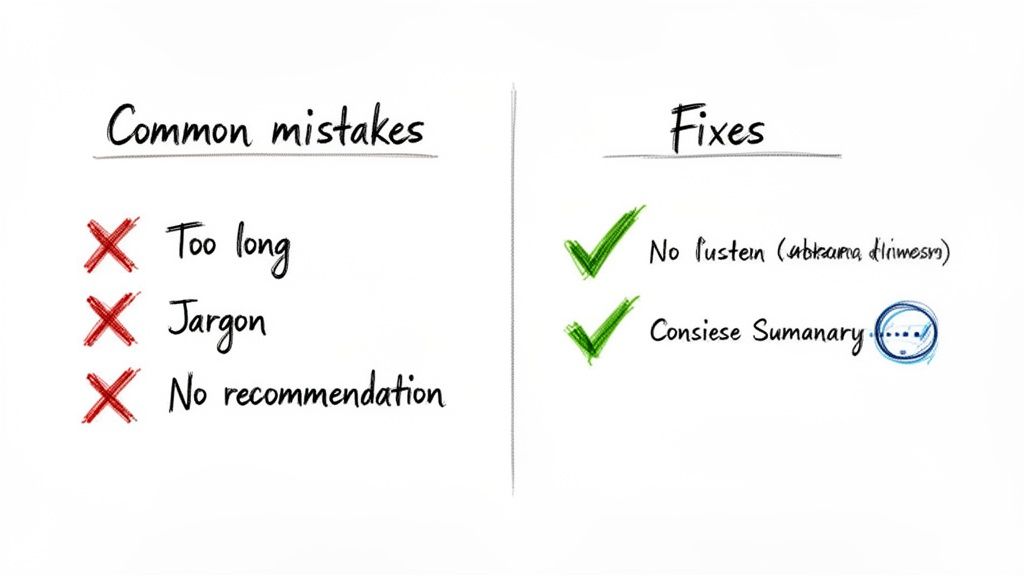
Making It Too Long (or Too Short)
This is hands-down the most frequent misstep. A summary that rambles on for pages completely misses the point and disrespects the reader's time. On the flip side, one that's too bare-bones can leave out vital context, creating more questions than answers.
The sweet spot is generally 5-10% of the full document's length. If you have a 20-page report, you’re aiming for about one solid page. This forces you to be ruthless with your editing. If you’re struggling to cut it down, check out our guide on what is concise writing.
Filling It With Jargon and Buzzwords
Your executive summary has to connect with a wide audience, many of whom won't be specialists in your particular area. Loading it up with technical terms or trendy buzzwords just builds a wall between you and your reader. It can come across as confusing, or worse, pretentious.
Always choose clear, direct language. Don't say you'll "leverage synergistic platforms to optimize user-centric paradigms." Just say you'll "use our combined software to improve the customer experience." One is fluff; the other is confident and easy for anyone to grasp.
Introducing New Information
An executive summary is exactly what its name implies: a summary. It should only reflect the information, findings, and recommendations already present in the main report. Dropping in a new stat or idea at this stage is jarring and instantly erodes the credibility of your entire document.
Think of it like a movie trailer. It shows you the most exciting parts of the film but never includes scenes that didn't make the final cut. Stick to the script you've already written.
Failing to Offer a Clear Recommendation
A summary that just lays out problems without pointing to a solution is a huge missed opportunity. Your reader is looking to you for direction. After you’ve presented the key facts, you need to state explicitly what you believe should happen next.
This is the "so what?" moment of your report. Don't be shy. A strong, data-backed recommendation shows confidence and turns your summary from a simple overview into a powerful tool for making decisions.
A great executive summary doesn't just inform; it persuades. Your final goal is to arm your reader with the clarity and confidence they need to take the action you're proposing.
A Quick Editing Checklist for Perfection
Before you share your summary, give it one last pass with this checklist. Think of it as your final quality check to catch common errors and ensure your work is polished and professional.
- Is it concise? Is every single word doing a job?
- Is the purpose obvious? Can someone understand why they're reading this from the very first sentence?
- Is it free of jargon? Would someone from a completely different department understand it?
- Does it reflect the main report? Are all key findings accurately represented?
- Can it stand alone? If this is the only thing they read, do they have what they need to decide?
- Is there a clear recommendation? Is it crystal clear what you want the reader to do?
- Is the tone right? Does it sound confident, professional, and suited for your audience?
Using AI to get a first draft on the page can be a real time-saver, but the output often sounds robotic and generic. This is where that final human touch becomes absolutely essential. At PureWrite, we’ve built our platform to help you ethically refine that initial draft, making sure your writing is authentic, readable, and free from the very mistakes that can dilute your message.
Ready to make your next executive summary flawless? Try PureWrite for free and see how our tools can help you humanize your content and polish it to perfection.
Frequently Asked Questions About Executive Summaries
We’ve walked through the strategy and the nuts and bolts of putting an executive summary together, but a few questions always seem to pop up. Let's tackle some of the most common ones we hear from creators and professionals like you.
What’s the Magic Number for Length?
This is, without a doubt, the question we get asked most often. The honest answer is "it depends," but the universal truth is that shorter is better.
A great rule of thumb is to keep it between 5-10% of the main document's length. So if you've got a 20-page report, you're aiming for a summary that's about one page, maybe two at the absolute most. If you see it stretching past that, it’s a red flag.
Should I Drop in a Chart or Graph?
It's really tempting, we know. You've got this great data visualization in the report, and you want to show it off. Our advice? Resist the urge.
Visuals eat up precious real estate in a document where every word counts. They can make the page feel cluttered and break the reader's flow. Instead of embedding a chart, pull out the single most important number and make it pop with bold text.
For example, skip the bar chart and just say: "Our new marketing campaign boosted Q3 lead generation by 45%." It delivers the punch without the clutter. Save the full-color graphs for the main report where they can be properly explained.
How Do I Summarize Something Super Technical?
This is a classic challenge. You've just finished a dense, 50-page technical analysis, and now you have to explain it to the C-suite. The secret is to completely reframe your thinking. Stop focusing on the how and start focusing on the so what.
Your executives don't need to understand the complex coding or the scientific methodology. They need to know what it all means for the business.
Your job is to be a translator. Ditch the jargon and translate the technical achievements into business outcomes.
For instance, instead of describing the new machine learning model you built, explain what it does: "Our new predictive algorithm improved forecast accuracy by 35%, a change we project will cut supply chain waste by $1.2 million a year."
See the difference? One is a technical explanation; the other is a business case. This makes your work immediately understandable and shows its value to people who don't have a technical background.
Does an Executive Summary Need its Own Intro and Conclusion?
Yes, it absolutely does. A top-tier executive summary should feel like a complete, self-contained story. It needs a beginning, a middle, and an end.
Start with a brief intro that sets the stage—what's the problem or the opportunity? Then, move into your key findings and recommendations. Finally, wrap it up with a clear conclusion that restates the most critical takeaway and points to the next step.
Think of it as the full report in miniature. This structure is what allows a busy executive to read only the summary and still walk away with a complete, coherent understanding of the situation and what you're asking them to do.
Crafting a summary that’s both tight and persuasive can feel like a real art form, especially if you’re trying to polish a draft that started with AI. At PureWrite, we're experts in turning that robotic, clunky text into something that sounds genuinely human and connects with your readers. Our platform is designed to help you refine your message until it’s clear, compelling, and ready to make an impact.
Ready to take your next report to the next level? Try PureWrite today and humanize your content with confidence.