
At its heart, a persuasive writing technique is any method you use to bring a reader around to your way of thinking. It's the art of using carefully chosen words and emotional hooks to influence what someone believes, how they feel, or what they do next. Think of it as a blend of sound logic and a bit of psychology, all working together to build trust and lead your reader to a specific outcome.
What Is Persuasive Writing and Why It Matters
Persuasive writing is how you use words to make a real connection with people, earn their trust, and ultimately inspire them to take action. This isn't about pushy sales pitches or slick tricks; it's about building a message that clicks with someone on both a logical and an emotional level.
This skill is absolutely essential for content creators, students, and professionals alike.
Whether you’re a marketer creating a new ad campaign, a student making a case in an essay, or a manager trying to get your team on board with a new idea, persuasion is what separates a message that gets ignored from one that gets results. In a world where over 90% of businesses use content marketing, a genuine, human touch is what makes your writing stand out. It turns plain information into something that actually moves people.
The Foundation of Effective Persuasion
Great persuasion always starts with one thing: knowing your audience inside and out. Before you can convince anyone of anything, you have to understand what makes them tick—their problems, their desires, and their secret hopes. To really get this right, you need to do your homework, and we cover this critical first step in our guide on what is audience analysis.
Once you have a clear picture of who you're talking to, you can start shaping your message. Powerful persuasion rests on a few core pillars:
- Building Trust: People won't listen if they don't believe you. You earn trust by being honest, showing you know what you're talking about, and always being transparent.
- Connecting Emotionally: Facts and figures are great, but they rarely inspire action on their own. To make your message stick, you need to tap into your readers' feelings, values, and ambitions.
- Presenting a Clear Argument: Your logic has to be simple and easy to follow. A well-organized argument, backed up with solid proof, gives people the logical justification they need to agree with you.
The goal of persuasion isn’t to strong-arm someone into a decision. It’s to guide them to a conclusion they feel genuinely good about, creating a "win-win" where the action you're suggesting truly helps them.
When you get these fundamentals right, you can write content that doesn't just inform but actually influences. In the sections ahead, we’ll break down the specific techniques you can start using to make your writing more powerful. Here at PureWrite, we’re all about ethical persuasion—the kind that respects the reader while helping you achieve your goals.
Understanding the Three Pillars of Persuasion
To get anyone to listen, let alone act, you need to connect with them on a few different levels. It turns out the blueprint for this was drawn up more than 2,000 years ago by Aristotle. He gave us three core appeals that are still the bedrock of persuasive communication: Ethos, Pathos, and Logos.
Think of these three as legs of a stool. If one is weak or missing, your entire argument can topple over. A message that balances all three feels trustworthy, hits home emotionally, and makes perfect sense. It's the secret to building a genuine connection, not just throwing facts at a wall and hoping they stick.
This concept map breaks down how these pillars work together to build trust, forge a connection, and ultimately drive your reader to take action.
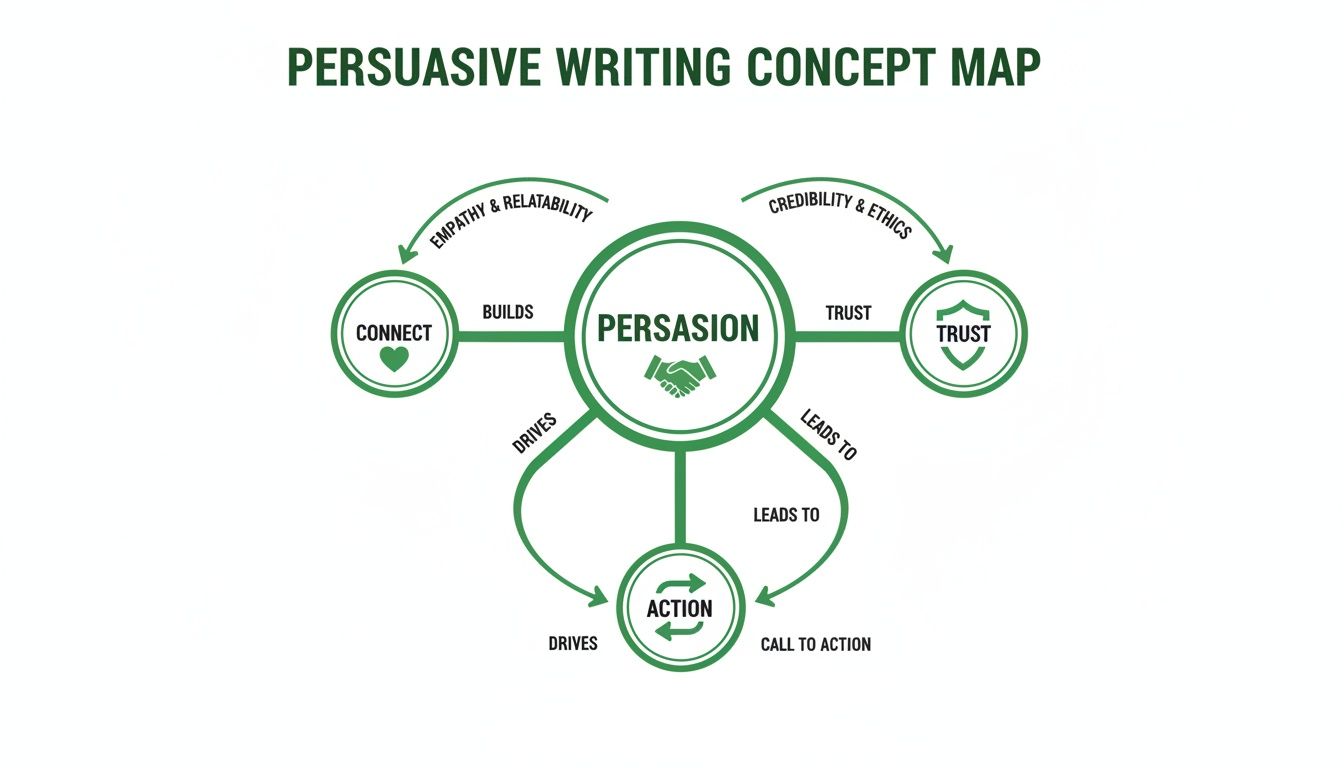
As you can see, persuasion isn't a single tactic. It's a blend of earning credibility, stirring emotion, and making a logical case that guides someone toward a desired outcome.
Let's break down each pillar and see how you can use them in your own writing. This table offers a quick comparison before we dive deeper into each one.
Comparing the Three Pillars of Persuasion
| Rhetorical Appeal | What It Is | How to Apply It | Example in Action |
|---|---|---|---|
| Ethos | The appeal to authority and credibility. It answers the question: "Why should I trust you?" | Use expert endorsements, customer testimonials, credentials, and transparent language. | "As a certified nutritionist with 15 years of experience, I've seen firsthand how this diet transforms lives." |
| Pathos | The appeal to emotion. It's about making your audience feel something—joy, fear, hope, or empathy. | Tell compelling stories, use vivid imagery, and tap into your audience's values and aspirations. | "Imagine the relief of finally paying off your debt and the freedom to plan the future you've always dreamed of." |
| Logos | The appeal to logic and reason. It provides the rational backbone for your argument. | Present hard data, statistics, case studies, and clear, step-by-step reasoning. | "Our new software increases team productivity by an average of 35%, as confirmed by a third-party study of 500 users." |
With this framework in mind, let's explore how to put each of these powerful appeals into practice.
Ethos: Building Credibility and Trust
Ethos is all about your credibility. It’s the answer to your reader’s unspoken question: Why should I listen to you? You build this appeal on a foundation of authority, expertise, and trustworthiness.
Every time you cite a reputable source, feature a glowing customer review, or mention your years of experience, you're using Ethos. It’s why brands put trust badges on their checkout pages or feature doctors in their ads. You're building a base of belief before you even get to your core message.
An argument without Ethos is just an opinion. When you establish your credibility first, you earn the right to be heard, and every point you make after that carries more weight.
Here are a few practical ways to build Ethos:
- Showcase Your Expertise: Mention relevant credentials, awards, or years in the field.
- Lean on Social Proof: Use real customer testimonials, in-depth case studies, or reviews from people your audience respects.
- Be Transparent: Always be upfront about your intentions and acknowledge any potential biases. Honesty is a cornerstone of trust.
Pathos: Connecting Through Emotion
Pathos is where you connect with the heart, not just the head. It’s about making your audience feel something—transforming a dry, logical argument into a story that resonates with their deepest values, fears, or dreams.
Storytelling is your most powerful tool here. A well-told story about a single customer’s success is infinitely more moving than a bulleted list of product features. You can also use vivid, sensory language to paint a picture that pulls the reader right into the scene.
Think about a non-profit asking for donations. They don't just say, "We need money." They tell you the story of one person whose life was turned around by their work. That emotional hook is often the final nudge that inspires someone to act.
Logos: Appealing to Logic and Reason
Finally, Logos is the appeal to logic. This is where you lay out your case with cold, hard facts, solid data, and a well-reasoned argument. It’s the rational scaffolding that holds your entire message together.
You’re using Logos when you present statistics, cite research, or walk your reader through a clear, step-by-step process. A strong logical appeal makes your conclusion feel less like a suggestion and more like an undeniable truth. Without it, even the most emotional pitch can feel flimsy and unsubstantiated.
A masterclass in this balance is Abraham Lincoln's Gettysburg Address. At just 272 words, it masterfully honors the fallen (Pathos), redefines the purpose of the war (Logos), and calls a nation to action from a position of authority (Ethos).
Mastering these pillars is a game-changer for any writer. To see how these concepts fit into a bigger picture, check out our guide on other powerful persuasion techniques in writing.
If your AI-generated drafts are coming out a little too heavy on the Logos, we can help. Our tool is designed to weave in the human touch needed to perfectly balance Ethos, Pathos, and Logos, turning robotic text into genuinely compelling content.
Seven Persuasive Writing Techniques You Can Use Today
Alright, you've got the foundational pillars of persuasion down. Now it's time for the fun part: putting them into practice.
Think of these seven techniques as your go-to toolkit for crafting more influential and compelling content. Each one is a specific strategy you can start using right away to make your arguments land with more impact and make your message stick.
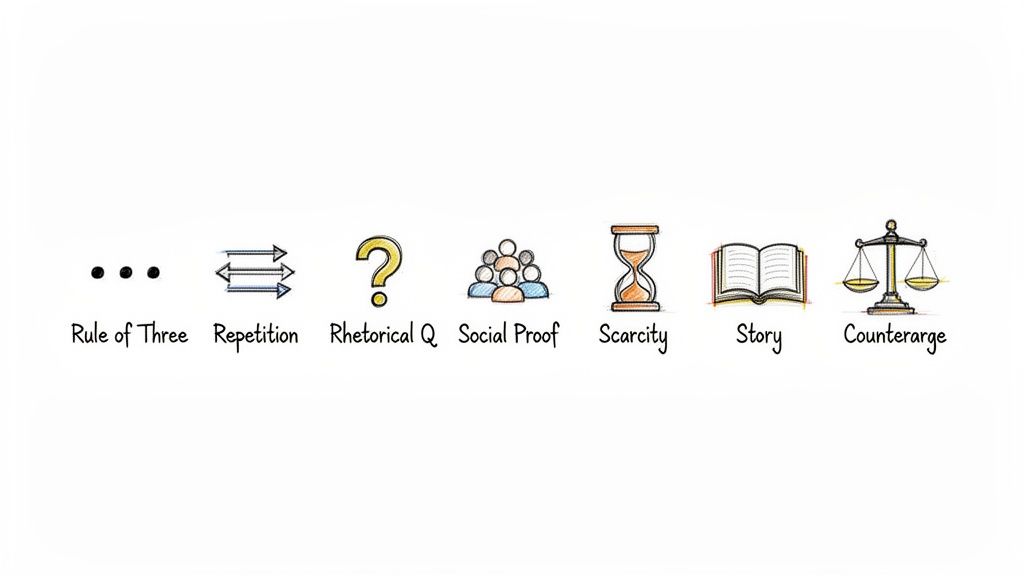
We’re going to move past the theory and dive into what really works. I'll show you the real-world impact of each method with some simple "before and after" examples. You’ll see firsthand how a flat, forgettable statement can be transformed into a powerful point that grabs attention and gets people to act.
1. The Rule of Three
This one is a classic for a reason. The Rule of Three is a simple yet incredibly powerful principle: ideas presented in groups of three just feel more memorable, satisfying, and effective. From ancient speeches to modern marketing slogans, this rhythmic pattern has a way of lodging itself in your mind.
It works because three is the smallest number of elements needed to create a pattern. It makes your point feel complete and well-rounded without overwhelming the reader.
- Before: "Our new software helps you work faster."
- After: "Our new software helps you work faster, smarter, and more collaboratively."
See the difference? That small tweak makes the statement feel far more substantial and much easier to recall.
2. Strategic Repetition
Let's be clear: repetition isn’t about annoyingly saying the same thing over and over. It's about strategically repeating a core idea or a key phrase to truly embed it in your reader's memory. When you use it thoughtfully, it gives your main message weight and significance.
Think about Martin Luther King Jr.'s "I have a dream" speech. The constant refrain of that single phrase is what turned a powerful speech into a historic anthem for an entire movement.
By echoing your main point in different ways throughout your piece, you ensure it becomes the central takeaway. This technique reinforces your message without ever sounding redundant.
For instance, a marketing email might repeat its core benefit in the subject line, the opening sentence, and again in the final call to action. Each time, the point sinks in a little deeper.
3. Rhetorical Questions
A rhetorical question isn't asked to get an answer; it's asked to make a point. The goal is to make the reader pause, reflect, and engage with your argument on a much deeper, more personal level. It’s a subtle way to prompt internal agreement, making your audience feel like they're part of the conversation.
These questions gently guide your reader toward a conclusion you want them to reach, making it feel like their own idea.
- Before: "Our productivity tool is essential for growing businesses."
- After: "Are you ready to stop wasting time on manual tasks and focus on what truly matters? Our productivity tool is the answer."
The question immediately shifts the focus to the reader's own frustrations and goals, making the solution you’re offering feel more personal and urgent. Nailing this kind of engagement is crucial across all kinds of content, from short social media posts to longer articles on platforms like Medium.
4. Social Proof
Here’s a fundamental human truth: we are heavily influenced by the actions and opinions of others. Social proof is the technique that leans into this tendency by demonstrating that other people already trust and value what you’re offering. It’s an incredibly efficient way to build credibility (Ethos) almost instantly.
Testimonials, reviews, case studies, and user statistics all count as social proof. They offer third-party validation that makes your claims far more believable than if you just said them yourself. In fact, a study by BrightLocal found that 79% of consumers trust online reviews as much as they trust recommendations from people they know.
Here's how it transforms a weak claim into a powerful one:
- Before: "Our course is very effective."
- After: "Over 10,000 students have completed our course, with 92% reporting a significant career boost within six months. Here’s what Jane D. had to say: 'This course changed my life...'"
The second version is infinitely more convincing because it replaces a vague, self-serving statement with concrete numbers and a real human story.
5. Scarcity and Urgency
People naturally place a higher value on things they believe are rare or in short supply—that’s scarcity. Urgency is its close cousin, compelling people to act now rather than putting it off for later. When used ethically, these two psychological triggers are powerful motivators.
You see it all the time in phrases like "Limited time offer," "Only 3 spots left," or "Exclusive to the first 100 customers." They all tap into a fear of missing out (FOMO) that encourages immediate action.
- Before: "Sign up for our webinar."
- After: "Seats are filling up fast! Reserve your free spot before they’re all gone and get our exclusive bonus guide."
This simple addition creates a compelling reason for the reader to act right away instead of thinking, "I'll do it later."
6. Storytelling
You’ve heard it before: facts tell, but stories sell. There's a reason for that. Storytelling might just be the most powerful persuasive technique of all because it connects directly with our emotions (Pathos). A well-told story forges a personal connection, making your message relatable and memorable long after the numbers and data points have faded.
Instead of just listing product features, tell the story of a customer whose life was made easier. Frame your data within a narrative that shows its real-world impact. This helps your reader actually see the benefits in their own life.
7. Addressing Counterarguments
One of the sneakiest—and most effective—ways to build trust is to address potential objections before your reader even has a chance to think of them. When you acknowledge and calmly refute counterarguments, you show that you’ve considered all sides of the issue. This makes your own position stronger and shows you have real confidence in your argument.
This is especially critical in more complex or academic writing. Research has actually shown that teaching students how to handle counterarguments significantly improves their ability to write persuasively.
- Before: "Our software is the best on the market."
- After: "You might think our software is too expensive, but when you consider the 20 hours of manual work it saves you each month, it pays for itself in just weeks."
By tackling the price objection head-on, you remove a major barrier to persuasion and turn a potential negative into a positive. And to make sure these arguments flow smoothly, it helps to use good transition words. We've put together a handy list of transitional words and phrases you can check out.
If you’re using AI to generate your first drafts, you've probably noticed it produces text that's logical but often lacks these crucial persuasive nuances. We designed PureWrite to help you weave these powerful techniques into your content, turning a robotic draft into a compelling piece that truly connects and convinces. Try PureWrite today to humanize your writing and make it genuinely persuasive.
Common Mistakes in Persuasive Writing (And How to Fix Them)
It’s one thing to know the right persuasive moves, but it’s just as important to know what not to do. Even the most polished argument can completely fizzle out if you fall into common traps that turn readers off and chip away at your credibility.
Let’s be honest, avoiding these mistakes is half the battle.
Here are some of the most frequent blunders writers make, along with simple ways to steer clear of them. Getting this right ensures your message doesn't just land—it actually sticks.
Forgetting Who You're Talking To
This is the big one. The single most common mistake is writing for yourself instead of your audience. You can construct a flawless, logical argument, but if it doesn't speak directly to your reader's pains, hopes, or questions, it’s just noise.
When you forget your audience, you end up with the wrong tone, examples that don't make sense to them, and a message that completely misses the mark.
How to Fix It: Always start by putting yourself in their shoes. Before you type a single word, ask:
- Who am I actually writing for?
- What problem is keeping them up at night?
- What do they currently think or believe about this topic?
- What kind of proof will they find compelling (data, stories, expert opinions)?
Making Claims Without Proof
Bold statements without anything to back them up are just empty opinions. Saying your product is "the best" or your method is "superior" is meaningless without data, testimonials, or solid reasoning. This kind of unsupported claim instantly makes readers suspicious and weakens your entire argument.
"It doesn’t matter what I think, only what I can prove." This gem from the movie A Few Good Men should be your mantra. Your claims are only as strong as the evidence you bring to the table.
How to Fix It: Make it a habit to support every major point you make. Use statistics, link to case studies, quote experts, or show off customer reviews. Every piece of proof acts like another brick in your wall of credibility, making your argument that much harder to ignore.
Using Overly Aggressive or Emotional Language
Passion is great, but letting it boil over into overly aggressive or emotional language can backfire spectacularly. It can make readers feel cornered or manipulated, and their natural reaction is to put up a defensive wall. Instead of sounding confident, you can come across as desperate.
How to Fix It: Let your logic and evidence do the heavy lifting. Don't tell people how to feel; guide them there with compelling stories and clear data. Swap out pushy, demanding language for confident, respectful phrasing. A calm, measured tone almost always sounds more authoritative. If you're having trouble striking that balance, our guide on achieving conciseness in writing can help you cut the fat and let your core message shine.
Crafting a Weak or Vague Call to Action
Finally, a surprisingly common error is simply failing to tell the reader what to do next. You can build a brilliant, compelling case and then end with a limp "learn more" or, even worse, no call to action (CTA) at all. You've just built up all this motivation and given it nowhere to go.
How to Fix It: Your CTA needs to be direct, clear, and impossible to misunderstand. Use strong, action-oriented verbs and give the reader a clear benefit for clicking.
- Weak: "Check out our services."
- Strong: "Start Your Free Trial Today and See Your Results in 7 Days."
Avoiding these mistakes is a huge part of becoming an effective and ethical persuader. When you notice your AI drafts are slipping into these bad habits, we're here to help. Our tool was built to catch these very issues, refining your text to be more credible, reader-focused, and genuinely persuasive.
Humanizing AI-Generated Drafts with PureWrite
Let’s be honest: AI writing tools are great for getting words on a page. They can churn out a first draft in minutes, saving you hours of staring at a blank screen. But when it comes to persuasion, they often miss the mark. The result is usually logically sound but emotionally flat—it sounds like a machine, not a person.
This is where you, the writer, come in, armed with the right tools. Your job is to bridge that gap between robotic output and human connection. We built PureWrite specifically for this. It's designed to help you take that raw AI draft and polish it into something that truly resonates, refining the tone, sharpening clarity, and adding the little nuances that build real trust.
This isn't about tricking anyone or hiding the fact that you used AI. It's about using technology as a collaborator to ensure your final piece is original, authentic, and genuinely persuasive. We always emphasize ethical AI usage, and that starts with authenticity.
Polishing Tone and Injecting Emotion
An AI might give you a sentence that's technically perfect but completely fails to make you feel anything. For a persuasive argument to land, it needs the right emotional weight. This is often the first thing that gets lost in an AI-generated draft.
We excel at spotting and fixing this tonal mismatch. PureWrite helps you tweak a dry, declarative statement into something more confident, empathetic, or urgent—whatever your goal requires. This is how you start weaving Pathos into your writing.
- Before (AI Draft): "Our product has features that can solve user problems."
- After (PureWrite Polish): "Imagine the relief of finally solving those frustrating daily issues. Our product is designed to bring that feeling to your workflow."
See the difference? We’ve moved from a sterile fact to a relatable benefit, which is instantly more powerful.
Improving Clarity and Logical Flow
Persuasion needs a clear, easy-to-follow argument (Logos). AI drafts can sometimes be tangled, using overly complex language that just confuses the reader and undermines your point.
A huge part of making content feel human is making it flow naturally. We help you untangle complicated sentences and build stronger bridges between your ideas. When your argument is easier to digest, it's far more convincing. A clear message is a trustworthy one.
The best persuasive writing feels effortless to read. It guides you so smoothly from one point to the next that you arrive at the conclusion feeling like you came up with the idea yourself.
This kind of clarity is crucial. Research consistently shows that even small improvements in readability can have a big impact on how much your audience engages with and understands your message.
Ensuring Authenticity and Credibility
At the end of the day, the most effective persuasive tool is authenticity. Your audience can smell generic, robotic content a mile away, and it's an instant turn-off that destroys credibility (Ethos). An authentic voice proves there's a real person behind the words—someone who gets it.
We see AI as a creative partner, not a replacement for the writer. It can do the heavy lifting on research and structure, but that final, human polish has to come from you. If you're curious about this partnership, check out this great resource on how AI can help us be more creative.
We are here to help you layer in those unique human touches—your turn of phrase, your sense of humor, your specific insights—that an AI simply can't fake. Ready to humanize your AI content? Give PureWrite a try.
Frequently Asked Questions
It's natural to have questions as you dive into persuasive writing. Whether you're a student trying to nail an essay, a marketer looking to punch up AI copy, or just someone who wants to make a stronger case at work, clarity is everything. We’ve pulled together some of the most common questions to help you master these techniques.
What Is the Single Most Important Persuasive Writing Technique?
If we had to pick just one, it would be this: deeply understanding your audience. This is the bedrock of all persuasion. Before you even think about Ethos, Pathos, or Logos, you have to know who you’re talking to. An argument that lights up one group will completely fall flat with another.
You need to get inside their heads. What are their biggest headaches, their secret hopes, their unspoken fears? What kind of proof do they trust? Everything—your tone, your examples, your core message—has to be tailored to their world. All the other techniques are built on this foundation.
The most convincing message in the world is useless if it's delivered to the wrong person. Real persuasion starts with empathy.
Can Persuasive Writing Be Used in All Settings?
Absolutely. Persuasion isn't just for sales pages and ad campaigns. It's a fundamental human skill that shows up almost everywhere. The trick is simply learning to adapt your approach to the situation.
Think about it. In an academic paper, you're persuading readers that your research is solid and your conclusions are sound. In an office, you're using it to pitch a new project, argue for a bigger budget, or write a cover letter that gets you in the door.
The ingredients just get mixed differently. Professional persuasion often leans heavily on logic (Logos) and credibility (Ethos), using hard data and proven expertise. Emotion (Pathos) is still there, but it’s more subtle—used to convey passion, build consensus, and paint a picture of a shared vision.
How Can I Be Persuasive Without Sounding Manipulative?
This is a big one, and it all comes down to your intent. Ethical persuasion is about guiding, not cornering. It’s built on authenticity and a genuine desire to add value to your reader’s life.
Your job is to build a logical, well-supported case that truly benefits your audience. Be transparent. Don't make wild claims you can't back up. One of the best ways to build trust is to tackle potential counterarguments head-on. It shows you respect your reader's intelligence and have thought things through from every angle.
Stick to these simple rules for ethical persuasion:
- Be Honest: Never twist data or make promises you can't keep.
- Provide Real Value: Make sure the action you're suggesting is genuinely helpful.
- Respect Your Audience: Treat them like intelligent people who can make up their own minds.
How Do I Know if My Writing Is Actually Persuasive?
The only way to know for sure is to look at the results. Measuring the effectiveness of your writing is how you get better.
Are people doing what you hoped they would? Are they clicking the link, signing up for the webinar, or replying to your email? Those actions are your clearest sign of success. For things like blog posts, look at engagement—are people commenting, sharing, or sticking around to read the whole thing?
But don't forget the human element. Sometimes the best feedback comes from simply asking a trusted friend or colleague to read your draft and tell you, honestly, if it convinced them.
How Does PureWrite Help Me Apply These Techniques?
Think of PureWrite as your secret weapon for polishing your persuasive drafts. Once you’ve laid out your arguments using an AI tool and found your key stories, our tool helps you humanize the language so it actually connects with people.
Let’s face it, a lot of AI-generated content sounds robotic because it leans too hard on logic and misses the emotional beat. We built PureWrite to fix that. It can smooth out clunky phrasing, shift the tone to be more confident or empathetic (Pathos), and sharpen your key points so your logic (Logos) lands with more force.
In the end, our tool helps ensure your final piece sounds like it came from a real, credible person (Ethos). That authenticity is what makes your arguments stick.
Ready to turn your AI drafts from robotic to resonant? PureWrite helps you polish your writing, making sure every word is clear, authentic, and persuasive. Try it today and see how a human touch can make all the difference.