7 Essential Transition Words for Conclusion Sentences
The final sentence of your article, essay, or email is your last chance to leave a lasting impression. While AI writing tools can generate content quickly, they often fall back on clichéd endings like "in conclusion." At PureWrite, we believe a powerful conclusion is a hallmark of authentic, human writing.
A well-chosen transition word not only signals the end but also frames your final thoughts with the weight they deserve. Statistics from the Content Marketing Institute show that well-structured content, including strong conclusions, can improve reader engagement by over 40%. This guide offers practical, actionable advice to help you move beyond generic phrases.
We'll explore a curated list of transition words for conclusion sentences, breaking down when and how to use them for maximum impact. You'll find real-world examples and tips to ensure your final words resonate with your audience, whether you're a student, marketer, or professional. For a deeper dive, explore our guide on mastering engaging post writing.
Our goal is to provide a practical resource you can return to again and again. We will also touch on how you can ethically use tools like PureWrite to refine AI-assisted drafts, ensuring your final words sound genuinely like you, not a robot. Let's dive in and elevate your conclusions from an afterthought to a powerful final statement.
1. In conclusion
The phrase "In conclusion" is arguably the most traditional and direct of all transition words for conclusion sentences. It acts as an explicit signpost for the reader, clearly signaling that you are about to summarize your main points and present your final thoughts. This phrase leaves no room for ambiguity.
While its directness is a strength, "In conclusion" can also be perceived as overly formal or even clichéd in less formal contexts. However, in specific situations, its straightforward nature is exactly what's needed.
When to Use "In conclusion"
This phrase shines in formal writing where clarity and structure are paramount. Think of it as a formal handshake to end a conversation.
- Academic and Scientific Papers: A research paper or dissertation benefits from this clear, conventional marker to frame final arguments properly.
- Formal Business Reports: When presenting data or proposals to stakeholders, this phrase ensures your summary is received with appropriate seriousness.
- Legal and Government Documents: Precision is key in these fields, and "In conclusion" offers an unambiguous transition to a final summary or verdict.
Actionable Tips for Implementation
If you choose this classic transition, ensure it introduces a powerful synthesis of your key arguments, not just a simple repetition. The phrase sets an expectation for a comprehensive wrap-up, so the content that follows must deliver.
Pro Tip: We advise avoiding "In conclusion" in creative writing, blog posts, or marketing copy. It can feel stiff and disrupt the conversational tone you’ve worked to build. For more guidance, our post on how to write a conclusion paragraph offers great alternatives.
2. To summarize
The phrase "To summarize" is a versatile and moderately formal transition that signals a concise recap of your main arguments. It tells the reader you are about to distill complex information into its most essential elements. This phrase is less rigid than "In conclusion" and focuses specifically on the act of synthesis.
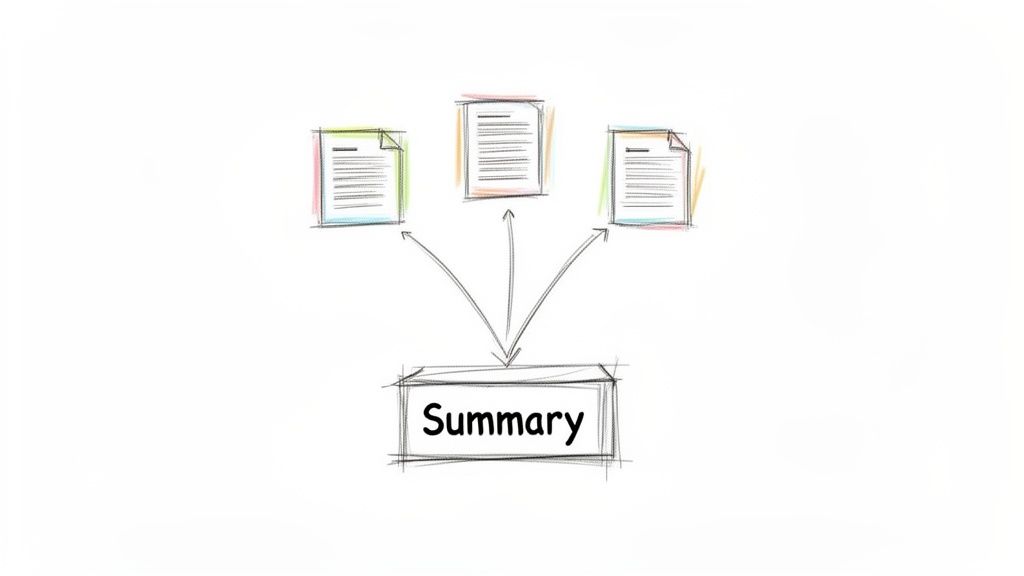
Unlike its more formal counterparts, "To summarize" offers a balance between structure and readability. It maintains a professional tone while feeling more direct and action-oriented, as if you're actively pulling together threads for your audience.
When to Use "To summarize"
This phrase is ideal when you've presented multiple data points or arguments and need to tie them together into a unified takeaway.
- Business Reports and Executive Summaries: Use it to condense quarterly findings or project outcomes into key takeaways for stakeholders.
- Complex Blog Posts and White Papers: When you've explained a detailed topic, "To summarize" helps you provide a clear, final recap for your readers.
- Presentations and Emails: It’s perfect for wrapping up a meeting or email by highlighting the main decisions or action items discussed.
Actionable Tips for Implementation
When you use "To summarize," ensure the sentences that follow are genuinely a condensation of what you've already discussed. The phrase sets an expectation of brevity and clarity, so avoid introducing new information.
Pro Tip: You can soften or specify the phrase to fit your exact context. For example, "To briefly summarize..." manages reader expectations for a quick recap, while "To summarize the key findings..." focuses their attention on the most critical outcomes. This is a great way to add a human touch to AI-generated text.
This transition signals a clear and logical conclusion. To explore more phrases that create strong, impactful endings, check out our list of powerful concluding sentence starters.
3. In the end
The phrase "In the end" offers a semi-formal, slightly more conversational alternative to traditional transition words for conclusion sentences. It signals finality and a moment of reflection, guiding the reader toward a concluding thought without rigid formality.
It works exceptionally well when you want to wrap up a narrative or a series of arguments by focusing on the ultimate outcome. It implies that after all considerations, a particular truth or result has emerged.

When to Use "In the end"
This phrase is perfect for contexts where you want to sound conclusive yet approachable, making it a versatile tool for many content creators.
- Blog Posts and Thought Leadership Articles: It provides a satisfying close to an article that has explored a complex topic for a general audience.
- Personal Essays and Narrative Nonfiction: Use it to deliver the final reflection or moral of a personal story, summarizing what was learned from the experience.
- Marketing and Persuasive Content: "In the end" can effectively emphasize the ultimate benefit of a product or service after outlining various features.
Actionable Tips for Implementation
To make "In the end" truly effective, use it to introduce a profound or definitive statement. The phrase sets the stage for a powerful final thought, so the sentence that follows must carry weight and offer a clear resolution.
Pro Tip: This phrase is an excellent choice when humanizing AI-generated content. Swapping a sterile phrase like "To summarize" with the more reflective "In the end" instantly adds a more natural, human touch. It’s a simple edit we often recommend at PureWrite.
For writers looking to create more dynamic conclusions, pairing this phrase with varied sentence structures is key. You can explore different ways to make your writing more compelling by learning how to vary your sentence structure.
4. Ultimately
The word "Ultimately" is a powerful and sophisticated transition for a conclusion, signaling that you are about to reveal the most fundamental truth. It suggests that after weighing all the evidence, the point that follows is the core takeaway. This single word elegantly elevates your conclusion.
Unlike more procedural phrases, "Ultimately" carries a sense of finality and importance. It tells the reader that this last thought is the definitive one, making it effective in professional and academic writing where demonstrating mature, analytical thinking is key.

When to Use "Ultimately"
This word is ideal when your conclusion aims to deliver a decisive, high-impact final statement that represents the core insight of your work.
- Analytical Essays and Research Papers: Use it to present your thesis in its final, most refined form. For example: "Ultimately, the data proves a direct correlation..."
- Executive Summaries and Business Proposals: "Ultimately" is perfect for emphasizing the bottom-line recommendation or the most critical factor for a decision.
- Persuasive Arguments: When you want to leave your audience with one last, compelling thought, this word adds weight and authority to your final point.
Actionable Tips for Implementation
To use "Ultimately" effectively, ensure the statement that follows is genuinely the most significant point of your entire piece. It should feel like the logical and definitive end of the journey you've taken the reader on.
Pro Tip: Pair "Ultimately" with your strongest insight, not just a simple summary. For example: "Ultimately, what this means for our marketing strategy is a complete pivot to digital channels." This connects the final truth to a practical implication.
If you're using an AI writer and struggling to make your text sound this polished, we can help. At PureWrite, we specialize in humanizing content to ensure it reflects the nuanced, authoritative tone your work deserves. Try PureWrite to see the difference.
5. As demonstrated
The phrase "As demonstrated" is one of the most powerful evidence-based transition words for conclusion sentences. It directly links your conclusion to the proof or data you have already presented, building significant credibility.
Unlike more general concluding phrases, "As demonstrated" forces your conclusion to be grounded in evidence. It serves as a final, authoritative nod to the analytical work you have done, reinforcing the validity of your argument.
When to Use "As demonstrated"
This transition is ideal for contexts where proof and analysis are central to your message. It is perfect for argumentative or research-driven writing.
- Scientific and Research Papers: Use it to summarize findings that are directly supported by the data or experiments detailed in the paper.
- Case Studies and White Papers: It effectively concludes a case study by linking the proposed solution directly to the proven, positive results.
- Business Proposals: "As demonstrated" can tie your solution to industry metrics or past performance data, making a compelling case for approval.
Actionable Tips for Implementation
To use this phrase effectively, you must have laid the groundwork with solid evidence. It loses its impact if the "demonstration" is weak or non-existent.
Pro Tip: Strengthen this transition by being specific. Instead of just "As demonstrated...", try "As demonstrated by the Q3 sales data..." or "As demonstrated in the patient-reported outcomes...". This immediately directs the reader's attention to the specific proof you want to highlight.
This phrase encourages you to use more sophisticated sentence structures. To refine your ability to link clauses and present complex arguments clearly, review our guide on crafting compound and complex sentences.
6. Therefore
The word "Therefore" is a classic logical connector used as one of the most powerful transition words for conclusion sentences. It signals a cause-and-effect relationship, indicating that your final statement is the direct outcome of the evidence you have presented.
Using "Therefore" adds a sense of weight and authority to your conclusion. It implies that the conclusion is not merely an opinion but an inevitable result derived from a logical progression of thought.
When to Use "Therefore"
This transition word thrives in analytical and argumentative writing where your conclusion needs to feel like the final piece of a logical puzzle.
- Argumentative and Philosophical Essays: When you have built a case step-by-step, "Therefore" provides a powerful way to state your final proposition.
- Scientific and Research Papers: It is ideal for stating the final implication of your data. For example: "The control group showed no change; therefore, the hypothesis is supported."
- Business Reports and Proposals: Using "Therefore" to introduce a recommendation gives it a strong foundation. For instance: "Our market share has declined by 15%; therefore, we must launch a new marketing initiative."
Actionable Tips for Implementation
The strength of "Therefore" lies in its logical rigor, so the connection between your premises and your conclusion must be crystal clear. If the logic is weak, the conclusion will fall flat.
Pro Tip: To soften the authoritative tone, you can use variations like "It therefore follows that..." or "Therefore, it seems that..." This adds a layer of nuance while still grounding your conclusion in reason, a great tactic for authentic writing.
To explore more logical connectors and see how they fit within your writing, check out our comprehensive guide on a transitional words and phrases list. This will help you build clear, reasoned arguments from start to finish.
7. Ultimately, what matters is
The phrase "Ultimately, what matters is" is a powerful, evaluative transition that shifts the focus to the core message or value. This phrase frames your conclusion around significance and priority, making it ideal for persuasive or reflective writing.
Unlike more neutral transitions, this one adds a layer of authorial judgment, telling the reader what is most important to remember. It’s a compelling way to end on a note of clarity and purpose.
When to Use "Ultimately, what matters is"
This phrase is most effective when you want to distill complex arguments into a single, essential truth. It works best in content that explores values or a higher purpose.
- Thought Leadership and Blog Posts: Use it in articles about personal development or organizational culture to leave your audience with a memorable core principle.
- Persuasive Essays: This transition helps you cut through the evidence and focus the conclusion on the fundamental ethical or practical takeaway.
- Marketing and Brand Storytelling: Conclude your copy by emphasizing the core value your brand provides. For example, "Ultimately, what matters is creating a community where everyone feels they belong."
Actionable Tips for Implementation
To use this phrase effectively, ensure the statement that follows is a genuine, distilled insight from your text. It should feel like a natural and earned conclusion, not a sudden declaration.
Pro Tip: This phrase can be easily adapted. Try variations like, "Ultimately, what we've learned is…" to summarize key findings, or "Ultimately, what emerges is…" to present a newly discovered truth. This flexibility makes it a versatile tool for impactful conclusions.
If you’re using AI to generate drafts, a tool like PureWrite can help you ethically refine your conclusion to ensure it lands with the intended impact. We help you transform a generic summary into a powerful final statement.
7 Conclusion Transition Words Comparison
| Transition | Complexity 🔄 | Resource requirements ⚡ | Expected outcomes 📊 | Ideal use cases | Key advantages ⭐ |
|---|---|---|---|---|---|
| In conclusion | Very low — direct and explicit | Minimal — no extra evidence needed | Clear formal closure; can feel clichéd | Academic papers, business reports, legal documents, student essays | Universally recognized; organizes structure |
| To summarize | Low — requires condensing multiple points | Low — needs synthesis of arguments | Concise recap that highlights essentials | Executive summaries, research syntheses, blog recaps | Dynamic synthesis; balances clarity and tone |
| In the end | Low — conversational, slightly informal | Minimal — best with reflective content | Natural, engaging closure with a sense of resolution | Blogs, personal essays, marketing and thought pieces | Feels authentic; adds personality without awkwardness |
| Ultimately | Low — concise single-word transition | Minimal — requires a strong concluding point | Sophisticated emphasis on the core takeaway | Executive summaries, reports, concise emails, research conclusions | Elegant and focused; highlights main insight |
| As demonstrated | Moderate — explicitly ties to evidence | High — requires solid supporting data/examples | Credible, evidence-backed conclusion | Scientific papers, case studies, analytical articles, white papers | Builds credibility by linking claims to proof |
| Therefore | Moderate — implies logical necessity | Moderate — argument must support causality | Logical, decisive conclusion that feels inevitable | Scientific, legal, analytical, high-stakes reports | Signals rigorous reasoning; appropriate for formal logic |
| Ultimately, what matters is | Moderate — frames values and priorities | Moderate — needs confident, supported claims | Memorable, values-focused ending that reframes discussion | Thought leadership, opinion pieces, values-driven marketing | Resonant and impactful; refocuses audience on core values |
Choosing the Right Words for Your Final Words
Mastering the art of the conclusion is a critical step in crafting impactful writing. The right transition words for conclusion sentences frame your final message, reinforce your arguments, and leave a lasting impression on your reader. The difference between a bland "In conclusion" and a powerful "Ultimately, what matters is" can be the difference between content that is read and content that is remembered.
The true takeaway is that context is king. A formal academic paper demands the precision of "As demonstrated," while a persuasive blog post benefits from the directness of "Ultimately." Your choice is a strategic one that elevates good writing to great writing.
From Good to Unforgettable: The Role of Nuance
As you continue to refine your writing, think of these transition phrases as tools in your toolkit, each with a specific purpose.
- For Clarity: Phrases like "To summarize" and "Therefore" are perfect for restating your main points in a direct, easy-to-digest manner.
- For Impact: Words such as "Ultimately" and "In the end" add a sense of weight and finality, ideal for driving home a persuasive argument.
- For Formality: In professional or academic contexts, "As demonstrated" provides an evidence-based closure that reinforces credibility.
For those of you using AI to assist in writing, ensuring the output sounds natural is paramount. Recent studies indicate over 60% of consumers distrust content that sounds overly robotic. These nuanced choices are often what separate AI-sounding text from fluid, authentic prose. For ethical refinement, you might find it helpful to use a dedicated AI Content Humanizer to polish your drafts.
Ultimately, your goal is to make the conclusion feel like a natural and satisfying end to the conversation you've started with your reader. By consciously selecting from this diverse list of transition words, you take control of that final moment and ensure your message lands exactly as you intended.
Is your AI-generated content feeling a little stiff? PureWrite helps you ethically refine robotic text into natural, engaging prose. Ensure everything from your introduction to your conclusion connects with your audience by trying PureWrite today.