What Is Writing Fluency? a Practical Guide for 2026
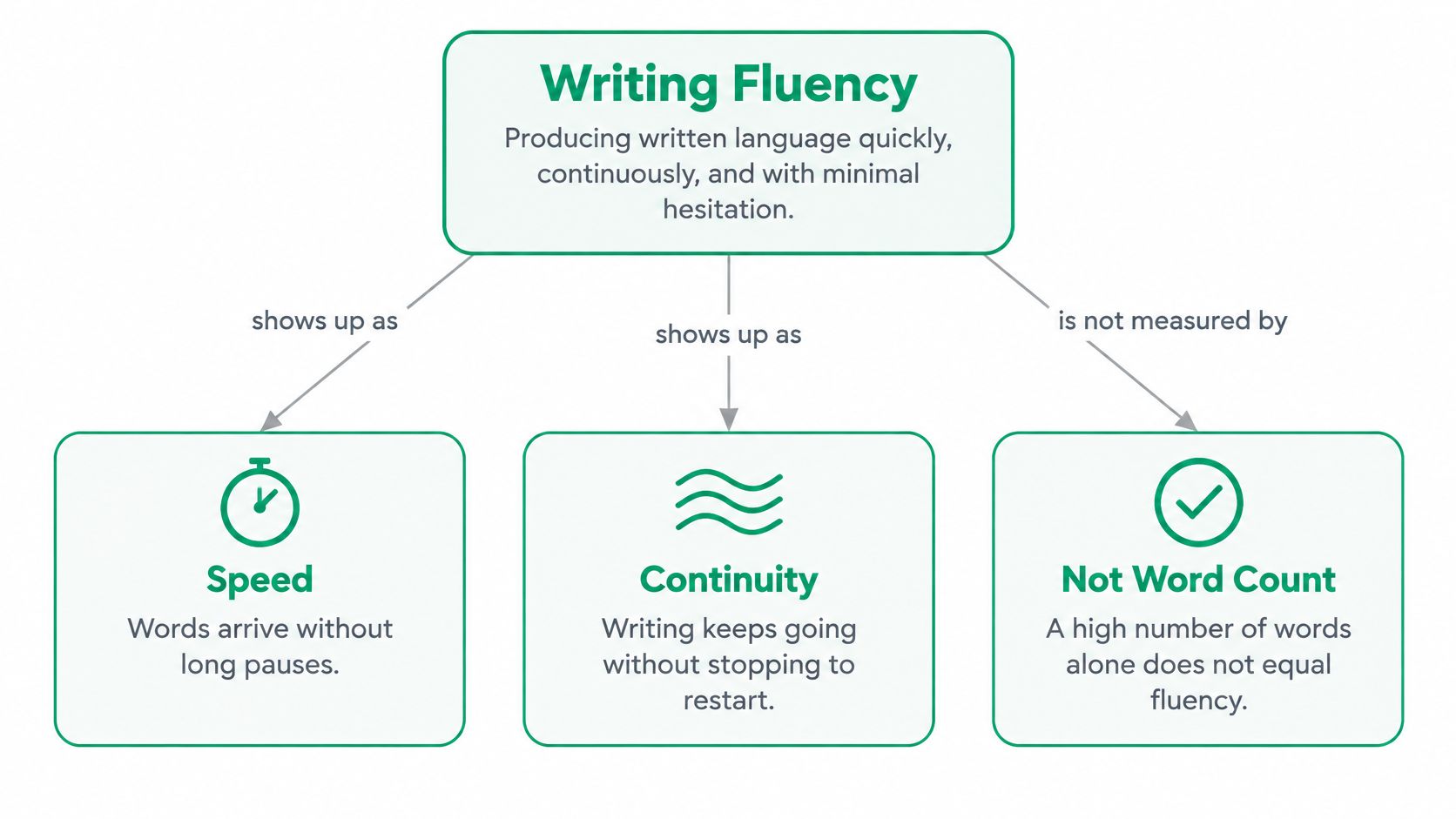
Writing fluency is the ability to produce written language quickly, continuously, and with minimal hesitation, not the number of words you can type, and its basic measure is composing rate in words per minute. If smooth prose can be produced by a tool in seconds, how do you know whether the fluency belongs to you or only to the finished page?
What Writing Fluency Means for Everyday Writers
Have you ever drafted an email in one pass, then spent twenty minutes on the next message rewriting a single opening line? That gap between the two experiences is what writing fluency describes, and it shifts with the topic, your familiarity with it, and how clear your plan is.
A fluent drafting session works like driving a familiar route. You watch the destination, your reader and your point, rather than concentrating on every turn. When the route is new, each sentence needs conscious steering.
Two fluencies hiding in one draft
A finished page can read smoothly for two very different reasons, so it helps to separate them. Performance fluency is how natural the final text reads: steady sentences, clean transitions, few visible hesitations. Developmental fluency is whether you can plan, draft, and revise that text on your own. A polished paragraph demonstrates the first. It proves nothing about the second.
Researchers capture part of this through composing rate, measured in words per minute, in research defining writing fluency and composing rate. The same rate, though, can come from steady typing or from long pauses broken by rapid bursts. That is why studies distinguish product fluency, total output over total time, from process fluency, the bursts of text you produce between pauses.
Why smoothness is not the whole goal
Smooth output still has to hold up as communication. In the 2011 NAEP computer-based writing assessment results, most students scored below the Proficient level, which that framework defines as writing that develops and organizes ideas, uses transitions, and shapes language for its audience. Fluency gets words onto the page. Those criteria decide whether the words do their job.
Fluency is how smoothly ideas become text; quality decides whether that text is worth reading.
Set a piece where the words came easily next to one where you stalled. What changed: the topic, the vocabulary, the plan, or your confidence with the sentences themselves?
The Four Parts of Writing Fluency
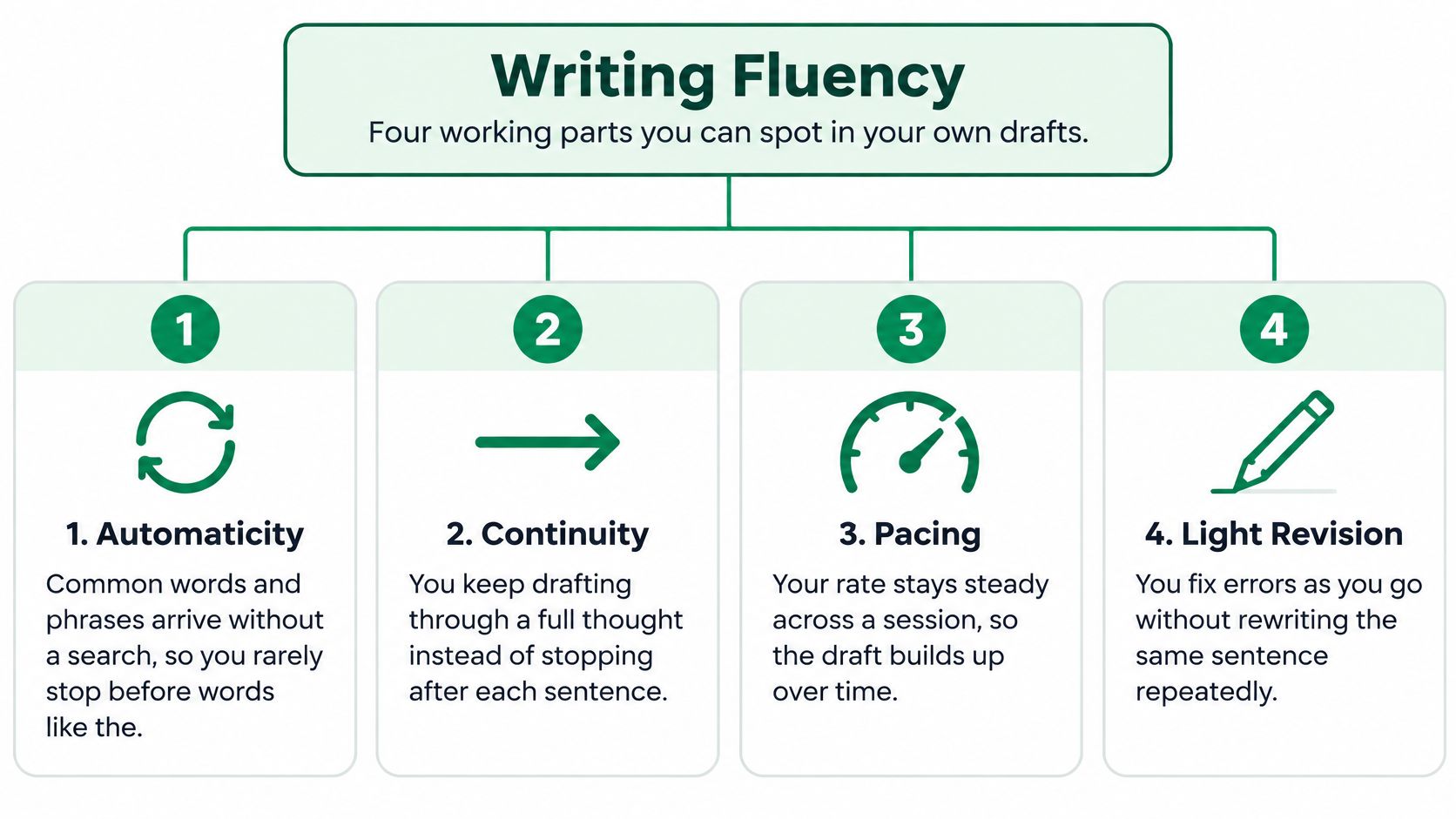
Writing fluency isn't one skill you either have or don't. It's a multidimensional production skill, and you can spot its parts in an ordinary draft if you know where to look.
Automaticity and accuracy
Automaticity means common words and phrases arrive without a search. You don't stop before words like "the" or "because," and familiar sentence patterns don't need assembling piece by piece. In second-language writing, this also depends on how quickly you can reach vocabulary and grammar you already know.
Accuracy means your sentences say what you mean on the first pass. Grammar supports the meaning instead of forcing you to repair it later. You may still revise for style, but you're not rewriting every sentence just to make it understandable.
The video below is a useful pause point before you judge your own drafts too quickly.
Speed and coherence
Speed is steady production during a timed draft, not a frantic sprint. For example, a routine article draft might build consistently across a session instead of arriving in one rush followed by a long stall.
Coherence is the thread between sentences. Each sentence answers, extends, or explains the one before it, so readers don't have to guess why a new claim appeared. Learning how to vary sentence structure while keeping connections clear helps here, because varied sentences still need logical links.
These parts don't always move together. You can be fast but incoherent, accurate but stalled, or automatic with simple sentences yet lost when ideas get complex. That's consistent with research cautioning that raw word count measures the product, not the process, and recommending words per minute alongside pause behavior and quality.
| Component | What It Looks Like | Warning Sign | Quick Check |
|---|---|---|---|
| Automaticity | Common words and phrases arrive without a search | Stalls before words like 'the' or 'because' | Draft 200 words without opening a thesaurus |
| Accuracy | Sentences match the intended meaning on the first pass | Sentences need repeated rewriting to make sense | Reread one paragraph and state its point in one line |
| Speed | Steady output during a timed draft | Long gaps between bursts of text | Compare words per minute across two timed drafts |
| Coherence | Each sentence links to the next through logic and transitions | Paragraphs read as a list of separate claims | Check whether each paragraph answers the question raised by the one before |
Score your last draft on all four parts. Don't average them away. Note the weakest one, because that's where practice will help first.
Writing Fluency vs Proficiency and Mechanics
These three terms get mixed up because they often appear in the same feedback. A teacher, editor, or client may say a draft "doesn't flow," when the actual problem is organization, grammar, or both.
Ask three separate questions. Writing fluency asks how easily words flow into text. Writing proficiency asks how well the finished piece meets its goal. Writing mechanics asks whether spelling, punctuation, and grammar follow convention.
| Term | Core Question | Typical Measure | Example |
|---|---|---|---|
| Writing fluency | How easily do words flow into text? | Composing rate and pause patterns | A blog draft written in one sitting, with pauses only at paragraph breaks |
| Writing proficiency | How well does the finished piece meet its goal? | Rubric scores for ideas, organization and audience fit | A persuasive essay with clear structure but dull examples |
| Writing mechanics | Do spelling, punctuation and grammar follow convention? | Error counts and style checks | A memo with no typos but a comma splice in every paragraph |
A piano analogy
Mechanics is like scales on a piano. It's the controlled practice underneath performance. Proficiency is the finished performance judged against the piece and the audience.
Fluency is playing without stopping. You can know the scales and still hesitate in the song. You can also keep playing while hitting wrong notes.
Two writers, two different problems
One writer produces clean sentences but works painfully slowly. Every paragraph is correct, yet drafting a short report takes all afternoon because each phrase is checked before the next one begins.
Another writer fills pages quickly but leaves comma splices, vague claims, and abrupt shifts. A grammar checker for catching convention errors may help the second writer's mechanics, but it won't by itself fix weak ideas or teach the first writer to draft with less hesitation.
The terms overlap in real life. Proficient writers usually have decent mechanics and enough fluency to finish. Still, each strength can exist without the others.
Use this diagnostic question on your next stalled draft. Are you stuck finding words, unsure whether the piece works, or worried about correctness? Your answer tells you which problem to solve first.
Fluent and Disfluent Writing Side by Side
Definitions get clearer when you see two versions of the same idea. Both samples below describe a reading lamp, but they ask very different amounts of work from the reader.
The stalled version
This lamp is good. It is good for reading. People like it because it is good and it is bright.
Nothing here is hard to decode, yet it feels stuck. "Good" repeats without adding information. "People like it" doesn't name a reader need, and "bright" arrives with no picture of when or why brightness matters.
Your eye keeps restarting. Each short sentence drops the previous one instead of carrying it forward.
The fluent version
The lamp holds steady brightness for hours, so you can read through a long evening without squinting or reaching for a switch.
The revision doesn't use fancy vocabulary. It works because it gives you a specific benefit, links cause to result with "so," and ends on an experience you can picture. Plain sentences can be fluent when they're produced and organized efficiently.
What this looks like at work and at school
A marketer revising an AI-generated product article faces the same choice. Replace a broad phrase like "high quality solution" with the concrete benefit a buyer gets. Then connect each paragraph to the question that buyer is likely asking next, such as cost, setup, or durability.
A student needs a different check. Read the smooth explanation and ask, "Could I explain this in my own words without looking?" If not, the prose may sound fluent while your understanding is still thin.
- Repetition check: Circle repeated words that add no new detail.
- Benefit check: Underline the sentence that tells readers why they should care.
- Link check: Mark where one sentence fails to connect to the next.
Try that exercise on one paragraph you've already written. Mark exactly where your eye slows down, then name the reason in plain words, such as repeated claim, missing detail, or abrupt jump.
How to Measure Writing Fluency
You don't need a lab to get a useful picture. You need comparable timed drafts, a simple record of pauses, and the discipline to compare yourself with yourself.
Set up a timed sample
Choose a familiar topic and write 300 to 500 words in one sitting. Use a keystroke logger if you have one, or a timer plus brief pause notes if you don't.
Don't edit heavily during the sample. You're measuring drafting, not final polish. Save revision for after you've recorded the numbers.
Calculate and sort
- Compute composing rate: Divide total words by minutes spent writing.
- Sort pauses: Group them as 300 to 999 milliseconds, 1,000 to 1,999 milliseconds, and over 2,000 milliseconds.
- Note location: Mark whether each pause fell inside a phrase, at a word boundary, or at a sentence or paragraph boundary.
- Repeat the task: Use three comparable prompts and compare medians, not one unusually good or bad run.
Location matters. In keystroke research with 101 university students writing narrative and argumentative essays, pause rates at word boundaries were associated with word-frequency choices, while sentence-boundary pauses predicted sentence length. Different pause locations point to different kinds of thinking.
| Metric | How to Calculate | What It Reveals |
|---|---|---|
| Composing rate | Total words divided by minutes spent writing | Overall production speed in words per minute |
| Writing burst length | Average words typed between pauses | Continuity of production |
| Short pauses (300-999 ms) | Count per 100 words | Brief word-level retrieval or typing hesitation |
| Medium pauses (1,000-1,999 ms) | Count per 100 words | Hesitation while choosing phrasing |
| Long pauses (over 2,000 ms) | Count per 100 words, with location noted | Planning or retrieval blocks; check whether they sit inside phrases or at boundaries |
| Median pause duration | Middle value across the whole session | Typical hesitation, less distorted by outliers |
| Sentence-boundary pauses | Count of pauses at sentence ends | Planning before new sentences |
Read the pattern, not just the score
Frequent long pauses inside phrases may point to vocabulary access, typing friction, or uncertainty about sentence shape. Pauses at sentence and paragraph boundaries may be healthy planning, especially before a longer or more complex sentence.
Practical rule: Don't try to remove every pause. Reduce the pauses that interrupt a thought you already have.
There's no universal words-per-minute target in this approach. Compare your median composing rate across three prompts over several weeks, and use a readability checker to review the finished draft separately. Speed tells you how production went, readability tells you how the result may land.
Why Speed and Smooth Prose Can Mislead You
Smooth AI-polished prose can create a false sense of progress. The paragraph reads naturally, the transitions sound confident, and you assume your writing has improved. But whose fluency are you looking at?
Fast writing alone is also not proof, because word count can reward rushed, repetitive, or poorly connected prose while a slower writer produces coherent and persuasive text. That's the first trap. Output looks impressive until a reader asks what it really says.
Not every pause is a failure
Planning pauses at sentence and paragraph boundaries can be purposeful. You may be choosing an example, checking logic, or deciding what the reader needs next. Removing those pauses could make drafting quicker and thinking worse.
Context matters too. Writers working in a second language, using unfamiliar keyboards, or managing dyslexia may look disfluent under a speed-only measure while still developing strong ideas.
Two kinds of fluency
It helps to separate performance fluency from developmental fluency. Performance fluency is how natural and effective the finished text reads. Developmental fluency is your capacity to plan, draft, revise, and transfer those skills independently to a new task.
Recent discussion of AI and student compositional fluency, summarized in research on AI tools and compositional fluency, points both ways. AI can improve efficiency, provide immediate feedback, strengthen mechanics, and expand linguistic repertoires. Uncritical or excessive use may also encourage dependence, reduce critical thinking, and homogenize writing styles.
That means AI can raise performance fluency while developmental fluency stays flat. Surface friction disappears, but idea generation, lexical retrieval, and revision judgment may remain underdeveloped.
Smoother final prose is not automatically evidence of stronger fluency.
Try a simple test this week. Write one paragraph unaided, then compare it with an AI-polished version. Which one could you explain, defend, and rewrite tomorrow without notes?
How to Build Writing Fluency Step by Step
Build fluency the way you'd build any production skill, with short repeated practice and feedback you can see. The goal isn't to write carelessly. It's to make drafting easier so revision can do its proper job.
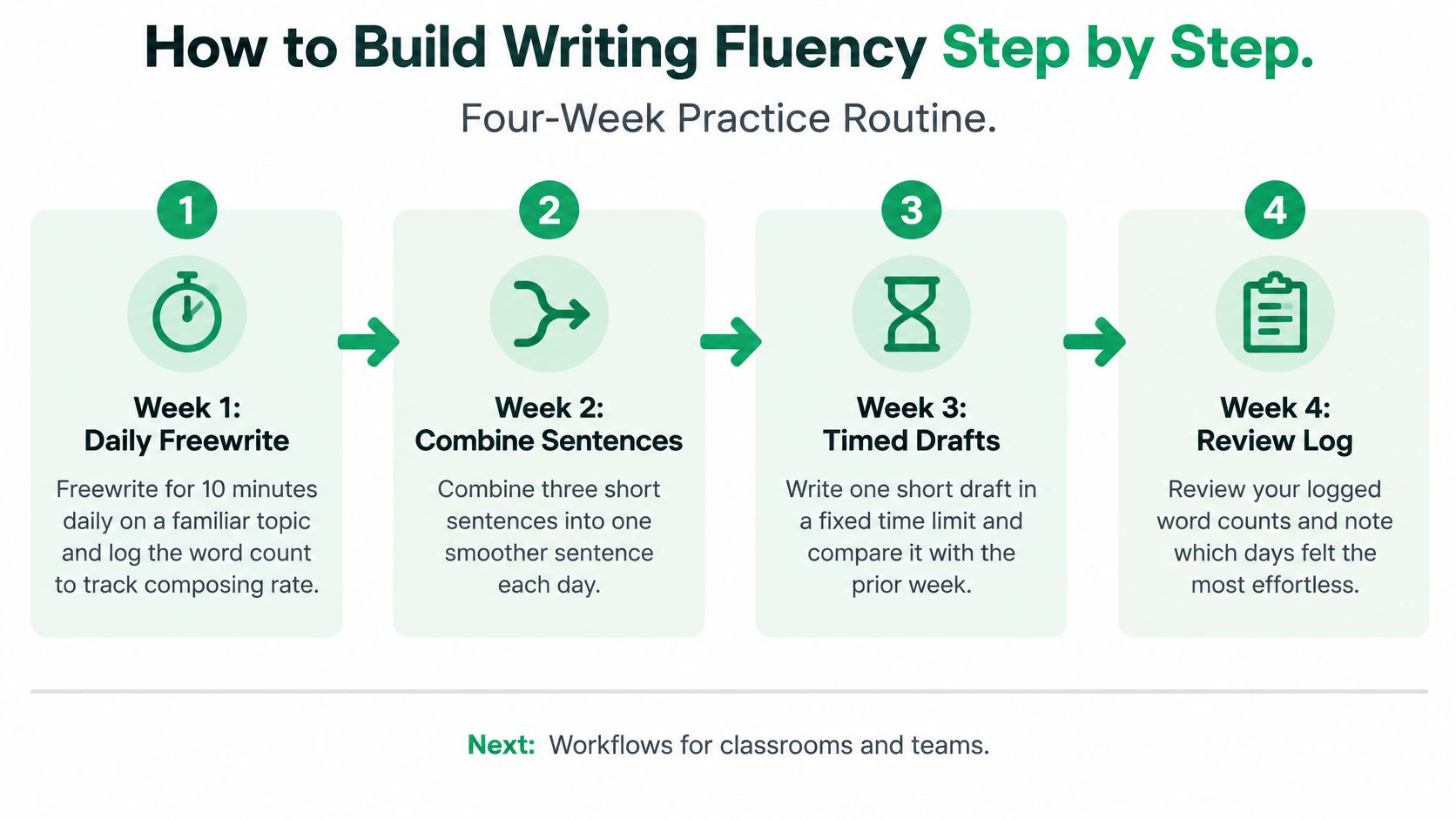
The routine below spreads six drills across four weeks. Week one uses short sessions, and each later week adds a longer timed draft.
Six drills to rotate
- Freewrite daily: Spend 10 minutes on a familiar topic and log your word count to track composing rate.
- Combine choppy sentences: Take three short sentences and combine them into one clear sentence in five minutes.
- Draft from an outline: Write 300 words from a bullet outline in 20 minutes without opening any tool.
- Listen for awkward joins: Read a finished paragraph aloud, mark every awkward transition, and rewrite only those joins.
- Retype from memory: Retype a passage you admire from memory, then compare it with the original to find where your phrasing stalls.
- Review your pause log: Every Friday, target long pauses inside phrases, not planning pauses at boundaries.
Notice what each drill isolates. Freewriting lowers the fear of starting. Sentence combining teaches your hands smoother patterns. Unaided timed drafting builds automaticity because there's no suggestion to lean on.
Reading aloud catches a different problem. Your ear notices a missing link or overloaded sentence before your eye does. The memory exercise is slower, but it shows which constructions you can reproduce and which ones you only recognize.
If you want broader language support alongside these drills, work through practical ways to improve English writing skills and apply one idea at a time. Don't change everything in the same week, or you won't know what helped.
Workflows for classrooms and teams
In a classroom, pair a timed in-class draft with revision on another day. Ask peers to comment on flow and coherence first, such as where they got lost, rather than hunting surface errors. Students then revise for meaning before mechanics.
For professionals and content teams, use a steady sequence. Start with a brief, then an outline, then an unaided draft. Revise for flow and reader questions, then fact-check before publishing.
That order protects both kinds of fluency. You get practice generating text yourself, and the finished piece still receives careful editorial attention.
Use AI to Refine Drafts Without Losing Your Voice
AI can help you revise, but only if you keep authorship clear. Start with your own draft, even if it's rough. Your ideas, examples, sources, and conclusions need to exist before a tool starts smoothing sentences.
A responsible sequence
Write unaided first. Then use AI for clarity and naturalness feedback, such as flagging repetition, tangled phrasing, or abrupt transitions.
Next, verify every fact and rewrite key passages in your own voice. If you need a structured method, follow a step-by-step approach to humanize AI text while keeping your original examples and reasoning intact.
We built PureWrite for that refinement stage. You paste a draft, review naturalness and readability analysis, apply recommendations, and use Humanize mode for stylistic polish before running AI detection and plagiarism checks. It refines text, but it doesn't replace fact-checking or your responsibility for the final work.
Treat detector scores carefully
A detector score isn't proof of authorship. In a study of 100 human-written behavioral-health articles and 200 AI-generated texts, a free detector labeled a median 27.2% of the human academic articles as AI-generated. That's a signal to review drafts and process, not a verdict.
Be skeptical of promises about being undetectable or perfectly accurate. Detection performance changes with editing, document type, and evaluation method, so don't write to chase a score.
- Keep evidence of process: Save drafts, outlines, source notes, and revision history.
- Disclose when required: Follow your school, employer, or client rules for AI assistance.
- Protect your voice: Keep your examples, judgments, and phrasing choices visible in the final text.
Ethical humanization improves readability and preserves your ideas. It should never disguise plagiarism or misrepresent who produced the work. Try the sequence on one draft you wrote yourself and compare the before and after line by line.
Bring one rough draft you wrote unaided to Pure Write , review its naturalness and readability suggestions, and apply only the changes that make your meaning clearer in your own voice. You'll improve the performance fluency of the finished text while keeping the planning, judgment, and authorship where they belong, with you.