An Example of Alliteration: 5 Clear Cases with Tips
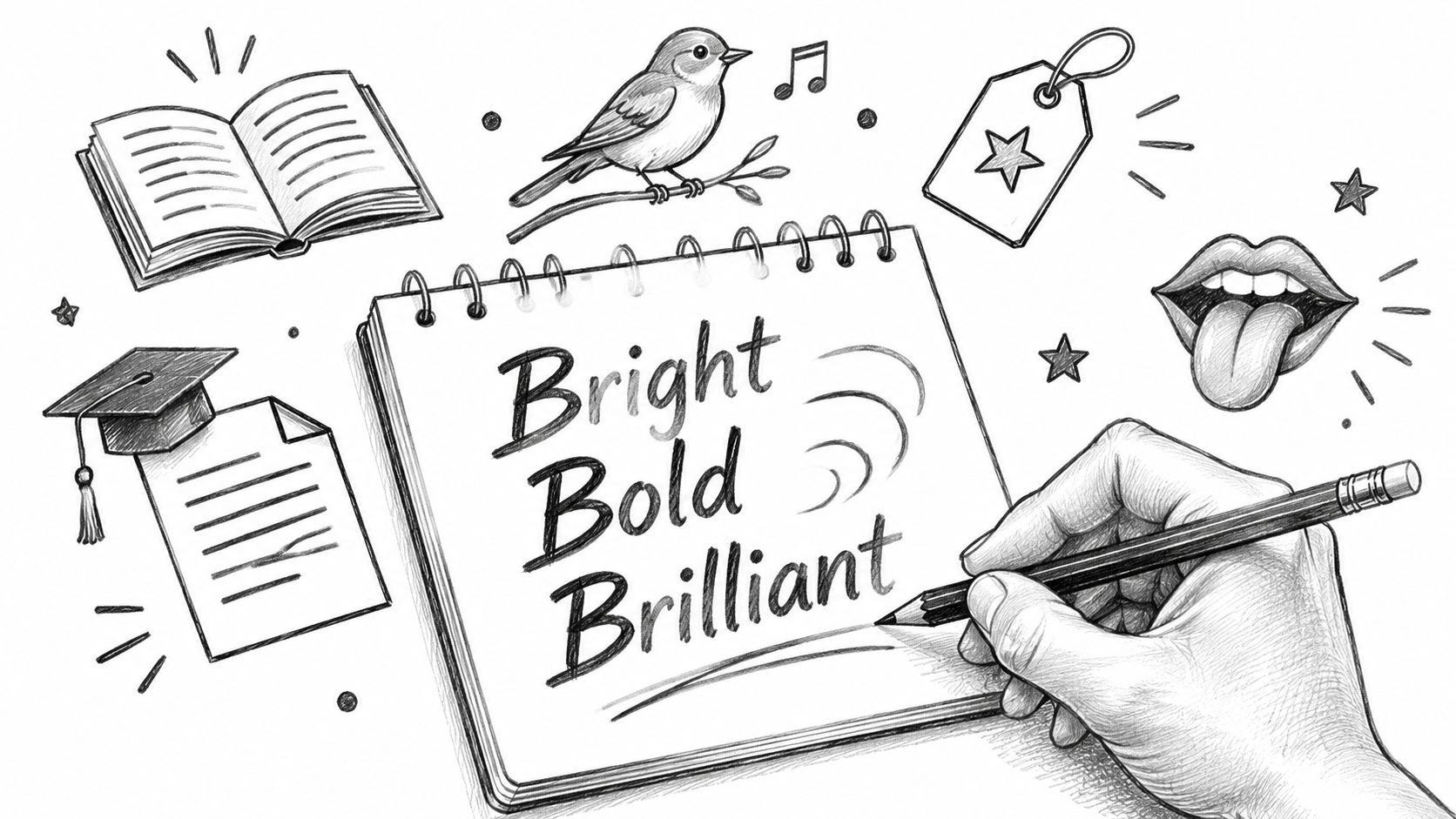
You're polishing a tagline, a presentation ending, or an AI-assisted blog introduction. The meaning is right, but the line feels flat: Tools for more effective planning. You try Plan with purpose, and suddenly you have a phrase you can hear as well as read.
That repeated opening sound is alliteration. More precisely, alliteration repeats the same initial consonant sound across nearby words, as the Merriam-Webster definition explains. The important word is sound: cat and kite match even though their opening letters differ.
Writers have used this technique across ancient poetry and speeches, literary language, advertising, and modern brand names. You don't need to write a tongue twister to benefit from it. A restrained sound pattern can give a heading rhythm or make a closing line feel deliberate.
Good alliteration gives readers a useful phrase to remember, not a pronunciation exercise to survive.
The familiar examples below offer different techniques you can borrow: playful repetition, atmospheric sound, compact parallel phrasing, memorable naming, and literary pacing. Each provides an example of alliteration worth studying for a practical reason, not just identifying on a worksheet.
If you use AI writing tools, treat these patterns as editorial choices rather than automatic upgrades. You still need to choose accurate words, preserve your meaning, and decide whether the result sounds like something you'd actually say.
1. Peter Piper Picked a Peck of Pickled Peppers
Peter Piper picked a peck of pickled peppers makes its sound pattern impossible to miss. The repeated /p/ creates a crisp, percussive rhythm, while the similar word shapes make the phrase challenging to say quickly.
The peppers make the sentence easy to visualize, even when the pronunciation gets tangled.

The Austin Peay State University writing-center handout includes this phrase as an alliteration example. Notice that the small connecting word of doesn't disrupt the pattern. Your sentence doesn't need matching sounds in every word.
Borrow the Rhythm, Not the Difficulty
Say you're writing a caption for a farmers' market stall. A plain version might be Fresh peppers available today, while a more playful version could be Pick your perfect peppers.
The revision keeps the product and action clear. Stretching it into Peter's premium perfectly picked pepper packs would create more repetition, but it would also make the reader work harder.
- For children's materials: Pair the repeated sound with a picture so learners can connect pronunciation, spelling, and meaning.
- For speech practice: Use the phrase slowly to notice the /p/ sound rather than treating speed as the only objective.
- For marketing copy: Borrow a compact phrase for a caption or display sign, not an entire paragraph of matching initials.
Listen to the spoken example and notice where the repeated sounds become difficult to separate.
Keep the Promise More Important Than the Pattern
Word choice changes more than rhythm. Premium peppers implies a quality claim, while pickled peppers identifies a preparation method; they aren't interchangeable just because both fit the sound.
Our guide to denotative and connotative examples helps distinguish literal meaning from the associations a word creates. Check both before choosing the catchiest version.
For professional emails and research papers, keep this level of repetition out of the main explanation. A playful heading might suit a workshop, but readers reviewing evidence or instructions need precision first.
When prompting an AI tool, specify the action and audience before requesting alliteration. Ask for a natural market-stall caption that preserves the product description, then reject any option that invents a benefit just to add another /p/.
2. She Sells Seashells by the Seashore
Read She sells seashells by the seashore slowly, then try it at conversational speed. Its difficulty comes partly from switching between /s/ and /sh/, not from repeating one identical sound throughout.
Sells, sea, and the opening of seashells share /s/. She begins with /sh/, so this familiar example is also a useful reminder to listen closely instead of counting matching letters.
The coastal image gives you a concrete scene to connect with the sound.
Use Sound to Support a Scene
A seaside accommodation business might describe an evening as soft surf beyond the balcony. The /s/ repetition is noticeable, but the reader still learns something concrete about the setting.
Compare that with serene seaside sensations. It sounds polished, yet it offers little information about the place. Atmospheric language works better when you attach it to something readers can picture, hear, or use.
The Brigham Young University SEEL Alliteration Dictionary connects repeated consonants with sensory effects, including soothing /sh/ patterns and snake-like /s/ patterns. That range matters: the same sound can support calm, secrecy, or unease depending on the surrounding words.
Editorial test: Name the scene or feeling you want before choosing the repeated sound.
For a coastal product description, soft sea-green linen can connect sound, color, and material. For suspense, something scraped beneath the stairs uses a related sound pattern in a very different context.
Neither effect comes from the consonant alone. The nouns and verbs do most of the descriptive work; repetition reinforces them.
Give the Reader an Easy Route Through the Line
Keep a short cluster of repeated sounds, then return to plain language. A description that begins soft surf can continue with useful details about the view, access, or room rather than searching for more matching words.
Our explanation of figurative language types can help you separate sound devices from techniques such as metaphor and personification. That distinction makes your edits more deliberate and your literary analysis more precise.
For a presentation warm-up, the original tongue twister is useful precisely because it's difficult. For a headline, that same difficulty is usually a drawback.
Read AI-generated headlines aloud before choosing one. If you repeatedly stumble between /s/ and /sh/, simplify the phrase rather than assuming that a smooth-looking sentence will be easy to speak.
3. Veni, Vidi, Vici
Veni, vidi, vici, associated with Julius Caesar and recorded by the Roman historian Suetonius, is commonly translated as I came, I saw, I conquered. Its connection with Caesar's victory at Zela supplies the context for its confident, compressed form.
For an English-speaking writer, the practical lesson is the combination of repeated openings, balanced phrasing, and decisive verbs. The familiar version has momentum because each unit advances the action.
A strong closing line should express a sequence your reader can follow, not merely a sequence your reader can repeat.
There's also a pronunciation caveat. The opening sound differs between reconstructed Classical Latin and familiar English readings, but the repeated initial pattern remains; don't assume that the English letter v tells you exactly how Caesar pronounced it.
Build Parallel Actions Before Matching Sounds
Say you're closing a presentation about improving a publishing workflow. Start with the actual sequence: We review the evidence, revise the draft, and release the approved version.
You could compress that into Review. Revise. Release. The repeated /r/ gives the ending cohesion, but the verbs remain useful because they describe recognizable stages.
Compare that with Rise. Rule. Reign. The second version sounds forceful but says little about editing, approval, or delivery. Confidence without relevant information becomes empty slogan writing.
- For presentations: Choose verbs that summarize the process you've explained.
- For sports copy: Make sure the actions fit the activity rather than borrowing generic language about victory.
- For business conclusions: Keep qualifications visible when approval, timing, or results remain uncertain.
Our guide to an example of diction explains how vocabulary shapes tone. Review sounds procedural, while conquer sounds combative; choose the register your audience needs.
Separate Memorability From Persuasion
There's evidence for a memory mechanism, but it isn't a promise that a catchy slogan will convince readers. In Lea and colleagues' study indexed by PubMed, three experiments found that alliterative cues reactivated earlier information during silent and oral reading, in poetry and prose.
The useful application is consistency. If you introduce an alliterative process label, retain the same wording in the summary and supporting materials instead of generating fresh synonyms everywhere.
With AI assistance, ask for parallel verbs only after you've established the actual sequence. Check that the tool hasn't changed an activity into an achievement, such as replacing test with triumph.
A memorable ending should help readers retrieve your message. It shouldn't exaggerate what you've proved.
4. Coca-Cola and Dunkin' Donuts
Alliteration in Brand Names
Coca-Cola repeats the /k/ sound, while Dunkin' Donuts repeats /d/. Both demonstrate how a compact sound pattern can give a name an audible identity.
Keep the distinction between the full and shortened names clear. Dunkin' Donuts contains the repeated initial sound; Dunkin’ alone doesn't demonstrate alliteration across nearby words.
These familiar products make the naming patterns easy to hear.

Test a Name Beyond Its Sound
Coca-Cola's cursive logo illustrates an important distinction: visual identity and spoken identity work together, but they aren't the same thing. A name needs to function when someone says it in conversation, not just when a designer presents it on a screen.
Say you're naming a bakery subscription. Butter Box is compact and alliterative, but it may suggest that subscribers receive butter rather than assorted baked goods.
Breakfast Box might describe the offer more accurately, even though its sound pattern is less exact. The stronger name is the one your audience understands, not necessarily the one with the neatest repetition.
- Check comprehension: Ask prospective customers what they expect the product to contain before explaining it.
- Check pronunciation: Have someone say the name after reading it without coaching.
- Check availability: Review relevant trademark registers, domains, and social handles before investing in packaging.
- Check associations: Ask speakers in your target markets whether the name carries an unintended meaning.
These checks reveal different problems. A name can be easy to pronounce yet misleading, or distinctive on paper yet awkward when spoken.
Keep Recall Claims Proportionate
Alliteration can support retrieval under specific conditions. In a poetry-memory study published in PMC, participants recognized target words approximately 85 milliseconds faster with matching-alliteration cues than with different-alliteration or no-alliteration cues.
That finding doesn't establish a sales lift or prove that an alliterative business name will outperform another name. Use it as a reason to consider consistent sound patterns, not as a forecast for a launch.
Our guide to persuasive writing techniques offers a useful companion to naming work. Once readers notice a name, your copy still needs a clear offer and credible reasons to choose it.
If AI generates candidate names, treat them as brainstorming material. You remain responsible for meaning, originality, availability, and any claims attached to the final choice.
5. Full Fathom Five Thy Father Lies
Full fathom five thy father lies, from Ariel's song in Shakespeare's The Tempest, repeats /f/ in full, fathom, five, and father. The intervening words don't break the pattern because those repeated sounds remain close and prominent.
Unlike Peter Piper, this line isn't useful because it challenges your tongue. Its value lies in the relationship between sound, pacing, and the troubling image of a father beneath the sea.
The ocean imagery gives you a way to think about that relationship.

Repeat a Sound Where the Image Needs Weight
Read the line slowly and listen to the breathy /f/ sounds. Then notice that the measured phrasing, sea imagery, and subject matter contribute to the solemn effect too.
Don't teach or apply this as a fixed formula in which /f/ always means sadness. In another context, the same consonant could sound lively or comic.
For a modern scene, try Foam folded over the flooded steps. The repeated opening sound links visible actions and objects, giving the sentence texture without requiring a string of decorative adjectives.
A weaker revision would replace precise details with ornate synonyms just to preserve the pattern. If you need a thesaurus to make every important word match, you're probably editing toward the wrong objective.
Keep the image accurate first. Let the sound pattern emerge from words that belong in the scene.
For literary study, MasteryMind revision for The Tempest provides a starting point for considering the play's broader context. Your analysis should connect sound to the song's dramatic situation rather than stopping at identifying repeated letters.
Balance Atmosphere With Plain Language
You can borrow this technique for fiction, reflective essays, or an evocative introduction. Follow a textured sentence with clearer, quieter prose so readers can understand what happened.
If you're also giving objects human actions, distinguish that choice from alliteration. Our guide to an example of personification helps you identify what each device contributes.
For AI-assisted creative work, draft the sensory details yourself before requesting stylistic alternatives. Then compare each suggestion against the scene: did the tool preserve the location, action, and emotional perspective, or merely make the prose more elaborate?
At PureWrite, we encourage you to use humanizing edits to refine expression without surrendering authorship. Keep the phrases that sound like your narrator, remove borrowed grandeur, and retain plain wording whenever it carries the emotion more faithfully.
How the five alliteration examples compare by sound pattern, context, and best use
| Item | Repeated Sound | Original Context | Best For | Main Risk |
|---|---|---|---|---|
| Peter Piper Picked a Peck of Pickled Peppers | “P” sounds | Traditional nursery rhyme and children's language learning | Pronunciation practice and playful content | Sound can overshadow meaning |
| She Sells Seashells by the Seashore | “S” sounds | Tongue twister used for diction and speaking practice | Vocal warm-ups and coastal descriptions | Repeated sibilants can be hard to say |
| Veni, Vidi, Vici | “V” sounds | Phrase attributed to Caesar after his victory at Zela | Concise, confident closing lines | Latin may be unfamiliar |
| Coca-Cola and Dunkin' Donuts: Alliteration in Brand Names | “C” and “D” sounds | Alliterative commercial brand names | Memorable branding and marketing copy | Can feel gimmicky or resemble other names |
| Full Fathom Five Thy Father Lies | “F” sounds | Ariel's song in Shakespeare's The Tempest | Evocative, somber literary writing | Archaic language may be unclear |
From Famous Lines to Your Own Drafts
A Practical Alliteration Checklist
Alliteration works when sound supports meaning. It backfires when you choose a less accurate word, exaggerate a promise, or make readers untangle a phrase just to notice the pattern.
The familiar examples offer different tools, not a single style to imitate. You can borrow the playful pulse of Peter Piper, the atmosphere of She sells seashells, the parallel actions of Veni, vidi, vici, the compactness of brand names, or the measured texture of Shakespeare's line.
Check the Sound and the Substance
Use this checklist on a heading, tagline, closing sentence, or descriptive passage:
- Pick one sound: Listen for an opening consonant you can repeat naturally in words relevant to your message.
- Keep it compact: Aim for two or three words per phrase rather than forcing a matching opening into every available position.
- Read the line aloud: Use conversational speed and your audience's likely pronunciation, not an exaggerated performance.
- Confirm the meaning survives: Restate the sentence plainly and check that both versions communicate the same information.
- Remove unsupported implications: Cut attractive words that introduce a benefit, guarantee, or emotional claim you can't justify.
- Compare with the plain version: Choose the alliterative version only when it improves emphasis, rhythm, clarity, or mood.
The word-count guideline is a drafting restraint, not a definition of alliteration. A longer literary pattern can work beautifully, while a short phrase can still feel forced.
For AI-assisted drafts, save the unedited sentence before revising. Ask the tool for alternatives that preserve every factual claim, then compare its suggestions with your own spoken phrasing.
Make the Final Decision Yourself
A line sounds authentic when its vocabulary, tone, and purpose fit the person writing it. Adding casual expressions, deliberate mistakes, or excessive alliteration doesn't make a draft more genuinely yours.
AI-detection scores also aren't a substitute for reviewing authorship, accuracy, or originality. Follow your school's, client's, or employer's disclosure requirements, and never use a humanizer to disguise prohibited assistance.
Try PureWrite to humanize AI-generated content while keeping your original intent intact. We recommend reviewing suggested changes aloud, restoring any distinctive phrasing you want to keep, and accepting edits because they improve the reader's experience, not because they promise to conceal how you worked.
At Pure Write, we help you turn AI-assisted drafts into clearer, more natural prose while preserving your voice and meaning. Visit Pure Write to refine tone, readability, and rhythm, then use your own editorial judgment to keep alliteration purposeful and your writing authentic.