Conjunction in a Sentence: Types, Rules, and Examples
You're polishing a blog post, an assignment, or an AI-assisted email, and the facts are all there. Yet the draft reads like a list: The launch went ahead. The testing wasn't finished. The team monitored feedback.
Add but, because, or so, and you make a decision about what those facts mean together. Choosing a conjunction in a sentence isn't just a grammar exercise. It's how you tell readers whether you're adding information, explaining a reason, presenting a result, or acknowledging a contrast.
The Seven Coordinating Conjunctions and What Each Signals
A draft can contain clear sentences without a clear connection between them. Compare these versions:
The deadline was close. The editor checked every claim.
The deadline was close, but the editor checked every claim.
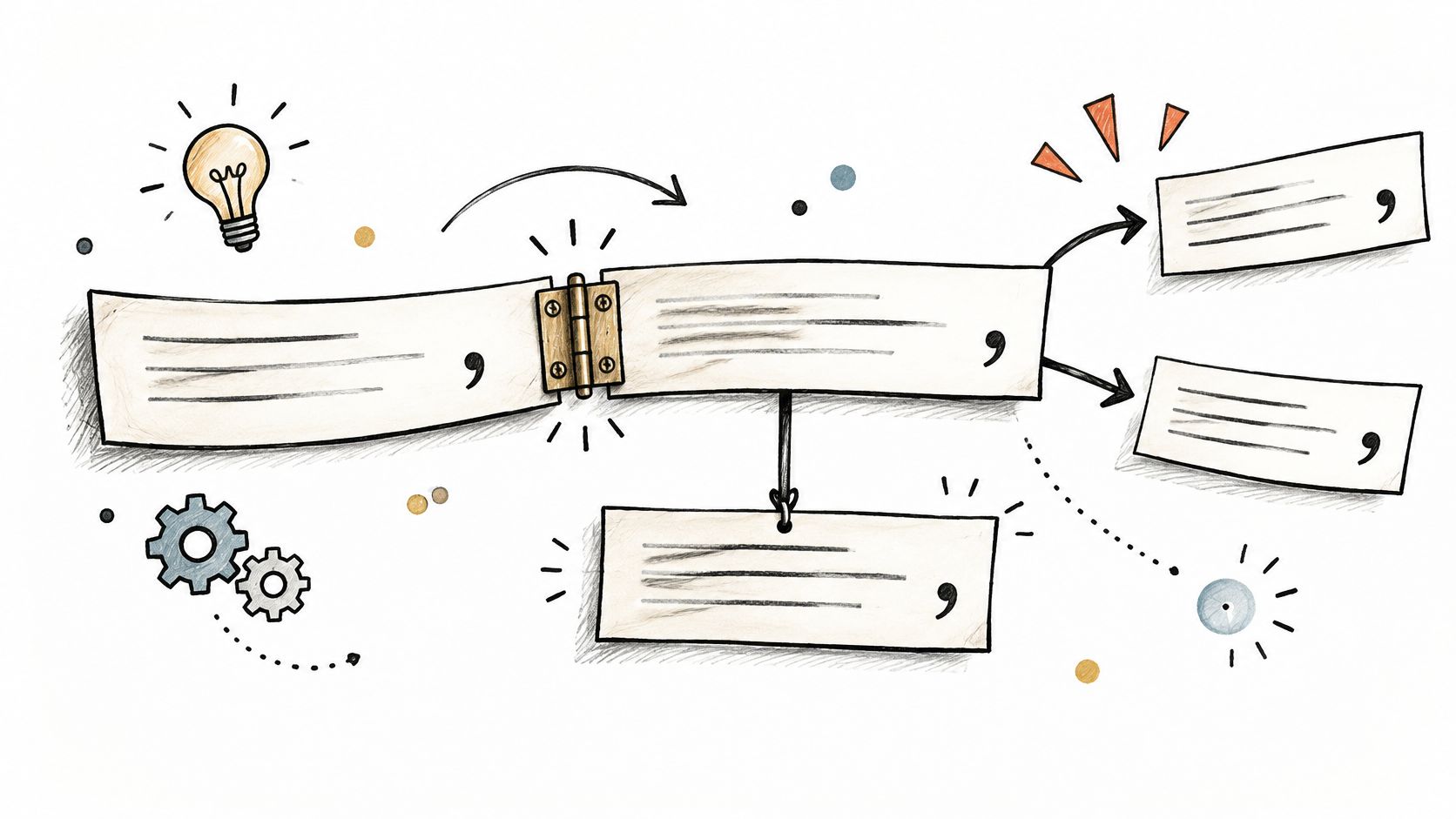
But tells readers that the editor's care contrasts with the time pressure. Think of a conjunction as a hinge: it joins separate pieces while letting you control how they work together.
A conjunction joins words, phrases, or clauses. Coordinating conjunctions connect elements of equal grammatical status, including complete clauses, as explained in the Purdue OWL conjunction guide hosted by Southern Illinois University.
Coordinating conjunctions, meanings and examples
The seven coordinating conjunctions are for, and, nor, but, or, yet, and so, remembered as FANBOYS.
| Conjunction | Relationship it signals | Example sentence |
|---|---|---|
| for | Reason | The team paused, for the data was incomplete. |
| and | Adds information | The team wrote the brief and sent it to the editor. |
| nor | Links negative alternatives | The brief did not mention cost, nor did it mention deadlines. |
| but | Direct contrast | The brief was short, but it was clear. |
| or | Alternative | You can send the brief today or tomorrow. |
| yet | Unexpected contrast | The brief was short, yet it was clear. |
| so | Result | The brief was short, so the editor finished quickly. |
Notice how but and yet can connect identical facts while suggesting different expectations. For explains the pause, whereas so connects brevity with its outcome.
And adds an action; it doesn't explicitly say why the team sent the brief. Or offers a choice, while nor extends a negative statement, often using the order nor did it.
Paired conjunctions need matching forms
Correlative conjunctions work in pairs: both…and, either…or, neither…nor, and not only…but also. Keep the material after each half grammatically balanced.
The plan is both fast and affordable matches adjectives. The plan is both fast and the cheapest doesn't maintain that balance; use both fast and inexpensive instead.
For longer examples, compare compound and complex sentences. As a quick check, remove the conjunction and ask yourself which connection readers would have to infer.
Subordinating Conjunctions and the Relationship They Signal
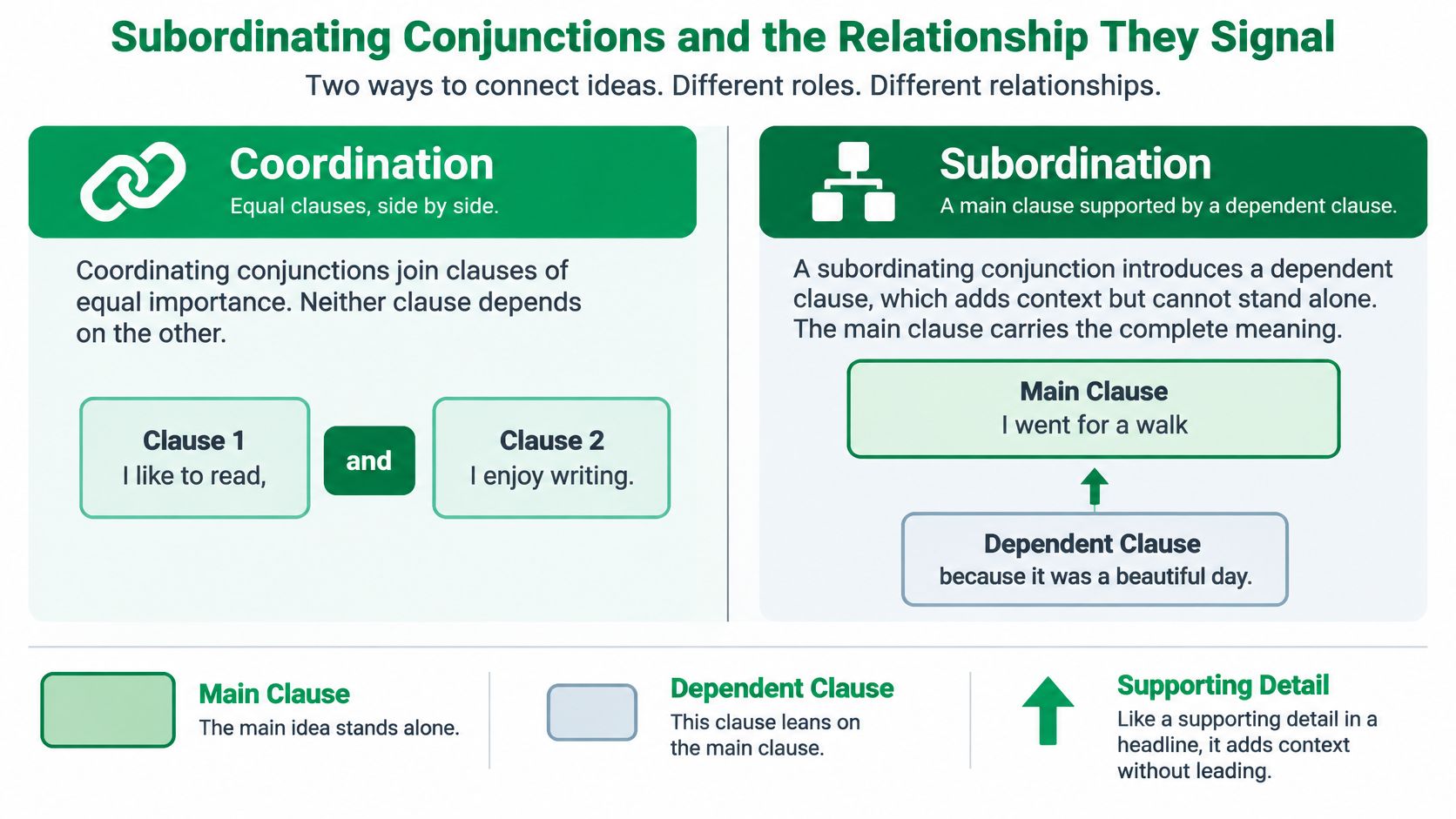
Coordinating conjunctions give connected elements equal status. Subordinating conjunctions make a clause dependent on a main clause, allowing you to foreground one idea and supply context through another.
Think of a headline and its supporting detail. The analyst revised the report carries the main news; because the forecast changed supplies the reason but leaves readers waiting for the main statement.
The diagram makes that difference visible.
Subordinating conjunctions grouped by relationship
The BBC Learning English explanation of subordinating conjunctions describes how these connectors link a dependent clause to a main clause. Choose the relationship before choosing the word.
| Relationship | Common conjunctions | Example |
|---|---|---|
| Cause | because, since, as | The team revised the headline because early readers found it unclear. |
| Time | when, before, after, while, until | The editor checked the draft before the report went out. |
| Condition | if, unless | The campaign will continue unless the cost rises. |
| Contrast | although, even though, while | Although traffic increased, conversion stayed flat. |
| Purpose | so that, in order that | The writer added subheadings so that readers could scan the page. |
In the cause example, reader confusion explains the revision. In the time example, before establishes the order of events without claiming that checking caused publication.
Unless introduces an exception to the campaign's continuation. Although acknowledges higher traffic while placing the main emphasis on unchanged conversion.
Watch for words with multiple jobs
Since can introduce either time or reason, and while can indicate simultaneous events or contrast. If readers might misinterpret your intention, choose a more explicit connector, such as because for reason.
Also distinguish so from so that. We simplified the page, so readers finished faster presents a result; we simplified the page so that readers could finish faster presents a purpose.
Completeness check: Read the dependent clause by itself. If you're still waiting for the main point, attach it to a main clause.
If identifying those parts feels difficult, practice recognizing clauses in grammar. You don't need elaborate terminology, just a reliable way to identify the main statement and its supporting information.
Comma Rules That Depend on the Conjunction
A comma splice occurs when you join complete clauses with a comma alone: The draft was ready, the editor approved it. The comma marks a boundary but doesn't properly join those statements.
You can add a conjunction that expresses the connection: The draft was ready, so the editor approved it. According to Purdue OWL's guide to independent and dependent clauses, standard edited English normally uses a comma before a coordinating conjunction joining independent clauses.
Comma rules by sentence pattern
| Sentence pattern | Comma needed? | Example |
|---|---|---|
| Two independent clauses joined by for, and, nor, but, or, yet, or so | Yes, before the conjunction | The draft was clear, and the editor approved it. |
| Two words or phrases joined by a coordinating conjunction | No | The clear and concise draft performed well. |
| Dependent clause first, then main clause | Yes, after the dependent clause | Because readers found it unclear, the team revised the headline. |
| Main clause first, dependent clause second | Usually no | The team revised the headline because readers found it unclear. |
| Three or more items joined by and or or | Yes, between items | The plan covers strategy, budget, and timing. |
The important distinction isn't whether you see and. It's what and connects.
In The editor reviewed the draft and approved it, the verbs share the subject the editor. You don't need a clause-separating comma before and, because approved it isn't an independent clause.
Position changes punctuation
Compare Although traffic increased, conversion remained flat with Conversion remained flat although traffic increased. The relationship stays similar, but moving the dependent clause changes the usual comma placement.
For lists, the comma before the final and or or is the serial comma. Follow your publication's style consistently, and rewrite a list if its grouping could confuse readers.
The word because deserves particular care when negation or an additional explanation makes the meaning ambiguous. These examples of the comma before because can help you assess those cases rather than inserting a comma automatically.
Practical rule: Cover the coordinating conjunction and inspect both sides. If each side could stand as a sentence, you'll normally need a comma before the conjunction.
Don't place commas only where you pause when speaking. Use sentence structure to decide, then read aloud to check the rhythm.
Test Any Conjunction in Four Steps
Knowing a connector's name doesn't guarantee that it fits your sentence. You also need to check what it joins, whether the sentence is complete, and whether its logic matches your intention.
The Cambridge grammar guide to subordinating conjunctions explains the dependency these words introduce. Use that distinction as a practical editing test, not just a definition to memorize.
A diagnostic routine for your draft
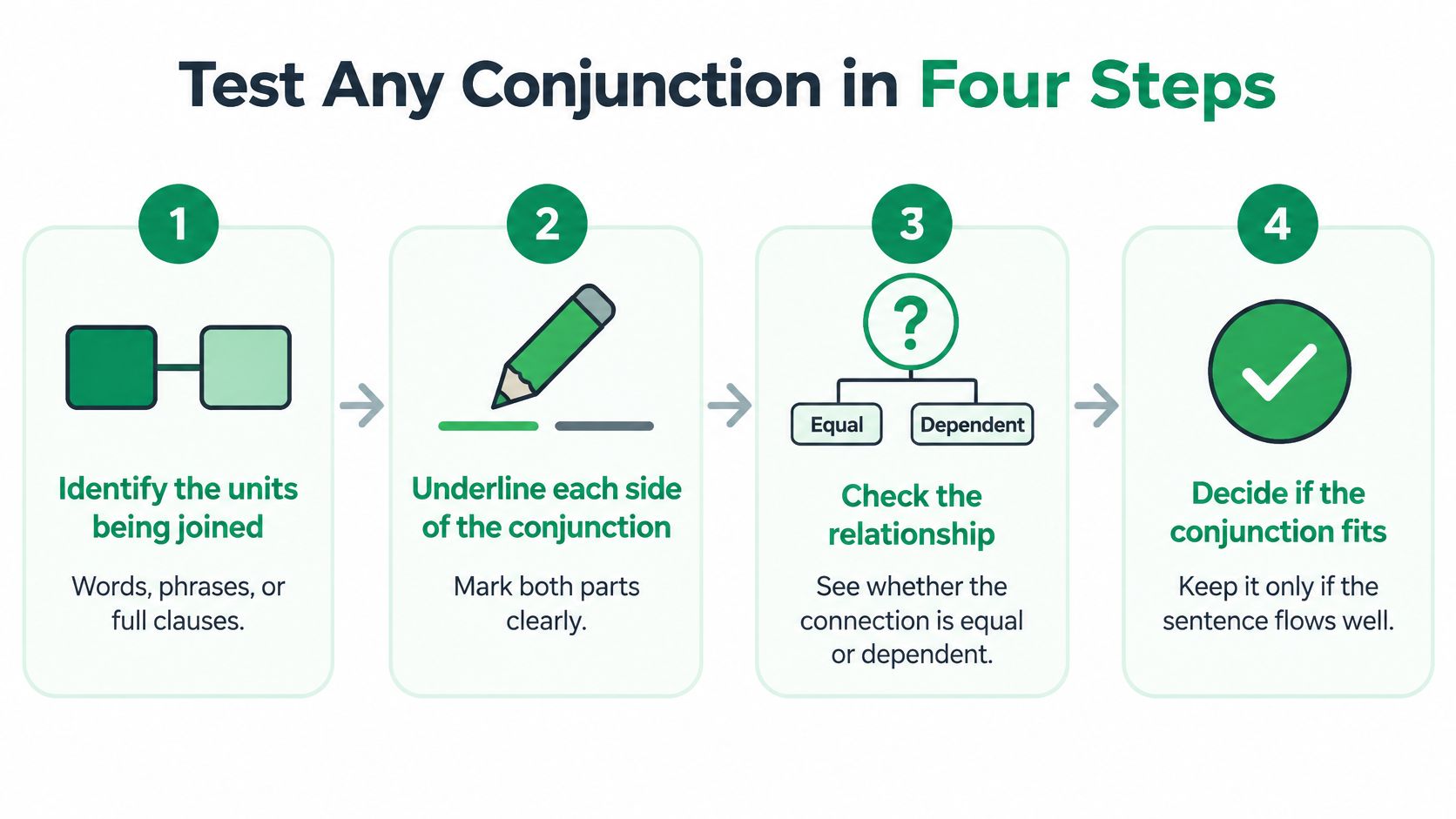
Identify the units being joined. Underline the material connected by the conjunction. Are you joining words, phrases, or clauses with their own subjects and verbs?
Test clause completeness. Read each clause separately. A dependent clause is fine within a complete sentence, but it can't normally serve as the whole sentence by itself.
Check parallel form. Compare the structures after paired conjunctions. Either revise the introduction or shorten the conclusion balances verb phrases; either a revision or shorten the conclusion doesn't.
Name the relationship. Say addition, reason, result, contrast, condition, or time. Keep the conjunction only if it expresses the relationship you mean, then check punctuation.
Use this visual checklist while inspecting a draft.
A sentence that fails and one that passes
Consider Because the designer changed the layout. You can identify a subject and verb, but the sentence fails the completeness check: the reason has no main statement attached.
Repair it with Because the designer changed the layout, the editor checked the captions again. Starting with because is perfectly acceptable when you finish the thought.
Now test The designer changed the layout, so the editor checked the captions again. It joins clauses, each can stand alone, their structures are compatible, and so presents the second action as a result.
Don't apply the standalone test mechanically to individual words. In clear and accurate, neither adjective is a sentence, but that doesn't make the phrase incorrect.
For workplace writing, use the routine whenever a sentence packs several decisions into one line. If you can't confidently name the connection, splitting the sentence may be clearer than adding another connector.
Choosing Between Similar Conjunctions by Meaning
Learners can treat and as an all-purpose connector, leaving readers to infer the logic. A 2025 classroom study of six adolescent EFL learners observed that habit and reported an approximately 60% increase in conjunction accuracy after four weeks of task-based instruction.
That's a small classroom sample, not a guarantee for every learner. Its useful lesson is to practice choosing relationships rather than merely memorizing connector lists.
Near-synonym pairs and the difference each makes
| Pair | What changes | Best used when |
|---|---|---|
| so vs because | So presents a result; because gives the reason | You want to move from cause to outcome, or explain an action |
| but vs although | But states a direct contrast; although makes one point a concession | You want to acknowledge an objection before stating your position |
| and vs while | And adds a fact; while can stress simultaneous events or contrast | Parallel facts need a time or contrast signal |
| but vs yet | But is neutral; yet can suggest a more formal, surprised tone | You want a slightly more formal or narrative contrast |
| or vs nor | Or offers an alternative; nor links negative alternatives | You're offering choices or extending an existing negative |
Compare the same facts
The train was delayed, so we left presents leaving as the result. We left because the train was delayed explains the departure.
The product is expensive, but it is durable directly contrasts the qualities. Although the product is expensive, it is durable acknowledges cost before emphasizing durability.
The writer drafted the email and the designer prepared the image adds activities. Replacing and with while suggests they happened simultaneously.
Likewise, replacing but with yet in The proposal was risky, but the team approved it can emphasize surprise. Choose tone deliberately, rather than rotating synonyms to avoid repetition.
The range of relationships is substantial: a 2024 discourse-connective resource, published in Transactions of the Association for Computational Linguistics, contained more than 10,000 sentences and 18,000 connective instances across 33 discourse relations.
For reports, because makes reasoning explicit; so can provide a conversational cause-to-result progression in a blog. Broader transitional words and phrases help with connections between sentences, too, but don't all follow conjunction punctuation rules.
Rewrite a sentence from your draft with a different conjunction. Explain what changed before deciding which version to keep.
Common Conjunction Mistakes and How to Fix Them
A comma splice is an easy error to miss in workplace messages and student drafts. The proposal was ready, we sent it sounds understandable, but the punctuation doesn't establish a proper sentence boundary.
Choose a repair based on your meaning: The proposal was ready, so we sent it emphasizes a result. The proposal was ready; we sent it leaves the connection less explicit, while separate sentences give each statement its own emphasis.
Match the symptom to the repair
| Symptom | What went wrong | Practical fix |
|---|---|---|
| The proposal was ready, we sent it. | Complete clauses joined by a comma alone | Add so, use a semicolon, or split the sentence. |
| Although traffic rose. | A dependent clause has no main clause | Add the main claim: Although traffic rose, sales stayed flat. |
| We need both accuracy and write quickly. | A noun is paired with a verb phrase | Use both accuracy and speed. |
| Neither the headline or the image worked. | The correlative pair is mismatched | Use neither the headline nor the image. |
| We drafted and revised and published and checked results. | Repeated addition obscures stages and emphasis | Group related actions and separate distinct stages. |
| Several consecutive sentences explain everything with because | Repeated sentence patterns make the paragraph monotonous | Keep essential reasons, but combine or restructure others. |
Repair meaning before polishing style
A long chain of and isn't automatically ungrammatical. The problem is asking readers to determine which actions caused others, which happened together, and which deserve emphasis.
Try We drafted and revised the page before publishing it. After launch, we checked the results. That revision gives readers an explicit sequence rather than an undifferentiated action list.
Repeated because needs the same judgment. Don't replace it with since merely for variety if since could be mistaken for a time reference.
A smoother sentence isn't an improvement if it changes the claim.
This matters especially in marketing copy. Sales increased, and we launched new ads reports events; sales increased because we launched new ads asserts a causal explanation that you need to support.
When reviewing AI-assisted text, inspect those causal connections yourself. Authentic editing means preserving defensible meaning, not accepting a polished explanation just because it sounds confident.
Practice Exercises With Answers
Try answering each question before reading its explanation. Focus on the relationship and the sentence structure, not on whether a connector sounds familiar.
Choose, punctuate, and repair
Fill the gap.
The campaign was cheap, ___ it reached thousands of readers.
Answer: but. It contrasts low cost with broad reach. Here, thousands of readers is part of a practice scenario, not a reported campaign result.Add a comma or leave it out.
Because the data arrived late the report was delayed.
Answer: Because the data arrived late, the report was delayed. The opening dependent clause needs a separating comma before the main clause.Find and repair the fragment.
Although the headline was unclear.
Answer: It's a fragment. Try Although the headline was unclear, the introduction explained the offer, which supplies the missing main statement.Choose so or because.
The train was delayed, ___ we left.
Answer: so. The sentence presents departure as a result of the delay. Choosing because would reverse the causal explanation and require different punctuation.Fix the parallel structure.
The editor was both fast and had great taste.
Answer: The editor was both fast and tasteful. This balances adjectives, though The editor worked quickly and showed excellent judgment may express the intended professional praise more precisely.
Transfer the practice to your own writing
Write three sentences about your work, using a different conjunction in each. For example, explain a decision, acknowledge a drawback, and state a condition for your next action.
Run each sentence through the diagnostic routine: identify the units, check completeness, inspect parallel form, and name the relationship. Then ask whether your wording says what you know, especially when you've chosen because or so.
If you're helping a child practice, use familiar situations such as choosing snacks or planning an outing. Talkio Kids' English teaching tips for parents offer context for building that kind of language practice into home activities.
Edit Your Conjunctions and Check Flow Before Publishing
A paragraph can feel choppy even when every sentence is grammatical. Before adding connectors, decide whether readers need a reason, a contrast, a condition, or a a clear sentence break.
Use this workflow to keep revision focused.
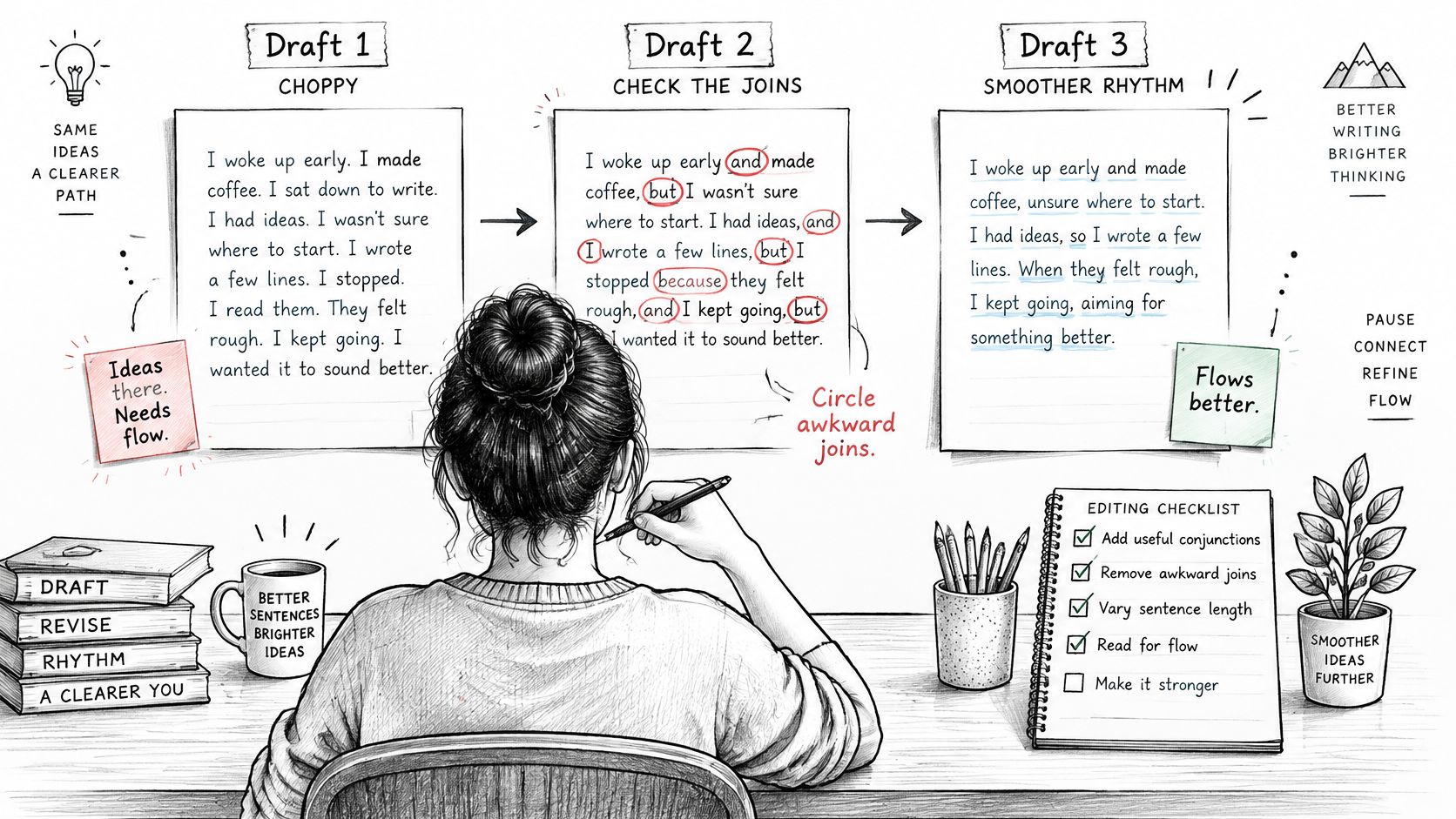
Make focused editing passes
- Scan for repetition. Highlight recurring connectors, but vary them only when the intended relationship allows.
- Check the logic. Inspect causal and contrast statements closely. Replace loose connections rather than decorating them.
- Read aloud. Listen for abrupt jumps and overloaded sentences, then test any uncertain clause connection.
Apply the same checks to AI-assisted drafts. During editing and revising, keep responsibility for facts, causal claims, and your final voice.
For another learning format, you can also use the video below.
After your own revision, an optional writing tool can help you review flow and clarity. Paste your draft, compare suggested changes against your intended relationships, and accept only edits that preserve meaning.
Humanizing AI content should mean making it clearer and more authentic, not disguising authorship or bypassing academic rules. Keep your own examples and judgment, and disclose AI assistance wherever your institution, client, or publication requires it.
At Pure Write , we offer AI text humanization and writing enhancement tools to help you refine clarity, grammar, and flow. Try a recent draft, compare its conjunction edits against these rules, and keep only the suggestions that preserve your meaning and voice.