Allusion in Literature: Types and How to Use Them
The most common advice about allusion in literature is to recognize the reference. That's useful, but it isn't enough. Knowing that a name comes from mythology won't tell you whether the writer admires a character, questions a tradition, or makes an ironic comparison.
For students, content creators, and professionals using AI writing tools, the harder task is deciding which meaning belongs in the new passage. A convincing explanation must account for the source, the surrounding sentence, and the reader who may never have encountered either.
What Allusion in Literature Actually Means
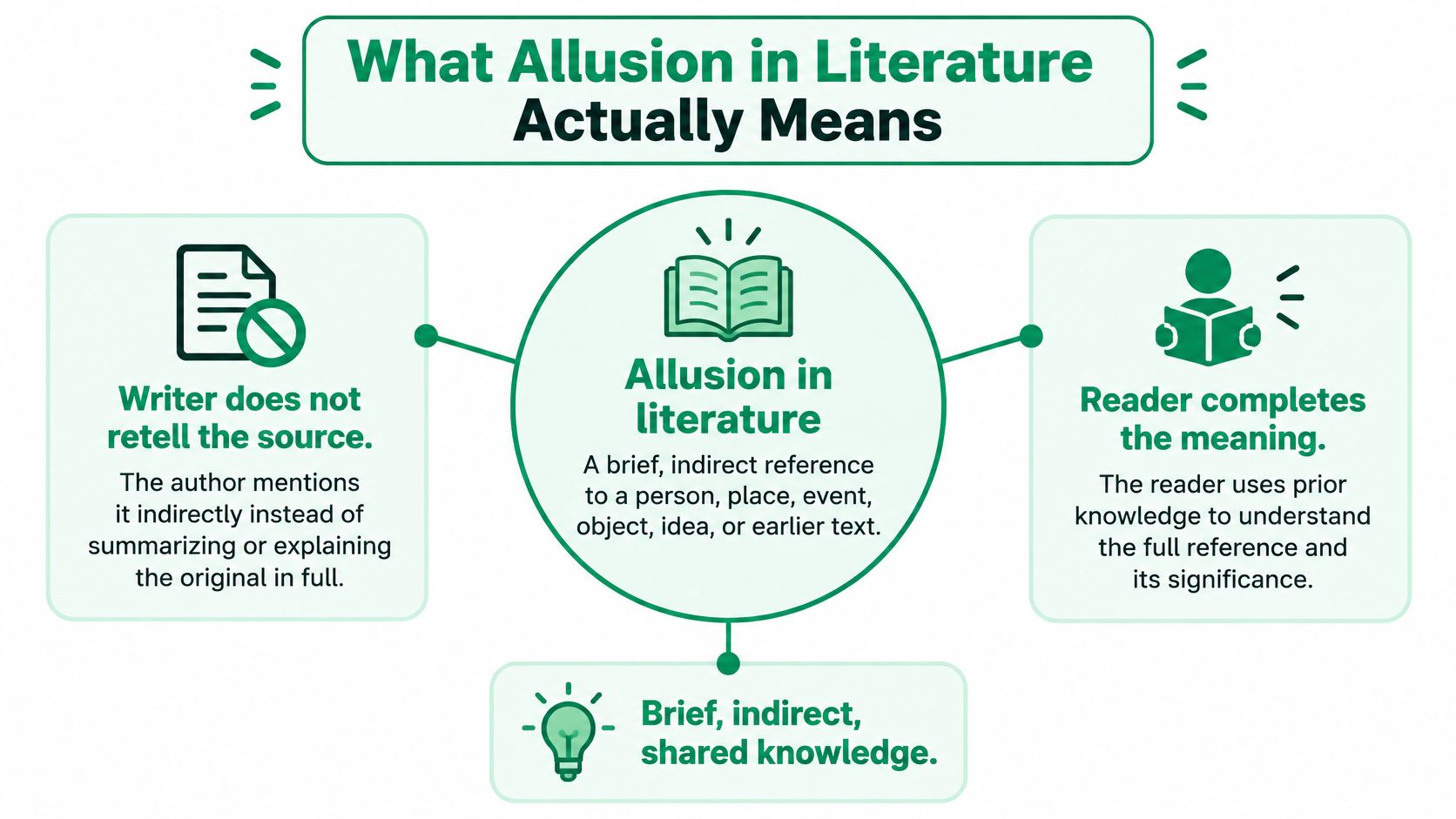
An allusion in literature is a brief, indirect reference to a person, place, event, object, idea, or earlier text. The writer doesn't retell the source; the reader completes the connection.
Allusion Beside Quotation, Reference, and Parody
| Device | How it appears | Reader's job | Main risk |
|---|---|---|---|
| Allusion | Brief indirect signal, usually uncited | Recall the source and apply selected associations | Missed meaning or the wrong irony |
| Quotation | Another writer's words reproduced, often marked | Read the wording as someone else's | Plagiarism if a substantial passage is unmarked |
| Ordinary reference | A named fact stated for information | Take the fact at face value | Clutter that adds no extra meaning |
| Parody or imitation | Extended reuse that transforms an earlier work | Recognize the model and the critique or joke | Confusion with a one-line allusion |
Brevity and indirectness are useful starting tests, not absolute rules. A named person isn't automatically an allusion, and quotation marks alone don't settle how borrowed language functions.
According to Britannica's account of allusion, the term derives from Late Latin allusio, meaning “a play on words” or “game,” and alludere, meaning “to play around” or “to refer mockingly.” That playful origin helps explain why an allusion can do more than acknowledge an earlier story.
A Small Signal With Several Possible Effects
A reference can enrich a description, borrow authority, establish irony, or reveal a mismatch between an old narrative and a new situation. The key question is not just where the reference comes from, but why this writer wants that source nearby.
Consider a hypothetical sentence describing a colleague's Herculean effort. The writer doesn't need to summarize Hercules' adventures because extraordinary strength or labor is the selected association.
By contrast, an informational sentence naming an author's birthplace may be an ordinary reference. Unless the place contributes another relevant association, the reader has no additional connection to reconstruct.
This concept map shows the division of work between writer and reader.
Shared Knowledge Is Never Universal
Biblical and Greek mythological sources became persistent resources in Western literature because writers could draw on familiar characters, narratives, and moral frameworks. That familiarity let them suggest substantial meaning without lengthy explanation.
But an audience's shared knowledge changes. A reference that once seemed self-explanatory may require an annotation for readers from another period, language, or educational background.
Working test: Delete the reference. If you also lose a specific association, such as endurance, betrayal, hubris, or loss, the allusion is doing meaningful work.
Don't confuse allusion with every other imaginative expression. Our guide to figurative language types can help you separate a reference to an earlier source from devices that work through comparison, exaggeration, or sensory description.
For your own writing, finish this sentence before keeping an allusion: the reference adds this particular meaning. If your only answer is that it sounds literary, replace it with something more precise.
Five Types of Allusion You Can Scan
Five Common Types of Literary Allusion
| Type | Typical source | Microexample | Usual association | Common misuse |
|---|---|---|---|---|
| Biblical | Scripture, parable, or sacred figure | Garden of Eden, prodigal son, thirty pieces | Innocence, forgiveness, sacrifice, betrayal, exile | Assuming every reader shares the theology |
| Mythological | Greek or Roman myth | Herculean, Achilles' heel, Pandora, Icarus | Labor, fatal flaw, unintended harm, hubris | Retelling the myth instead of using one trait |
| Literary | Earlier poem, novel, or play | Milton's Eve via Ovid's Proserpine | Authority, revision, or ironic distance | Name-dropping a classic the scene does not use |
| Historical | Real person, battle, or public event | Waterloo, a Munich analogy, Watergate | Scale of failure, warning, scandal | Inflating an ordinary mistake into a catastrophe |
| Pop-culture | Film, song, meme, or brand story | A Matrix choice, a Thanos snap | Instant recognition and a dated in-joke | Exclusion, cliché, or a reference that expires quickly |
These categories identify the source tradition, not the final interpretation. The same source can support admiration in one passage and criticism in another.
The Oregon State University explanation of allusion emphasizes the device's brief, often oblique presentation. Your task as a writer is to choose the association that earns its place, rather than import everything you know about the source.
Biblical and Mythological Allusions
Biblical allusion draws on scripture, sacred figures, and parables. A prodigal return can suggest forgiveness, while thirty pieces of silver can suggest betrayal; those associations aren't interchangeable.
A Garden of Eden reference may emphasize innocence, but its surroundings can also make temptation or exile relevant. If you're describing a cheerful product launch, decide whether those darker implications belong before choosing the phrase.
Mythological allusion often compresses a recognizable predicament. Achilles' heel suggests a vulnerable point, Pandora suggests harmful consequences, and Icarus can suggest dangerous overreaching.
The common mistake is treating those names as decorative synonyms for weakness, trouble, or ambition. Choose the trait your scene develops, and avoid retelling the entire myth unless your reader needs that explanation.
Literary and Historical Allusions
A literary allusion places your writing in conversation with an earlier poem, play, or novel. It may acknowledge a predecessor's authority, but it can also revise the earlier work's assumptions.
For a student, that means identifying a classic is only the beginning of an argument. For a content writer, it means a famous title should contribute something more exact than a cultured tone.
A historical allusion draws on a real person, battle, or public event. Waterloo can suggest decisive defeat, while Watergate can suggest scandal.
Scale matters here. Calling a routine scheduling error a Waterloo may produce deliberate comedy, but presenting it earnestly can exaggerate the situation and weaken your credibility.
Pop-Culture Allusions and Audience Fit
A pop-culture allusion can create quick recognition among readers who share a film, song, meme, or brand story. A Matrix-style choice and a Thanos snap suggest different kinds of action, even when both seem instantly recognizable to their intended audience.
The trade-off is reach. A reference that feels effortless to one group may confuse another or make a professional message sound like an insider joke.
If you need a comparison without the cultural homework, consider a simile instead. An example of simile can help you see how an explicit comparison differs from an allusion that asks readers to retrieve an earlier story.
For every category, select one intended association first. Then check whether the actual sentence supports it.
From Shared Canon to Modernist Difficulty
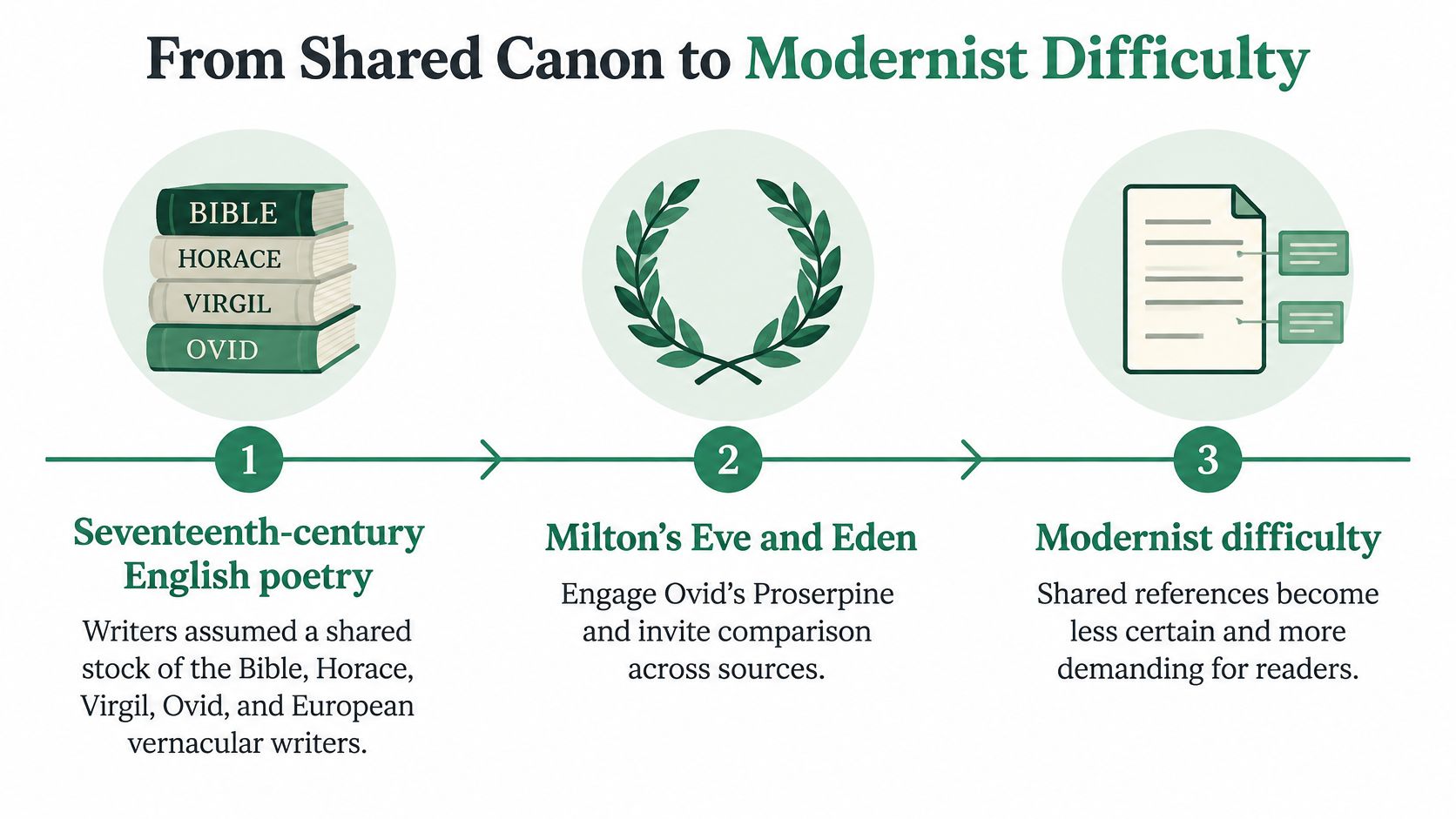
A reader approaching seventeenth-century English poetry may encounter several traditions within a single passage. Writers drew on the Bible, Horace, Virgil, Ovid, and English and other European vernacular authors, according to Oxford Academic's account of allusive practice.
John Milton's Paradise Lost shows that practice on an epic scale through the relationship between Eve, Eden, and Ovid's Proserpine. Andrew Marvell's The Garden shows that a shorter pastoral poem could also participate in a substantial network of earlier writing.
The timeline below sketches this change in the demands placed on readers.
From Familiar Inheritance to Deliberate Difficulty
The useful historical contrast isn't between simple old poetry and complicated new poetry. It's between different expectations about what readers will recognize and how much reconstruction they'll undertake.
Milton could develop a distinct Christian and poetic vision while engaging a classical predecessor. A reader needed to notice both the connection and the difference, rather than treat the classical story as a substitute for Milton's.
Modernist writers such as T. S. Eliot and James Joyce deliberately used obscure, complex references that many readers wouldn't immediately recognize. Their readers might have to assemble connections across religion, mythology, history, and literature before understanding how a passage works.
- Shared-canon expectation: Readers bring an established body of earlier stories to the text.
- Modernist difficulty: Readers encounter unfamiliar or fragmented connections and reconstruct their relationships.
- Interpretive consequence: Identifying a source matters only if you can explain how the later work extends, contrasts with, or revises it.
If classical names are unfamiliar, Million Whys' Greek mythology for curious learners offers a starting point for building background knowledge. Use such an overview to orient yourself, then consult the relevant source passage before making a detailed literary claim.
What a Shared Canon Leaves Out
Calling a canon shared doesn't mean everyone had access to it. The phrase describes an expectation about an audience, not proof that every reader possessed the same education or cultural inheritance.
That distinction matters for multilingual students and translators. An unfamiliar reference may reveal a gap between educational traditions, not a weakness in the reader's intelligence or attention.
Keep sound-based effects separate from source-based effects, too. An example of alliteration can train your ear, but repeated sounds don't establish an allusion without a meaningful connection to an earlier source.
For another way into the topic, consider this accompanying video.
For today's reader, the practical response is selective investigation. Look up what changes your interpretation, and don't assume that collecting every possible reference automatically produces a better reading.
How to Identify and Interpret an Allusion
Start with the passage, not a list of famous stories. An explanation should account for the writer's actual words before it expands into cultural background.
The study Allusion as Form describes a reader-dependent process of recognizing a source, recalling relevant meaning, and connecting it to a new work. That helps explain why readers can recognize the same reference yet reach different interpretations.
Follow the Evidence in Order
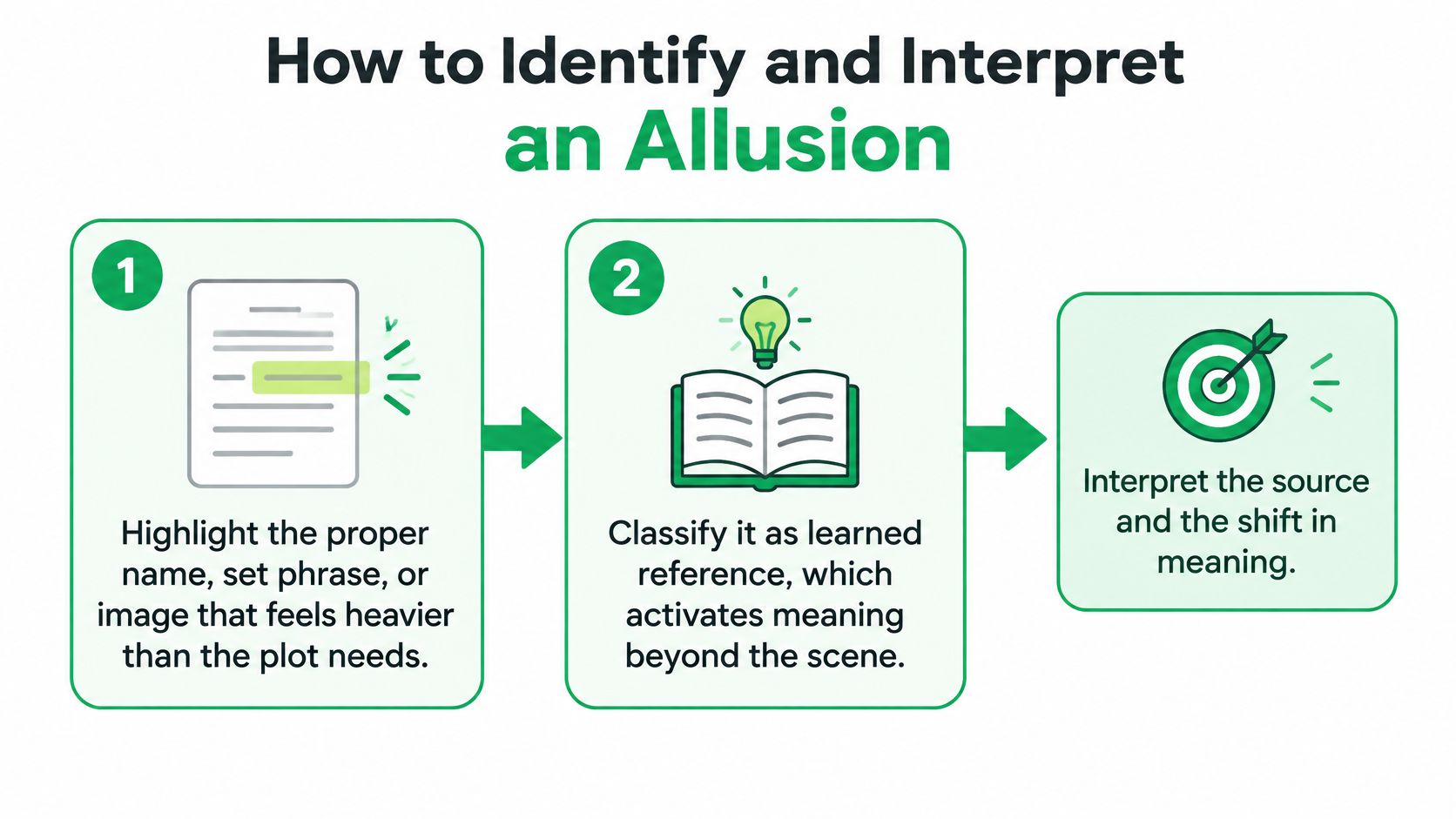
Highlight the unusual signal. Mark a proper name, set phrase, or image that seems heavier than the immediate action requires. A strange phrase is a candidate, not proof.
Classify the connection. A learned reference activates cultural or historical knowledge; phraseological adaptation reshapes earlier wording. This distinction, discussed in scholarship on allusion and intertextuality, helps you decide whether to investigate a story, a verbal echo, or both.
Name the source precisely. Identify the work, episode, or tradition rather than stopping at a broad label such as mythology. Include a version or translation when its choices affect the interpretation.
Select the relevant traits. List only what the new passage uses. A source character's entire biography isn't evidence for every possible association.
Test the relationship. Ask whether the writer reinforces, revises, parodies, or undermines the earlier text. Support your answer with nearby wording, tone, or narrative consequences.
Separate literal understanding from added meaning. Decide what you need to follow the action and what adds irony, characterization, or emotional force. This prevents an unfamiliar detail from blocking your understanding of the whole passage.
Resolve unfamiliarity carefully. Use surrounding clues, consult a reliable source text, and compare translations when necessary. Reject an interpretation if the passage doesn't support it, even when an AI tool presents it confidently.
The following diagram gives you a compact reminder of the process.
Treat Identification as a Testable Claim
A 2024 study by James Gawley examined 1,000 proposed parallels between Virgil and Homer, with four annotators rating each on a five-point scale for the likelihood of intentional allusion, as described in the Bryn Mawr Classical Review discussion. That graded approach provides a useful model: an identification can have stronger or weaker support rather than being a simple yes-or-no answer.
Computational tools need similar restraint. The Tesserae study of Lucan and Virgil combined automated retrieval with human evaluation because ordinary epic language could generate parallels without establishing a significant allusion.
Look for distinctive wording, meaningful placement, thematic fit, and patterns across the work. Word overlap can suggest where to investigate, but it can't settle what the comparison means.
Recognizing a source gives you a hypothesis. The surrounding passage supplies the test.
Make Room for Different Readers
International students, translators, and content teams should ask which parts of the source their audience knows. Readers may recognize a name through an adaptation while missing the values or consequences the writer expects them to recall.
For sustained practice in drawing meaning from context, ReadLab's daily comprehension guide provides a useful companion. Our explanation of denotative and connotative examples also helps distinguish what a phrase directly names from the associations readers bring to it.
Don't demand agreement with a source's cultural values as a condition of understanding. A careful reading can identify those values and explain how the new text accepts, questions, or rejects them.
Annotated Allusions in Canon and Current Writing
An annotation becomes useful when it explains a consequence. Instead of writing only a source name in the margin, identify what changes when you place that source beside the new passage.
These cases show different interpretive problems. They also demonstrate why a literary essay and a marketing review both benefit from attention to audience and tone.
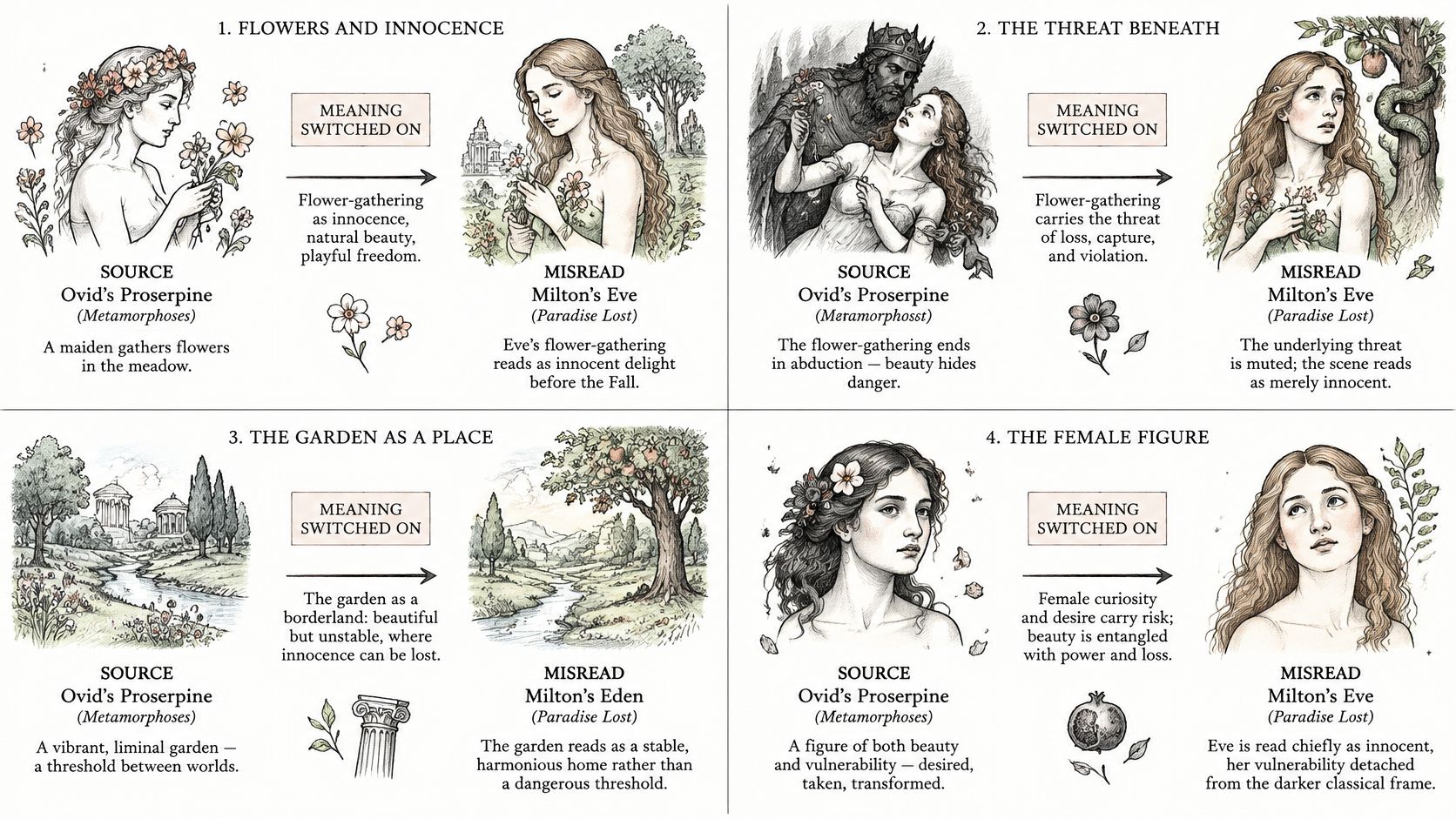
Milton's Eve Beside Ovid's Proserpine
Source: Ovid's Proserpine provides a classical counterpart for considering Milton's Eve and Eden. The connection invites a comparison rather than an equation between the figures.
Activated meaning: Read flower-gathering innocence beside the threat of abduction. Through that comparison, a beautiful setting can appear vulnerable rather than merely peaceful.
Likely misread: Treating the passage as a postcard of untouched purity misses the possibility of danger. Equally, assuming that Milton merely repeats Ovid would overlook the distinct purposes of the later poem.
The visual comparison below keeps the figures beside one another without treating them as identical.
Marvell's Compact Garden
Source: Marvell's The Garden participates in classical traditions of pastoral writing and rural retreat. Its relatively small scale doesn't prevent it from engaging substantial literary questions.
Activated meaning: Read the garden as a setting through which the speaker can consider retreat, desire, and the attractions of withdrawal. Then examine where the poem supports or complicates that appeal.
Likely misread: Assuming a short nature poem is descriptive. The relevant question isn't how many lines the poem contains, but whether its language positions it in relation to an earlier tradition.
A useful student annotation would name the earlier model, identify the local verbal evidence, and explain the difference. Without that evidence, a claim about classical influence remains too general.
A Modernist Cluster in Eliot
Source: Consider a passage in Eliot where several religious, literary, or mythological references occur close together. Investigate their relationship rather than treating each as an isolated vocabulary item.
Activated meaning: The contrast between an inherited story and a present speaker's situation may create irony. Several references can also establish competing expectations that no single annotation captures.
Likely misread: Assuming obscurity exists only to display learning. Missing an individual reference may leave the sentence readable, while missing the pattern can flatten its tone.
For students developing evidence-based interpretations, literature advice from Queens Online School can complement this habit of connecting a detail to a defensible argument. Keep your claim narrower than your evidence when the precise source remains uncertain.
A Hypothetical App Launch in 2026
Suppose a launch draft describes a new app as a Garden of Eden. The intended message may be freshness and ease, but readers could also hear religious authority, temptation, rules, and eventual expulsion.
Source: The Eden narrative. Selected meaning: An inviting, seemingly unspoiled environment. Likely misread: A promise whose hidden conditions will eventually cause trouble.
The solution isn't always to explain the reference. If those stakes don't fit the product, plain wording about the app's actual benefits is stronger.
Allusion also extends well beyond the English-language canon: a 2026 Nature study examining 683 Song Dynasty poems identified 533 literary-allusion occurrences, an average of 0.78 allusions per poem. That scope encourages readers to investigate the traditions relevant to a text rather than assume their familiar canon supplies every answer.
Before publishing a reference, annotate it with these labels: source, selected meaning, and who might miss it.
How to Use Allusion Without Losing Readers
Choose your intended effect before asking an AI tool for literary polish. Otherwise, you may receive a familiar reference that sounds fluent but changes the meaning of your sentence.
For students, marketers, and professionals, the best allusion is not the most impressive one. It's the one your audience can interpret accurately without unnecessary effort.
Do Make the Association Deliberate
- Choose a precise purpose. Decide whether you need endurance, betrayal, vulnerability, or another specific quality. Make the surrounding sentence support that choice.
- Provide a usable clue. A brief description can help unfamiliar readers without turning your paragraph into a summary of the source.
- Verify generated suggestions. Check the actual story, wording, or event, including pop-culture references and contested historical comparisons.
- Preserve your intended stance. If you mean irony, make sure an edit hasn't converted the comparison into sincere praise.
- Read for audience fit. Ask a reader outside your immediate cultural circle what the phrase suggests before using it in broadly distributed content.
For an email or campaign, a short cue may be enough. Pairing an Achilles' heel reference with a concrete description of the vulnerability gives readers a route into the intended meaning.
Word choice matters just as much as source choice. Our example of diction can help you evaluate whether the surrounding language sounds playful, solemn, technical, or conversational.
Don't Use Familiarity as a Substitute for Accuracy
Don't insert a famous name merely to sound refined. Don't stack unrelated traditions so closely that readers can't tell which comparison matters.
Avoid religious or tragic implications in cheerful copy unless you intend them. And don't paste another writer's distinctive wording into your draft and label it a subtle nod.
Attribution boundary: An indirect reference isn't permission to present someone else's expression as your own.
The boundary between allusion and quotation isn't always sharp. Oxford Academic's discussion of allusion considers earlier wording brought into a new work with or without quotation marks, making attribution a judgment about the borrowing rather than formatting alone.
A short recognizable phrase may function as an allusion. Reproducing a substantial passage, or depending on another writer's distinctive expression, raises quotation and plagiarism concerns that the word allusion doesn't remove.
Students should follow assignment rules and cite the original when their analysis depends on it. Professionals should credit borrowed wording, evidence, and distinctive ideas; content teams should retain research notes and delete fabricated quotations.
Keep AI Assistance Accountable
AI can suggest a plausible source while missing irony, political disagreement, or a distorted translation. Scholarship on literature and AI places automated analysis within a broader interpretive environment, where cultural context still requires careful judgment.
One narrowly scoped result illustrates why performance claims need boundaries: a 2024 PLOS ONE study by Li, Wang, Shi, and Bu reported a 6.35% accuracy improvement for its best model in sentiment prediction of allusive words. That finding doesn't establish that a general writing tool can reliably explain literary irony.
We at PureWrite can help improve grammar, tone, and readability after you make source and attribution decisions. Humanizing a draft must never mean disguising copied material or misrepresenting authorship.
Practice the Device Then Publish with Care
Practice with a paragraph you need to write. A class response, newsletter introduction, product description, or internal email gives you a real audience against which to test your choices.
The following exercises turn recognition into decisions about meaning. Keep your original draft so you can compare what each revision adds or removes.
Short Exercises With a Clear Purpose
Replace a vague mythic adjective. In about 150 words, revise a description using an allusion whose intended association you can name in five words. If you can't state that association briefly, narrow your choice before polishing the sentence.
Annotate references you already enjoy. Choose three references from a poem, advertisement, or email. Label each with its source, effect, and the readers who might miss it, then distinguish evidence in the text from associations you supplied yourself.
Rewrite the Eden sentence in contrasting directions. Keep the religious stakes in one version, making temptation or a consequential rule relevant. Remove those stakes in another version and describe the product directly, then decide which better serves the audience.
Audit an AI suggestion. Ask a writing tool for an allusion suited to your paragraph, then confirm the proposed connection in a real source. Reject it if the association is inaccurate, the tone clashes, or the audience would need more explanation than the reference is worth.
Don't judge these exercises only by elegance. Compare the implications a reader could reasonably draw from each version.
A plainer sentence may win. Removing an allusion is a successful revision when the reference introduces meanings you don't want.
Apply a Final Publish Test
Keep a reference only when it adds meaning the sentence cannot carry as effectively alone. Readers must be able to reach that meaning, either through their background knowledge or through a clue you provide.
Then check attribution separately. A culturally familiar story and another author's distinctive wording aren't the same kind of borrowing.
- Meaning: Can you explain the reference's contribution without vague praise?
- Access: Can your intended reader follow it without guessing?
- Integrity: Have you credited borrowed wording and distinctive ideas?
- Voice: Does the finished paragraph sound like a choice you would defend?
Consistency matters in AI-assisted academic work, too. Wei Z. describes that aim: “I use AI to summarize sources for my thesis, then humanize those summaries so the whole lit review reads in one voice. Citations and terminology come through untouched.”
That workflow still leaves source checking with the writer. Read every revised sentence against your notes, especially where a small change could turn criticism into agreement or uncertainty into a confident claim.
Paste a revised paragraph into Pure Write to refine an AI-assisted draft for clarity, tone, and natural expression. We help students, marketers, and content teams develop one authentic voice while preserving citations and terminology, so you can polish the prose after verifying its allusions, not instead of verifying them.