
You've got a case document open, a deadline approaching, and an AI-generated draft that sounds polished but doesn't quite make a decision. It recounts what happened, repeats the organization's explanation, and ends with advice almost any business could use.
If you searched for “analysis a case,” you probably need something more useful than a summary. You need a defensible argument that shows what to do, which evidence supports it, who could lose out, and what would make you change your mind.
For students, content creators, marketers, and professionals, that means treating the draft as the final expression of your reasoning, not a substitute for it. Start with a traceable evidence trail, then work on the prose.
Map the Six Stages of Case Analysis
Case analysis takes a messy, real situation, names the decision it forces, and defends a recommendation with evidence you can trace. Your job isn't to include everything that happened. It's to identify which facts should change the decision.
The method's origins make that distinction clear. Harvard's first standalone business case, General Shoe Company, was written by Clinton P. Biddle and published in 1921, asking students to propose policies for a labor-management problem, according to Harvard Business School's history of the case method. The enduring structure is practical: examine incomplete evidence, identify the problem, weigh alternatives, and defend a choice.
Use Outputs to Control the Work
Give every stage a visible output. Otherwise, you can spend hours reading without knowing whether you've resolved anything.
Case analysis workflow by stage
| Stage | Question it answers | Output |
|---|---|---|
| 1. Frame the case | What decision is actually on the table? | One-sentence decision statement |
| 2. Choose a framework | Which lens fits this decision? | Named framework with two reasons |
| 3. Diagnose the problem | What is causing the symptoms? | Issue tree with testable branches |
| 4. Gather and weigh evidence | What do the sources show, and where do they conflict? | Evidence log with source grades |
| 5. Structure the argument | How do the findings lead to a choice? | Claim-evidence outline |
| 6. Recommend and verify | What should happen, and what would prove it wrong? | Recommendation with risks and checks |
These stages aren't sealed compartments. An interview might expose a missing alternative, while a cost estimate might force you to narrow the original decision.
Still, don't skip ahead just because a recommendation sounds convincing. If you can't show the evidence behind the diagnosis, you're polishing an assumption.
Separate the Analysis From the Story
A publishable case study may foreground a customer's journey. An analytical case file needs to foreground the decision and its justification; our guide to how to write a case study helps distinguish the storytelling task from the underlying reasoning.
For an investment or expansion case, feasibility deserves a separate check. Smart Classic Business Hub's resource on technical checks for business feasibility provides relevant context when your recommendation depends on whether a proposed operation can function.
A writer might recommend launching a service because customers want it. A stronger analyst also asks whether the organization has the capacity, systems, and skills to deliver it.
Keep the workflow table open as a checklist. Move forward when you have the output, not merely when you've written enough words.
Pick a Framework That Fits the Decision
Name the decision before choosing the framework. Then select a primary lens and a secondary check, rather than stacking familiar models until the document looks thorough.
Use this sketch as a reminder to compare frameworks against the decision you face.
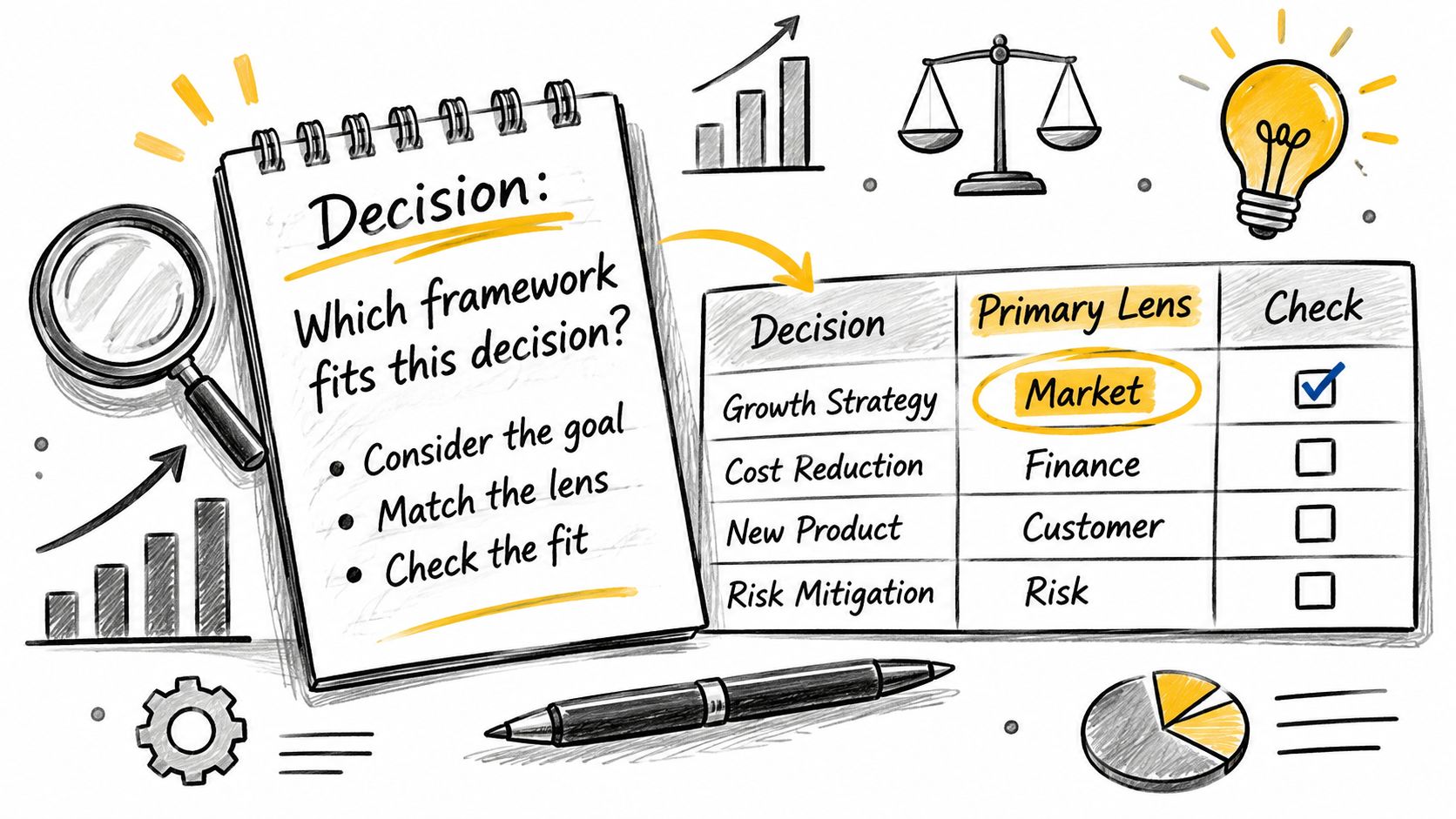
Compare Fit, Not Familiarity
A framework earns its space by helping you discriminate between alternatives. If it only generates headings, it's adding formatting rather than insight.
Common analysis frameworks and when to use them
| Framework | Best for | Core questions | Watch out for |
|---|---|---|---|
| SWOT | Strategy for one organization | Strengths, weaknesses, opportunities, threats | Lists grow vague unless each item is ranked |
| Porter's Five Forces | Industry profitability and entry decisions | Supplier power, buyer power, rivals, substitutes, new entrants | Assumes a fairly stable industry structure |
| PESTLE | External shocks in policy, economy, technology, law and environment | Which external factors change demand or cost? | Scans everything; needs a relevance filter |
| Five Whys | Operational failures with one clear symptom | Why did this happen, asked five times | Stops too early when evidence is thin |
| Issue tree | Complex decisions with several possible causes | Which branches can be tested with data? | Takes time; needs a clear root question |
| Stakeholder map | Decisions that affect several parties | Who gains, who pays, who can block? | Influence ratings are judgments; document them |
Consider a hypothetical regional bakery chain whose weekend sales fall after a menu change. Five Whys can help trace whether ordering confusion leads to slower service, abandoned purchases, or production mistakes.
PESTLE doesn't automatically belong in that analysis. It earns a place if, for example, a local food regulation changed and could explain ingredient availability or pricing.
Don't force a single causal chain when several explanations remain plausible. Use an issue tree to separate them, then investigate the branches individually.
Apply the Two-Reason Test
Choose a framework only when you can name two decision-specific reasons it fits. For the bakery, Five Whys fits because the symptom is clearly bounded and the proposed cause can be traced through ordering and production records.
Legal evaluation illustrates why context matters. Ares's resource on AI-assisted case reviews for PI firms concerns a different decision setting, where a general business strategy model shouldn't replace domain-specific review.
If you need help translating concepts into relationships you can examine, consult these conceptual framework examples. Keep the distinction clear: a framework organizes inquiry; it doesn't establish that your preferred explanation is true.
Use the accompanying video as a supplementary framework resource.
Keep your selection disciplined:
- Start broad, then narrow. Scan plausible explanations before selecting the lens for detailed investigation.
- Cap working lists at five items. Combine overlapping categories instead of creating an unmanageable inventory.
- Record rejected frameworks. Explain what they wouldn't help you decide.
Your opening paragraph can then say: This analysis uses Five Whys because the sales decline is concentrated in a defined ordering process and its proposed causes can be checked against operational records.
How to Diagnose the Real Problem
A diagnosis should explain why the decision is necessary. “Customers are unhappy” doesn't do that, because dissatisfaction is a symptom, not an explanation of what caused it.
Keep the bakery scenario hypothetical and distinguish what the case establishes from what you're proposing. Staff may describe the menu as confusing, while transaction records show a decline concentrated in weekend family orders; neither observation, by itself, proves the cause.
Move From Symptoms to a Testable Explanation
Write the decision as a question beginning with “Should we.”
For the bakery, ask whether to simplify the weekend menu rather than whether the business should improve sales. The narrower question identifies an action you can compare against keeping the current menu or changing prices.List each symptom with its source and date.
Record customer complaints, sales extracts, and staff reports separately, preserving when each was collected. A complaint recorded after a price change shouldn't become evidence about the earlier menu launch.Separate observed facts from proposed causes.
Use adjacent columns labelled observed fact and proposed cause. The observation might be fewer weekend family orders; the proposed explanation might be that customers can't identify suitable bundles.Build an issue tree with testable leaves.
Split the decline into plausible branches such as fewer visitors, fewer completed orders, and smaller baskets. Under order completion, distinguish menu clarity, price resistance, product availability, and competitor appeal.Mark every leaf as supported, contradicted, or untested.
Don't label menu confusion supported merely because staff agree with one another. Look for evidence such as repeated clarification requests, abandoned orders, or a mismatch between displayed options and customer expectations.Prioritize the leaves that could change the decision most.
If a pricing explanation would rule out a menu redesign, test it before spending time rewriting descriptions. Investigate consequential uncertainty, not the branch with the easiest evidence to collect.Restate the problem around the leading testable cause.
A provisional diagnosis could be that unclear family-bundle descriptions discourage weekend purchases. Keep the word provisional until you've compared that explanation with pricing, stock availability, and competitor activity.
The process below condenses those moves into a diagnostic reference.
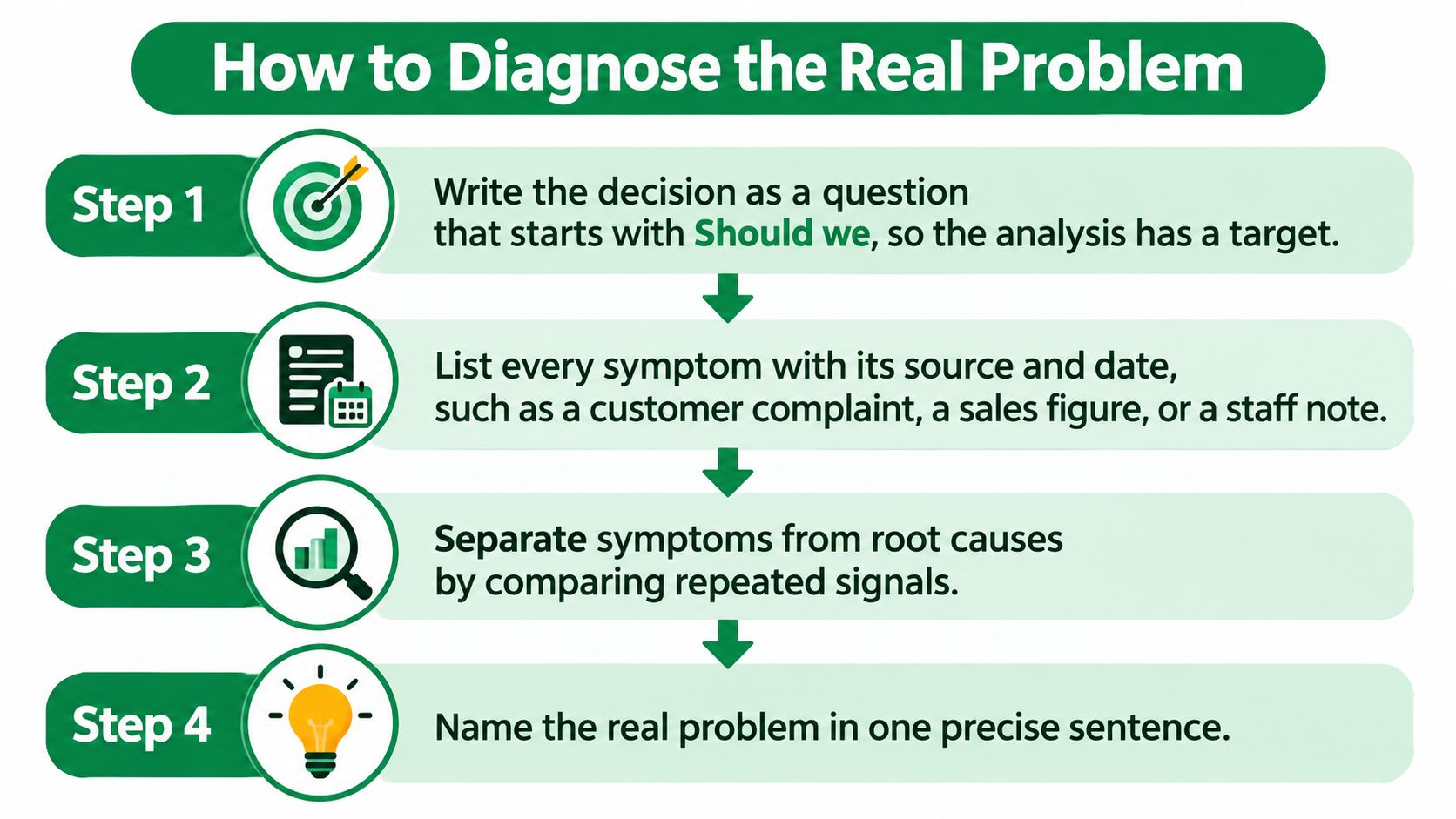
Make the Missing Evidence Explicit
An issue tree is useful only if you can say what observation would weaken each branch. For menu clarity, that might be customers correctly understanding the bundles while still rejecting their prices.
Diagnostic check: If the proposed cause is just the symptom rewritten in more formal language, you haven't diagnosed the problem.
“Sales fell because customers purchased less” is circular. “Family buyers abandoned orders after asking how the bundles worked” offers a mechanism you can investigate, provided the case contains records supporting it.
Don't broaden the diagnosis to avoid choosing. A paragraph blaming communication, competition, staffing, pricing, and economic conditions leaves the reader unable to tell which intervention deserves priority.
A good diagnosis ends with a pair of precise sentences. The first names the leading cause: Unclear family-bundle descriptions appear to be discouraging weekend orders. The second names the gap: Order-observation records and a price comparison are still needed to distinguish confusion from price resistance.
Gather and Weigh Evidence Without Cherry-Picking
A rigorous case follows a documented sequence, not a search for quotations that support an attractive conclusion. Define your research question and unit of analysis, establish what you'll measure, collect multiple kinds of evidence, and test rival explanations against an organized case file.
The case-study methodology guidance published in Empirical Software Engineering emphasizes a traceable chain connecting original observations, analysis, interpretation, and conclusions. It also explains why comparing evidence across sources and retaining contradictory findings matter for validity.
Grade Evidence for the Claim It Supports
Your unit of analysis is the thing you're examining: an organization, team, campaign, product launch, or particular decision. Don't start with a team-level question and draw conclusions about the entire company.
Treat the following grades as working judgments, not automatic credibility scores. A well-maintained log can still measure the wrong thing.
Evidence types, strength and what to check
| Evidence type | Strength | Check before using |
|---|---|---|
| Primary data from your own logs or surveys | High when the method is documented | Sample size, collection dates, who was excluded |
| Company or agency documents | High for facts, low for motives | Who wrote it, for what audience, and why |
| Interviews | Medium, rich in context | How many people, and whether they share one incentive |
| Published research or reports | Medium to high | Methods section and whether results have been replicated |
| Press coverage or anecdotes | Low on their own | Corroboration from a second, independent source |
| Your own assumption | None until tested | Marked as untested in the evidence log |
Triangulation means comparing different sources to see where their accounts converge or conflict. Independent agreement strengthens a finding; repeated versions of the same original account don't offer the same reassurance.
Suppose a support manager says complaints rose after a software update. Check ticket timestamps, release notes, and another team's account before using that explanation in the case.
You might discover that the team changed its ticket classification at the same time. The apparent increase could reflect recording practices rather than additional customer problems.
Maintain a Claim-Level Evidence Log
Use a spreadsheet with a row for each claim. Include the source location, collection date, relevant excerpt or measure, whether it supports or contradicts the claim, and your confidence judgment.
Also record excluded material and why you excluded it. Removing a duplicate document is different from omitting an inconvenient interview.
- Preserve originals. Store source documents separately from summaries and working interpretations.
- Assign evidence IDs. Use stable labels so a reviewer can locate support without searching your entire folder.
- Document transformations. Note filters, category changes, and calculations before relying on a chart.
- Track uncertainty. Mark missing records and unresolved conflicts rather than filling gaps with plausible prose.
For a formal submission, your methodology section should explain enough of this process for another reader to understand your choices.
AI summaries can help you review documents, but they aren't replacements for the passages you cite. For financial content, Artul.ai on earnings summary limitations provides a relevant prompt to examine what a compressed account may leave out.
The single-source trap is especially easy when a confident interview supplies both the facts and their interpretation. Separate those functions, and seek material that could challenge the interviewee's explanation.
Write contradictory findings in the main text, where readers can judge their importance. An appendix shouldn't become a hiding place for evidence that changes the verdict.
Structure the Argument and Draft the Recommendation
Organize the argument around the decision, not the order in which you found your sources. A reader shouldn't need to reconstruct your reasoning from a sequence of interview summaries.
Use this outline order: decision, brief context, thematic findings, strongest rival explanation, recommendation, main risk, and next steps. Put each evidence reference beside the claim it supports.
Turn Findings Into a Choice
Grouping by theme lets you compare documents and interviews within the same argument. A section on ordering friction might combine transaction records, customer comments, and staff observations rather than giving each source a separate chapter.
Handle the strongest rival explanation fairly. If it hasn't failed, say what remains unresolved and limit your recommendation accordingly.
Use this formula:
We recommend X because Y; the main risk is Z; we would reverse this if W.
A weak sentence says: The company should improve training. It doesn't identify the intervention, supporting evidence, cost exposure, or test of success.
For a hypothetical onboarding case, a stronger version would be: We recommend moving night-shift onboarding to a two-week paid program because first-month ticket volume was highest for staff who had less than a week of training; the main risk is cost, and we would reverse this if error rates do not fall within one quarter.
Those durations are illustrative design choices, not established findings. In a real case, you'd need evidence for the training comparison and a reason the review window suits the work.
The checklist visual below keeps the argument's main components visible during drafting.
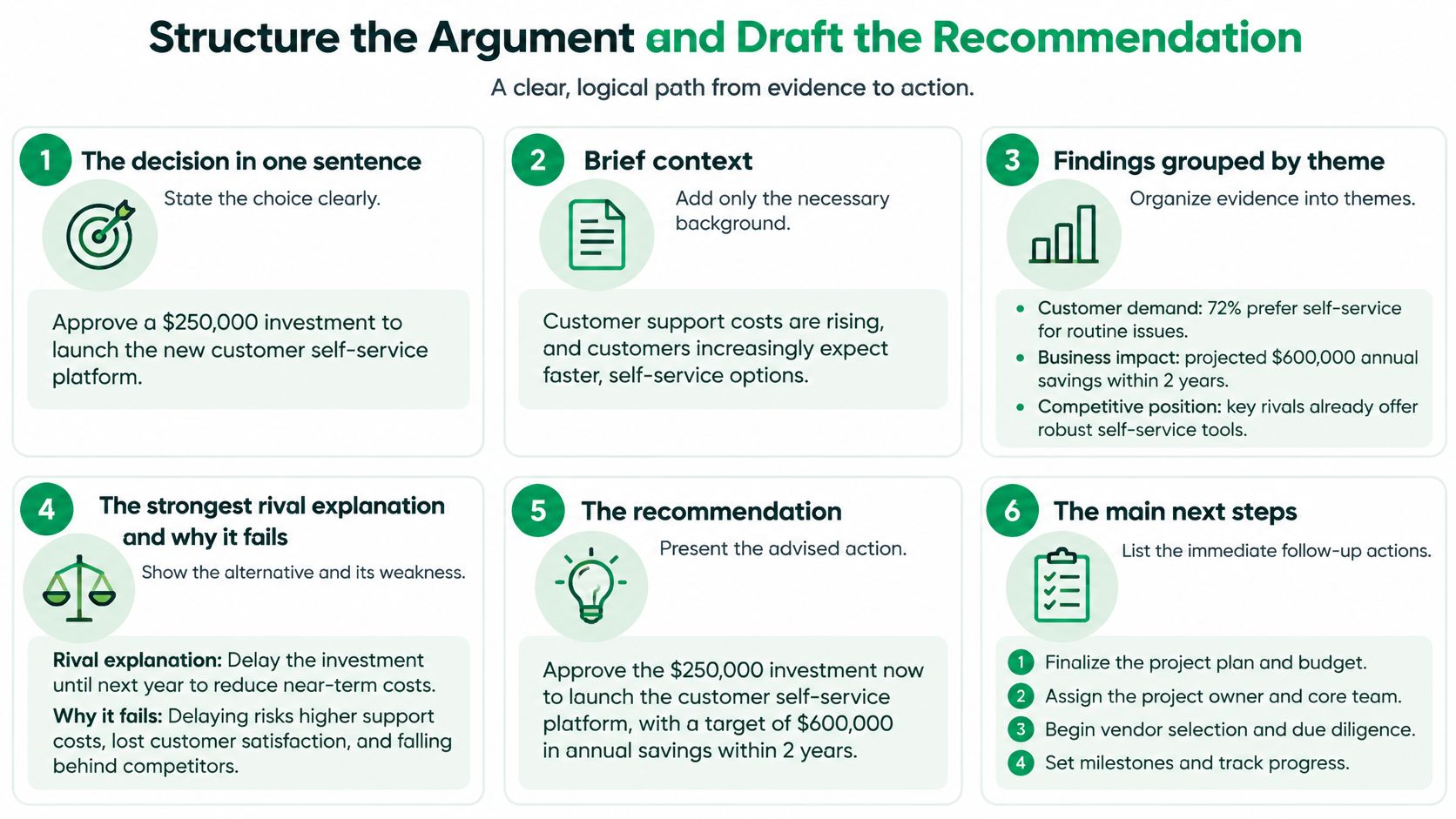
Write a Verdict, Not Another Introduction
State the verdict in the conclusion's first sentence. Follow it with the decisive justification, the boundary of your confidence, and the action someone should take.
If you're struggling to distinguish interpretation from repetition, use our guide to writing a discussion section. The practical test is whether you explain what the findings mean for the choice.
A recommendation without a named risk and a reversal condition reads as opinion.
Before drafting the final section, run this checklist:
- Choice identified. Can the reader name the action and the alternative?
- Support attached. Does every major finding have a traceable evidence reference?
- Rival addressed. Have you tested the strongest competing explanation?
- Trade-off acknowledged. Is the main cost or downside explicit?
- Reversal defined. Have you specified evidence that would change the decision?
- Ownership assigned. Does someone know what to do next?
Make reversal conditions observable. “Review if needed” gives nobody a trigger; a condition tied to errors, cost, customer harm, or implementation failure is actionable.
Copy This One-Page Case Template
- Decision. State the choice in one sentence.
- Context. Use three sentences at most to explain the necessary background.
- Findings. Group them by theme, each with an evidence ID.
- Strongest rival explanation. Explain why it fails, or what remains unresolved.
- Recommendation. Use the action, justification, risk, and reversal formula.
- Main risk. Identify who bears it and how you'll monitor it.
- Reversal condition. Specify the observation that would change your advice.
- Next steps. Assign the immediate action, owner, and review point.
Avoid Pitfalls and Verify Before You Submit
A polishing tool can improve a sound analysis, but it can't rescue an unsupported one. The most common failure is making a summary sound authoritative before checking whether its conclusion follows from the evidence.
Don't confuse readability with validity. A fluent paragraph can still conceal a weak comparison, an excluded subgroup, or a recommendation nobody could implement.
Case analysis pitfalls, causes and fixes
| Pitfall | Why it weakens the analysis | Fix |
|---|---|---|
| Describing events instead of deciding | Reads like a summary with no verdict | Rewrite the opening as a decision question |
| Treating one source as definitive | Measures become subjective and weakly supported | Find a second source that could contradict it |
| Taking positive results at face value | Ignores dose, selection and implementation conditions | Compare against a baseline or comparison group |
| Reporting averages without subgroups | Hides who gains and who bears new risk | Break results down by the groups most affected |
| Recommending without naming a risk | Looks naive to any experienced reviewer | Name the top risk and the condition for reversing the decision |
| Leaving out AI assistance | Breaks trust with editors, instructors and readers | Check the policy, disclose where required, keep drafts and notes |
Challenge Success Before Publishing It
A positive outcome doesn't establish that the intervention caused it. Ask whether participants started with stronger skills, received extra support, used the tool more consistently, or worked under unusually favorable conditions.
The contrast matters in AI adoption. The Hechinger Report's examination of AI tutor results describes an Arizona study involving about 6,000 middle-school students, where frequent AI math practice was associated with higher year-end scores, alongside a separate experiment involving roughly 1,100 AI-assistant users and about 1,200 controls, where users' grades fell by an average of 0.11 points.
Don't combine those results into a universal verdict about AI tutoring. Examine the comparison groups, outcome measures, usage patterns, and teaching conditions before deciding which case resembles yours.
For a marketing case, apply the same discipline to a successful campaign. Check whether the audience, offer, distribution budget, or attribution method changed alongside the copy.
Ask Who Benefits and Who Absorbs the Cost
An average improvement can conceal an unacceptable burden on a smaller group. A workplace writing tool might help experienced staff while creating extra review work for new hires or accessibility barriers for others.
A Frontiers in Education review of AI-supported learning identifies privacy, infrastructure, bias, and educator training as important constraints on implementation. Those conditions belong in the recommendation, not merely in a closing disclaimer.
Inspect the groups most likely to experience different outcomes:
- Access. Can people use the required devices, connectivity, and paid resources?
- Language and accessibility. Does the workflow accommodate different communication and support needs?
- Workload. Who must correct errors, supervise outputs, or handle exceptions?
- Data exposure. What information enters the tool, and is that use authorized?
If subgroup evidence is missing, state that limitation and propose a bounded pilot. Don't interpret an absence of recorded complaints as evidence that everyone benefited.
Treat AI Detection as a Signal
A detector estimates whether text resembles patterns associated with generated writing. A false positive labels human writing as AI-generated; a false negative misses generated writing.
A 2025 study of STEM essays in an American Physiological Society journal found that the strongest detectors classified essays correctly about 93% to 98% of the time, yet approximately 1.3% of human essays were incorrectly labelled AI-generated. The researchers also reported that aggregating results from at least three detectors reduced false positives to nearly zero in their evaluation.
That finding doesn't make a detector score universal proof of authorship. Its practical meaning is narrower: automated classification can be useful, but you still need human review and documentation.
UNESCO's guidance on generative AI in education and research favors human accountability and notes limited evidence that labels, watermarks, and detection tools are fully effective. Check your school, journal, or employer policy, disclose assistance where required, and remain responsible for accuracy, citations, interpretation, and final wording.
Authorship safeguard: Keep the material that shows how you reached the argument, not just the file that contains the finished prose.
Preserve outlines, source notes, substantive drafts, and revision history. Don't rewrite solely to obtain a lower detection estimate or misrepresent generated work as independent scholarship.
Verify Substance Before Editing Style
Work in a fixed order. First, open every statistical source and confirm the population, measure, date, and qualification; then confirm that the framework and recommendation are explicitly named.
Next, compare the conclusion with the evidence log. Check that tentative findings haven't become certainties during revision and that the recommendation still acknowledges unresolved alternatives.
For web publishing, Google's guidance on generative AI content emphasizes accuracy, quality, relevance, and manual verification. More natural wording doesn't add value if the article still contains unsupported claims.
Use this separation between editing and revising: revise the argument when the reasoning changes; edit the language when the reasoning is ready.
Illustrative scenario: A student has verified a case analysis but finds that AI-assisted passages sound more formal than the rest. The appropriate final step is to refine tone and sentence flow while checking the output against the source file, not to replace the student's interpretation.
At PureWrite, we can help improve clarity, tone, concision, and formatting at that stage; every humanization is scored on the spot with a built-in AI detection estimate, which isn't an authorship verdict. Wei Z. describes summarizing thesis sources with AI and humanizing them into a consistent voice while leaving citations and terminology untouched, while Maya C. describes outlining papers independently, using ChatGPT for rough sections, and making PureWrite the final step before submission.
Those customer workflows don't replace your institution's rules or your own verification. After any edit, inspect quotations, citations, technical terms, qualifications, and recommendation wording for unintended changes.
Run the Final Reader Test
Finish with checks that require judgment rather than another automated score:
- Read the opening as a stranger. Can you identify the decision without knowing the assignment or client?
- Circle every unsourced claim. Supply evidence, label the statement as interpretation, or remove it.
- Ask a colleague to read only the conclusion. Can they name the recommendation, its main risk, and the condition for changing it?
If the colleague can't identify the action, rewrite the verdict. If you can't defend a claim without pointing to polished wording, return to the evidence.
At Pure Write, we help you turn a verified AI-assisted draft into clearer, more natural prose while preserving your own editorial voice. Visit Pure Write to polish your case analysis after checking its evidence, citations, and recommendation, so the writing improves while the analysis stays your own.