APA Cite a Book: Ready-to-Use Templates for APA 7
You've finished a draft, opened your reference list, and found a book citation that looks almost right. The author and title are there, but you're unsure about the edition, the ebook platform, or whether you should cite the chapter instead of the whole book.
If your search was APA cite a book, the most useful starting point isn't punctuation. It's identifying exactly what you read. Once you know whether you used an authored book, an edited collection, or an independently authored chapter, you can choose a reliable template and check the details against the source.
APA Book Citation Templates for Every Case
A book written by one author and a collection of chapters written by different contributors may look similar on a shelf, but their references follow different patterns. The APA reference guide shows the core formats. Use the book's title page and copyright page to choose the right one, rather than relying on a cover or catalog listing.
Choose the pattern that matches your source
Replace each bracketed placeholder with information from the book you used. Include a DOI URL when the book has one.
APA 7 reference templates by book type
| Book type | Reference-list pattern |
|---|---|
| Authored book | Author, A. A. ([year]). [Title of book in sentence case]. [Publisher name]. [DOI URL, if assigned] |
| Edited book | Editor, A. A. (Ed.). ([year]). [Title of book in sentence case]. [Publisher name]. [DOI URL, if assigned] |
| Book with edition | Author, A. A. ([year]). [Title of book in sentence case] ([edition number] ed.). [Publisher name]. [DOI URL, if assigned] |
| Two authors | Author, A. A., & Author, B. B. ([year]). [Title of book in sentence case]. [Publisher name]. [DOI URL, if assigned] |
| Three to twenty authors | Author, A. A., Author, B. B., [additional authors in published order, with & before the final author]. ([year]). [Title of book in sentence case]. [Publisher name]. [DOI URL, if assigned] |
| Translated book | Author, A. A. ([translation year]). [Title of book in sentence case] (T. Translator, Trans.). [Publisher name]. (Original work published [original year]) |
| Chapter in edited book | Chapter Author, A. A. ([year]). [Chapter title in sentence case]. In E. E. Editor (Ed.), [Title of book in sentence case] (pp. [page range]). [Publisher name]. [DOI URL, if assigned] |
| E-book | Author, A. A. ([year]). [Title of book in sentence case]. [Publisher name]. [DOI URL, if assigned] |
| Audiobook | Author, A. A. ([year]). [Title of book in sentence case] (N. N. Narrator, Narr.) [Audiobook]. [Publisher name]. [DOI URL, if assigned] |
For a book with multiple editors, use (Eds.) instead of (Ed.). For three to twenty authors, list each author in the published order, up to twenty. The bracketed note in the table is an instruction, not text to include in your reference.
The authored-book and edited-chapter choice is easy to miss. If you cite ideas from a chapter with its own author in an edited collection, use the chapter format. If you cite the book as a whole, use the edited-book format, naming the editor or editors in the author position.
Read the small details before copying
Sentence case capitalizes the first word of a title, the first word after a colon, and proper nouns. A cover may capitalize more words for design; the reference uses sentence case instead.
For a translated book, put the year of the translation you read in the main date position. The original publication year goes in the final parenthetical note. For an audiobook, keep the book's author in the author position. Add the narrator after the title when relevant; a narrator's prominent credit on a listening platform does not make them the book's author.
If you work across publication styles, the overview of writing style guides can help distinguish APA conventions from other systems. Use the matching pattern as a frame, then replace every placeholder and remove any optional DOI placeholder when no DOI is assigned.
How to Build a Book Reference in Four Steps
Keep the book open while you build the entry. Working from the source lets you separate bibliographic information from cover copy, retailer descriptions, and automatically generated metadata.
The APA book-reference examples establish the core pattern: author, copyright year, italicized title, publication details, and DOI when available. They also explain why print books and ebooks generally share the same reference structure.
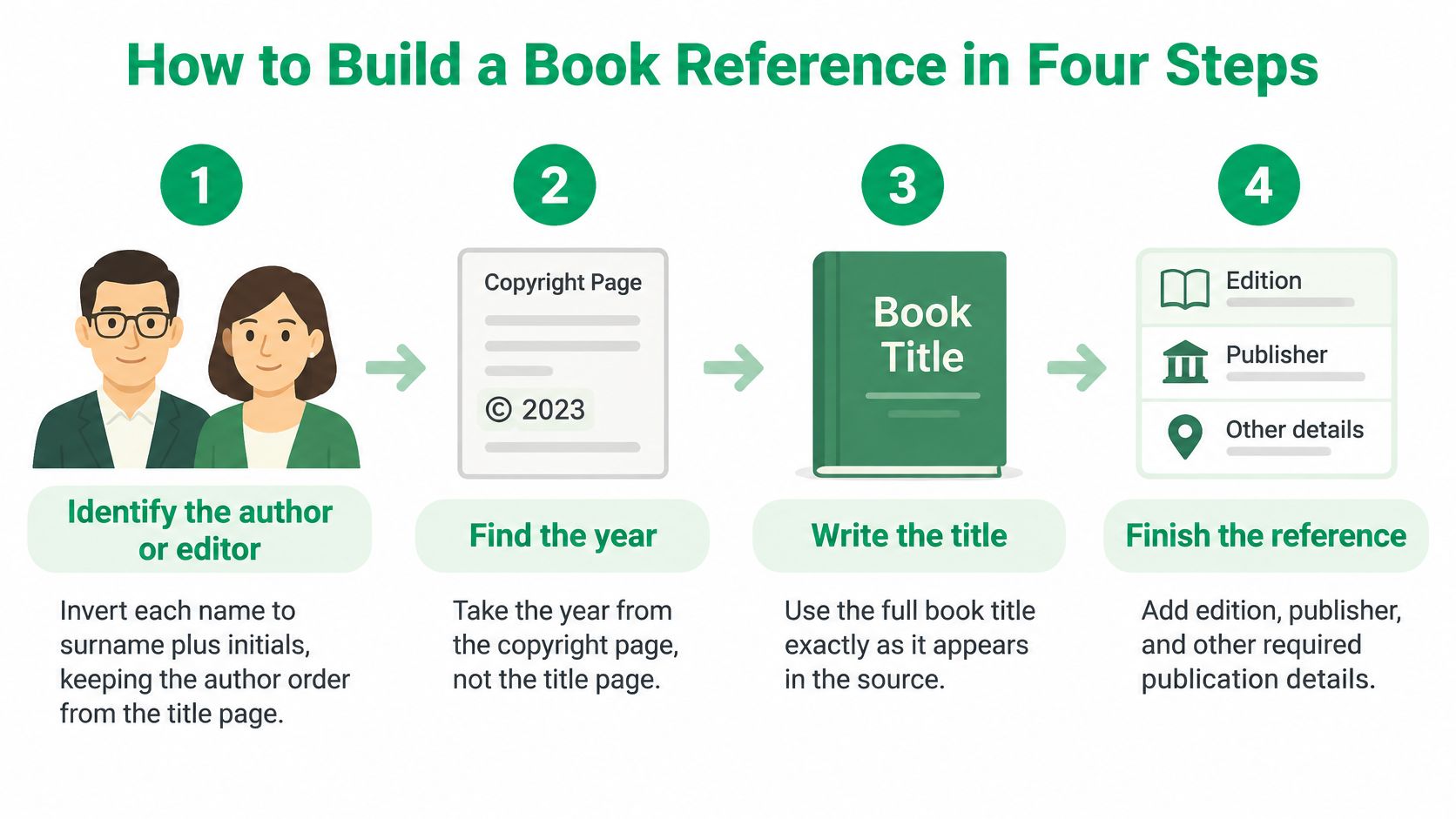
Use this visual as a quick process reminder, then apply the capitalization and edition details below.
Gather and arrange the publication details
Identify the author or editor. Write each individual's surname followed by initials, preserving the order shown on the title page. Don't alphabetize coauthors within an entry, because their published order is part of the source's authorship information.
Find the year on the copyright page, rather than copying a retailer's release date or a later printing date. You're identifying the publication you used, not the date a particular seller made it available.
Write the title and subtitle in sentence case, then italicize the complete standalone title. Preserve the wording, but adjust the capitalization to APA style; place edition and volume information immediately afterward in regular type, with edition before volume.
Finish with the publisher's name, without its city or state, followed by the DOI when assigned. For a book found through an academic database, leave out database names such as ProQuest or EBSCO, and don't add Kindle as a publisher or platform label.
Work through a complete example
Suppose the book's author is J. A. Smith, its copyright year is 2022, and you consulted the second edition of Writing for digital audiences, published by Academic Press. Your practice reference would read:
Smith, J. A. (2022). Writing for digital audiences (2nd ed.). Academic Press.
This is an illustrative entry, not a recommendation to cite an independently verified publication. Notice that only the title is italicized; the edition parenthetical remains in regular text.
If a source also has a volume, the publication detail would take the form (2nd ed., Vol. 1). Don't add an edition statement when the book doesn't supply one that needs to be recorded.
Practical rule: Collect the details from the book first. Apply the formatting afterward, so you're not trying to solve identification and punctuation problems at the same time.
Handle missing information carefully
An ISBN doesn't belong in an APA book reference. It can help you locate the correct edition during research, but it isn't a substitute for a DOI in the finished entry.
If a book has no author, move the italicized title into the author position. Use a shortened italicized title in the in-text citation so readers can connect it to the beginning of the reference.
If no date appears anywhere, use (n.d.) in place of the year. Check the copyright page again before making that choice, especially when the ebook's opening screens omit publication information.
For a health-sciences project, source collection and synthesis need attention alongside formatting. Ace Med Boards' resource on how to write medical literature reviews offers useful context for organizing that broader work.
Before saving the entry, compare it with the title page and copyright page one last time. Check the words and names, not just whether the punctuation looks familiar.
Deciding Between an Authored Book and an Edited Chapter
Who wrote the material you used? That question determines whether your reference should identify an entire book or an individual chapter. A chapter heading alone doesn't mean you need a chapter reference.
The distinction is easier to follow when you separate the chapter's writer from the people responsible for the collection.
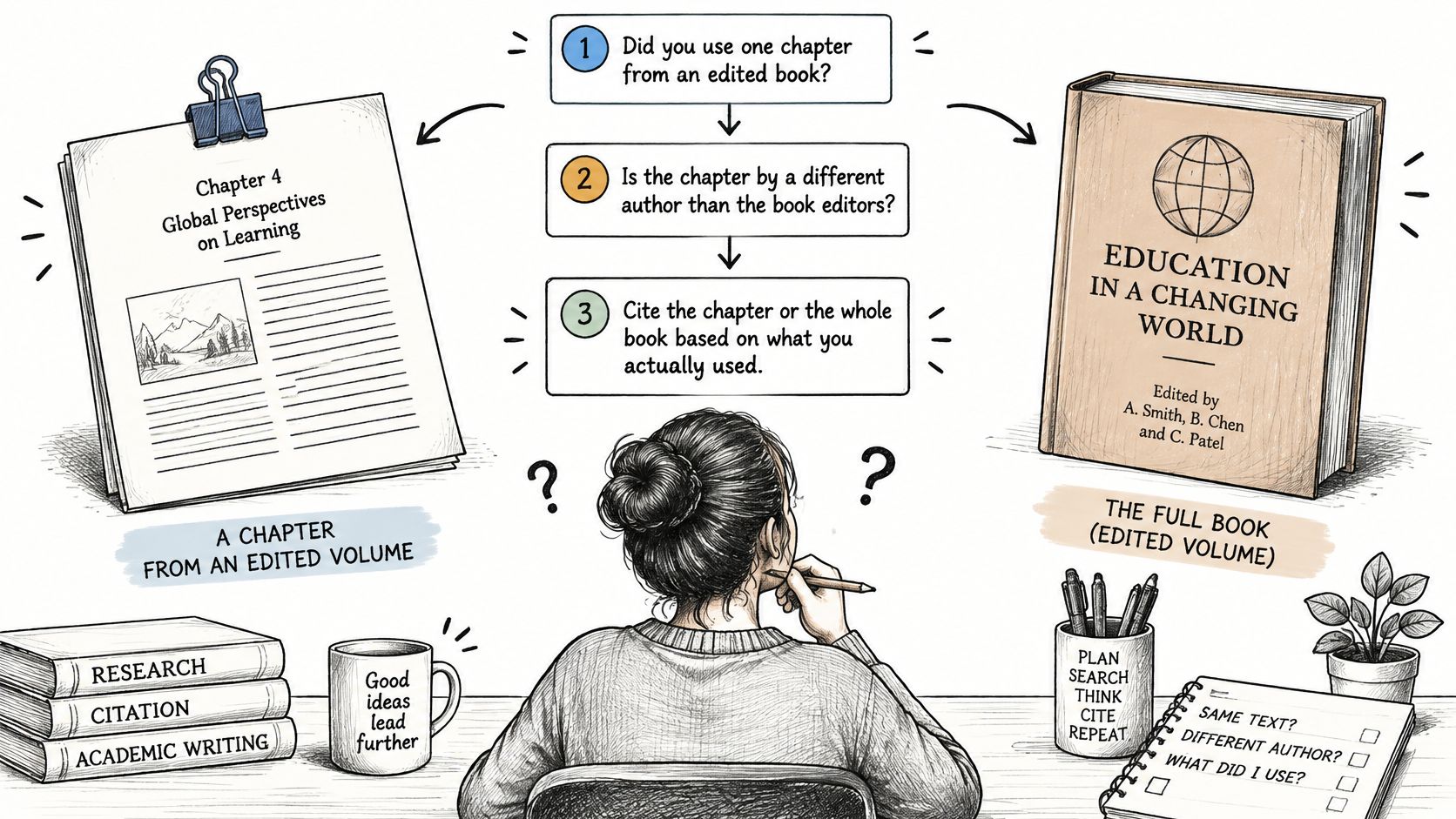
Follow the authorship decision path
The APA guidance for edited-book chapters distinguishes chapters in authored books from separately authored contributions in edited collections. Use these questions before choosing your template:
- Did the chapter's author also write the whole book? Cite the entire authored book. Identify a particular page, chapter, or section in the text when readers need that location.
- Are the people on the title page identified as editors? If you used a separately authored chapter, begin the reference with that chapter's author, then include the editors, book title, chapter page range, and publisher.
- Is the authorship still unclear? Look for “edited by,” contributor biographies, and author names beneath chapter headings. A contributor list is a useful clue, but confirm who wrote the particular material.
Be cautious with academic databases. A chapter-level search result can look like a standalone publication, while a downloaded chapter may omit the book's title page.
Open the surrounding book record or preliminary pages before deciding. The download format doesn't determine the citation type.
Compare the outcomes using one practice title
Consider the hypothetical title Writing for digital audiences. These alternative scenarios show how its reference would change depending on who wrote it.
If Smith authored the whole book, a discussion of one chapter would still use the complete-book reference:
Smith, J. A. (2022). Writing for digital audiences. Academic Press.
If Smith edited the collection and Lee wrote the chapter you used, the reference would identify Lee's contribution:
Lee, B. B. (2022). Planning accessible content. In J. A. Smith (Ed.), Writing for digital audiences (pp. xx-xx). Academic Press.
Replace the page placeholders with the chapter's actual range. The chapter title stays in regular type, while the collection's title is italicized.
For a video-based explanation, this walkthrough provides another way to approach the citation decision.
An edited collection can also be cited as a whole when your discussion concerns the complete collection. Don't use that option merely to avoid identifying the author of a chapter that supports your claim.
If another assignment requires a different system, our guide to citing in Chicago style can help you keep the formats separate. Don't borrow Chicago's notes or bibliography conventions for an APA reference list.
Parenthetical or Narrative In-Text Citations
A parenthetical citation puts the author and year in parentheses, usually near the end of the sentence. A narrative citation names the author in your sentence and places the year immediately afterward in parentheses.
Choose the form that best fits your emphasis. Narrative citations foreground the writer; parenthetical citations let you foreground the idea.
Pick the form that fits your sentence
These examples use practice names and dates to demonstrate formatting. They aren't claims about particular books or organizational publications.
In-text citation forms for books
| Situation | Parenthetical | Narrative |
|---|---|---|
| One author | (Smith, 2022) | Smith (2022) |
| Two authors | (Smith & Lee, 2022) | Smith and Lee (2022) |
| Three or more authors | (Smith et al., 2022) | Smith et al. (2022) |
| Direct quotation with page | (Smith, 2022, p. 14) | Smith (2022, p. 14) |
| Two works, same author, same year | (Smith, 2022a, 2022b) | Smith (2022a) and Smith (2022b) |
| Group author, first mention | (World Health Organization [WHO], 2021) | World Health Organization [WHO] (2021) |
| Group author, later mentions | (WHO, 2021) | WHO (2021) |
For a group author's first narrative appearance, the more natural integrated form is World Health Organization (WHO, 2021). The square-bracket form is used when introducing the abbreviation inside a parenthetical citation.
Use and between author names in running text and & inside parentheses. For works with three or more authors, use the first author's surname followed by et al. from the first citation, unless additional names are needed to distinguish otherwise identical citations.
The punctuation is easy to mistype: there's a period after al., not after et. Our guide to et al. punctuation addresses those small but noticeable errors.
Make the source location useful
For a direct quotation, include a page locator using p. for one page or pp. for a page range. In a narrative sentence, you can name the author and year at the beginning and put the page locator after the quoted wording.
A paraphrase still needs a citation even though you've rewritten the wording. Page numbers aren't generally required for paraphrases, but they can help readers locate a specific argument in a long book.
A citation identifies whose idea you used. Writing authentically means explaining that idea through your own reasoning, not merely replacing a few words.
That distinction matters beyond academic essays. The Online College of Art & Design's OCAD guide to using art references offers a useful parallel for creators learning from existing work without copying it.
When the same author has multiple works from the same year, assign the matching a and b suffixes in the reference list and use them consistently in the text. Don't assign letters according to whichever work you happen to mention first.
Your final test is traceability: each in-text citation should identify exactly one reference-list entry. For an edited chapter, that usually means citing the chapter author in your sentence, not the book's editor.
Citing Books Summarized or Drafted With AI
An AI-generated reference can look polished and still point to a source that doesn't exist. In a 2024 study published in Contemporary School Psychology, GPT-4 produced 16 APA-style citations, of which 25% pointed to non-existent references.
That finding concerns the output examined in that study, not every AI tool or every generated bibliography. It does establish a practical reason to verify suggested references before treating them as evidence.
Keep the source open while reviewing any AI-generated summary or citation.
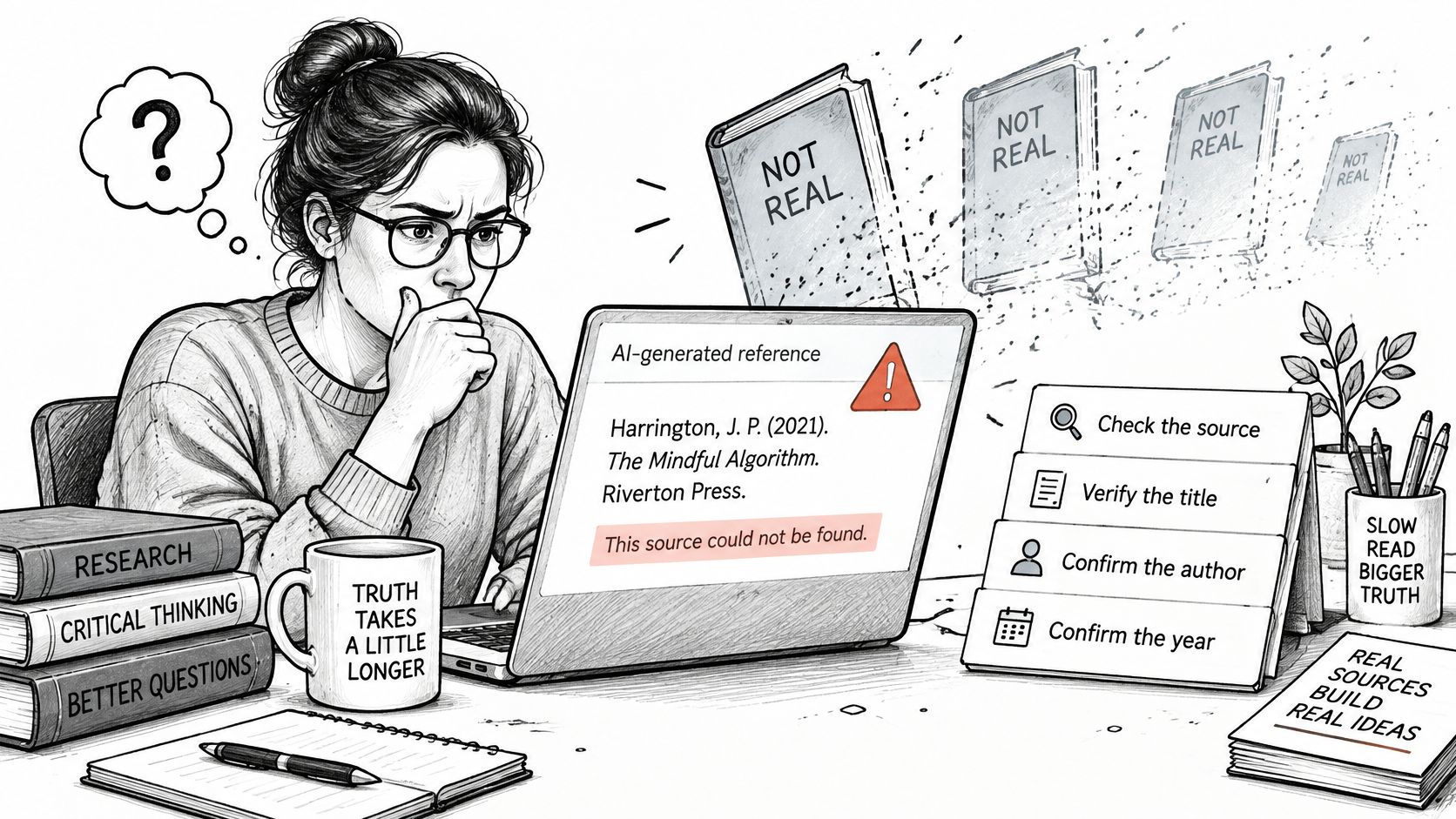
Verify existence, identity, and support
- Search by title and author. Use a library catalogue, publisher page, or bookseller listing to establish whether the suggested book exists.
- Compare the author, year, and edition with the book's own publication pages. A similar title isn't enough.
- Read the relevant passage. Confirm that the book supports the claim the AI attributed to it, including any qualifications or limitations.
- Build the reference from the verified publication details. Don't preserve a generated entry merely because it already looks like APA.
Hypothetical scenario: A student asks an AI tool to summarize four books for a literature review. Two suggested titles turn out to be altered versions of real titles, so the student checks each source, obtains the relevant books, and rewrites the summaries from the passages consulted.
Finding a real book with a similar name doesn't validate the original summary. The argument, quotation, or page reference could still be wrong.
Keep assistance separate from evidence
Cite the book you read as support for its ideas, not the AI summary as a substitute for reading it. If your instructor or publisher requires documentation of AI assistance, provide that disclosure separately; citing the book doesn't remove that obligation.
Form Timer's discussion of peer influence on academic dishonesty offers context for resisting pressure to adopt shortcuts. Your classmates' or colleagues' practices don't determine what your own institution permits.
At PureWrite, we can help polish a literature review into clearer, more natural prose, but we don't verify its sources. Our guidance on how to paraphrase without plagiarizing supports responsible revision rather than disguising borrowed writing.
“I use AI to summarize sources for my thesis, then humanize those summaries so the whole lit review reads in one voice. Citations and terminology come through untouched.”
Wei Z.
Treat that workflow as writing assistance, not evidence validation. You remain responsible for reading the sources, preserving technical meaning, and checking the citations after revision.
Fix Common Book Citation Mistakes and Run a Final Check
Citation mistakes are common and correctable. In a 2025 study published in Frontiers in Education, 80% of participating undergraduates scored below 50% on a pre-test measuring APA seventh-edition citation knowledge.
Those results describe the participating students, not every undergraduate. For your own reference list, a calm diagnostic check is more useful than assuming you should already know every detail.
Common book citation errors and their fixes
| Symptom | Likely cause | Fix |
|---|---|---|
| Year is a reprint or release date | Used the wrong date from the title page | Use the copyright year on the copyright page |
| Edition shown in italics | Edition treated as part of the title | Place (2nd ed.) in regular text after the italic title |
| City and state before publisher | Carried over from an older style | Delete the location and keep the publisher name |
| Database name in the entry | Copied from the library search screen | Remove it and keep only the DOI when assigned |
| Title in title case | Followed the book cover | Convert to sentence case, capitalizing the first word, the first word after a colon, and proper nouns |
| Wrong edition cited | Cited the newest or first edition by habit | Cite the edition you consulted and match its page numbers |
| Chapter has no page range | Missed the page numbers in the table of contents | Add (pp. xx-xx) after the book title |
Match the reference to the edition you read
An edition statement identifies the version supporting your work. It isn't a recommendation about which version readers should buy.
The APA explanation of book editions directs writers to reference the edition they consulted, whether quoting or paraphrasing. Pagination, examples, terminology, and conclusions can change, so substituting the newest edition can make your source harder to verify.
Suppose you used an older textbook borrowed from your department. If an automated citation generator finds a newer edition, don't accept the replacement without checking it against your copy.
Your quotation may be accurate, yet its page number may refer to a different passage in the newer edition. The correct repair is to identify the book you read, not to change its publication details to look current.
Also distinguish a new edition from another printing of the same edition. A later printing date doesn't automatically mean the book contains revised content or needs a different edition statement.
Separate source accuracy from polished presentation
A reference can be perfectly italicized and still identify the wrong source. Check the underlying publication before spending time on spacing and indentation.
This matters when importing citations from library catalogues, reference managers, or AI tools. Treat imported entries as editable records, not approved answers.
For a marketing report, for example, a chapter about audience behavior might support a specific recommendation. If the reference credits only the collection's editor, readers may struggle to identify whose evidence you used.
For a student essay, the problem might be subtler: the reference names the right book, but the quotation comes from a secondary discussion rather than the original passage. Formatting can't resolve that mismatch; return to what you consulted and represent it accurately.
An originality review can complement this work. Our guide to a plagiarism checker for students explains a related part of revision, but a similarity result can't confirm that a book exists or supports your interpretation.
Before submission: Check what the source says, what your sentence claims, and whether the reference identifies the version you used. Those are separate questions.
Run a five-minute final check
Use this as a focused final pass, not as a substitute for source verification during drafting. Keep your document and source files open together so you can correct mismatches immediately.
Confirm the template for each book type. Check whether the entry represents an authored book, a complete edited collection, or an independently authored chapter. Inspect the edition placement, title italics, and final DOI when assigned.
Match citations in both directions. Every in-text citation should lead to a reference entry, and every reference-list entry should be cited in the text; remove books that remained in the list after you deleted the passages using them.
Alphabetize and format the list. Sort entries by the first author's surname and apply a 0.5-inch hanging indent through your word processor's paragraph settings. Don't create the indent with spaces or manual line breaks, because later editing can disrupt it.
Check publication details against the book. Compare the copyright year and edition with the copyright page, then verify the full title and author order against the title page.
Compare the finished entry with the source itself. Open the exact print copy, ebook, or chapter you used and confirm that a reader could locate it from your reference. For quoted material, check the wording and locator before closing the file.
If you're working in Microsoft Word or Google Docs, use paragraph-formatting controls rather than adjusting each line individually. That keeps the hanging indent consistent when a long title or DOI wraps onto another line.
Read author names carefully during this pass. A misspelled surname can break the connection between the in-text citation and the reference even when everything else is correct.
Keep your argument and voice intact
After the references are accurate, read the surrounding prose for meaning. A smooth paraphrase can still overstate the source, omit a limitation, or make your interpretation sound like the author's conclusion.
Ask whether each paragraph distinguishes the source's idea from your analysis. That distinction matters in essays, professional reports, and content marketing alike.
Maya C. describes a revision workflow this way:
“I outline every paper myself and use ChatGPT for the rough sections. PureWrite is my last step before submitting: the draft comes back sounding like my own writing, and the score tells me exactly where it stands.”
Maya C.
Keep the responsibility clear: a writing-quality score isn't proof of source accuracy, authorship, or compliance with an assignment's AI rules. Your outline, reasoning, source checks, and required disclosure remain yours to manage.
Quick-reference cheat sheet
- Right source type. Choose the entry that matches who wrote the material you used.
- Complete citation match. Connect every in-text citation to its reference, and remove unused entries.
- Readable list. Alphabetize consistently and use a hanging indent.
- Verified publication details. Check names, year, title, and edition against the actual book.
- Supported claims. Reopen the cited passages and confirm your quotations, paraphrases, and locators.
Save your verified references before making a final prose revision. If an AI-assisted draft sounds stiff, refine its clarity and voice without changing the argument, technical terminology, or source details you've checked.
At Pure Write, we help turn AI-assisted drafts into clearer, more natural prose while preserving your voice. Once you've verified your APA book references, visit Pure Write to humanize the surrounding writing, keeping your argument, citations, and required AI disclosures intact.