Definition of Academic Dishonesty: Types and Examples
Academic dishonesty is any conduct that misrepresents the authorship, effort, evidence, or achievement a student presents for credit, in breach of the institution's rules. You're probably reading this because that line feels blurry right now, especially if you used AI to brainstorm, outline, or clean up a draft and you're unsure whether you helped yourself or broke a rule.
That uncertainty is common for students, content creators, professionals, and marketers who now write with AI in the room. You don't need a scare story. You need a clear definition, concrete examples, and a practical test you can apply before you submit anything.
What Academic Dishonesty Means in Plain Terms
Academic dishonesty is conduct that misrepresents the authorship, effort, evidence, or achievement a student presents for academic credit.
Think of a graded essay like a receipt. It says the person named on the paper did the thinking, reading, and writing behind it. Dishonesty is any act that makes that receipt false.
That means the definition of academic dishonesty is behavioral and ethical, not stylistic. Weak structure, awkward phrasing, or a poor argument isn't dishonest. Presenting someone else's thinking as yours, inventing evidence, or hiding help you weren't allowed to use is.
Why there's no single universal rulebook
There's no single universal definition that fits every school. Institutions define misconduct through their own academic integrity policies, so boundaries vary by country, education system, course, and assessment format, as the broad overview of academic dishonesty and its common forms explains.
That variation also changes statistics. A study counting only exam cheating will report a different rate from one that also counts plagiarism, unauthorized collaboration, fabrication, or contract cheating. Common forms include unauthorized assistance during examinations, copying or colluding on assignments, plagiarism, fabrication or falsification, and submitting work completed by another person.
Most cases come down to three linked questions. Was the act prohibited, what did the assessment rule say, and did the act deceive the evaluator about who did the work?
Before you go further, check your own course rules. Your syllabus matters more than any general definition, including this one.
The Four Core Types and Concrete Examples
Academic dishonesty is an umbrella term for conduct that seeks credit for work a student didn't complete or deliberately harms another person's academic work. Drake University's four core categories of plagiarism, cheating, fabrication, and facilitation give you a practical framework for sorting real cases.
| Type | What it covers | Concrete example | Core test |
|---|---|---|---|
| Plagiarism | Presenting others' ideas, wording, or work as your own, intentionally or through negligence | Pasting a paragraph from a website without quotation marks or a citation | Was the source credited? |
| Cheating | Giving or getting unauthorized help on a test or assignment | Using notes in a closed-book exam or having a classmate complete a take-home task | Was this help allowed by the rules? |
| Fabrication | Inventing or falsifying data, quotations, interview material, or citations | Citing a journal article that doesn't exist to support a claim | Does the evidence actually exist? |
| Facilitation | Knowingly helping another person commit misconduct | Sharing a finished essay file with a classmate for submission | Did you knowingly enable the act? |
Where everyday writing mistakes fit
Plagiarism isn't limited to copy and paste. Presenting another person's ideas, wording, discourse, or work as your own counts, whether it's intentional or caused by negligence. That's why learning how to paraphrase without plagiarizing matters before you rewrite a source in your own words.
Cheating covers giving or obtaining unauthorized assistance to meet an academic requirement, including an examination. Submitting another person's work, including paid ghostwriting, usually falls here or under misrepresentation, depending on the local rule. Changing a graded exam and resubmitting it for more credit is another concrete example institutions name.
Fabrication is narrower and often more serious. It means intentionally falsifying or inventing information or citations, not making an honest referencing typo.
Facilitation catches the helper, not just the submitter. If you knowingly share answers, files, or completed work so someone else can pass it off, you've participated.
One act can fit more than one category. An invented citation copied from a classmate could involve plagiarism, fabrication, and facilitation at once. The label matters less than the core tests in the table.
Where AI Assistance Crosses Into Misconduct
A student uses an AI tool to brainstorm, then to fix grammar, then to write the whole argument, and the instructor cannot tell which step mattered. That sliding scale is where most current confusion lives.
The visual below shows that progression from support toward substitution.
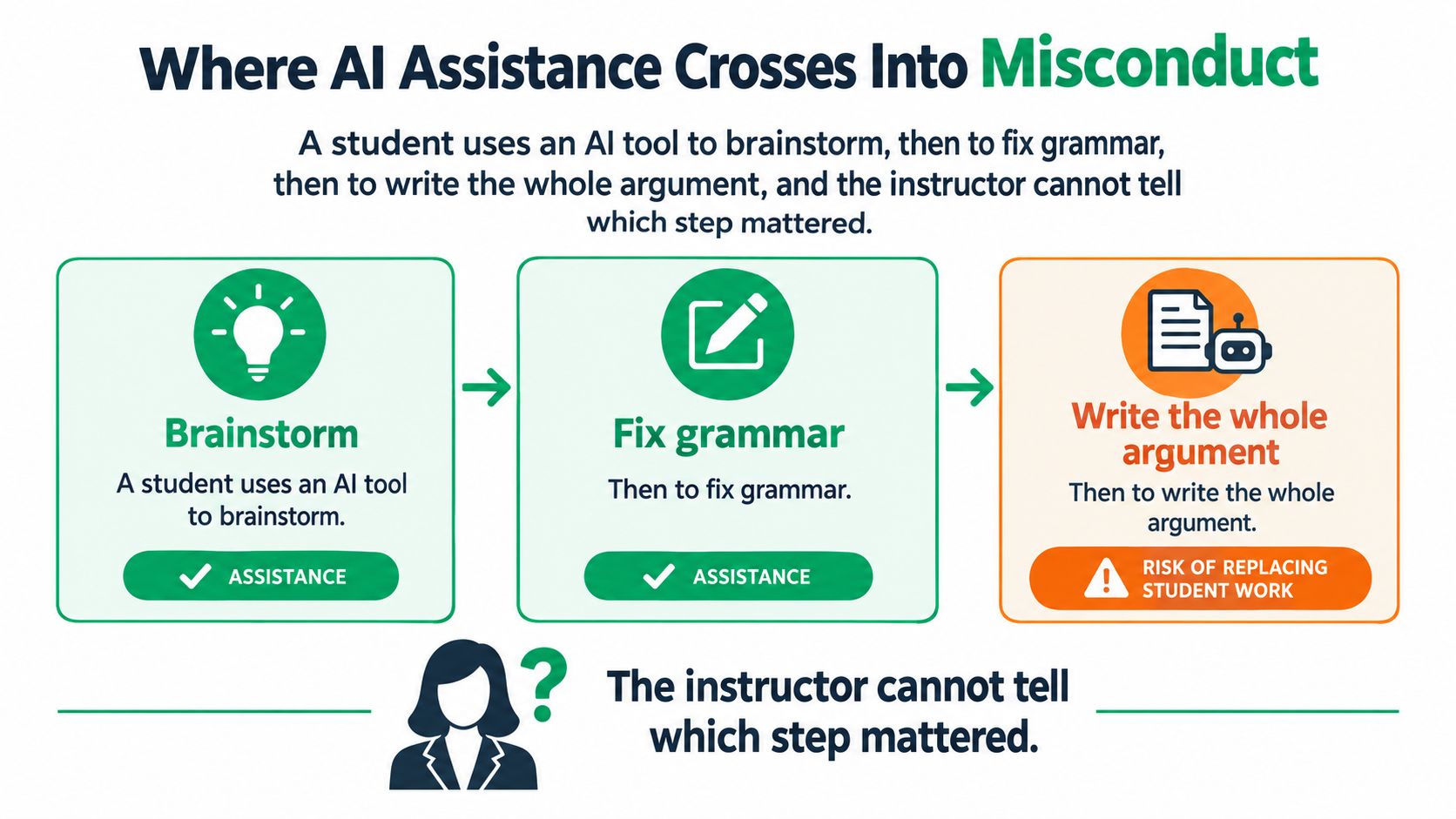
Don't ask only whether AI was used. Ask three questions instead. Was the use authorized, was it disclosed where required, and did the tool replace your intellectual contribution?
| Activity | Usually acceptable when | Becomes misconduct when |
|---|---|---|
| Brainstorming topics | The instructor allows it and you develop the ideas yourself | The AI supplies the thesis or argument you submit as your own |
| Grammar and spelling correction | The assessment permits editing support and you wrote the draft | It rewrites the argument beyond what the rule allows |
| Translation | The policy allows it and you drafted in your own language | You submit a translated text you never wrote |
| Outlining | You build the structure and then write the text | An AI outline becomes the undisclosed backbone of your work |
| Citation discovery | You open and verify every source you cite | You cite references you haven't read or that don't exist |
| Rewriting for readability | You drafted the work and refine it with disclosure where required | Rewriting disguises copied or AI-written text as your own |
| Full AI-generated essay | The instructor explicitly permits it and you disclose it | You submit it as personal work without authorization |
Student attitudes reflect that gray area. In a 2025 survey of 277 university students on AI use and misconduct, most viewed submitting an entirely AI-generated essay as serious misconduct, while attitudes toward partial use, such as brainstorming or editing, were substantially more ambiguous.
Context matters for equity, too. Multilingual students and students with disabilities may use language or accessibility support that improves expression without replacing subject matter reasoning. That distinction is central to what academic integrity means beyond a list of bans.
The video below offers a useful walkthrough of how these boundaries play out in practice.
A rule that's acceptable in one course can violate another course's assessment rules. Check authorization first, then judge substitution and disclosure.
How Widespread Academic Dishonesty Really Is
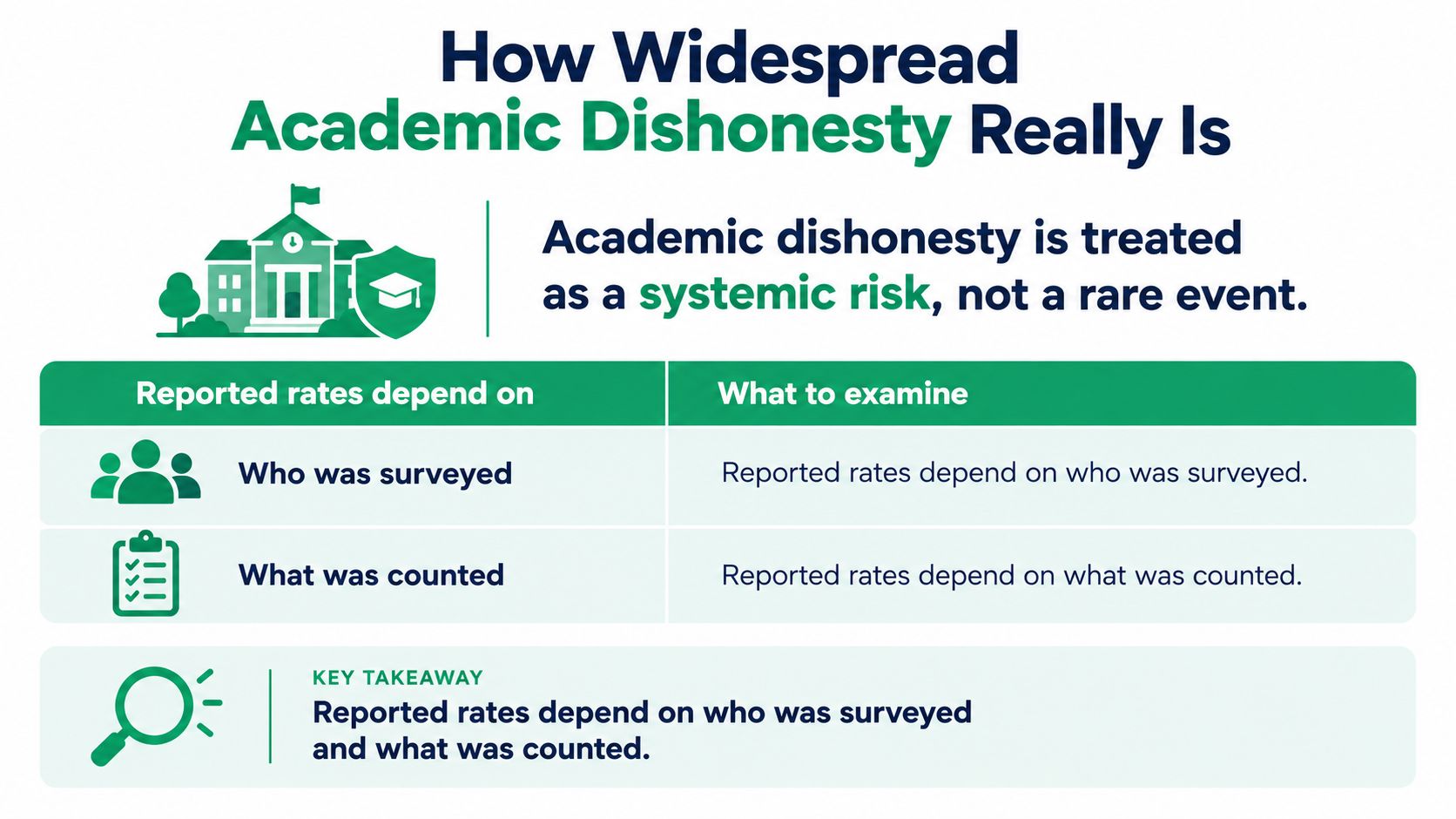
Start with the numbers that anchor most discussions of scale. Data collected by the International Center for Academic Integrity from approximately 71,300 undergraduates between fall 2002 and spring 2015 found 39% admitted cheating on tests, 62% admitted cheating on written assignments, and 68% admitted cheating on either.
That 68% only means something with its definition attached. The survey asked whether each behavior had happened at least once, so a student who copied homework a single time counts the same as a student who cheated on every exam. It works like a "have you ever" question on a medical form: it measures reach across a population, not frequency for any one person. The graduate sample from the same source, roughly 17,000 respondents, reported 17% for tests, 40% for written assignments, and 43% for either type.
| Study | Population | What was counted | Reported rate |
|---|---|---|---|
| ICAI undergraduate data, 2002-2015 | About 71,300 undergraduates | Cheating on tests | 39% |
| ICAI undergraduate data, 2002-2015 | About 71,300 undergraduates | Cheating on written assignments | 62% |
| ICAI undergraduate data, 2002-2015 | About 71,300 undergraduates | Cheating on tests or written work | 68% |
| ICAI graduate data, 2002-2015 | About 17,000 graduate students | Cheating on tests or written work | 43% |
| KPK Education Integrity Assessment, 2024 | 449,865 respondents | Cheating while knowing it was dishonest | 57.87% |
| EDUCAUSE Students and Technology Report, 2024 | Surveyed students | Used AI for coursework then edited it | 5% |
| EDUCAUSE Students and Technology Report, 2024 | Surveyed students | Submitted AI material without editing | 1% |
Indonesia's Corruption Eradication Commission reported 57.87% of surveyed students admitted cheating despite knowing it was dishonest in its 2024 Education Integrity Assessment with 449,865 respondents. For AI specifically, the 2024 EDUCAUSE Students and Technology Report figures reported by Inside Higher Ed found 5% used AI to generate coursework they edited, while 1% submitted AI-generated material without editing.
Here is where the framework from earlier sections earns its keep. Those AI figures describe behavior, and behavior only becomes misconduct after you check authorization, disclosure, and substitution. Editing AI output that your instructor permitted is a different act from submitting it as your own, even though both might appear in the same survey response.
Reading rule: Always ask which population, time period, and behavior a statistic measures before comparing it with another.
Three traps explain most confusion when these numbers get quoted. "Ever cheated" differs from "cheated on this assignment," self-report wording shifts what students admit, and each survey draws the boundary of cheating in a different place. Read these figures as evidence of scale, each one tied to its own definition.
How Instructors Investigate Fairly
A student's essay sounds different from earlier work. A detector flags a passage. Either signal may prompt a conversation, but neither proves who wrote the work or whether a rule was broken. Fair decisions rely on evidence and the instructions that applied to the assignment.
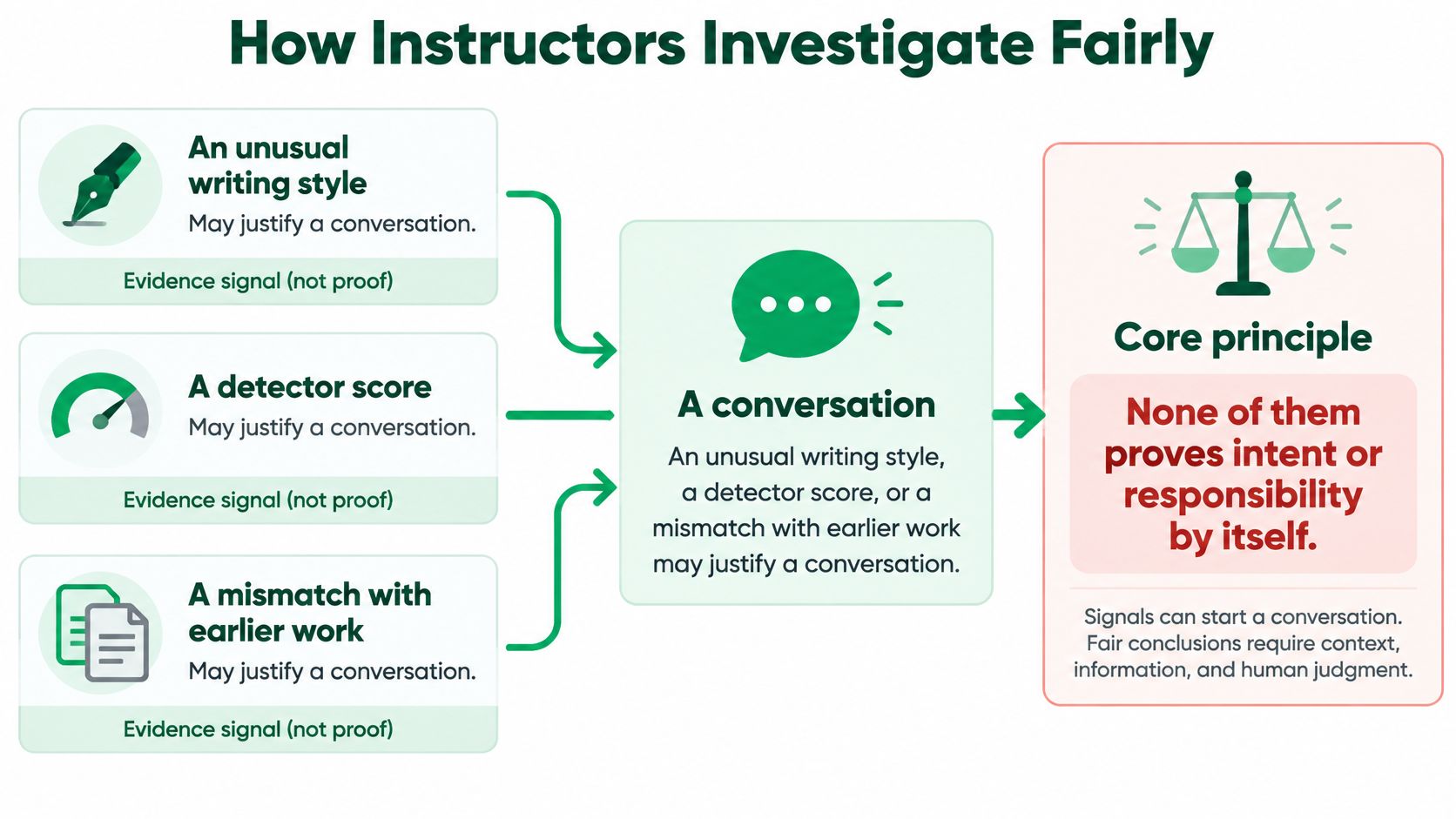
A fair investigation in six steps
- Treat a flag as a prompt: A detector score or polished paragraph can start an inquiry, not settle it. Understanding what Turnitin checks for and what it cannot decide helps keep software results in perspective.
- Check the assignment rule: Compare the work with the instructions for that task. A general integrity policy may not answer whether a particular tool or kind of assistance was allowed.
- Request process evidence: Drafts, notes, outlines, or version history may help clarify how the work developed. Their absence, on its own, does not establish misconduct.
- Ask for the student's account: Give the student a chance to explain their choices, sources, and revisions. State the concern clearly rather than asking them to guess.
- Check sources and development: Confirm that citations and quotations are accurate, and consider how the argument took shape. This can help distinguish a sourcing problem from a concern about authorship.
- Explain the decision and appeal route: Base the outcome on the evidence and the published rule. Tell the student how to appeal.
A survey result can describe why students hesitate to use AI, but it cannot show whether an investigation is fair. In the 2025 HEPI Student Generative AI Survey, 53% of respondents cited fear of being accused of cheating as a reason to avoid using AI. That finding points to fear of accusation as a deterrent, not to how investigations are conducted.
Fair review also requires attention to context. A multilingual student may use translation or permitted proofreading support, and that assistance can affect the wording without replacing the student's ideas. In AI-related cases, the practical questions are whether the tool was authorized, whether its use needed to be disclosed, and whether it substituted for work the student was expected to do.
Penalties and Policies You Are Likely to Face
Every institution publishes its own academic integrity policy, and penalties usually scale with severity, intent, and repetition. You can't predict an outcome from another school's example, but you can understand the typical ladder.
- Zero or reduced grade on one assignment: Often used for a minor or first, unintentional case, such as sloppy citation that the instructor treats as a teachable error.
- Failing the course: More likely for serious or deliberate cheating on a test or a major submission.
- Probation or suspension: Typically tied to repeated or substantial offenses where earlier warnings didn't change behavior.
- Expulsion or degree revocation: Reserved in rare cases for fabrication, impersonation, or a pattern discovered later, especially in research.
A concrete policy example
CUNY's academic integrity policy on unauthorized AI use explicitly treats unauthorized use of artificial intelligence systems as cheating. It covers unauthorized use or attempted use of materials, information, notes, study aids, devices, AI systems, or communication during an academic exercise.
CUNY also treats submitting content generated or altered by AI or digital paraphrasing tools as solely your own work without proper citation as plagiarism. Copying from another student or a generative AI system, or allowing others to copy your work for credit, are named examples.
That example shows why the local rule controls the penalty. The same AI edit could be permitted support in one class and unauthorized assistance in another.
Find your exact policy before you assume anything. Look in the syllabus first, then the student handbook, then your integrity office website. If the policy is silent on AI, ask your instructor for clarification in writing.
Prevention and Detection Strategies
Prevention works best when instructors design for process, not only for a final file. Staged submissions, short in-class writing, and brief oral defenses make it easier for honest students to show their work.
- Publish a clear AI rule per assignment: Give examples of permitted and prohibited use, not just a generic ban.
- Require a short disclosure statement: Ask students to state briefly when AI helped and how.
- Tie prompts to course material: Questions linked to specific readings and class discussion are harder to answer generically.
- Collect drafts or version history: Process evidence protects honest writers and clarifies disputes early.
- Teach citation early: A low-stakes practice task on source verification prevents panic later. Students can also improve note-taking to prevent plagiarism by separating quotations, paraphrases, and their own comments from the start.
Detection needs honest limits. Text-matching software and AI detectors can flag patterns, and a plagiarism checker for students reviewing their own drafts can help writers spot overlap before submission. Scores still carry error, especially for second language writers, so use them only to start a conversation.
Visible rules reduce both misuse and fear. Students who worry about false accusation often avoid helpful tools altogether, which doesn't improve learning. Explain the rules before the assignment, not after a flag.
Using Writing Tools Without Crossing the Line
Integrity rules feel less arbitrary once you translate them into three decisions: were you authorized to use the tool, did you disclose the help that mattered, and did the tool substitute for thinking the assignment was meant to measure? The International Center for Academic Integrity framework of honesty, trust, fairness, respect, responsibility, and courage treats integrity as a community standard. Used well, those standards turn a vague worry into a practical check: your submission should represent your knowledge, your process, and your contribution.
A detector score cannot settle that question by itself, and polished prose is not evidence of misconduct. The score works like a smoke alarm: useful as a prompt to check the kitchen, unreliable as proof that someone committed arson. If your process was permitted, documented, and accurately described, support with grammar or clarity can sit inside the rules even when the final sentences read smoothly.
An ethical workflow you can repeat
- Write your own draft or outline first: Get your argument, evidence, and structure on the page before any tool touches the text. This is your proof of authorship and your best protection in a dispute.
- Use AI only for allowed tasks: Match each use to the assignment rule. Brainstorming may be fine while full drafting is off limits, and that line can change from one task to the next.
- Keep dated version history and source notes: Save outlines, notes, and earlier drafts. Keep the messy middle, because it often shows how the work became yours.
- Mark quotations and verify citations: Check every reference against the original publication. Never invent references, findings, quotations, interview material, or data, and do not treat paraphrasing as a substitute for citation.
- Disclose meaningful AI help where required: A short, honest statement is easier than defending a concealed edit later. If you are unsure whether the help counts as meaningful, disclose it and ask.
Pure Write is built for the polishing step in that workflow, after you have written a draft you can stand behind. It can help you improve clarity, tone, grammar, concision, and formatting while keeping your voice, and its quality analysis, AI detection, and plagiarism checks help you review your own draft before submission. Those checks do not replace your institution's rules or your accountability, so read how accurate AI detectors are before treating a score as a verdict. No tool makes dishonest work safe, and rewriting should never be used to disguise copied or unauthorized text.
Your pre-submission checklist
Run through these questions truthfully. If any answer is no, pause and clarify before you submit.
- Syllabus checked: Does it mention AI, editing tools, collaboration, or reuse of earlier work?
- Silence resolved: If the policy does not mention your planned use, have you asked your instructor in writing?
- Core argument yours: Did you draft the thesis, reasoning, and conclusions yourself?
- Process visible: Can you show notes, outlines, or version history if asked?
- Sources verified: Have you opened every source you cite and confirmed it says what you claim?
- Help disclosed: Have you credited collaborators and disclosed AI assistance where required?
- No unauthorized reuse: Are you avoiding resubmitting earlier work across courses without permission?
If you could not explain your argument, your sources, and your revisions in a short conversation, the draft is not ready to submit as your own.
That checklist protects content creators and professionals, too. A marketer who publishes client work, a freelancer who repurposes an article, or a researcher who reuses text faces the same authorship question in a different setting. Clear attribution and an honest draft history travel well across all of them.
Your next step is simple: visit Pure Write to polish a draft you wrote and run a pre-submission check before you hand it in.