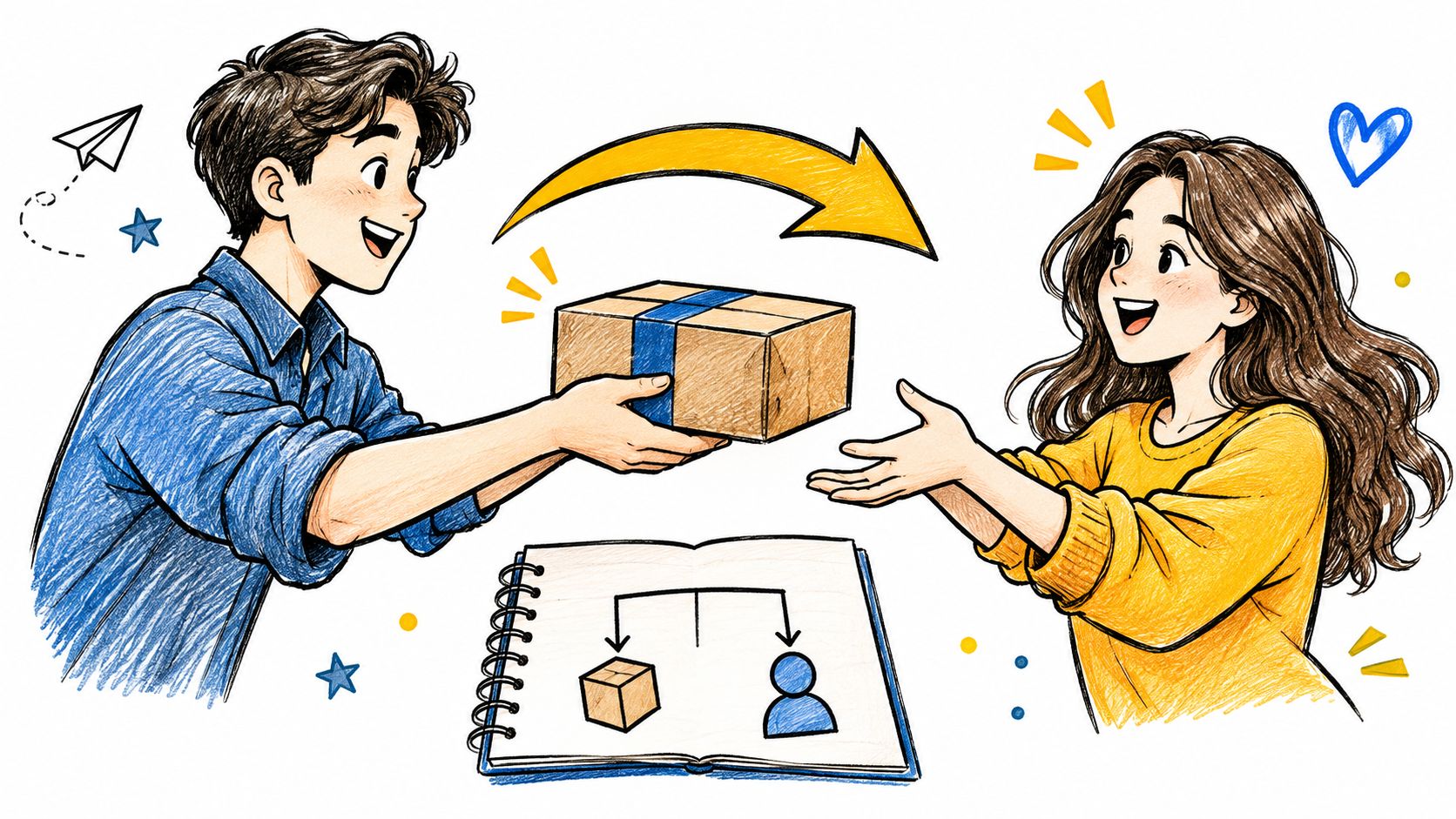
The direct object is what the verb acts on or transfers, and the indirect object is who receives it or is affected, as in they gave her a present.
You're probably staring at a draft right now where the verb is clear but the nouns after it aren't. You can feel who got what, yet you can't name it, and an AI tool has just rearranged the sentence into something slightly wrong.
What Direct and Indirect Objects Do in a Sentence
Say your draft says, "The editor sent the author a revision." It reads smoothly until a reviewer asks a simple question. Who received what, and could a reader ever flip those roles?
In that line, a revision is the thing that moved. The author is the person it moved to. Once you see that split, the sentence stops being a string of nouns and becomes a small transaction you can check.
The direct object is the person or thing the verb acts on or transfers, and the indirect object is the person or animal that receives that thing or is otherwise affected.
Try it on "They gave her a present." Present is direct because it's what was given. Her is indirect because she received it.
Why the labels matter in real drafts
Swap the two nouns in an email, brief, ad, or essay and you can change the client, the fee, or the promise. "We sent the client the invoice" and "We sent the invoice the client" aren't interchangeable, and only one survives an edit.
Getting direct and indirect objects right also keeps your meaning stable when you shorten a sentence. If you know which noun is the thing and which is the person, you can cut words without cutting the recipient. That's the difference between revising and guessing.
You'll get a three question test first, then the verbs that carry most double object sentences. After that come worked examples with passives and pronouns, the cases where to whom fails, and a short answer key you can score yourself.
Clear objects make AI assisted drafts easier to edit because you can spot when a tool has moved the wrong noun. Ethical tools should support your authorship rather than disguise it, so you stay responsible for what the sentence claims. If you want the wider rules around this one, start with these basic grammar rules for everyday writing.
Take the test in the next section and use it on the very next sentence you revise. One honest pass beats rereading a paragraph five times and hoping it sounds right.
How to Identify Direct and Indirect Objects
Start with the test, not the theory. You only need three moves, in this order, every time.
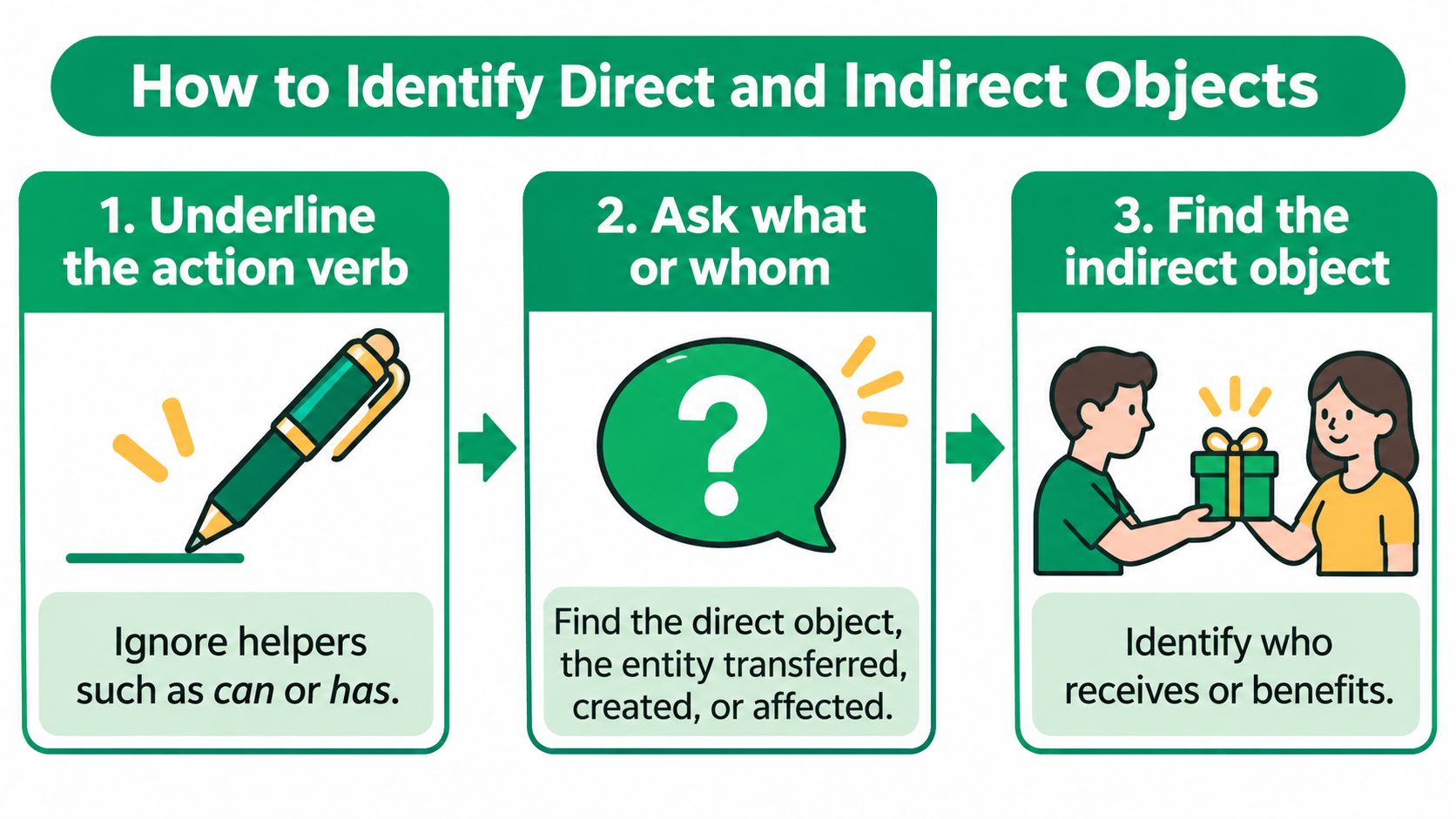
- Underline the action verb. Ignore helpers such as can or has, because they don't carry the action.
- Ask what or whom after the verb. The answer is the direct object, the entity transferred, created, or affected.
- Ask to whom, for whom, or who is affected. The answer is the indirect object, which in the double object pattern sits between the verb and the direct object.
That order matters. If you hunt for the person first, you'll often label the first noun you see and get it backwards.
Run the test once, slowly
Take "The editor sent the author a revision." The verb is sent. Sent what? A revision, so that's your direct object.
Sent to whom? The author, so that's your indirect object. Notice the person comes first in the sentence but second in your test, which is exactly why the test protects you.
Now flip it. "The editor sent a revision to the author" keeps the same roles, but the recipient is now marked by to and the direct object moves forward. The labels didn't change just because the order did.
The Cambridge grammar guide on direct objects puts it plainly. A direct object is the person or thing affected by a verb's action, while an indirect object is usually the person or animal that receives the direct object.
Object labels you can check with two questions
| Sentence | Direct object | Indirect or recipient | Questions |
|---|---|---|---|
| They gave her a present | a present | her | gave what / to whom |
| The editor sent the author a revision | a revision | the author | sent what / to whom |
| She told the client the deadline | the deadline | the client | told what / told whom |
| Can I ask you a question | a question | you | ask what / ask whom |
| She gave the report to him | the report | to him (prepositional) | gave what / to whom |
Read each row out loud with the questions. You'll hear that what always lands on the thing, even when the thing is abstract, like the deadline or a question.
That last row is the one writers miss. To him does the recipient's job, but it's a prepositional phrase, not a bare indirect object tucked after the verb. Same meaning, different packaging.
Pronouns follow the same test
Me, you, him, her, us, and them are indirect when they name the receiver. It and them are direct when they name the thing handed over, so the pronoun itself doesn't decide, the question does.
Clause level thinking helps. If you're unsure where one clause ends and another begins, this guide to clauses in grammar and how they fit together will keep you from testing the wrong verb.
Gate rule: If what or whom gets no answer, there's no direct object, and without a direct object there's no indirect object.
"The team met yesterday" fails that gate. Met what? Nothing answers, so you stop there and don't invent an object out of yesterday.
Double Object Order and the Verbs Behind It
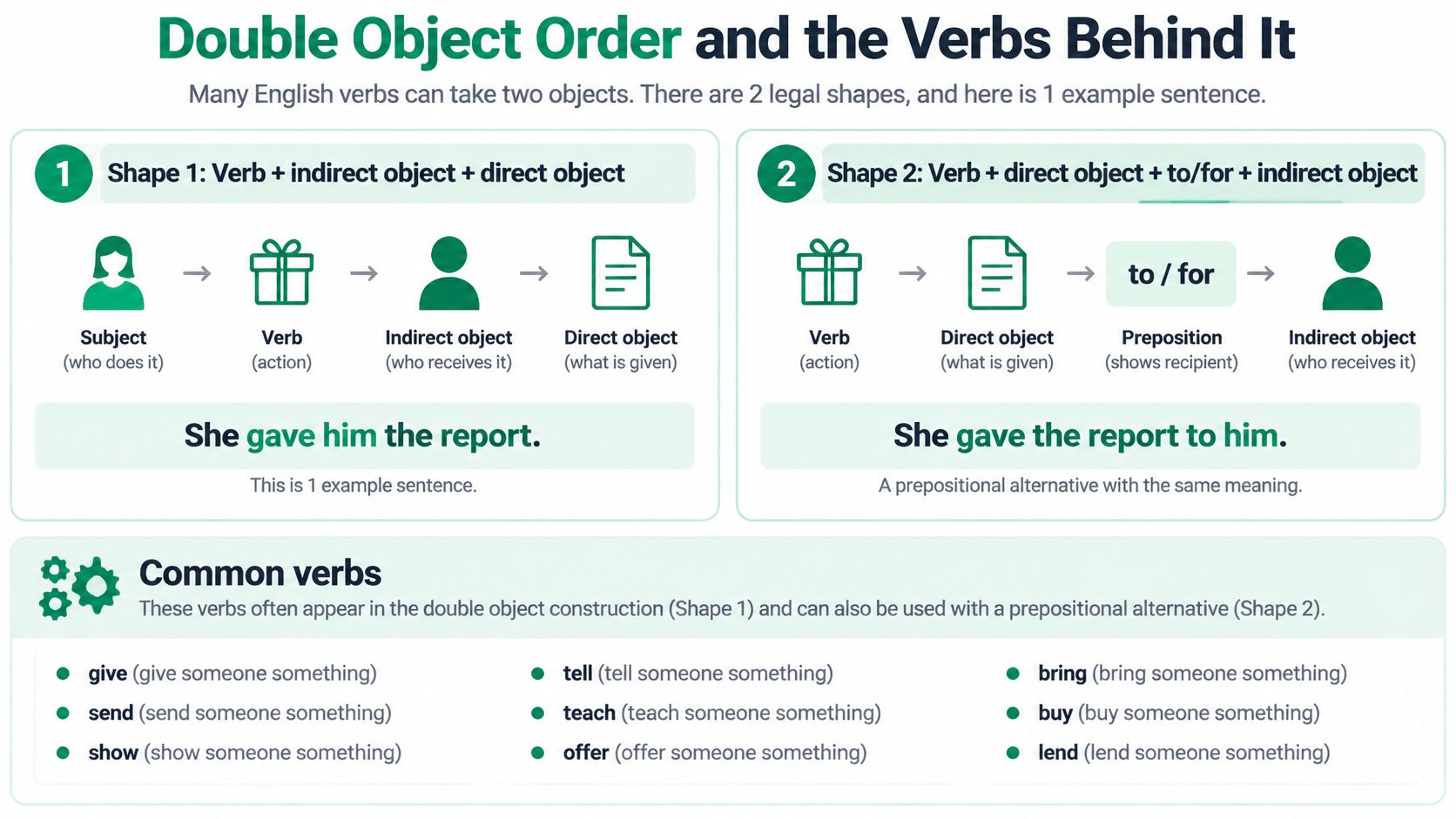
English gives you two legal shapes for the same handover. Shape one is verb plus indirect object plus direct object, as in "She gave him the report."
Shape two puts the direct object first and marks the recipient with to or for. "She gave the report to him" and "She bought lunch for him" both use that second shape.
What real usage prefers
Writers don't split evenly between the two shapes. A dialectal study using the FRED and BNC-reg corpora, reported in a corpus study of ditransitive clauses, found approximately 85–86% of ditransitive clauses occurred in the double object construction.
By contrast, about 13–14% used the prepositional construction and only 1–2% used an alternative double object pattern. So the bare recipient right after the verb is the workhorse in those British varieties, not the exception.
That doesn't make the to version wrong. It means readers meet the double object shape far more often, so it tends to feel like the default when the verb allows it.
A few verbs do most of the work
The pattern is also concentrated in a handful of verbs. The ICE-GB corpus study of ditransitive verbs identified 70 such verbs producing 1,741 parsed ditransitive occurrences.
GIVE alone accounted for 562 occurrences, or approximately 32.3% of the total. TELL contributed 491, or approximately 28.2%, so together they represented roughly 60.5% of all examples.
The next tier is much smaller. ASK had 91 occurrences, SHOW had 84, SEND had 79, and OFFER had 54, which tells you transfer and communication verbs shape most of what you'll edit.
Which pattern each common verb allows
| Verb | Bare indirect object | Preposition if used | Safe example |
|---|---|---|---|
| give | yes | to | She gave him the report |
| tell | yes | to | She told him the news |
| send | yes | to | She sent the author a revision |
| promise | yes | to | She promised them a refund |
| buy | yes | for | She bought him lunch |
| explain | no | to | Explain the issue to the client |
| cost | yes, affected person | none natural | The delay cost them an hour |
Don't treat every verb as equally flexible just because the pattern exists. Grammatical possibility and observed frequency are distinct facts, and many verbs use the double object shape only in a minority of their appearances.
Before you force a recipient into the slot after a verb, check the verb itself. If you're also sorting out verb types while you edit, this comparison of action verbs and linking verbs in practice pairs well with the table above.
Annotated Examples with Voice and Pronouns
Rules stick better when you watch them survive real edits. These five short scenes cover the moves you'll make on client work, posts, and essays.
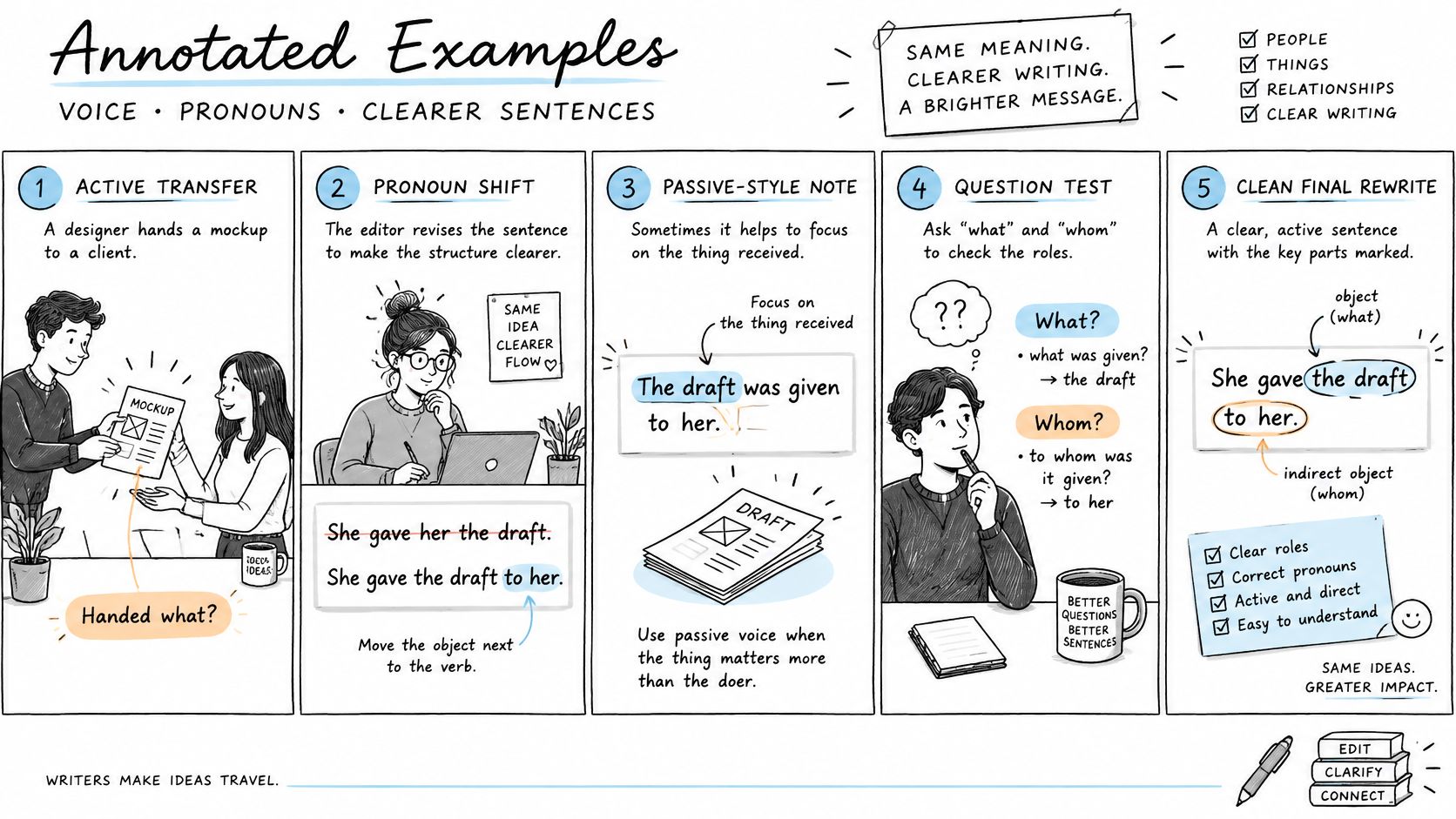
The visual below maps the same labeling habit onto a full sentence.
Scene one and two show the same handover
Scene one, active transfer. "The designer handed the client the mockup." Handed what? The mockup (direct). Handed to whom? The client (indirect).
Scene two, reordered. "The designer handed the mockup to the client." Same roles, but the recipient is now marked by to, which helps when the mockup is the news you want up front.
Nothing about the facts changed between those two lines. Only the emphasis moved, and that's a choice you get to make on purpose once direct and indirect objects are labeled.
Scene three fixes a clumsy pronoun pair
Scene three, pronouns. "She handed him it" is possible, but it's clumsy on the page. "She handed it to him" is the clearer edit.
A pronoun that names the thing, like it, usually prefers the end of the sentence. When both objects shrink to pronouns, switch to the to shape and the line relaxes.
Watch the same pronoun choice explained step by step in the clip below before you try the passive.
Scene four moves the recipient into the subject slot
Scene four, passive. "The client was handed the mockup." The old indirect object, the client, is now the subject, and the mockup stays the direct object.
Don't invent a new indirect object to fill the gap. The recipient didn't disappear, it got promoted, and the thing handed over kept its job.
Passives trip writers up because the first noun looks like the actor. If you want more side by side rewrites, work through these passive voice and active voice examples for editors with your own draft open.
Scene five is a benefit, not a parcel
Scene five, benefit. "We saved the team a week." Saved what? A week (direct). Saved for whom? The team (indirect), as the beneficiary rather than someone holding a box.
Communication verbs behave the same way. "They taught the interns the style guide" puts the interns first as indirect object, while "They taught the style guide to the interns" leads with the material.
Choose double object order when the person is the point, and choose the to or for order when the thing handed over is the point.
That single choice controls what your reader notices first. In a client update, lead with the person. In a product post, lead with the deliverable.
When the Recipient Test Gives the Wrong Label
The shortcut says an indirect object is a person receiving a thing. That works for "She gave him the book" and then falls apart on the verbs you use every week.
Not every indirect object receives a parcel. Some name an affected person, an experiencer, or someone denied something, and to whom starts to sound wrong even though the label is right.
People who hear, learn, lose, or miss out
With tell and teach, the person hears or learns rather than takes an item. "She told him the risk" and "She taught them the shortcut" both put the person in the indirect slot, and the risk and the shortcut stay direct.
Cost, envy, and deny push further from a handover. "The reprint cost us the margin," "I envy her that calm," and "They denied him a byline" all name someone affected, not someone handed a thing.
For those, ask who is affected instead of to whom. You'll still find the indirect object, you'll just stop expecting a delivery that never happens.
The double object shape foregrounds the recipient, while the prepositional shape puts the transferred entity first. The Cambridge grammar reference on objects distinguishes verbs that permit verb + indirect object + direct object from verbs that require direct object + to or for + recipient, such as "explain the issue to the client" and "buy a book for the student."
The opposite error forces a bare recipient
Some writers overcorrect and jam a person after any verb. "Explain me the process" and "suggested her the headline" aren't the standard pattern, no matter how often you hear them in conversation.
Write "Explain the process to me" and "suggested the headline to her" instead. The verb wants a preposition, so give it one.
Buy and make are for verbs, not to verbs. You buy a book for the student because the student benefits, and picking the wrong preposition makes the sentence feel translated.
That translation feel is often literal. If you write in another language too, copying a dative pattern from that language into English produces exactly these bare recipient errors, and a worksheet on give won't diagnose them.
Run this three line check when a sentence feels off.
- Direct object check. Does what or whom find one?
- Role check. Is the person a recipient, a beneficiary, or merely affected?
- Verb check. Does this verb allow the bare pattern, or does it need to or for?
Practice Sentences and the Answers
Work through these eight items without scrolling ahead in your head. Each answer sits in the next sentence, so you can check yourself as you go.
The easy four
1. Maya handed Leo the draft. Direct object, the draft. Indirect object, Leo, because he received it.
2. We owe the vendor a reply. Direct object, a reply. Indirect object, the vendor, who's waiting on it.
3. The storm cost the crew a day. Direct object, a day. Indirect object, the crew, an affected participant rather than someone who received a parcel.
4. Send the file to Priya. Direct object, the file. Priya sits inside a to phrase, so she isn't a bare indirect object here.
If those four felt automatic, good. That means the what question is landing on the thing before you go hunting for the person.
The harder four
5. Leo was handed the draft. This is passive, so Leo, the old indirect object, is now the subject. The draft is still the direct object.
6. She told them it. Them is indirect and it is direct. If the rhythm feels awkward in public copy, "She told it to them" reads cleaner.
7. Explain me the steps. Rewrite it as "Explain the steps to me." Explain needs to before the person.
8. The team met yesterday. There's no direct object and no indirect object. Yesterday tells you time, nothing more.
Score yourself candidly. Six of eight means the test is holding under pressure, and misses on items 5 and 7 are the usual ones because passives and explain break the simple recipient picture.
Missed item 3? That's the affected person trap, and it clears up once you ask who is affected alongside to whom. Missed item 4? You labeled a prepositional phrase as a bare object, which is easy to fix once you spot the to.
Teachers building follow up drills from these eight can borrow fresh angles from language teaching ideas from Keybaki and turn each miss into a two minute rewrite task. Short, targeted practice on your actual errors beats a long generic worksheet.
Keep your misses in front of you for the revision pass that follows. They're a better checklist than any rule list, because they're yours.
Revise Object Order Before You Publish
Run this four point pass on the piece you're about to send. It takes minutes and catches the object errors readers feel but can't name.
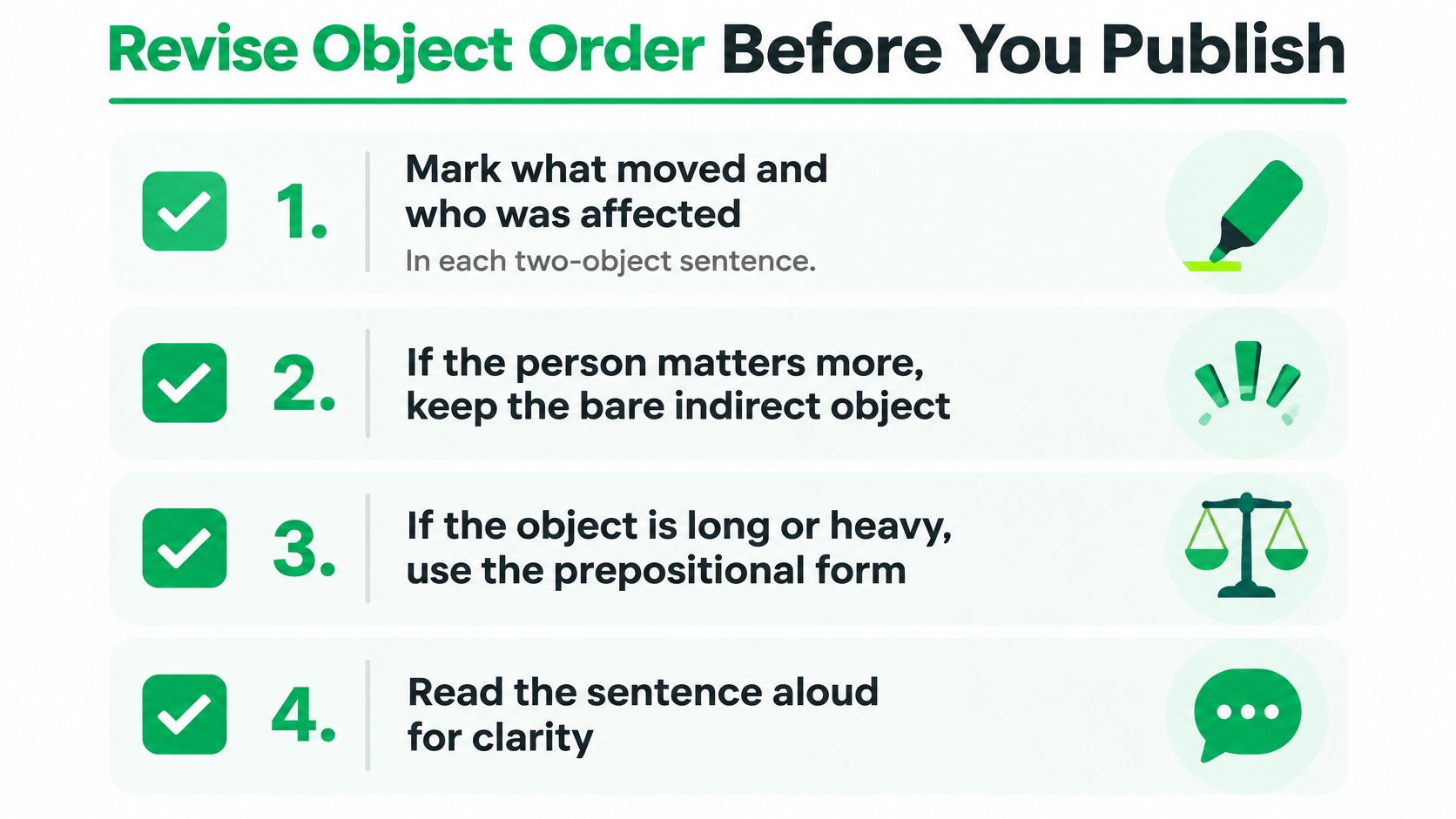
- Mark what moved. In each two object sentence, note what moved and who was affected.
- Decide the emphasis. If the person matters more, keep the bare indirect object. If the thing matters more, move it forward and use to or for.
- Read pronouns aloud. Prefer "handed it to him" over a clumsy double pronoun when the line will be published.
- Recheck the stubborn verbs. Look hard at explain, suggest, and similar verbs so the person isn't jammed in before the direct object.
Don't outsource that judgment to a labeler. A 2025 corpus-linguistics study reported classification accuracy of 72.09% for direct objects and 78.49% for indirect objects in its evaluated workflow, so read client facing lines yourself.
"I write for clients in Portuguese and English, and it handles both. Drafts come back sounding like a person, and the built-in check has saved me more than one awkward email.", Rafael S.
We built our paste and click humanize flow to help a draft you've already labeled read in your own voice, with a grammar check before you send. Use it to clarify your own writing, never to pass off work that isn't yours, and pair it with a manual correct the sentence check for final drafts.
Take one paragraph you just labeled and run it through that pass now. You'll hear the difference in a single read aloud.
Paste one paragraph where you've labeled the direct and indirect objects into Pure Write and let us help it read in your own clear, natural voice while you keep full authorship. You'll get a quick humanize pass and grammar check on emails, posts, or essays, so the recipient and the thing you promised stay exactly where you put them.