Grammar and Punctuation Rules That Keep Writing Clear
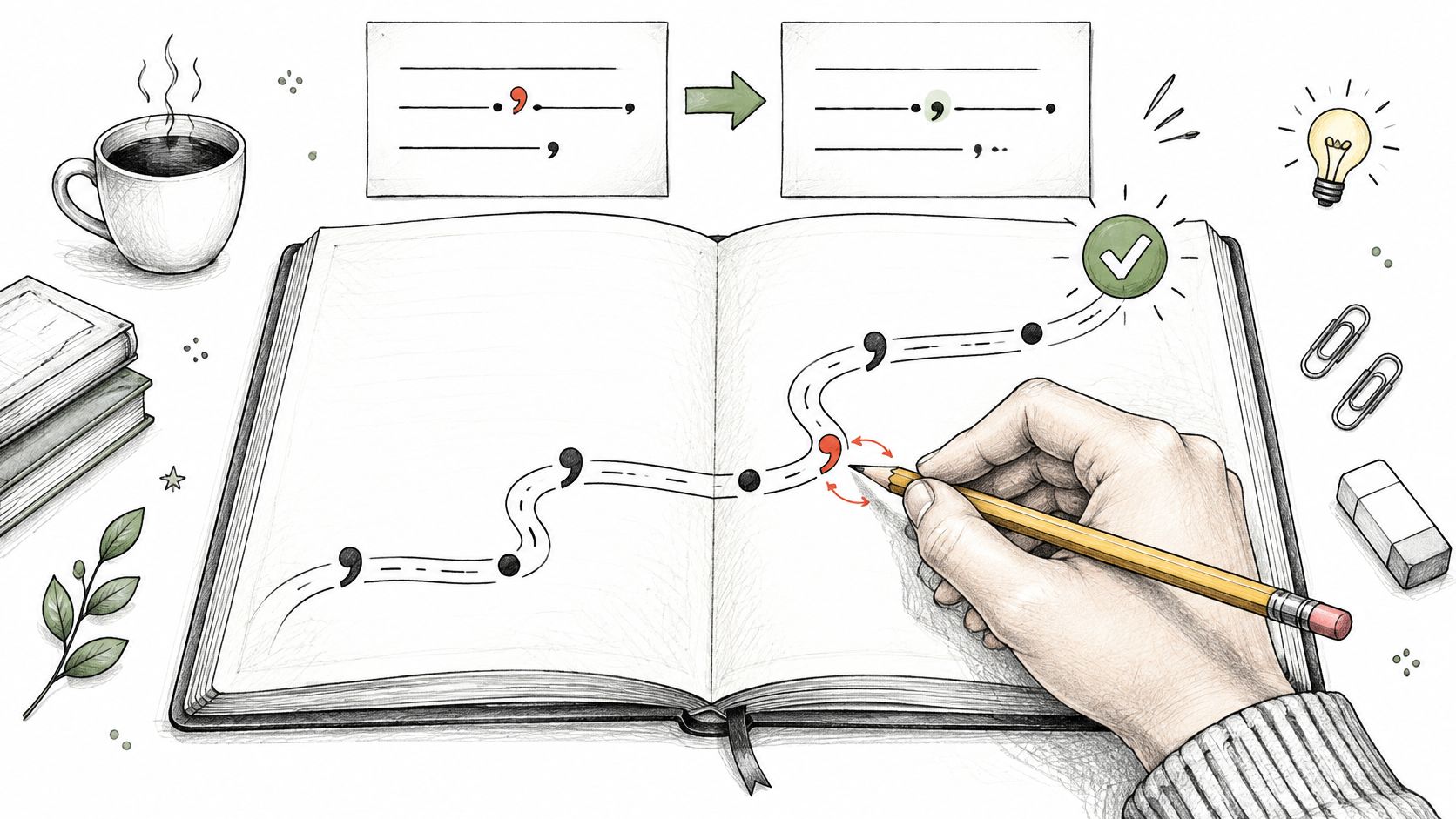
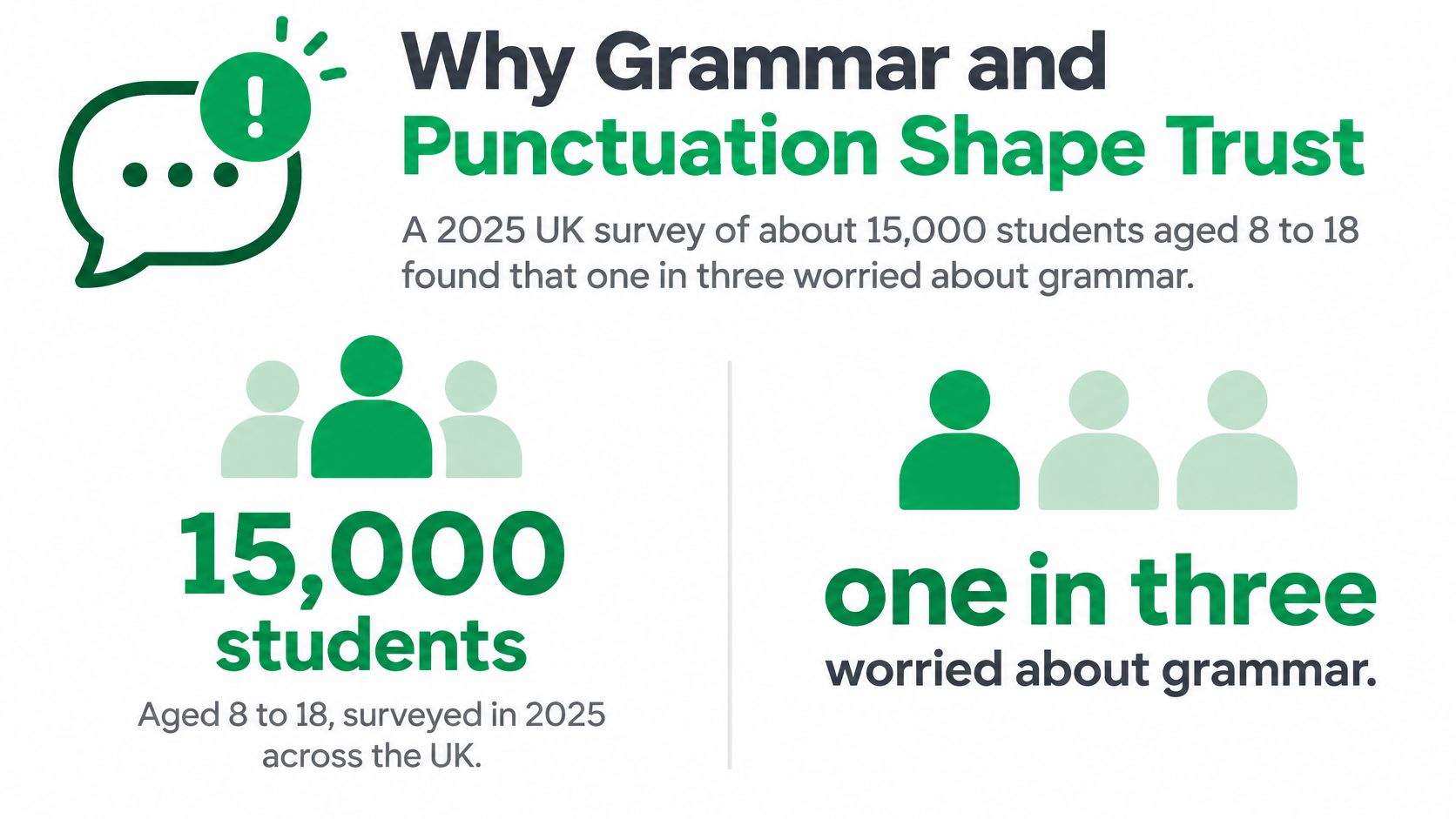
A 2025 UK survey of approximately 15,000 students aged 8 to 18 found that one in three worried about grammar, punctuation, and spelling while drafting, according to the National Literacy Trust's writing survey. That worry can make a comma feel like a verdict on your writing, when it's usually just one small decision about how a reader follows your meaning.
Why Grammar and Punctuation Shape Trust
A student drafts an argument for class, then stops after the opening sentence to check whether a comma belongs there. A marketer can do the same with an AI-generated landing page, scanning for errors before deciding whether the central claim is clear. In both cases, correcting too early can interrupt the work of getting an idea onto the page.
Grammar is the route: it helps words form sentences that show who did what and whether the parts agree. Punctuation is the signage: commas, periods, and other marks help readers see where ideas connect, separate, or end. When the route is unclear or the signs point the wrong way, readers may have to work harder to understand the point.
The National Literacy Trust survey's finding matters because concern about mechanics can arise while students are still drafting, not just when they're proofreading. A practical response is to separate making meaning from checking correctness. Draft the idea first, then return to the sentence to decide whether its grammar and punctuation help a reader follow it.
That approach is useful well beyond school. A professional writing under time pressure, a student revising an essay, and a content creator reviewing AI-assisted copy all need to distinguish a confusing sentence from a stylistic choice that differs from their preference.
Grammar also isn't one universal set of rules applied identically in every language and community. English conventions shift across dialects, genres, and house styles, so good editing means knowing what your audience expects while keeping the meaning intact. If you're learning English alongside another language, a resource on grammar support for language learners can offer relevant support without treating every difference as a lack of care.
Core Grammar and Punctuation Rules at a Glance
| Rule | When it applies | Correct example | Common slip |
|---|---|---|---|
| Subject–verb agreement | A singular subject needs a singular verb; match dialect for group nouns | The report is final. The team is split. | The report are final. |
| Comma splice | Two independent clauses need more than a comma | The draft is ready, but the client has not seen it. | The draft is ready, the client has not seen it. |
| Introductory comma | A word, phrase, or clause comes before the main clause | After the headline test, the team cut the first line. | After the headline test the team cut the first line. |
| Nonessential pair | Middle material can be deleted while leaving a sentence | The landing page, which launched Monday, increased sign-ups. | One comma only, or commas around essential information |
| Essential that | A that clause identifies which person or thing | The report that includes the survey is final. | The report, that includes the survey, is final. |
| Serial comma | A list contains three or more items | clarity, tone, and precision | clarity, tone and precision when the items can blur |
| Apostrophe | A contraction differs from a possessive | It's ready. The brand kept its voice. | Its ready. The brand kept it's voice. |
| Semicolon | Two related full sentences connect, or list items already contain commas | The test ended Friday; the new headline ran Monday. | The test ended Friday, and; the new headline ran Monday. |
Read each row as a quick editing decision, not a rule you need to recite. For subject–verb agreement, locate the subject before choosing the verb. In “The report is final,” report is singular, even if extra words between subject and verb make the sentence feel more complicated.
Group nouns show why dialect matters. US business and web prose commonly treats team as singular, as in “The team is split,” while some British usage allows “The team are divided.” Pick the form that fits the English variety and readership you're writing for, then use it consistently. If you're learning a language with grammatical articles and noun genders, this introduction to understanding articles and noun genders can help show why English conventions don't map neatly onto every language.
A comma after an introductory phrase gives readers a visible boundary before the main clause: “After the headline test, the team cut the first line.” Purdue OWL's guidance on introductory commas and nonessential clauses also distinguishes removable information from essential information. If “which launched Monday” is nonessential, paired commas set it off; if a that clause identifies which report you mean, don't separate it with commas.
The serial comma, as in “clarity, tone, and precision,” can help keep the final items in a list distinct. Some style guides omit it, so follow your publication's chosen style when it's clear and the list remains easy to read. A guide to whether a phrase takes “is” or “are” can be a useful next step if subject–verb agreement gives you trouble.
How Punctuation Steers the Reader
A sentence can send readers down the wrong path before its meaning becomes clear: “The manager told the client the plan failed was outdated.” At first, “the plan failed” may seem to complete “told,” leaving readers to reread and work out what was outdated. Give each idea a clearer place: “The manager told the client that the plan had failed. The client's reading of the report was outdated.” If the relationship still feels difficult to follow, split the sentence.
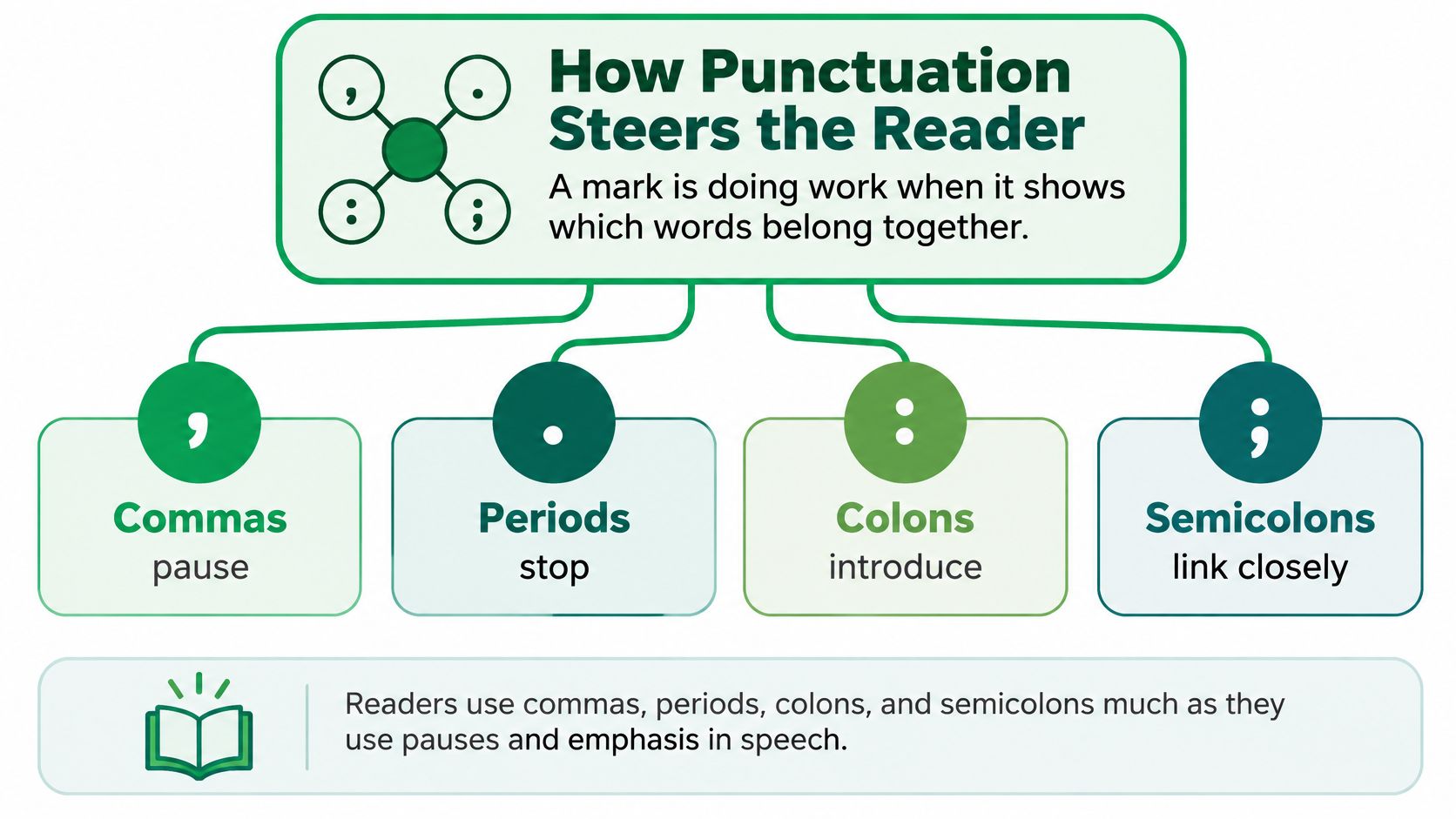
Commas, periods, colons, and semicolons guide readers through a sentence much like road signs guide traffic. They mark boundaries and show how ideas relate. Choose punctuation to match the sentence's structure, not merely to represent a pause you heard while drafting.
Try two checks on a long sentence. First, check attachment: which phrase belongs to which verb? Then, check chunking: where might a busy reader pause or group the ideas? If either answer is hard to find, simplify the sentence or make the boundary clearer.
A study of Japanese relative-clause sentences found that a comma at the correct clause boundary reduced reading time at the point where the meaning became clear, while a comma that conflicted with the structure increased processing costs, according to a study of punctuation and syntactic ambiguity. The practical lesson is to check what a mark connects. A comma added because you paused while typing can make the sentence harder to follow if it points readers toward the wrong structure.
Some punctuation choices depend on dialect, genre, or house style. A serial comma may be a style preference when the list remains clear; a mark that causes a reader to attach a phrase to the wrong clause creates a different problem. In a first draft, keep ideas moving. During mechanical editing, check whether each mark directs readers to the relationship you intend. For instructions, academic claims, and conversion copy, split a sentence when one mark is doing too many jobs.
Mistakes That Hide Meaning and How to Fix Them
Start with the comma-splice test: look at the words on both sides of the comma and ask whether each side could stand alone as a complete sentence. “The campaign launched yesterday, it generated 2,000 leads” has two independent clauses joined only by a comma. Purdue OWL's punctuation guidance on comma splices and run-ons gives three straightforward repairs: use a period, use a comma plus a coordinating conjunction, or use a semicolon.
For example, “The campaign launched yesterday, and it generated 2,000 leads” connects the claims with a conjunction. “The campaign launched yesterday; it generated 2,000 leads” keeps them closely linked without and. A period works too if you want each statement to land separately.
| Problem | Why the reader stumbles | Repair |
|---|---|---|
| Fused sentence | Two full sentences have no connecting mark | Use a period, comma plus conjunction, or semicolon |
| Dangling modifier | The opening action has no actor in the sentence | Name who did the action, or move the phrase next to that person |
| Mixed bullet punctuation | Full sentences and fragments share one list | Make every item a sentence with a period, or every item a fragment with no end period |
| Over-punctuated transition | However or In contrast is joined with a comma splice | Put a comma after the transition and complete the main clause, or begin a new sentence |
A fused sentence has the same basic problem as a comma splice, except it has no punctuation between the clauses: “The campaign launched yesterday it generated 2,000 leads.” Give the reader a clear boundary by writing “The campaign launched yesterday. It generated 2,000 leads.” The edit doesn't change the facts; it makes the relationship easier to see.
A dangling modifier leaves the person doing the opening action unnamed. In “After uploading the draft, the headline still felt flat,” the headline appears to have uploaded the draft. Name the actor: “After uploading the draft, you saw that the headline still felt flat.” Or move the opening phrase beside the person who performed the action.
Bullet lists can become hard to scan when one item is a complete sentence and the next is a fragment with a different structure. Decide whether the list consists of full sentences or fragments, then keep that choice throughout. Transitions need the same care: “However, the results improved” is a complete sentence, while “The results improved, however the page remained unclear” needs a clearer connection, such as “The results improved; however, the page remained unclear.”
Use the same meaning-first judgment for apostrophes: “its” shows possession, while “it's” means “it is.” If possessive forms are also challenging across languages, a focused resource on correct Irish possessive forms can help you compare how those forms work. For a specific comma question, consult this guide to whether to use a comma before “because”.
Grammar Choices for Academic Web and Email Writing
The rules don't change just because you're writing for a different audience. The editing priority does. An academic paper needs a reader to trace a claim; web copy needs a reader to find the point quickly; an email needs the request to stand out.
| Context | What matters most | Punctuation habit | Length cue |
|---|---|---|---|
| Academic essay or paper | Exact claims and traceable sources | Serial comma; no splices; hedges inside a full sentence | One claim per sentence |
| Blog or landing page | Fast, accurate scanning | Periods instead of semicolons; conclusion before the qualifier | One idea per sentence |
| Email or short update | A visible request | Few commas; the ask in the first lines | Paragraphs of two or three sentences |
| Client report | Decisions a reader can audit | Complete sentences under headings; semicolons only in complex lists | No mixed fragment and sentence bullets |
In academic writing, make the claim precise enough that a reader can tell what your source supports. A sentence such as “The results suggest that the revised headline improved recall” names the finding and signals appropriate caution. A missing citation isn't a punctuation error, and no semicolon can replace the source a reader needs to check.
On a blog or landing page, a sentence that introduces a point, offers evidence, and makes an offer may be trying to do too much. Put the conclusion where a skimmer can find it, then add the qualification in a separate sentence if needed. Prefer a period to a semicolon when the connection is clear without extra punctuation.
Email puts a different demand on the same mechanics: the recipient should be able to find the ask without reading a long setup. Put the request in the opening lines and keep paragraphs short. If you're polishing workplace messages, this practical guide to workplace email etiquette can complement a sentence-level edit.
A client report sits between the formality of an academic paper and the speed of a marketing page. Use headings to make decisions easy to locate, and write complete sentences when explaining findings. Keep a bullet list structurally consistent so a reader doesn't have to guess whether an item is a decision, an action, or a fragment.
Before sending any draft, read it aloud in the register of its intended context. A careful academic hedge may suit a paper but slow down a landing page; a clipped marketing fragment may look out of place in a report. The edit is successful when the grammar supports the reader's task, not when every sentence sounds the same.
Errors That Change Across Languages and AI Drafts
English does not use the same sentence patterns or punctuation conventions as every other language. A sentence that feels complete to a multilingual writer may need an article or subject in English. A comma that works in one writing system may make an English clause harder to follow.
A 2025 study of research scholars reported that 46% had difficulty with sentence structure and 42% with subject–verb agreement. These figures point to two areas writers may need to check closely, rather than to a single cause of error.
When you revise, look for patterns before changing words. If a writer's first language uses articles differently from English, a missing the may reflect a language pattern rather than carelessness. Likewise, punctuation choices can carry over from another writing system. Identify the unclear part of the sentence, then edit it for the English variety and reader you have in mind.
English conventions also vary by dialect and style. Some British usage allows a plural verb with a collective noun, as in “The team are divided,” while US business prose generally favors “The team is divided.” A serial comma may be required by one house style and omitted by another. Consistency with the chosen dialect and style guide helps readers follow the sentence without treating every variation as a mistake.
AI suggestions can miss these distinctions. A tool might Americanize a British paper, change an article in a way that shifts meaning, or smooth a sentence until its claim changes. Before accepting an edit, ask: What does the sentence assert? Who will read it? Which variety of English are you using? Fluency alone is not proof that the revision preserves your meaning.
Keep a short checklist of patterns you regularly encounter, such as article use, prepositions, or comma splices. Use it during mechanical editing, after you have drafted the ideas. For a closer look at rewriting AI-generated text, compare the suggested phrasing with your intended meaning before accepting it.
Run a Two-Pass Edit with Pure Write
A clear edit starts by separating meaning from mechanics. In the first pass, read for the main claim, what happened, and what you want the reader to do. Check that no sentence changes a fact or leaves the intended meaning unclear.
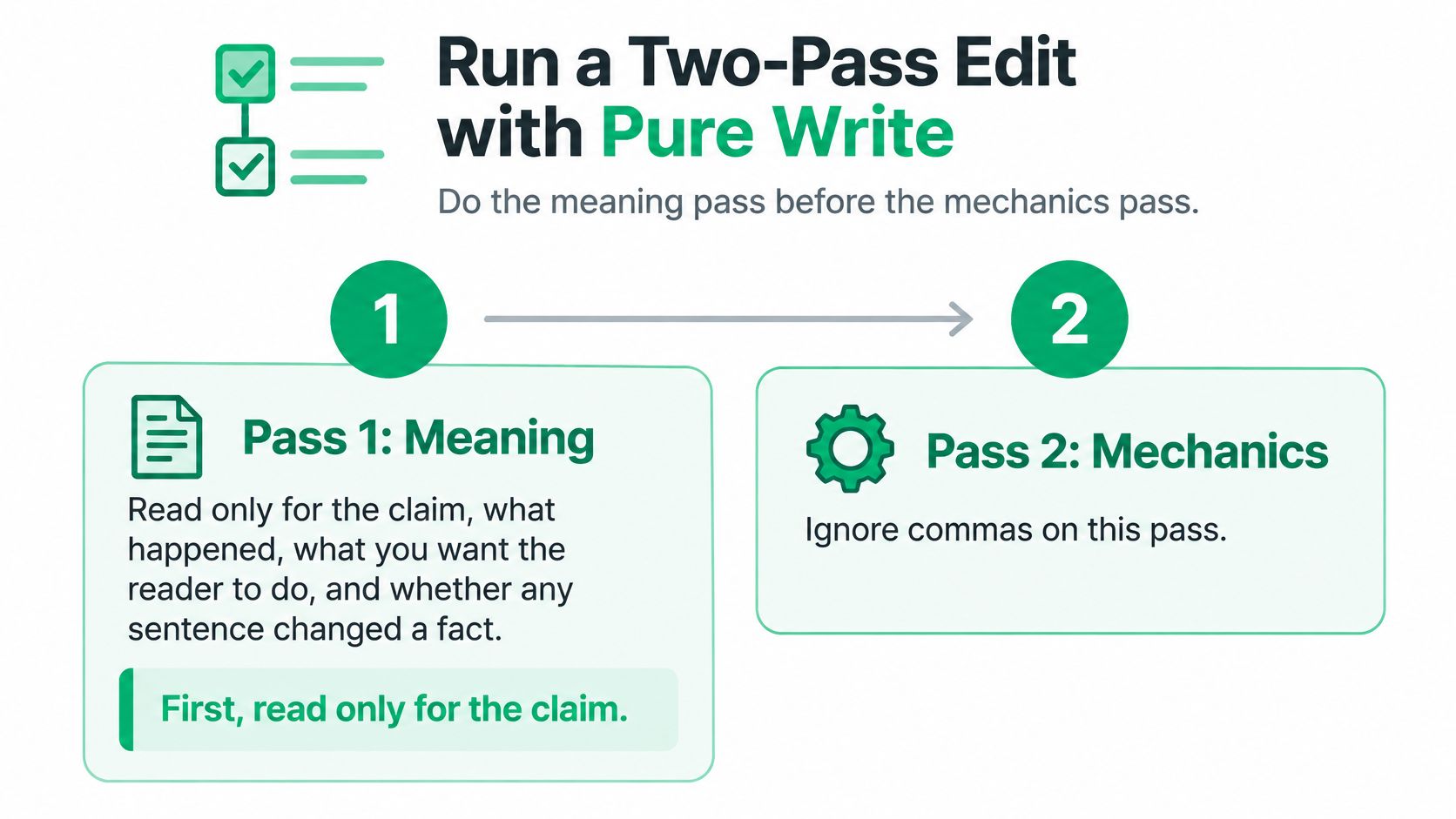
In the second pass, check agreement, clause boundaries, commas, apostrophes, and list consistency. Read for the setting, too: an academic paper, web page, email, or report may follow different conventions. If punctuation is trying to guide the reader through several ideas at once, split the sentence.
Practical rule: Don't polish a sentence until you're sure what it needs to say.
AI can help with brainstorming, clarity, grammar, or accessibility, but you remain responsible for accuracy, originality, attribution, and the final voice. Keep drafts, notes, sources, and revision history. Follow your school, employer, publisher, or client policy, and disclose AI assistance when required. An editing tool can flag possible improvements, but you must decide whether each change preserves your meaning.
Detector scores are not definitive proof of authorship. Some human writing may be flagged, while some AI-generated writing may be missed. Don't use a score alone as the basis for an accusation.
Pure Write can help review readability and style, but it should not be used to hide how a draft was made. Check each suggestion against your claim and source notes, and reject edits that alter a fact or citation. For more guidance on editing and revising, keep the meaning pass separate from the mechanics pass.
Try the method on a real draft: check the meaning first, then use Pure Write to review grammar, clarity, and phrasing. Compare suggestions with your notes and sources before sharing the piece.
Pure Write offers writing enhancement tools for reviewing AI-assisted drafts for grammar, punctuation, readability, and tone. Visit Pure Write to try it on a draft and decide which suggestions fit your voice.