How to Improve Readability Without Dumbing It Down
An eighth-grade readability score can sit beside a blog post that still fails its reader. The offer is buried under three paragraphs of background, and the headings are clever but don't tell you where to find the answer.
That's why a lower grade level isn't the definition of readable writing. A useful page lets the right reader find the answer, understand what to do, and keep the qualifiers that change what a claim means.
What Readable Writing Has to Do
A cleaner score can make a weak page look finished. Readability is the reader's result: find the answer, carry out the action, and keep the condition that changes what the claim means. A 2025 workshop analysis of 1,200 human judgments found that information content and topic strongly influenced perceived comprehensibility, and model-based metrics generally tracked those judgments better than the 15 traditional formulas tested. Use scores as a first signal, then check the work itself.
The work changes with the assignment. A product page has to surface the offer and key conditions before a shopper loses patience. A student essay has to keep the evidence and qualifications that make the argument accurate. A policy email has to name who must do what, and when, without hiding the deadline in a courtesy line.
The usual shortcuts fail those jobs. Context can push the point below the first screen. Precise terms swapped for vague words can lower the apparent difficulty while raising the chance of a wrong action. Read for outcome instead: could the intended reader find what matters, do it correctly, and repeat the claim without dropping its limits? That check catches buried offers, vague agents, and qualifiers that vanished in editing. If any answer is no, the score is decoration.
Diagnose the Draft Before You Rewrite
Before changing a sentence, note what's working and what isn't. A quick diagnosis keeps you from polishing the wrong problem.
| Check | Practical target | Warning sign | Next move |
|---|---|---|---|
| Reader task | One action or answer in the first screen | The point appears after several paragraphs of context | Move the answer or required action to the top |
| Flesch Reading Ease | About 60–70 for a general public page | Under 30, or a high score made by deleting needed qualifiers | Keep the score as a signal and mark terms that must stay |
| Grade level | Near grade 8 for public pages; grades 10–12 if readers share the jargon | Grade fell because precise words became vague | Restore the term and define it at first use |
| Scan path | Descriptive headings, one idea per short paragraph, steps in lists | Clever headings or a wall of text | Restructure before polishing tone |
| Voice and tone | Actor named when responsibility matters; claims stated plainly | Passive wording hides who acts, or hype adds no instruction | Name the actor and cut slogans |
| Access basics | Logical headings, descriptive links, page language set, alt text on meaningful images | Score looks fine but the page can't be navigated or heard clearly | Fix structure and labels before another prose pass |
Treat readability scores as signals, not verdicts. Most word processors or a free checker can give you a Flesch Reading Ease value; record it beside the other checks, then ask whether the text does its job for its intended audience.
A marketing email may need its offer and call to action moved to the first screen. A lab report can keep specialist terms if the intended readers know them, but should define unfamiliar terms where they first appear. A help article may need numbered steps and headings that match the user's problem. Same table, different first edit.
Access needs a separate check because a prose score can't tell you whether someone can move through a page or use it with assistive technology. WCAG 2.2 frames accessibility around content that is perceivable, operable, understandable, and durable, and calls for pages to identify their language and any language changes within the text.
Practical rule: Fix the row that most blocks the reader's task. Don't rewrite the whole draft just because one score looks poor.
If you want a quick baseline, paste the text into the Pure Write readability checker, then use its score as one input alongside the table. Choose the worst row as your starting point.
Rewrite the Draft in Two Passes
The first pass removes friction. The second makes the remaining copy easy to scan. Keep the reader's task in view throughout, so a shorter draft still answers the right question.
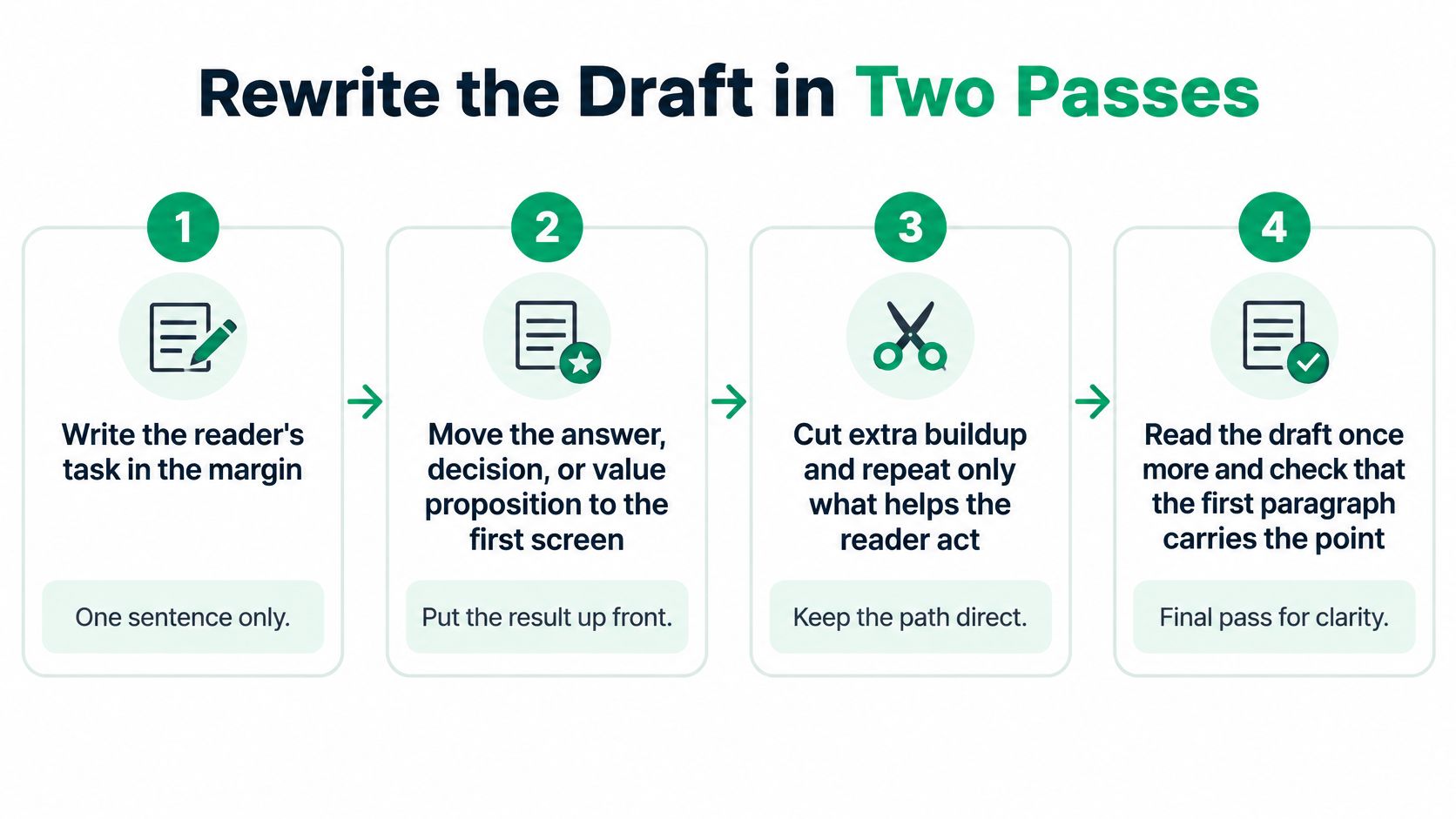
- Write the task in the margin. Use one sentence: buy a product, submit a form, choose an option, or learn a step.
- Move the answer to the first paragraph. Put the decision, answer, or value proposition where readers meet the page.
- Cut the buildup. Keep the core claim, and remove repetition, slogans, and words that don't change what the reader understands or does. In an NN/g comparison, concise copy produced a 58% usability improvement over a wordier control.
- Give each paragraph one job. Keep it to one idea and two or three sentences. Turn steps or sequences into a numbered or bulleted list.
- Replace clever headings. Name what each section answers or explains.
- Front-load the section. Put its conclusion or main point in the first line.
- Use objective wording. A claim such as “This plan includes same-day support” tells readers more than “This amazing plan offers incredible peace of mind.” NN/g found a 27% usability improvement when writing was objective rather than promotional.
- Check the scan path. Headings, short paragraphs, lists, and front-loaded conclusions made copy scannable. NN/g found a 47% usability improvement for scannable copy.
- Read only the headings and first sentences. Can you still find the required fact? If not, restructure.
That order matches how people use web pages. In NN/g testing, 79% of users scanned new pages, while only 16% read word for word; scannable users completed tasks faster and made fewer errors, according to NN/g's guidance on concise, scannable, objective writing.
Shorter isn't automatically clearer. A short sentence full of abstract jargon still makes readers work, and a lower score can hide a qualifier that matters. If you're learning to write about unfamiliar subjects, practice writing on unfamiliar topics by explaining one idea to a reader who doesn't know the field.
A buried product claim might begin with several paragraphs about company history. Instead, lead with the offer and give readers the details they need:
Get free delivery on orders over $50.
- Choose any in-stock item.
- Enter the delivery address at checkout.
- Place the order before the stated cutoff time.
Line Edits That Make Prose Easier to Follow
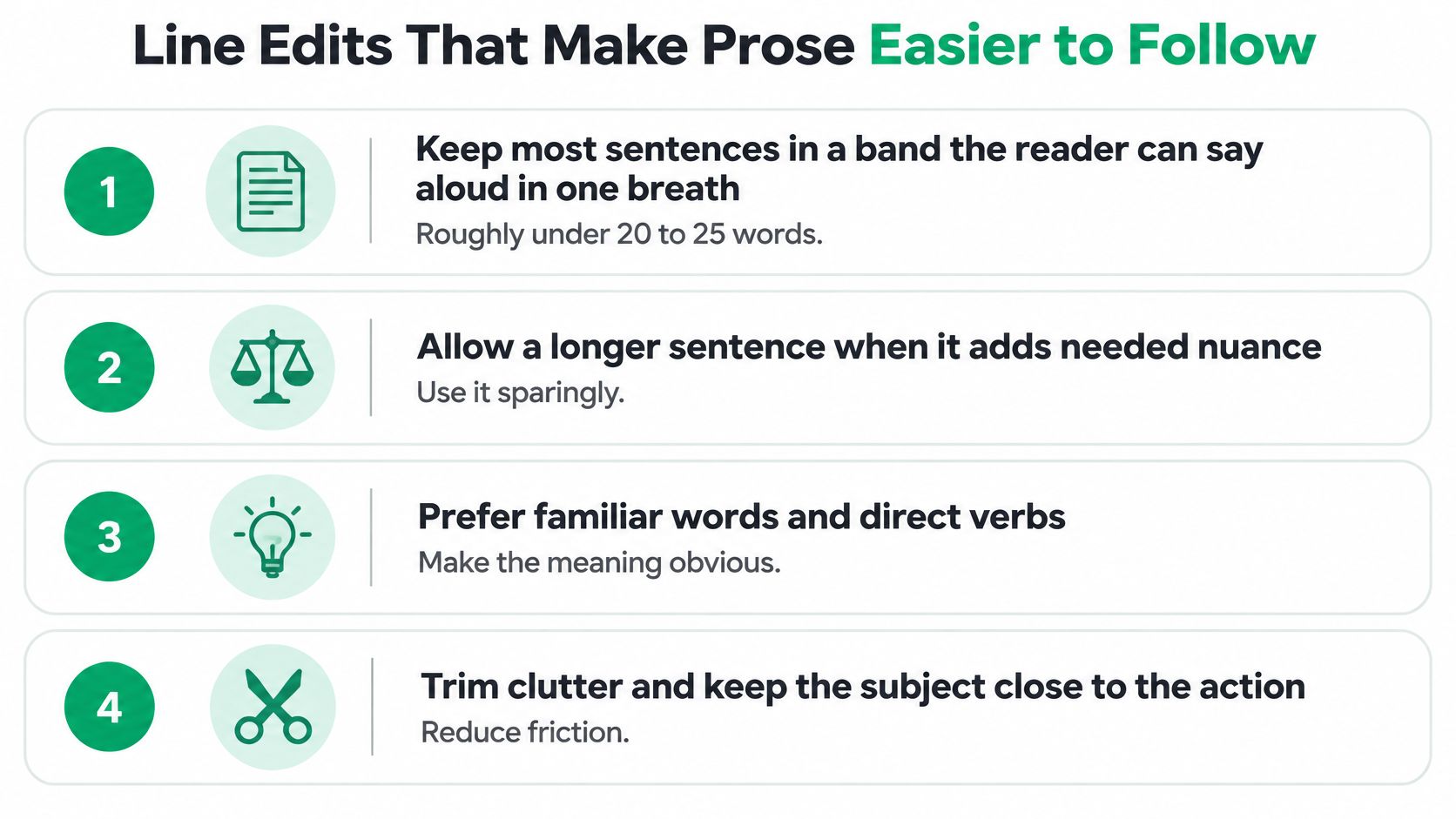
Once the answer is at the top, sentence-level edits can smooth the route to it. Aim for sentences most readers can say aloud in one breath, roughly under 20 to 25 words. Keep a longer sentence when shortening it would erase an important condition.
Prefer a concrete verb to a nominalization. “Decide” is cleaner than “make a decision,” “send a message” is clearer than “send a notification,” and “compare the plans” beats “perform a comparison.” These small choices keep the action visible.
Use active voice when the reader needs to know who acts: “The manager approves the refund.” Keep passive voice when the actor is unknown or doesn't matter, as in “The form was submitted yesterday.” Familiar information usually works best before new information, because it gives the next point something to connect to.
Transitions should show a real change in logic, such as contrast, cause, sequence, or an exception. Don't pad every paragraph with the same opening phrase. A bolded decision can help a skimming reader, while a list works better than a sentence when you have three or more parallel items.
Consider a refund rule written as a single 45-word sentence:
Before: Customers who paid more than $100 may request a refund within 14 days, except when the item was marked final sale at the time of purchase, in which case the order isn't eligible for a refund, and customers should contact support with their order number to confirm the request.
After:
- Rule: If you paid more than $100, you can request a refund within 14 days.
- Exception: Final-sale items aren't eligible for a refund.
- Action: Contact support with your order number to confirm your request.
The rewrite separates the rule, exception, and action without dropping the dollar condition or deadline. For longer pieces, these tips to break up text in longer articles can help you choose where headings, lists, and paragraph breaks will make the structure easier to scan.
Sentence variety matters, too. If every sentence has the same length and shape, the prose can feel mechanical; vary your sentence structure while keeping each sentence easy to follow.
Read the paragraph aloud. If the second clause already says what the first clause says, cut the first.
Keep this pocket list beside the draft:
- One idea
- One actor
- One new point
- One honest transition
- No lost qualifier
Test Whether Readers Get the Action
Plain-language edits can change whether readers understand what to do. In a controlled comparison of legal forms, 90% of participants correctly identified what to do on a treated subpoena form, compared with 60% on the untreated form. For another form, average comprehension rose from 61% before treatment to 81% after treatment, with the result reported as statistically significant beyond the 99% confidence level, according to the plain-language legal forms study.
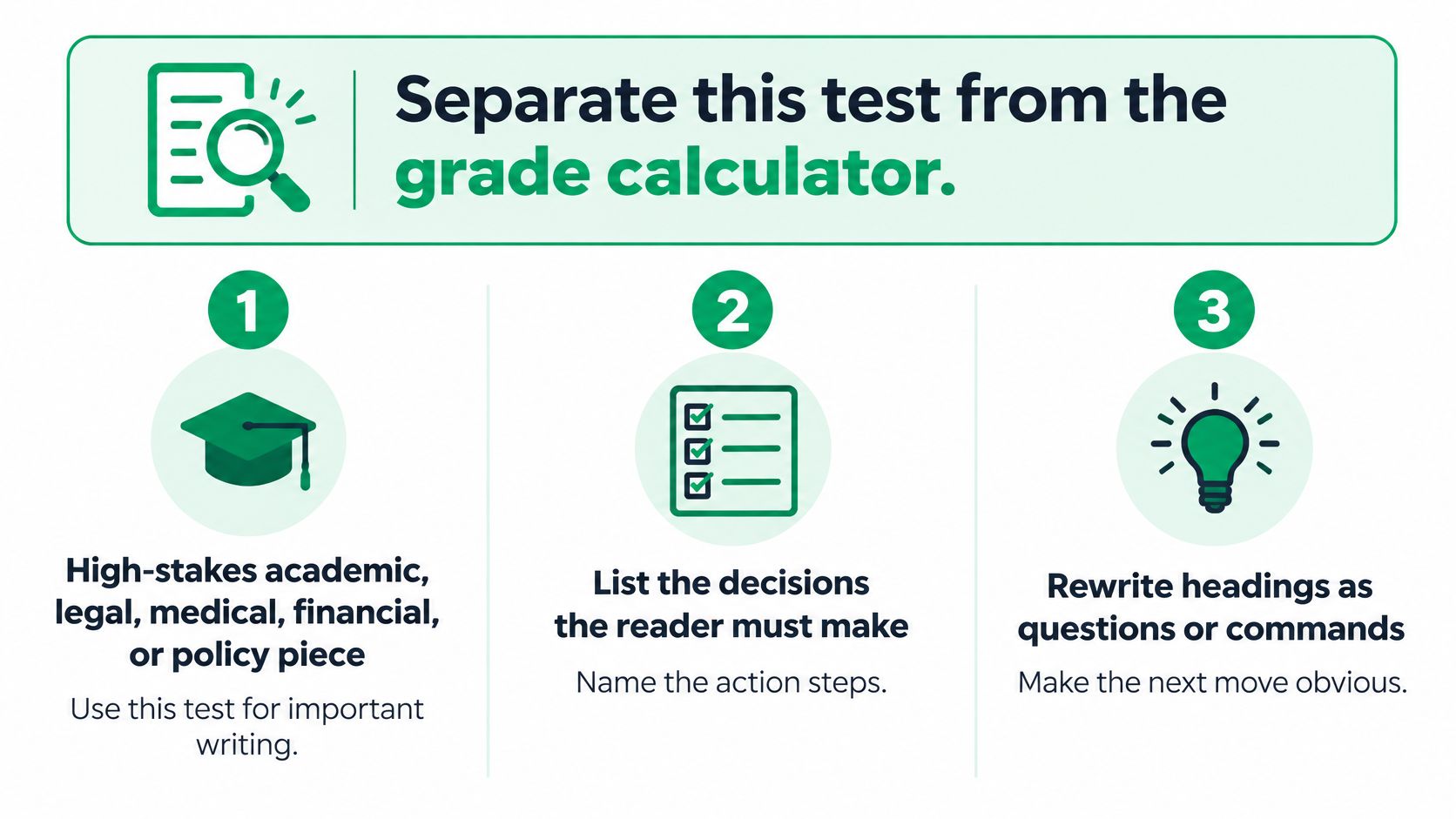
For important academic, legal, medical, financial, or policy writing, test the task itself rather than trusting a grade calculator. Start by listing the decisions readers must make, then turn headings into questions or instructions. Define technical terms at first use, make the responsible actor clear, and put an exception in its own sentence so it doesn't disappear in a long clause.
Run a small acceptance test before publication:
- Recruit representative readers. Ask at least five people from the audience who will use the document. Don't rely only on colleagues who already know the subject.
- Use the same five questions. Ask each reader about the action and meaning, not just whether the wording feels clear.
- Log every miss by section. Record task time, wrong answers, and whether the reader can find the relevant fact.
- Revise repeated problems. If readers repeatedly misunderstand a section, rewrite it and test again.
Question stems help keep the test focused: What should you do first? What's the exception? What would be the wrong action? Compare responses to the old and revised versions, and look at what readers can correctly find and do, not just whether the grade score dropped.
There are trade-offs. Simplifying a legal or scientific distinction can change the meaning; swapping a precise term for a vague, friendly word can leave readers less sure of what applies. This guide to writing technical documentation is useful when the document needs plain instructions without losing necessary details.
Make an AI Draft Readable and Honest
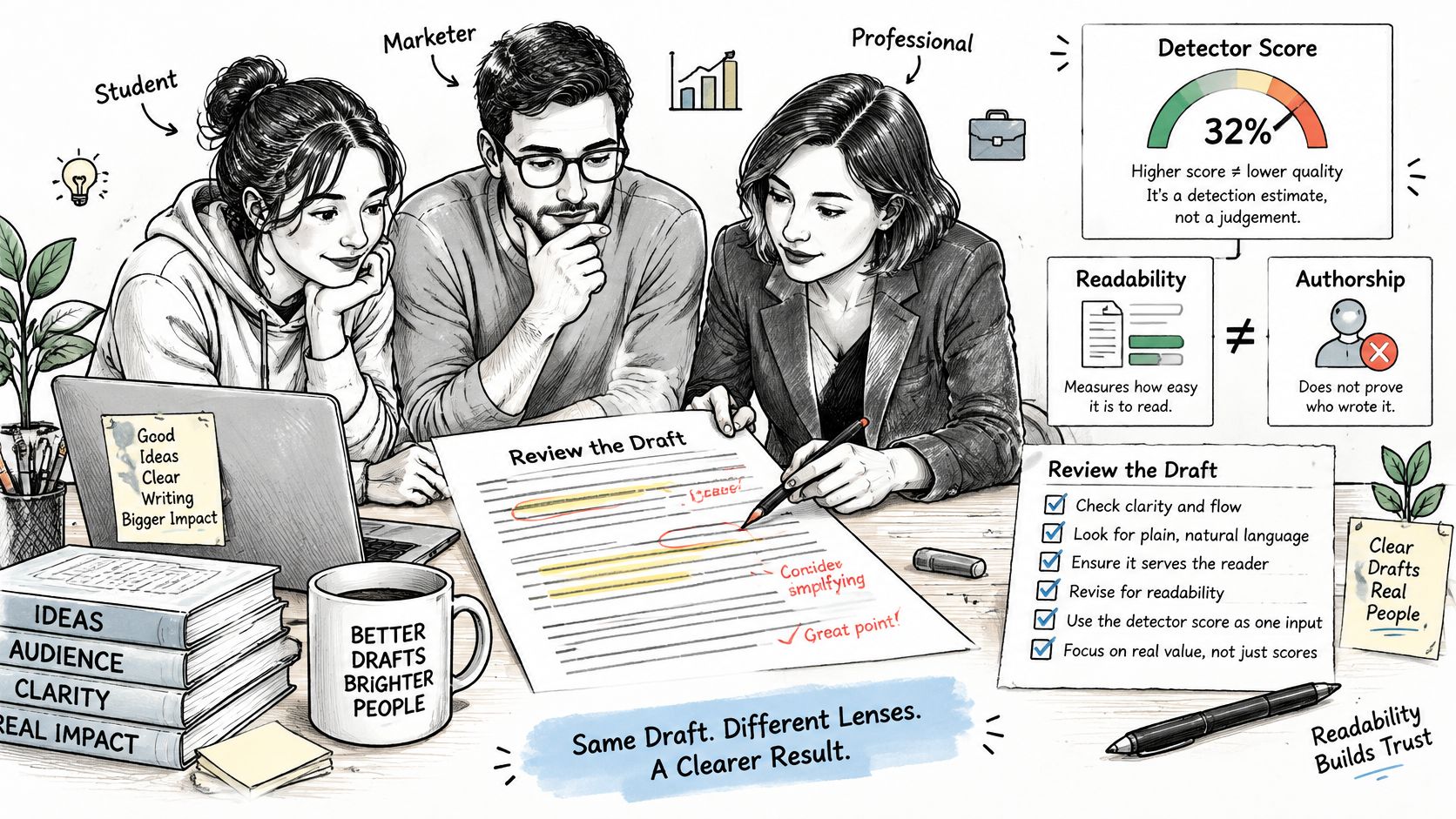
A lower grade level can still hide the answer, and a high detector score proves nothing about authorship. One review of publicly available detectors reported accuracy ranging from 63% to 100%, with false-negative rates as high as 36% and false-positive rates between 10% and 14%, in this review of AI-text detector research. Those numbers are a first signal, not a verdict.
If you're a student, marketer, or professional starting with a model draft, keep the thinking trail and improve the text for readers:
- Keep the brief, sources, and first draft. They show how the work developed if anyone asks later.
- Check every factual claim. Remove or verify anything you can't support.
- Make the same structural edits as you would to any draft. Put the answer first, then use shorter paragraphs and informative headings so a reader can find the action.
- Use an editing tool selectively. Pure Write gives naturalness and readability notes, and its Humanize option can smooth stiff or repetitive passages while preserving the point and voice. Treat the suggestions as edits to review, not as a replacement for judgment.
- Treat detection and plagiarism checks as a second look. Never rewrite just to move a detector score.
- Disclose meaningful AI assistance when a school, client, or employer requires it.
A model-generated marketing outline is raw material, not a finished article. Add original examples, check the sources, and contribute analysis that gives the page value beyond its draft. AI copywriting approaches for marketing teams can help you plan where human review and editorial judgment belong in the workflow.
For students, the line is different. Grammar help refining your own essay is one thing; submitting an untouched model essay as your own work is another. Rewriting solely to evade detection is unreliable and unethical.
Non-native English writers face an added risk. Detectors have flagged authentic essays by writers working in English as a second language at noticeably higher false-positive rates than work by native speakers. A flag is not evidence of misconduct. Instructors should review drafting history before acting on a score, and writers remain responsible for accuracy, originality, and any disclosure their policy requires.
Google's guidance targets scaled, low-value pages made to manipulate rankings rather than AI use by itself. Whether the draft began in a model or in your head, the test stays the same: a reader finds the answer, acts on it correctly, and loses no necessary meaning.
Run that test on one paragraph today. Learn how to humanize AI text while keeping the writer's intent at the center.
Publish After the Draft Passes a Real Read
Publish when a stranger can find the answer from the headings and first lines, a representative reader can state the required action, and no necessary qualifier has vanished in the edit. If AI helped, disclose that use wherever the relevant policy requires it.
Hold the draft if the score improved but the task is still buried, if only colleagues who know the subject reviewed it, or if the changes mainly aim to move a detector score. For marketers, add original examples; for students, check citations and course policy; for professionals, make sure the sentence naming who does what is unmistakable.
Take one concrete step this afternoon: choose the weakest row in your diagnosis, run both rewrite passes, and ask one person the action question. If the draft began in a model, paste that section into Pure Write, review the readability notes, and keep the version a reader can use. For a final check on sentence-level polish, distinguish copy editing from proofreading.
Readable writing isn't prose that merely looks simple. It's writing that helps the right reader find the answer, understand it, and act.
Pure Write helps you review readability, improve tone and clarity, and refine AI-assisted text while keeping your intended meaning in view. Try it on a paragraph from your draft at Pure Write .