What Is Paraphrasing in Writing and How to Do It
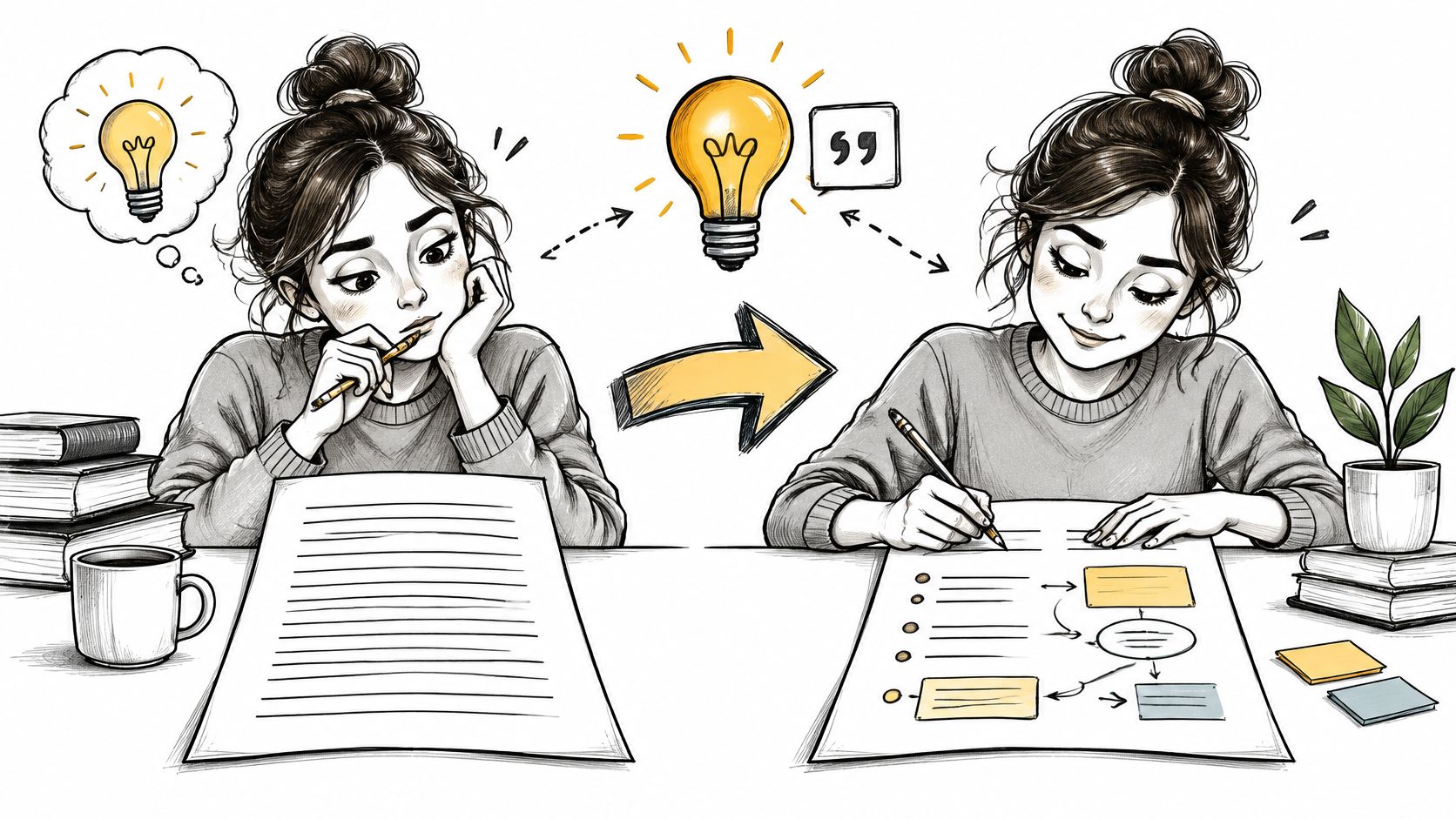
Paraphrasing is restating another writer's essential idea in new structure and wording while keeping the meaning accurate and citing the source.
If you replace every obvious word with a synonym, have you written something new? Not necessarily. The harder skill is rebuilding the explanation without changing what the original author meant.
You might need that skill for an essay, a research-backed blog post, a client email, or an AI-assisted draft. In each case, your job is to make the evidence fit your writing without disguising where it came from.
What Paraphrasing Means in Writing
Paraphrasing changes the expression, not the ownership or substance of an idea. You preserve the important details while choosing a sentence structure and vocabulary that fit your paragraph.
Purdue University's guidance on reference and citation distinguishes a detailed restatement of a particular idea from a summary of a broader passage. It also emphasizes that paraphrased information still needs documentation, including an appropriate citation in APA, MLA, Chicago, or your required style.
Think of source use as working with a map. Quoting is borrowing the author's sentence intact, summarizing is shrinking the whole map to a postcard, and paraphrasing is redrawing a particular street in your own hand while preserving the destination.
Choose the form before changing the words
The question isn't just whether you can rewrite a sentence. It's whether your reader needs its specific detail, its general point, or its exact wording.
Paraphrase, summary, quotation, and patchwriting
| Form | Detail kept | What must change | Use it when |
|---|---|---|---|
| Paraphrase | About the same detail as one idea | New sentence order and wording; cite; no quotation marks | You need a specific idea in your own prose |
| Summary | Only the main points, in far less space | Compress the broader passage; cite | You need the big picture, not every step |
| Quotation | The source's exact words | Add quotation marks and a precise citation | The wording is unique, technical, or legally precise |
| Patchwriting | Nearly the same length and order | Not acceptable as a finished draft | Never; rebuild the idea instead |
A paraphrase keeps enough detail for readers to understand the particular point you're discussing. It doesn't have to match the source's word count, but it shouldn't remove a qualification that matters.
A summary deliberately leaves out supporting detail. If you're introducing a report before discussing its findings, a compact overview might serve your reader better than a sentence-by-sentence rewrite.
Separate your wording from borrowed wording
A quotation is appropriate when readers need to inspect the language itself. For instance, your discussion might depend on how a policy defines a term, rather than only on the policy's general intention.
Patchwriting preserves the source's recognizable sentence pattern while changing scattered words. A citation acknowledges the idea's owner, but it doesn't turn borrowed phrasing into your own writing.
Practical rule: Decide what you're borrowing before deciding how to write it.
Attribution also needs to fit smoothly into your paragraph. Contesimal's explanation of how to introduce sources with clear attribution can help you distinguish the author's position from your response.
So, what is paraphrasing in writing beyond using your own words? It's a demonstration that you understand an idea well enough to reconstruct it responsibly. Before rewriting your next borrowed sentence, sort it into the appropriate row.
How to Paraphrase a Passage Step by Step
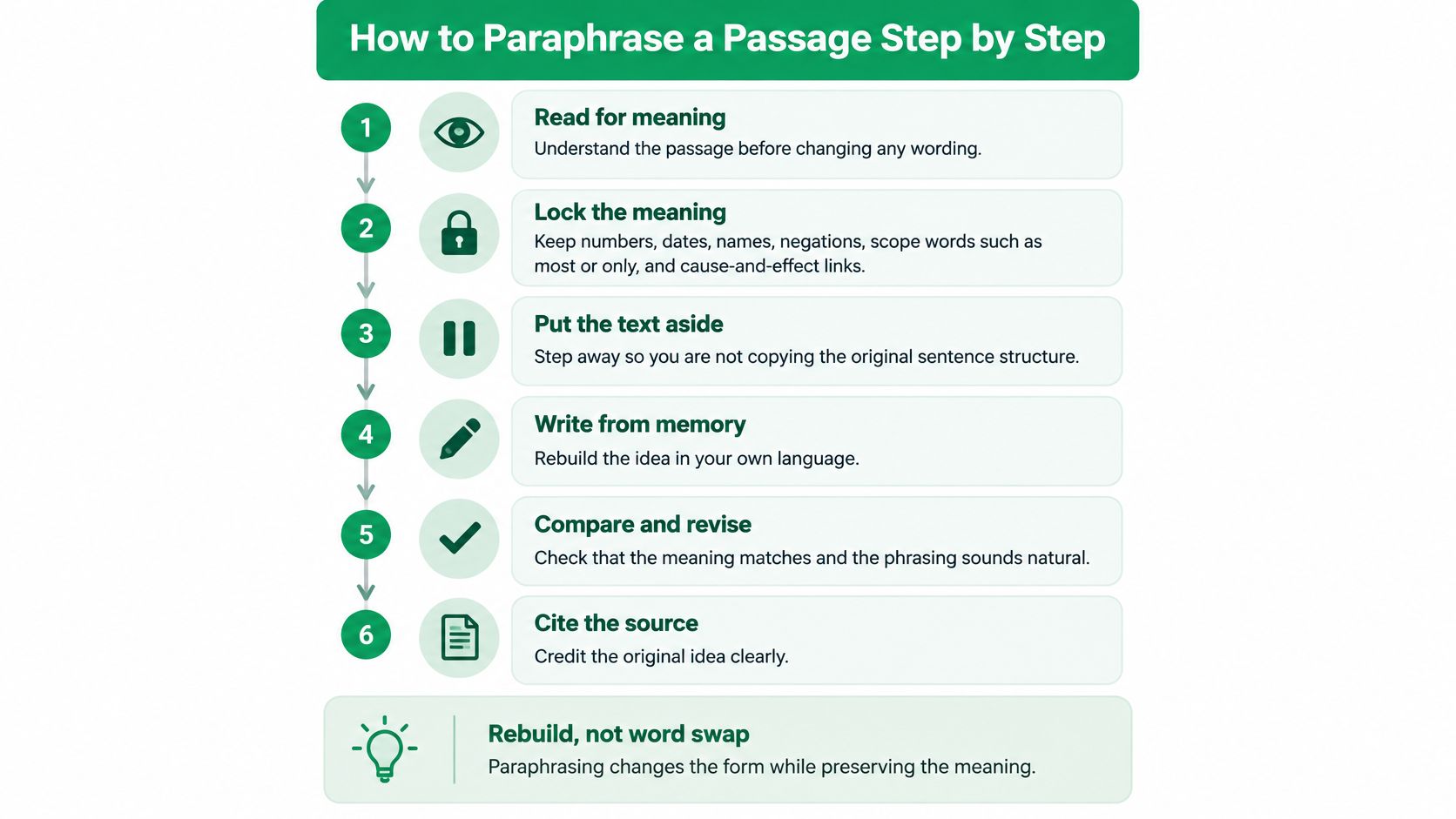
Start by identifying the meaning locks, the details you can't change without changing the claim. These include numbers, dates, names, negations, scope words such as most or only, and relationships between causes and outcomes.
You can rearrange the explanation around those details. You can't turn a possible result into a guaranteed result, or a finding about a narrow group into a statement about everyone.
Rebuild the idea from understanding
Read until you can explain the passage aloud. Identify the author's main point and how the supporting details qualify it. If you can only repeat the sentence, you're not ready to rewrite it.
Jot down the meaning locks. Record essential facts and qualifications as fragments, not copied sentences. Keep the source details with these notes so attribution doesn't become a separate research project later.
Set the original aside. Close the tab or cover the passage. This makes it harder to borrow the author's rhythm and clause order without noticing.
Draft from memory in the order your paragraph needs. You might begin with a limitation, a comparison, or a practical consequence. Don't add a consequence unless the source supports it or you clearly identify it as your own analysis.
Change the grammar as well as the vocabulary. Split a dense sentence, combine closely related points, or make the actor the subject. Switching from active to passive voice alone isn't enough if everything else remains recognizable.
Compare your version with the original. Check accuracy before elegance. Highlight matching phrases and inspect whether you've reproduced the same sequence of clauses with substituted words.
Handle retained wording and citation together. Put quotation marks around distinctive wording you need to retain, and add the citation. Include page or other location details when the citation style requires them.
Read the result aloud. Replace stiff expressions with words you'd use to explain the idea to your intended reader. A rare synonym isn't an improvement if it makes the meaning less precise.
The visual workflow groups these actions into a compact reference you can keep beside your draft.
Decide what deserves a quotation
You don't need to paraphrase language whose exact form is central to your discussion. A distinctive definition may deserve quotation, while the surrounding explanation can become a paraphrase or summary.
Purdue OWL's paraphrasing handout offers a teaching benchmark of roughly 10% directly quoted material in a final research manuscript. Treat that as guidance, not a universal requirement, and check your instructor's, publisher's, or organization's rules.
For a report-based article, you might summarize the overall conclusion, paraphrase a method relevant to your argument, and quote a definition you intend to examine. Your own analysis should explain why that evidence matters.
If you used AI to suggest alternative wording, compare the accepted version against the original source, not just against your previous draft. A paraphrase is ready when a colleague can recognize the source's idea without recognizing its sentences.
Before and After Paraphrase Examples
How different does a paraphrase need to be? There's no useful shortcut based only on how many words you replace. You need independent expression and faithful meaning.
Oxford's guidance on plagiarism warns that close paraphrasing can mislead readers even when a reference is present, because the wording or argument structure may appear to be yours.
The following visual offers another way to examine sentence-level changes.
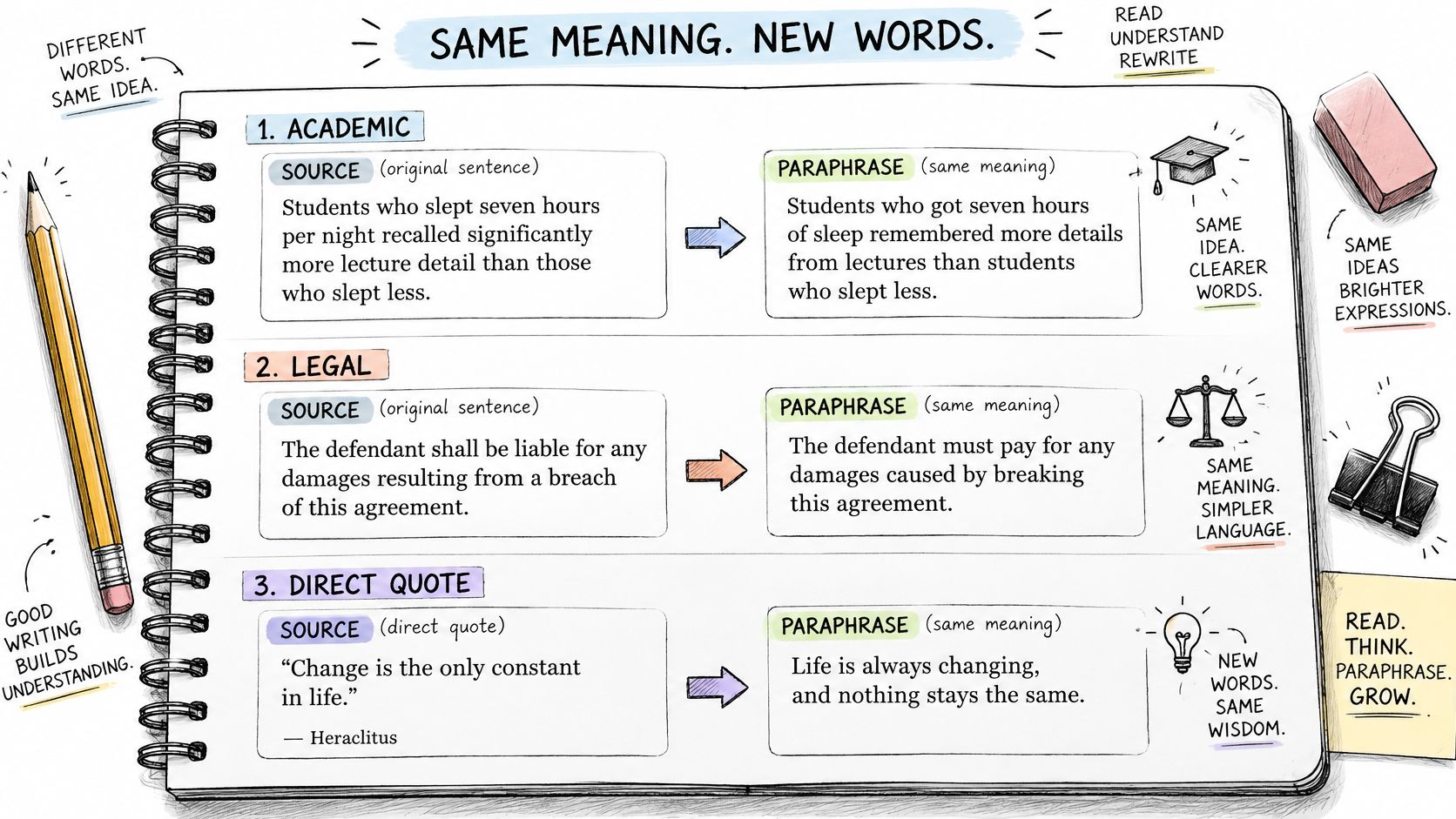
Academic writing without overstating a finding
Consider this hypothetical teaching example, not an actual study. The attribution labels below represent where you'd insert a real source's citation.
| Version | Example |
|---|---|
| Source sentence | In a small study, students who slept seven hours recalled more lecture detail than students who slept five hours. |
| Weak patchwriting | In a small study, students who rested seven hours remembered more lecture detail than students who rested five hours. |
| Strong paraphrase | Lecture recall was better among the seven-hour sleepers than among those who slept five hours, although the study was small, according to the study author. |
| Summary | The small study linked longer sleep with better lecture recall, according to the study author. |
The strong paraphrase preserves the comparison and the small-study limitation while changing the opening and grammatical organization. The weak version follows the source almost word for word.
The summary serves a different purpose. It gives the general finding but omits the exact sleep durations, so it wouldn't replace a paraphrase when those details matter.
Marketing without borrowing a competitor's voice
Say a competitor's page makes this hypothetical claim about its planner. You haven't independently verified the claim, so your wording must keep it attributed rather than present it as an established benefit.
| Version | Example |
|---|---|
| Source sentence | Our planner saves teams three hours a week. |
| Weak patchwriting | Our planning tool saves teams three hours weekly. |
| Strong paraphrase | The competing vendor claims that teams using its planner spend three fewer hours on planning each week. |
The strong version changes the perspective and structure while identifying who makes the claim. In a published article, attach the vendor's actual source page to that attribution.
You can then add your own clearly labeled use case: a team evaluating such a saving could consider whether the recovered time would help with client revisions. That's a possible application, not evidence that your product delivers the same result.
A video explanation can complement the written comparisons.
Professional writing without deleting a condition
Suppose an internal policy contains the following hypothetical rule. Your email should simplify the instruction without changing when approval is required.
| Version | Example |
|---|---|
| Source sentence | Expense reports filed after ten business days require manager approval. |
| Bad rewrite | Expense reports require manager approval. |
| Strong paraphrase | If you submit an expense report after ten business days, you'll need your manager's approval. |
| Direct quotation | The policy states, “Expense reports filed after ten business days require manager approval.” |
The bad rewrite expands the rule to every expense report. The strong version keeps the deadline and approval condition while addressing the employee directly; the quotation preserves the sample policy's exact words.
A citation doesn't license a near-copy. Readers must be able to distinguish borrowed wording from your own expression.
For a quick self-test, highlight overlapping phrases, compare the order of the claims, and inspect every number and negation. Don't force changes to necessary terminology just to make the text look different.
Paraphrasing Longer Passages and Multiple Sources
A paragraph needs more than a collection of rewritten sentences. You need to understand how the author connects the main claim, evidence, and limitations before rebuilding that relationship for your reader.
Write the main claim in a short note, then list the supporting points in the source's order. Draft from that outline rather than keeping the original paragraph open.
Preserve the chain of evidence
Suppose a hypothetical report describes a training program, finds improved completion in a pilot city, and says the program hasn't been tested elsewhere. A responsible paraphrase retains the setting and testing limitation rather than announcing that the program improves completion everywhere.
You can adjust the paragraph's emphasis, but readers still need to understand how the method, result, and limitation relate. Don't move a qualification so far from the claim that readers miss the connection.
- Track each claim: Keep the source name and relevant page or section beside every note.
- Separate evidence from interpretation: Label your explanation of why a result matters instead of attributing that explanation to the report.
- Retain qualifications: Carry location, population, and testing limits into the finished paragraph.
Combine sources without inventing agreement
When sources support the same point, you can state the shared idea and cite both, using the required style. Keep any source-specific qualifications close enough that readers won't assume the findings are identical.
When sources disagree, present their claims separately. A difference in population, method, or setting may explain the disagreement, but don't invent that explanation if you haven't checked it.
For a larger synthesis project, use a structured approach to writing a literature review so you organize evidence around questions rather than a procession of author names.
Finish by checking attribution at paragraph level. Can a reader tell which source supports each claim, and which conclusions belong to you? If not, revise the source boundaries before polishing transitions.
Mistakes That Still Count as Plagiarism
Changing a few words and adding a citation can feel safe because you've acknowledged the author. But if the original sentence pattern and phrasing remain, you may still be presenting borrowed expression as your own.
Purdue OWL's guidance on summary, paraphrase, and quotation identifies this kind of patchwriting as a plagiarism problem even when a citation is supplied. Apply the distinction between attribution and quotation when diagnosing your draft.
Diagnose the problem before editing
Not every weak rewrite has the same problem. Some misuse wording, some lose attribution, and others distort the evidence or substitute borrowed text for analysis.
Paraphrase mistakes, why they fail, and the fix
| Mistake | Why it fails | Fix |
|---|---|---|
| Synonym swap with the same structure | Still patchwriting, even with a citation | Rebuild from memory in a new order |
| No citation on a clean rewrite | The idea still belongs to the source | Add an in-text citation in the required style |
| Dropped limit or number | The claim becomes stronger or weaker than the source | Restore scope, negations, and figures |
| Too many direct quotations | The draft is a collage, not analysis | Quote only distinctive lines; paraphrase the rest |
| Rewriting only to fool a detector | Hides process instead of improving the writing | Revise for voice, facts, and required disclosure |
Synonym swapping needs a fresh draft, not another vocabulary pass. Set the source aside and explain the point as if answering a colleague's question.
Missing attribution requires a citation even when the prose is independently written. Don't assume that changing the sentence makes a borrowed finding your own.
Dropped qualifications need an accuracy correction. Restore words such as may, only, or in this sample before worrying about flow.
Excessive quotation is a composition problem rather than automatically plagiarism when properly documented. Explain what the evidence contributes instead of asking a string of quotations to carry your argument.
Detector-focused rewriting requires a change in purpose. Edit so a person can understand and evaluate the work, not so software returns a preferred label.
Audit manually before relying on software
Highlight echoes of the source, compare the order of claims, and inspect causes, exceptions, and negations. Keep source and page details available so you can resolve questions without reconstructing your research.
A plagiarism-checking workflow for students can supplement that inspection, but it can't replace your judgment about meaning and ownership. If you're repurposing material for a course, LearnStream's guide offers a legal checkpoint before your course launch alongside your editorial review.
The finished passage should be easier to read while still making its intellectual owner visible.
Paraphrasing for Students Marketers and Teams
The shared standard stays the same: preserve the claim, express it independently, and make borrowed material traceable. What changes is the document's purpose and the tone your reader needs.
An essay may require formal parenthetical citations. A blog post may use a named source and a direct link, while an internal email may refer to a specific policy document.
Match your approach to the document
Use this comparison to identify the most important risk before editing for style. The citation format may change, but accountability doesn't disappear.
How paraphrasing changes by audience
| Audience | Main goal | Citation habit | Main risk |
|---|---|---|---|
| Students and researchers | Integrate a specific idea with their analysis | In-text citation and page notes in the required style | Patchwriting or a missing citation |
| Marketers and SEO teams | Explain a sourced fact in an original article | Name a checkable source and keep the figure exact | Cloning another page's phrasing |
| Business professionals | Make a policy or finding clear in email or a report | Attribute claims that are not internal knowledge | Dropping a deadline, limit, or negation |
| Non-native English writers | Sound fluent without changing the claim | Same citation rules as the document type | Fancy synonyms that distort meaning |
Students and researchers can use a literature-review sentence to connect a finding to their research question. After paraphrasing the finding, explain its relevance or limitation rather than moving immediately to another author.
Keep page details in your notes even if your chosen style doesn't require them for every paraphrase. They help you verify the passage during revision or answer a supervisor's question.
Marketers and SEO teams might recap a survey in a blog post. Preserve the survey's population and question wording where relevant, then contribute an original interpretation, practical example, or decision framework.
Don't use a competitor's article as a sentence template. Go to the underlying study or product documentation when available, and distinguish a vendor's claim from independently established evidence.
Change the tone without changing the obligation
Business professionals often need to translate dense wording into a client email. If you're explaining a contract clause, keep the trigger, condition, and exception intact, and get appropriate review when interpretation matters.
Friendly language shouldn't soften a mandatory requirement into a suggestion. You can shorten the sentence while preserving who must act and under what circumstances.
Non-native English writers may need a fluency pass on a stiff draft rather than a completely new explanation. Prefer familiar verbs and direct sentence patterns to unusual synonyms that sound more formal but mean something different.
A useful approach to finding your writing voice is to choose language you can comfortably explain and defend. Authenticity doesn't require elaborate vocabulary.
- Use common knowledge carefully: Leave a fact uncited only when readers in that field wouldn't reasonably need a source.
- Credit borderline claims: If you're unsure whether a finding is common knowledge, retain the attribution.
- Choose the document first: Identify your audience and purpose before making the prose more conversational or formal.
An Ethical Workflow with Humanizing Tools
Treat an AI writing tool as an editor, not a way to disguise a source or conceal machine assistance. You remain responsible for the claims, citations, and final wording you publish.
A useful humanizing pass makes prose easier to follow without inventing evidence or erasing qualifications. If a suggested edit changes the substance, reject it even when the sentence sounds smoother.
Keep control through every revision
Start with sources and a purpose. If your school or workplace permits AI assistance, use it for brainstorming or a rough structure. Keep the actual source material beside the draft rather than treating generated text as evidence.
Write the source-based passage from understanding. Use your notes and memory draft, then add the citation while you still know exactly which claim it supports.
Verify before polishing. Compare facts, names, numbers, and limits against the original. Don't spend time refining a sentence you can't substantiate.
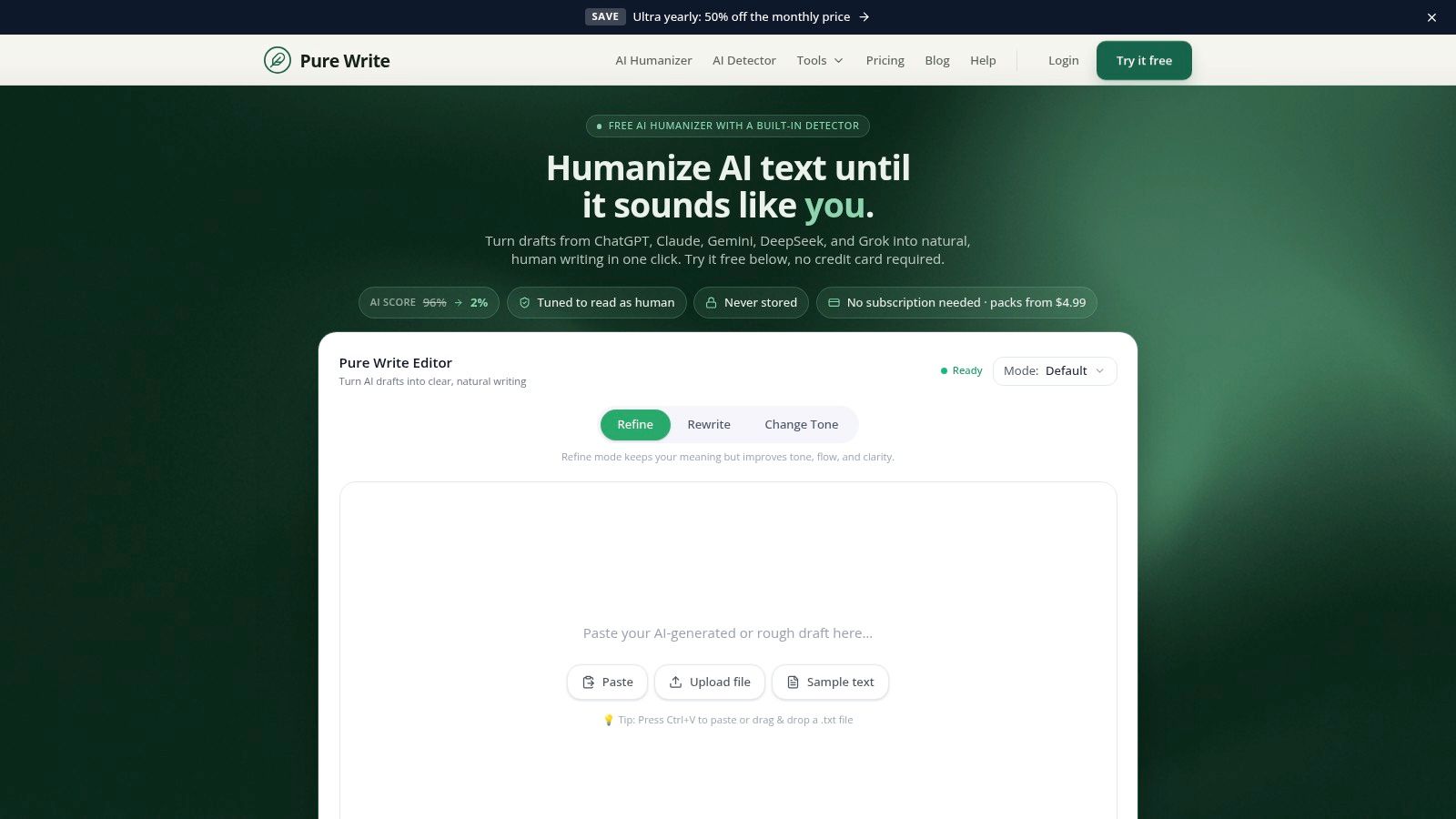
Use a tool for a defined editing task. We offer PureWrite as an option for improving clarity, tone, grammar, and concision, alongside manual revision or feedback from a human editor. Submit an already checked draft and keep the citations attached.
Review edits individually. Accept wording that improves readability and reject changes that broaden a claim, replace a precise term incorrectly, or remove attribution.
The interface below shows the editing environment, but your source comparison remains the essential safeguard.
Treat detection as a prompt for review
- Use checks as signals, not verdicts. A 2025 study in Advances in Physiology Education reported that the best-performing detectors in its evaluation had average true-positive and true-negative rates of 93.9% and 98.7%, respectively, with false-positive and false-negative rates of 1.3% and 6.1%. Those findings describe that evaluation, not guaranteed performance on your document.
A true positive means AI-generated text was correctly identified; a true negative means human-written text was correctly identified. A false positive incorrectly labels human writing, while a false negative misses AI-generated text.
These errors matter to students, multilingual writers, and marketers. A score can justify closer inspection, but it can't establish authorship on its own, and repeated rewriting to manipulate the score isn't an integrity check.
- Document and disclose assistance when required. Save meaningful drafts, retain your source notes, and follow the applicable school, publisher, or employer policy. We don't support using paraphrasing or humanizing to commit academic dishonesty.
For practical editing guidance, use an ethical approach to humanizing AI text that prioritizes clarity and authorial judgment. The outcome you want is a passage you understand, can substantiate, and are willing to stand behind.
Credit the Source Then Polish Your Voice
Before writing your next source-based paragraph, make a decision about what the reader needs. Choose a quotation when the exact words are the point, a summary when only the headline matters, and a paraphrase when the specific detail belongs in your explanation.
That choice prevents unnecessary rewriting. It also keeps you from compressing evidence that needs context or reproducing language that should have been clearly marked as a quotation.
Put the draft through a publication gate
A polished sentence isn't ready just because it sounds natural. Check whether you can explain how you arrived at it and show what supports it.
- Understanding: You can state the idea without looking at the source.
- Accuracy: The facts, limits, and relationships still match.
- Independence: Your sentence organization reflects your explanation rather than the source's pattern.
- Attribution: The reader can identify where the borrowed information came from.
- Borrowed wording: Any distinctive language you retained is clearly marked and documented.
If attribution is the unfinished part, fix that before editing tone. For a website-based assignment using MLA, a practical guide to citing a website in MLA format can help you complete the reference without guessing.
Then examine how the passage fits the surrounding paragraph. Does your introduction explain why this source is relevant, and does your follow-up distinguish your interpretation from the author's claim?
Polish what you can already defend
An accurate but wooden paraphrase has an editing problem, not an originality problem. You can improve it by shortening an opening clause, replacing an inflated verb, or moving background detail into a separate sentence.
Read it as if the intended reader were sitting across from you. If you wouldn't use an expression in that explanation, ask whether it serves a precise purpose or merely makes the sentence sound more formal.
Final check: Publish language you can explain, evidence you can trace, and conclusions you actually mean.
Humanizing should help you communicate your understanding, not create the appearance of understanding. Keep your reasoning and source notes available even after the prose becomes more fluent.
Return to the choice before you revise: quote the wording, summarize the big picture, or paraphrase the detail. Once that decision is sound, polish the voice without renegotiating the facts.
Pure Write offers humanizing and writing-enhancement tools to help make an already checked draft clearer and more natural. Try Pure Write on a paragraph you've already cited, keep the attribution, and reject any suggestion that changes the source's meaning.