
“Always use active voice” is popular advice, but it can make a good sentence worse. A passive sentence may put exactly the right information first, while an active rewrite may introduce an actor you can't identify or shift attention away from the procedure readers need to understand.
The useful question in active versus passive voice isn't which construction sounds stronger. It's what readers should focus on, who should take responsibility, and how much your evidence lets you say.
Why Active Versus Passive Still Splits Writers
Say a content team is editing a laboratory methods description: The samples were centrifuged for ten minutes. An editor proposes The researchers centrifuged the samples for ten minutes, assuming that naming people automatically improves the prose.
The original may be the better choice. Readers need to understand what happened to the samples, and the surrounding methods section may already identify the researchers.
Neither voice is a quality score. Active voice often makes responsibility visible and removes unnecessary wording; passive voice can keep attention on a procedure, recipient, or result.
Hear the difference before judging it
In active voice, the grammatical subject performs the action. In passive voice, the subject receives the action, usually through a form of be plus a past participle, with an optional phrase beginning with by.
Listen to these pairs:
- Editorial responsibility: The editor cut the claim. / The claim was cut.
- Publication activity: We shipped the guide on Tuesday. / The guide was shipped on Tuesday.
- Research procedure: Researchers measured uptake. / Uptake was measured.
The active versions identify actors immediately. The passive versions lead with what those actors affected, leaving their identities unstated.
That omission can be helpful or evasive. The claim was cut works when you're discussing changes to a draft, but it may frustrate someone who needs to know who authorized the deletion.
An editor's marks can help distinguish a useful change in focus from a purely mechanical rewrite.
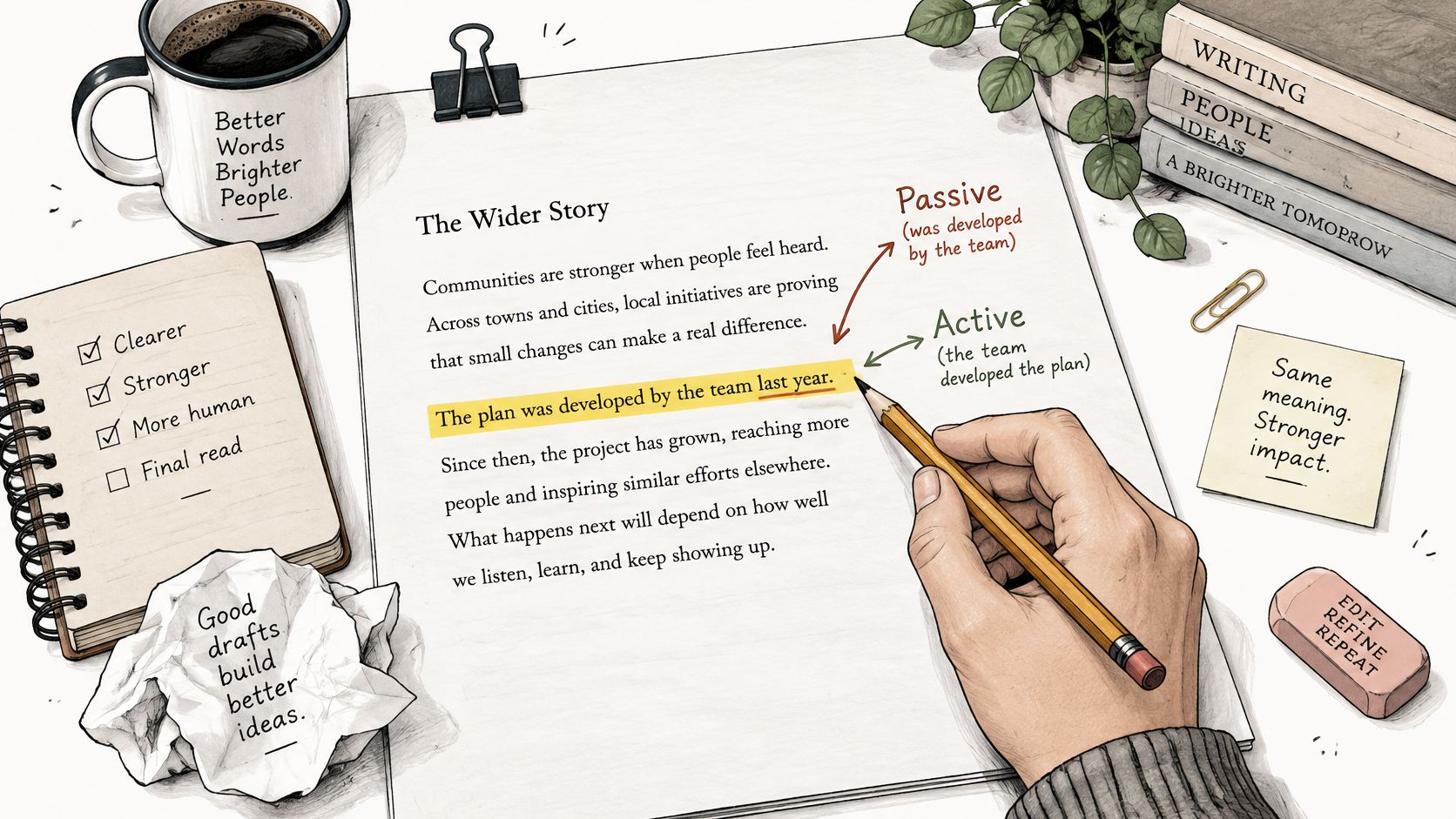
Don't confuse a be-verb with passive voice
The draft is clear isn't passive. The verb connects draft with a description rather than expressing an action performed on it.
We are revising the intro isn't passive either. The subject we performs the action, and are revising describes an ongoing activity.
Practical rule: Choose the sentence that gives readers the right focus without adding responsibility or certainty you can't support.
Some searchers mean active versus passive investing: the SPIVA Global Institutional Scorecard found that more than 70% of equity funds underperformed their respective benchmarks over the 10-year period ending December 31, 2023. The distinction here concerns grammar, not funds.
For writing, a useful decision combines sentence structure, purpose, and evidence. A short sentence isn't necessarily clearer, and a named actor isn't necessarily an accurate one.
Active and Passive Voice Side by Side
Active versus passive voice at a glance
| Criterion | Active voice | Passive voice |
|---|---|---|
| Who acts | Subject performs the verb | Subject receives the verb |
| Typical shape | Actor + verb + object | Object + be + past participle, optional by-phrase |
| Best focus | Responsibility, decision, or recommendation | Process, result, recipient, or unknown agent |
| Usual effect | Direct ownership and a shorter path | Steady topic and an impersonal tone |
| Main risk | New actors and false certainty | Wordiness, hidden accountability, vague agents |
| Length tendency | Often fewer words | Often extra auxiliaries and a by-phrase |
Read the comparison as a set of choices
Start with who acts. The event can remain the same while the grammatical subject changes: the active construction begins with the actor, and the passive construction begins with the affected thing.
The typical shape row needs a small clarification. In the passive pattern, “object” means the thing that would have been the object of the active sentence; after conversion, it becomes the grammatical subject.
For best focus, ask what the reader needs first. A recommendation often benefits from a visible decision-maker, while a laboratory description may need to keep attention on the material under examination.
The diagram offers a visual way to follow that change in sentence position.
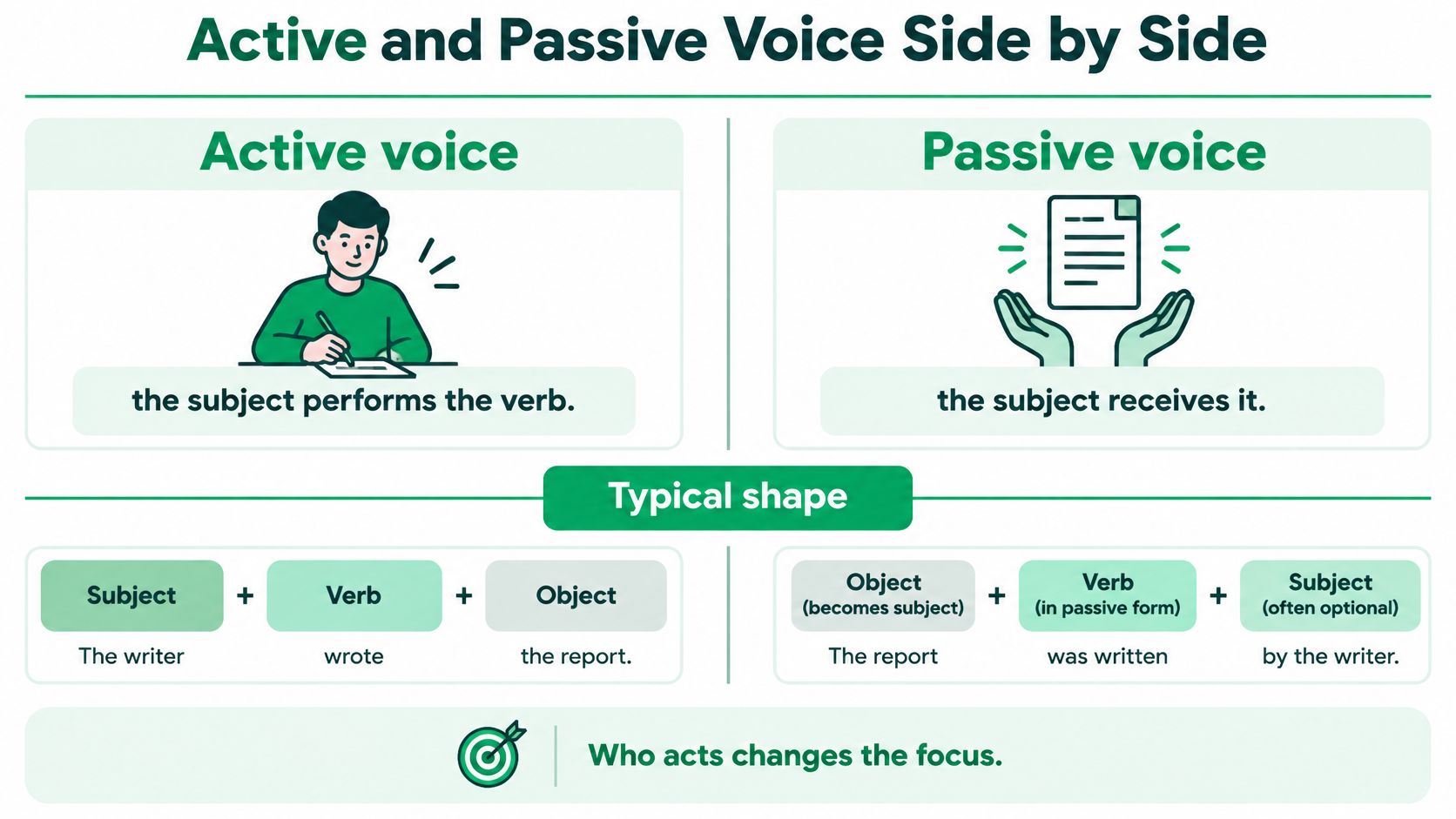
The usual effect of active voice is direct ownership: readers reach the person and action quickly. Passive voice can create continuity by keeping the same subject matter at the beginning of neighboring sentences, with an intentionally impersonal tone.
The main risk is different for each choice. Active rewrites can introduce a procession of distracting actors or imply knowledge the writer lacks; passive wording can conceal decisions and leave readers unsure who must respond.
Finally, consider length tendency without turning it into a verdict. Passive wording often needs auxiliary verbs and sometimes a by-phrase, but removing words doesn't help if the shorter version emphasizes the wrong information.
Apply the criteria to different jobs
For a hypothetical marketing line, compare Our team reviews your campaign brief with Your campaign brief is reviewed by our team. The active subject performs the review; the passive subject receives it.
The active pattern places the service provider first, which suits a promise about responsibility. It sounds direct, makes ownership easy to locate, and avoids the passive version's extra auxiliary and by-phrase; its risk is drawing attention away from the customer's brief if that brief is the paragraph's established topic.
For a hypothetical lab line, compare The technician chilled the solution with The solution was chilled. Here, the passive pattern foregrounds the material and the procedure rather than the operator.
Its impersonal effect can suit a methods description, and omitting an irrelevant actor may even keep it compact. The risk is losing necessary accountability if the technician's identity matters to interpreting what happened.
A spoken explanation can also help you hear how the grammatical subject changes.
The winning construction changes with the writing job. Evaluate all the criteria together rather than treating the active column as a list of automatic advantages.
Which Voice Fits Each Writing Job
Voice defaults by writing job
| Writing job | Prefer | Why | Pattern to keep |
|---|---|---|---|
| Academic methods | Passive or mixed | The procedure is the topic | The samples were centrifuged for ten minutes |
| Results and claims | Active | Someone or the data must own the conclusion | We found no difference after adjustment |
| Marketing copy | Active | The reader or brand should act | You can publish the draft today |
| Technical docs | Mixed | User steps are active; system behavior can be passive | Click Save. The file is stored locally |
| Active | Asks, owners, and deadlines stay visible | I will send the revised brief Friday | |
| Compliance or unknown cause | Passive | Do not invent an agent | The record was updated after review |
These are editorial defaults, not rules that override evidence or house style. The sample timings and deadlines illustrate sentence patterns, not scientific instructions or actual commitments.
Match the voice to the reader's task
Academic methods usually answer what happened, under what conditions, and to which materials. When the operator is already known, inserting that person into every sentence can interrupt the procedure.
The San José State University Academic Language handout describes passive voice as useful when the affected entity or process matters more than the agent, or when the agent is unknown or irrelevant. Readable academic writing can therefore use a deliberate mixture rather than an absolute ban.
Results and claims need a clear source of interpretation. We found no difference after adjustment identifies the authors as responsible for the finding without implying that the result settles every possible question.
For broader help connecting sentence choices with evidence and argument, Verbal Experiment's guidance to improve clarity in research papers is a useful companion. Sentence-level fluency shouldn't come at the expense of accurate attribution.
Marketing copy generally needs a reader or brand to act. You can publish the draft today makes the available action easy to understand, provided the product supports that promise.
Avoid treating active wording as permission to exaggerate. A clear actor doesn't make an unsupported benefit more defensible.
Use different defaults within the same document
Technical documentation needs a distinction between instructions and descriptions. Click Save directs the user; The file is stored locally explains the resulting state without assigning a human operator to an automated process.
Email benefits from visible commitments. I will send the revised brief Friday tells the recipient who owns the next action and when to expect it.
For requests, the same principle applies: name the action and the person expected to take it. An email can sound polite without making its responsibilities difficult to find.
Compliance or unknown cause requires restraint. The record was updated after review may be appropriate when the available evidence establishes the update but not the person responsible.
If readers need that identity, flag the missing information for investigation. Don't fill the gap with we, staff, or the administrator merely because an editing tool wants an active subject.
- Keep the topic steady: Let the next sentence begin with the same result or process when that continuity helps readers follow the explanation.
- Expose necessary ownership: Name the decision-maker when authorization, responsibility, or a required response is the point.
- Respect the genre: Compare your wording with the document's purpose and conventions, not just a grammar checker's preference.
Writers moving among essays, reports, and campaigns can use these different ways of writing to distinguish format choices from sentence-level choices. A voice that suits a promotional email may be distracting in a methods paragraph.
The decisive test is local: what should stay in focus, and who needs to answer for the statement?
Before and After Lines That Keep Meaning
A rewrite can be grammatically correct and still change the message. Treat the following lines as hypothetical editing scenarios, with the action label indicating how much judgment the revision requires.
Before-and-after pairs and what changed
| Before | After | Action | What changed |
|---|---|---|---|
| Your report can be downloaded here | Download your report here | Convert | Reader becomes the actor |
| The deadline was missed by the team | The team missed the deadline | Convert | Ownership is explicit |
| The filter is selected from the menu | Select the filter from the menu | Convert | Steps instruct the user |
| It was concluded that the treatment worked | The cited trial found that the treatment worked | Revise with care | Vague it replaced by the named source |
| The samples were centrifuged for ten minutes | Keep as written | Keep | Operator identity is not the point |
| The file was deleted | Keep as written unless the deleter is known | Keep | Avoids inventing an actor |
Convert when the reader needs action or ownership
Marketing, convert. Download your report here addresses the reader directly, with an understood you as the subject. Unlike the original, it gives an instruction rather than describing availability.
Email, convert. The team missed the deadline brings existing responsibility to the front. It doesn't identify a new culprit because the original already names the team in its by-phrase.
Technical step, convert. Select the filter from the menu tells the user what to do next. Keep the passive version only if you're describing an existing workflow rather than issuing an instruction.
These edits improve the relationship between sentence and task, not merely the verb form. For a different application of actor-led writing, Dunia's guide to writing action scenes with impact offers useful context for making physical sequences understandable.
Academic result, revise with care. The cited trial found that the treatment worked replaces a vague it with an identifiable source. In an actual paper, name the trial and cite it, then verify that worked accurately represents its outcome, population, and limitations.
A named source doesn't justify a stronger conclusion. If the trial only suggested a possible benefit, retain that uncertainty in the revision.
Keep sentences that already do the right job
Methods, keep. The samples were centrifuged for ten minutes gives the procedure priority. Adding by the researchers contributes little if the surrounding text already establishes who performed the work.
The operator becomes relevant when different operators, teams, or handling procedures could affect interpretation. Otherwise, the passive sentence leaves room for the conditions readers need.
Incident, keep. The file was deleted states the observed event without identifying its cause. Replacing it with Someone deleted the file introduces a human actor when an automated process could also explain the deletion.
That distinction matters in incident reports. A smoother sentence must not turn an unresolved cause into an accusation.
Before accepting a shorter version, compare its emphasis, certainty, and accountability with the original.
If you're unsure whether the verb expresses an action or links a subject to a description, this explanation of action verbs versus linking verbs can help. Diagnose the sentence before deciding how to change it.
How to Convert Passive Voice Safely
Use a complete sentence for the conversion, not an isolated verb highlighted by an editor. For this worked example, start with The recommendation was approved by the client on Monday.
The task is to change the grammatical arrangement while preserving the participants, event, and timing. Don't add an explanation for the approval or imply anything about how quickly the client decided.
Follow the sentence through the edit
Find the past participle and the be-verb. In the example, was approved is the passive verb phrase. Approved carries the action, and was supplies the past-tense passive construction.
Find the agent. The phrase by the client identifies who approved the recommendation. In other sentences, the agent may appear in an earlier line or a source note, but you should be able to point to that evidence.
Stop if the agent isn't available. Here, the agent is explicit, so conversion can continue. If you can't establish an actor, retain the passive or narrow the statement to what the evidence supports.
Move the agent into subject position. Put the client at the beginning. Don't replace it with we, the team, or another actor who seems plausible.
Use the main verb in the correct tense. The active past-tense verb is approved. Keeping was approved after the client would incorrectly make the client the recipient of approval.
Move the old subject into object position. Place the recommendation after the verb. Check that you haven't dropped a qualifier identifying which recommendation received approval.
Preserve timing, hedging, and limits. Keep on Monday. In other sentences, retain wording such as may, appears to, or under these conditions rather than flattening a qualified statement into a fact.
Compare the versions for meaning and emphasis. Confirm that the same client approved the same recommendation at the same time. Then decide whether leading with the client suits the paragraph better than leading with the recommendation.
The visual summary groups the recognition and rearrangement stages into a compact editing sequence.
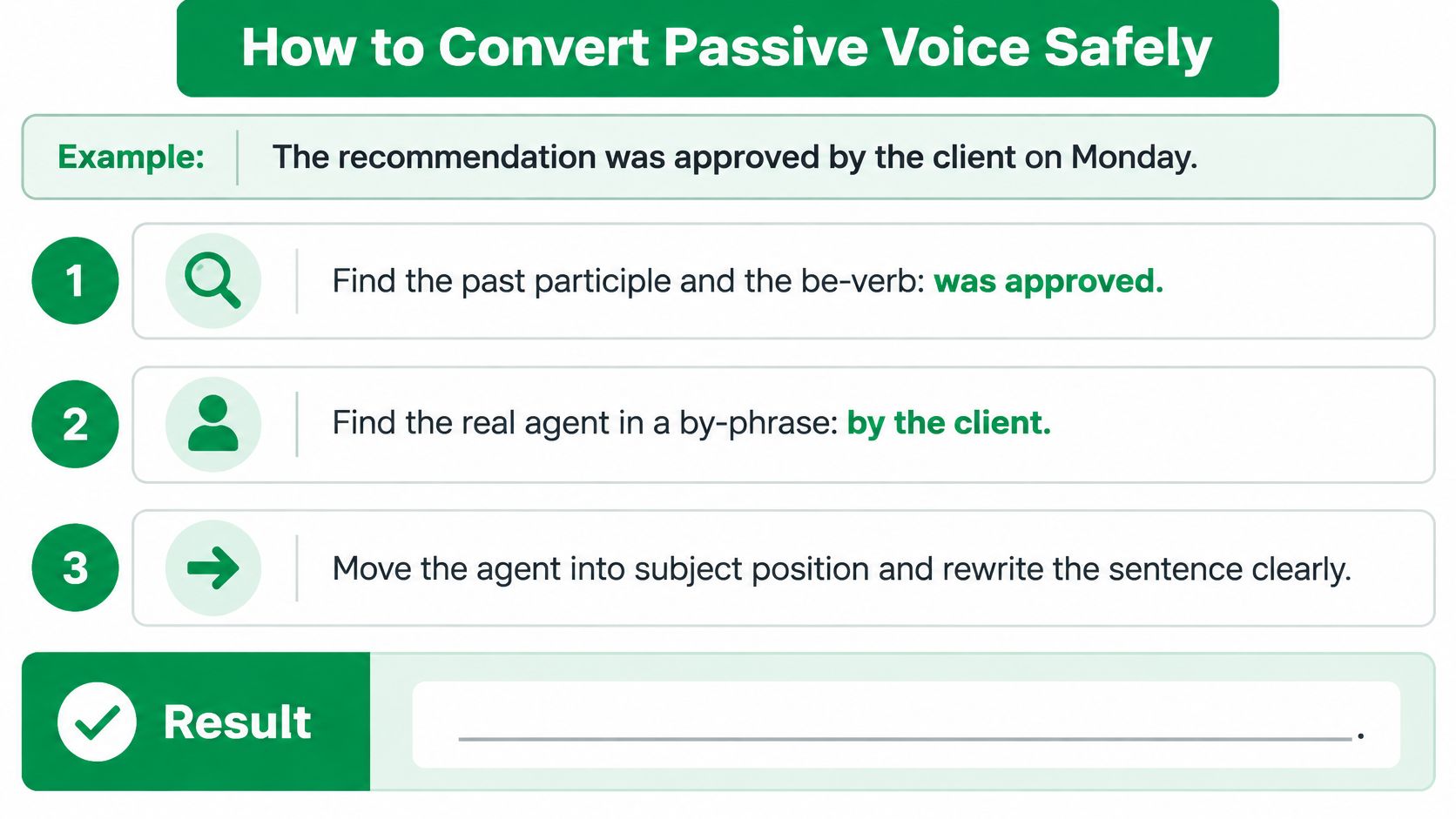
Recognize when the procedure should stop
A missing agent is a reason to pause, not a blank to fill. If a source only says that a recommendation was approved, adding the client would create information rather than clarify it.
An obvious but irrelevant agent creates a different problem. Repeatedly adding the researchers to a methods paragraph can make the prose repetitive while pushing each procedure farther from the beginning of its sentence.
Convert a paragraph in passes. Handle decisions and commitments first, then consider process descriptions only where naming the actor adds useful information.
For rhythm, use these techniques for varying sentence structure without forcing every sentence into the same subject pattern. Variation should come from the relationships among ideas, not arbitrary grammatical alternation.
The result of the worked conversion is: The client approved the recommendation on Monday.
A Style Check Before You Ship the Draft
A passive-voice flag is a prompt to inspect a sentence, not an instruction to replace it. The California State University, Long Beach active and passive voice guide supports distinguishing passive constructions from other verb forms rather than treating every be-verb as a problem.
The tone is formal links a subject to a description. The team was meeting describes an ongoing action performed by the team; neither belongs in the passive pile.
Check grammar before checking style
- Verify the construction. Look for a past participle and a subject receiving an action, with an understood or stated agent. A search for is, are, was, and were can locate candidates, but it can't make the final diagnosis.
- Classify the agent. Decide whether the actor is important, unknown, irrelevant, or risky to name. Keep a separate note when the sentence exposes a factual gap.
- Compare both versions. Read for meaning, emphasis, and evidential certainty. Reject a rewrite that sounds fluent but makes a stronger claim.
Use the checklist as a review aid rather than a target for eliminating particular words.
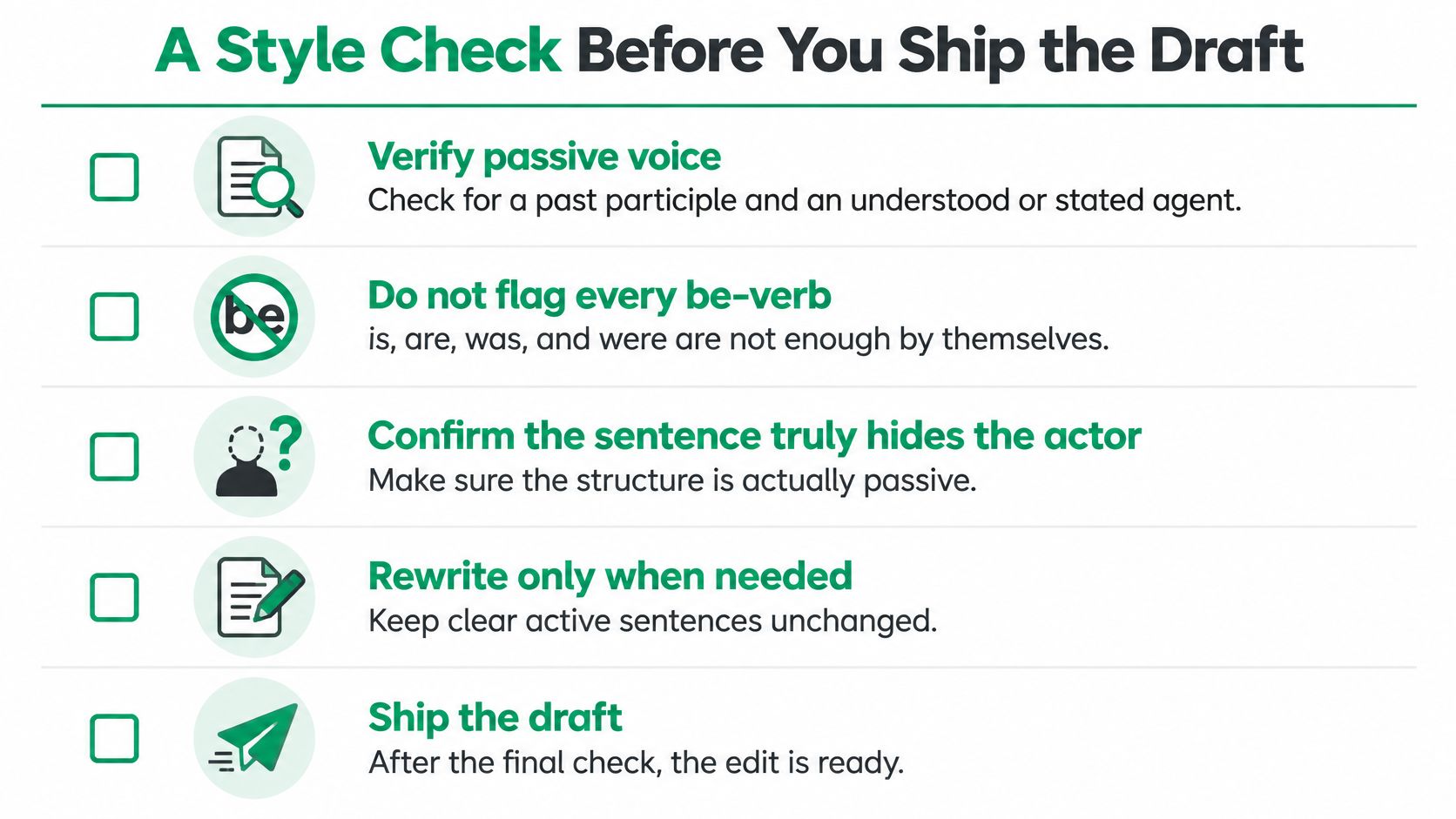
Read across sentence boundaries
Check topic strings, the subjects readers follow through a paragraph. If neighboring sentences concern the same result, introducing a different human subject into each one may make the passage harder to track.
Then check accountability gaps in requests, claims, and recommendations. A sentence about an approval or commitment should let the reader identify the responsible person when that identity is necessary and known.
Research, legal, and compliance writing also need an invented-actor check. Compare revised subjects against the underlying record, especially after automated editing.
- Listen for buried action. Read aloud and notice stacked passive constructions, long introductory phrases, or layers such as it was determined that. Fix the obstruction rather than chasing a passive count.
- Check rhetorical purpose. A passive sentence may classify a subject, summarize earlier literature, or maintain a technical topic. Its function matters more than its presence.
- Record the decision. Mark each candidate convert, keep, or query so another editor can see what remains unresolved.
A count of passive constructions isn't a style score. In research introductions, categorizing earlier work and reviewing literature are legitimate writing tasks, so an editor needs to evaluate what each sentence contributes.
For a broader revision pass, combine this review with writing revision strategies that address structure and missing evidence. Polishing sentence form can't repair an unsupported conclusion.
Editorial boundary: Anything marked query needs information or a source, not just a smoother verb.
Shift Voice Ethically and Choose the Final Voice
Start with a paragraph you own and are permitted to edit using AI. Ask for voice and clarity suggestions, then compare each proposed change with the original rather than accepting a full rewrite automatically.
A useful request is: Identify possible passive constructions, suggest alternatives where responsibility matters, and preserve unknown agents, qualifications, and technical meaning. That gives the tool a bounded editing task without handing it authority over your claims.
Humanize the language without disguising authorship
Accept changes you can explain and defend. Reject suggestions that add an unsupported we, remove a hedge, or turn a description of a process into an invented account of who performed it.
Humanizing should mean making prose natural and reader-friendly, not concealing how the ideas were produced. Keep your reasoning, evidence, and intended tone recognizable after the edit.
Use a guide to tone and voice in writing to separate grammatical voice from your authorial character. You can sound thoughtful, direct, or approachable while using either active or passive constructions.
Don't make a detector score your editing objective. A study published in AI and Ethics found that, across seven detection systems, authentic TOEFL essays written by non-native English speakers were incorrectly labeled AI-generated at an average rate of 61.3%.
That finding concerns those essays and detection systems, not every writer or every detector. It nevertheless shows why a score shouldn't replace review of drafts, sources, revision history, and the writer's explanation.
Document assistance and retain responsibility
Disclosure requirements depend on the applicable journal, institution, or client. A medical-education publishing article distinguishes routine language editing from substantive assistance and advises writers to follow the target publication's policy.
Don't assume that shortening text, generating a table, or drafting a paragraph counts as grammar correction. Check the actual policy before using a tool, particularly for assessed academic work.
Keep a simple assistance record:
- Tool details: Record the tool, version when available, provider, and date or period of use.
- Scope of help: Describe whether the assistance involved minor editing, substantive drafting, or another task.
- Verification: Note how you checked factual claims, citations, technical language, and the final wording.
The PNAS Nexus authorship guidance calls for disclosure of tool details and specific tasks, while placing accountability for submitted content on human authors. Your responsibility doesn't disappear because a suggestion came from software.
For the final read, label sentences by job: method, result, claim, user step, email request, or uncertain event. Choose active wording where responsibility needs to be visible and passive wording where the procedure, recipient, or unresolved event should lead.
The final voice should preserve what you know, make clear what you mean, and leave uncertainty intact. Authentic writing comes from those judgments, not from forcing every sentence into the same grammatical shape.
At Pure Write, we help you refine AI-assisted drafts for clarity, tone, grammar, and natural phrasing while preserving your intended meaning. Visit Pure Write , try one paragraph, and compare active and passive alternatives before keeping the version you can stand behind.