Cover Letter for Customer Service Representative Guide

Approximately 289,500 customer service representative openings each year are projected despite declining employment, according to the U.S. Bureau of Labor Statistics. That combination changes how you should write: employers don't need another declaration that you enjoy helping people. They need evidence that you can resolve problems, use digital tools responsibly, and recognize when a customer needs human judgment.
Why This Letter Still Gets Read
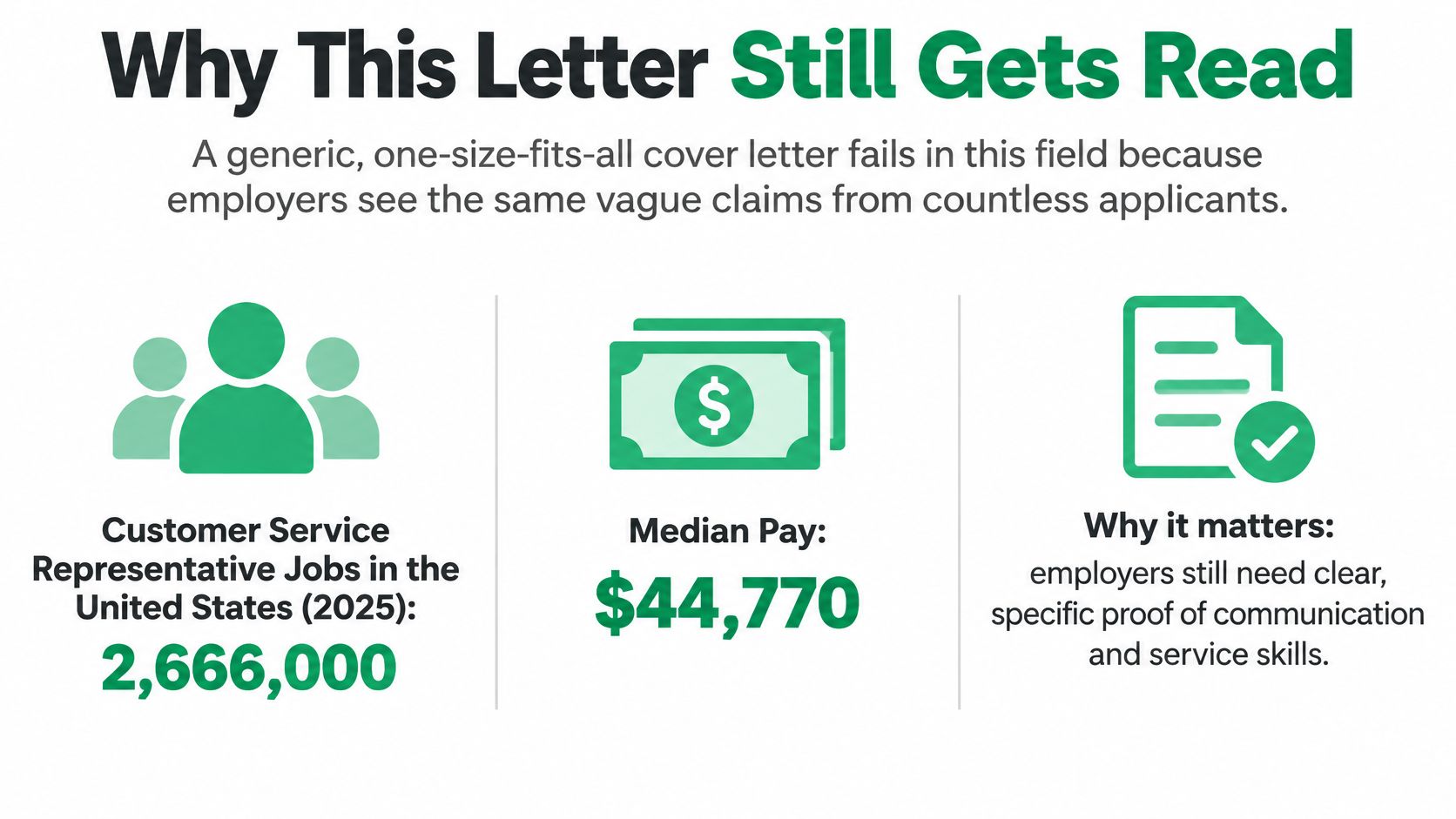
According to the U.S. Bureau of Labor Statistics, approximately 2,666,000 U.S. customer service representative jobs existed in 2025, with median pay of $44,770 annually, or $21.53 hourly. The BLS projects employment to decline 5% from 2025 to 2035, approximately 141,800 jobs, while replacement openings continue as workers leave or transfer.
Those figures give context to the role. Your letter gives the hiring manager evidence of how you make service work better. An adjective such as “patient” is hard to assess; a concise example of resolving a disputed charge without promising an unauthorized refund shows judgment in action.
Write for the customer problem
Suppose an online retailer's posting emphasizes delayed orders and chat support. A paragraph about your outgoing personality does not show how you would help. A brief account of checking shipment information, explaining realistic options, and documenting the next step does.
Show what you contribute when self-service falls short. You might describe identifying an incorrect automated answer, keeping the conversation history intact, or escalating a sensitive complaint without making the customer repeat the issue. The point is to show how you improve the service process while keeping the response human.
Practical rule: Describe what you did when the standard answer wasn't enough.
Gather evidence before sentences
Start with evidence, then shape it into a compact letter. A useful guide to writing a cover letter can help you organize the application without repeating your résumé.
Keep three items beside the job posting:
- The actual vacancy: Note its responsibilities, service channels, and required skills.
- A real result: Check a ticket report, quality review, customer message, or documented resolution.
- A company detail: Find a product or support promise you can accurately connect to your experience.
Use only results you can support. If you lack a precise metric, describe the action and outcome plainly rather than inventing a number.
Five Parts of the Letter and How to Write Each
Use this five-part word budget as an editing framework, not a requirement to fill every available word. The greeting allowance includes the addressee and identifying details, not a long salutation.
| Part | Job in the letter | Words | What to prove |
|---|---|---|---|
| Greeting | Name the person or hiring team and the role | 25–40 | Correct company and job title |
| Opening | Role plus one value sentence | 40–60 | One result tied to their customers |
| Proof one | First competency in the posting's words | 100–120 | Situation, action, and a metric |
| Proof two | Second competency or channel | 100–120 | A different result, not a repeat |
| Close | Specific invitation to talk | 30–50 | How those results transfer, no new claims |
These are drafting allowances rather than quotas. Shorten the proof paragraphs when the application needs a tighter letter, and always follow the employer's submission requirements.
Build the letter in a useful order
Greet the right person. Use the hiring manager's name when it's available and verified. Otherwise, use Dear [Company] Hiring Team rather than To Whom It May Concern. The email salutation guide helps you choose an appropriate greeting when you're submitting the letter directly by email.
Pair the role with a result. Your opening should establish what you're applying for and what relevant value you've already delivered. A useful pattern is: I'm applying for [Role Title], bringing experience resolving [customer issue] while maintaining [verified service outcome]. Avoid beginning with a long explanation of where you found the vacancy.
Write the first proof as a short story. Choose a priority competency from the posting, such as de-escalation. Explain the customer's problem, the action you took, and the outcome. Include the policy or verification step that made your response reliable, not merely pleasant.
Use another channel for the next proof. If your first example concerns a phone call, move to email or chat when your experience supports it. Explain how you adapted: a written summary, clearer instructions, better case notes, or a useful knowledge-base update. Don't retell the same achievement with different adjectives.
Add a company-specific motivation sentence. Read the employer's official product or support pages. Connect a detail to your experience, such as helping customers understand a subscription or supporting people unfamiliar with an app. Don't attribute values to the company unless its own materials support them.
Close with a concrete invitation. Ask to discuss how your experience could support the employer's customer-service goals. Include your contact details, and don't introduce a surprise qualification in the final sentence.
Read aloud and cut repetition. Delete phrases that merely announce enthusiasm or professionalism. Listen for language you wouldn't comfortably use in an interview, especially exaggerated promises about transforming the customer experience.
If your work history is scattered across temporary jobs, volunteering, and projects, organize it before polishing the prose. ParakeetAI can help you turn career experience into a resume, giving you a clearer inventory of responsibilities and accomplishments to draw from.
Make the file easy to screen
CIO's applicant-tracking-system overview cites a report that 75% of recruiters use recruiting or applicant-tracking software and Harvard Business Review research in which 88% of employers believed qualified high-skilled applicants could be filtered out when they didn't match job-description criteria. These findings support using recognizable terminology, not guessing at a secret keyword formula.
Use conventional fonts, standard labels, and plain-text-compatible formatting. The planning table above belongs in your drafting notes, not your submitted letter: avoid tables, graphics, text boxes, and keyword stuffing in the application itself.
Terms such as CRM proficiency or first-contact resolution belong in sentences that demonstrate them. A list of software and service buzzwords doesn't explain whether you can use those tools appropriately.
Your final quality test is straightforward: every claimed skill needs a concrete example. If you write that you're an excellent communicator, identify the explanation, customer interaction, or written follow-up that earns that description.
Full Sample Letter With Annotations
Use this sample as a structure, not a ready-made account of your experience. Replace every bracketed detail, and retain the scenarios only if they accurately represent your work.
Editable sample letter
[Your Name]
[Phone] | [Email]
[Date]
[Hiring Manager Name]
[Company]
Re: [Role Title]
Dear [Hiring Manager Name],
I'm applying for the [Role Title] position at [Company]. In my current customer support role, I resolve [X] tickets daily while maintaining a [X] percent quality score. I'd bring that combination of careful case handling and clear explanations to customers using your [verified product or service].
My de-escalation experience includes helping a billing caller who was angry about an unexpected charge. I let the customer explain the concern, verified the account through the required checks, and compared the charge with the account history.
After identifying [verified cause], I explained the available correction within my authorization and confirmed that the customer understood the next step. The case was resolved on first contact, and my recorded first-contact resolution rate for [period] was [X] percent. I documented the explanation so another representative wouldn't have to reconstruct the conversation.
I also handle complaints through chat and email. When a customer received conflicting instructions about [issue], I reviewed the conversation history, checked the current policy, and sent a follow-up message that clearly separated the action already completed from what would happen next.
I then proposed a knowledge-base note covering the recurring point of confusion. After [verified review or publication process], repeat questions about that issue declined by [X] over [period]. That experience taught me to improve the information behind the response rather than send another reply.
Your website's description of [specific support feature or customer promise] interests me because [genuine connection to your experience]. I'd welcome the opportunity to support that approach while learning your team's systems, service standards, and escalation procedures.
Could we discuss how my billing-resolution and written-support experience could help your team improve first-contact resolution? You can reach me at [Phone] or [Email]. Thank you for considering my application.
Sincerely,
[Your Name]
What to keep and what to verify
- Opening: The role and service result appear immediately. Ticket volume and quality score must match your records.
- Phone example: The account checks demonstrate judgment. Verify the case outcome, reporting period, and resolution rate.
- Written-support example: The channel changes, and the knowledge-base contribution shows process improvement. Don't claim sole credit for a team result.
- Motivation and close: The company detail needs checking against its website; the invitation adds no new qualification.
For document layout, use the business-letter formatting guide for Word.
A retail career changer could replace the opening and first proof with: I'm moving from retail service into digital customer support. After resolving a disputed return in store, I sent the customer a policy-based follow-up and recorded the outcome for colleagues.
Match the Posting With Real Metrics
Customization is substantive work, not a final polish pass. ResumeGo's cover-letter research reported a 53% higher callback rate for job-specific letters than applications without a letter; 81% of surveyed professionals valued personalized letters significantly more than generic ones, and 87% said they read cover letters.
The same source summarizes iHire findings that 77.3% of surveyed employers wanted position-specific letters, while 30.3% expected one even when the posting called it optional. Those findings aren't a promise of an interview, but they make changing only the company name a weak strategy.
Tailor the evidence before the wording
- Identify the customers and channels. Supporting business account holders over email calls for different evidence from helping retail customers through live chat.
- Mark the service measures. Look for satisfaction, response speed, resolution, accuracy, or retention requirements.
- Map requirements to accomplishments. Assign a real example to each priority. Leave out unsupported competencies rather than stretching an unrelated story.
- Explain the product connection. State why helping these customers matters to you without inventing a personal history with the brand.
- Match the support tone. Use calm, precise language for sensitive account issues. A conversational brand still needs clear, professional writing.
- Audit names and numbers. Check the employer, role, platform names, reporting periods, and attribution of results.
Prioritize measures you can explain: customer satisfaction, Net Promoter Score, first-contact resolution, average handle time, escalation reduction, retention, quality-assurance scores, and ticket volume. Distinguish an individual result from a team result, and explain your contribution.
Replace praise with checkable proof
The following are illustrative replacement lines, not achievements to copy. Every number and event must be replaced or verified against your own experience.
| Weak line | Stronger proof | Where it fits |
|---|---|---|
| I am a people person | Resolved 40–50 tickets a day while holding a 95 percent quality score | Proof paragraph |
| I am a great communicator | Walked an angry billing caller through three account checks and closed the case on first contact | Opening or proof |
| I am a team player | Lowered chat escalations by 12 percent after rewriting macros | Second proof |
| I am passionate about service | Named why this brand's support promise matches a result you already earned | Motivation sentence |
A macro is a reusable response template. If you improved one, explain what you changed, such as removing ambiguous instructions, and how the team evaluated the result.
If exact figures are confidential, use an authorized, defensible range or describe a documented outcome without a number. Confidentiality isn't permission to estimate freely, and an unsupported percentage is less persuasive than a specific, truthful resolution.
Before drafting, your posting checklist should identify the customer, channel, priority competency, and matching evidence. Finish with distinct proof lines ready for the body, rather than a paragraph that could accompany any application.
Letters for Career Changes and Digital Support
Automation makes judgment about exceptions a useful differentiator. Robert Half's customer-service hiring guidance discusses digital and AI-supported workflows and cites Forrester's projection of a 13.5% decline in U.S. customer service representative jobs by 2031, particularly affecting junior roles.
That doesn't mean you should add a sentence claiming expertise in AI. Show that you can recognize an unhelpful automated response, investigate the underlying issue, and involve the right person.
Retail experience translated into chat support
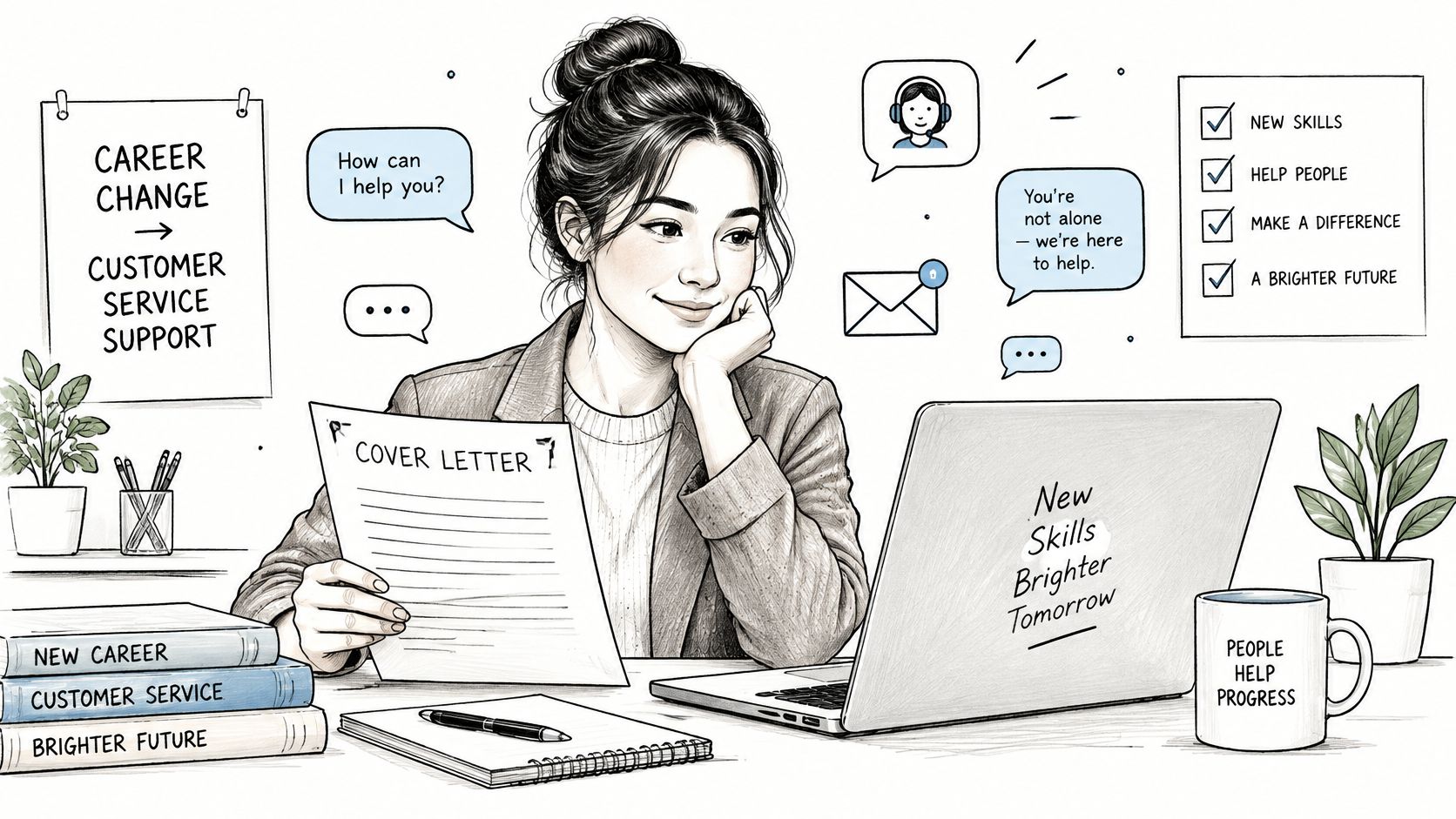
A retail associate can connect an in-person complaint to written follow-up. Describe checking the purchase record, explaining an available remedy, and sending accurate instructions afterward.
Your transition sentence might be: I'm moving from retail service into chat support, bringing experience resolving purchase problems and documenting follow-up actions. If you learned a register or order system quickly, explain how you learned it and what you could subsequently do independently.
For a clearer picture of remote responsibilities, consult the Virtustant Jobs guide to customer support. Compare the duties with your experience before claiming readiness for a particular workflow.
A gap or an unconventional background
Administration, education, student organizations, and volunteering can provide relevant evidence. A student who clarified event instructions, maintained accurate registration records, and handled a difficult public interaction has a usable service story.
State a career transition or gap briefly, without turning the letter into a personal defense. For example: After time away from paid work, I'm returning to a customer-facing role, building on recent volunteer experience coordinating inquiries and maintaining records.
- Name the problem: Explain what someone needed or misunderstood.
- Show your response: Describe the checks, explanation, or follow-up you provided.
- State the outcome: Use a documented result, even if no formal dashboard existed.
The first-job cover-letter guide can help you select relevant evidence when your experience doesn't include a conventional support title.
Multilingual experience without an apology
You don't need to present an accent or language background as a flaw. Emphasize clear explanations, attentive listening, and additional languages when they're relevant to the employer's customers.
A multilingual applicant might describe checking that a customer understood an account instruction and providing an accurate written summary. Don't claim translation credentials or proficiency levels you can't support.
Useful digital-service proof isn't that you always accept the automated answer. It's that you know when to check it.
If you haven't used a CRM, say what adjacent system you have used and how you maintained reliable records. Readiness to learn is credible; invented software experience isn't.
Humanize the Draft and Run the Send Check
An AI-written letter can sound polished while claiming experience you don't have. Google's guidance on generative AI content recommends checking accuracy and trustworthiness because generated material can contain false information.
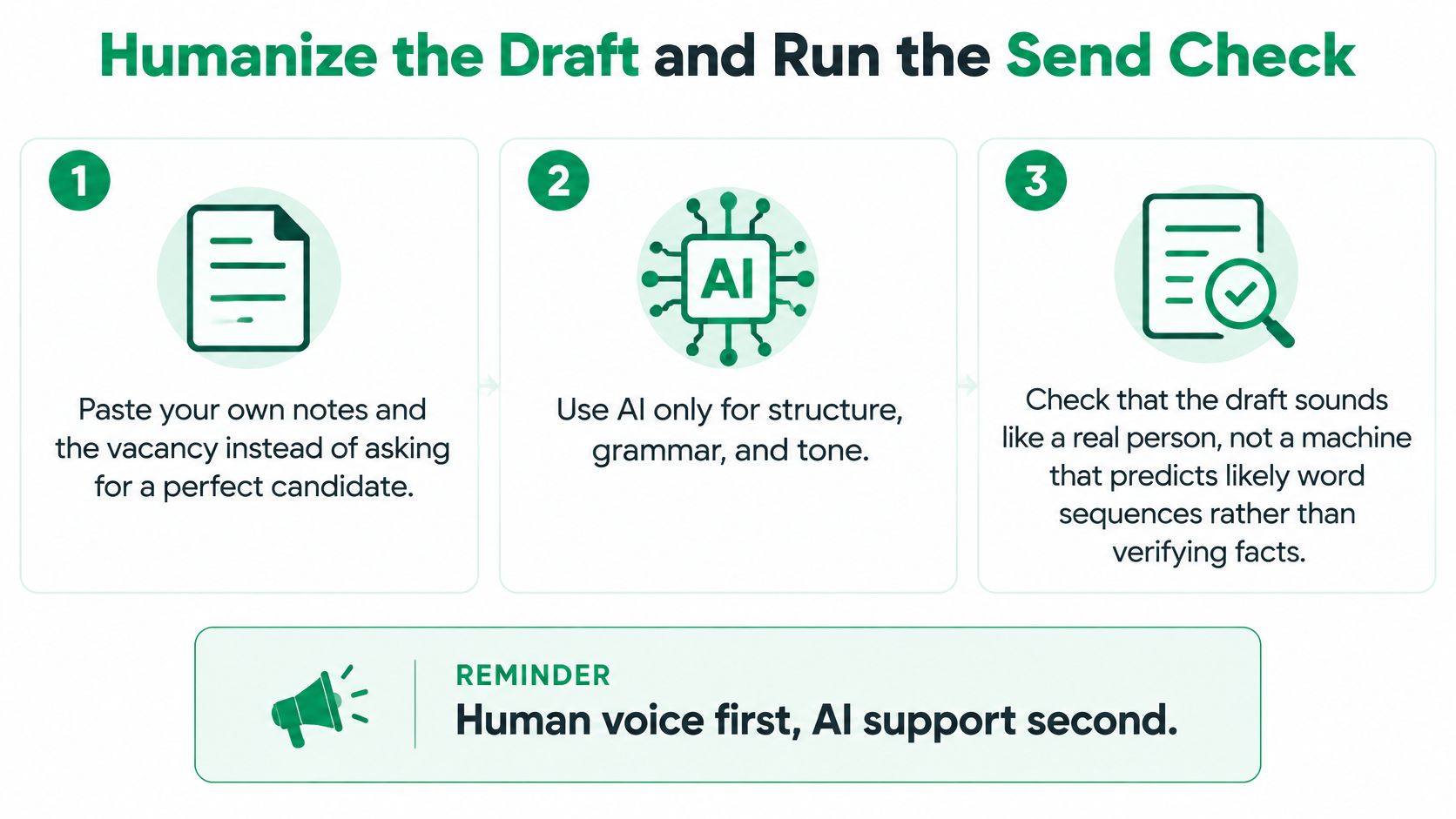
Start with your own notes and the vacancy, not a request to invent the perfect candidate. Ask for help with structure, grammar, and tone while explicitly prohibiting new achievements, tools, duties, or metrics.
Verify first, then restore your voice
Compare company claims with official information and experience claims with your records. Delete any metric you couldn't explain in an interview, and remove tool names that appeared only because they sounded plausible.
Then replace generic wording with language you'd use. The guide to tone and voice in writing helps distinguish professional polish from a voice that no longer sounds like yours.
Detector scores aren't proof of authorship. A 2025 American Physiological Society study found that its best-performing detectors identified essay origin at 93% to 98% accuracy, within that study's conditions.
A 2026 AI-and-ethics review reported a 61.3% mean false-positive rate across seven detectors for authentic TOEFL essays by non-native English writers. These different results show why you shouldn't damage clear writing to chase a score, particularly when the tests concern essays rather than hiring decisions.
Apply the final edit responsibly
At PureWrite, we help refine clarity and tone while you retain responsibility for the facts. Every humanization is scored on the spot with a built-in AI detection estimate, which you should treat as an estimate, not a hiring guarantee.
Our one-time word packs cost $4.99 for 1,000 words, require no subscription, and never expire. Use the edit to improve readability, not to disguise fabricated qualifications or bypass an employer's stated AI-use rules.
Before sending, check the following:
- Identity: The company and role title match the posting and résumé.
- Priority: Your strongest relevant result appears early.
- Evidence: Your main claims are defensible, with documented numbers where available.
- Specificity: No skill rests solely on an adjective.
- Motivation: A sentence belongs specifically to this employer.
- Presentation: The file is readable, concise, and in the requested format.
- Ownership: You recognize every sentence as an accurate account of your experience.
Don't force numbers into a letter when your evidence is qualitative. A verified account of resolving a difficult problem is better than a measurement invented to satisfy a template.
Send it when every claim has a story.
We help turn AI-assisted drafts into natural, reader-friendly writing while preserving your meaning and voice. Visit Pure Write to polish your customer service cover letter, then verify the final version against your records before you send it.