Definition of Problem Statement: How to Write One Well
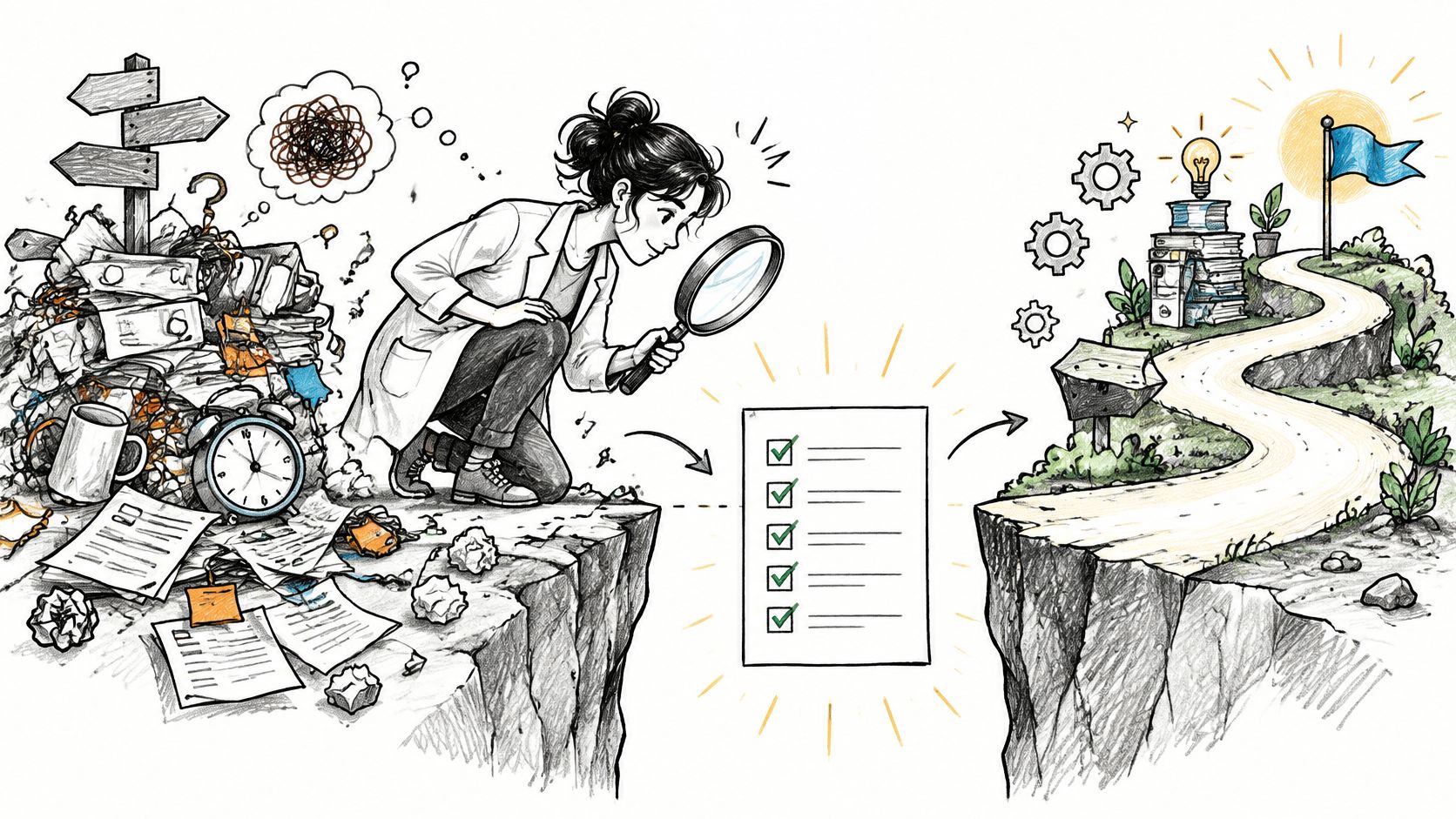
A problem statement is a concise, evidence-based description of a specific gap between the current situation and the desired one, along with why that gap matters.
You may have a promising essay topic, an AI-generated introduction, or a project brief that sounds convincing until someone asks what needs fixing. At that point, polished language won't help unless you can identify the condition, support it with evidence, and explain its consequences.
The useful distinction is between an interesting subject and a defensible reason to investigate or act. You don't need dramatic wording. You need a claim that your evidence can support.
What a Problem Statement Means and Why It Matters
A problem statement works like a doctor's diagnosis: it should come before the prescription. Choosing a treatment before identifying the condition is a guess, even when the treatment sounds sensible.
Say you're preparing a proposal about AI in student writing. That's a topic, not yet a problem. A researchable concern might involve students submitting claims whose sources instructors can't verify, within a particular course and assessment setting.
The framework below shows how to connect the situation you observe with the outcome you want.
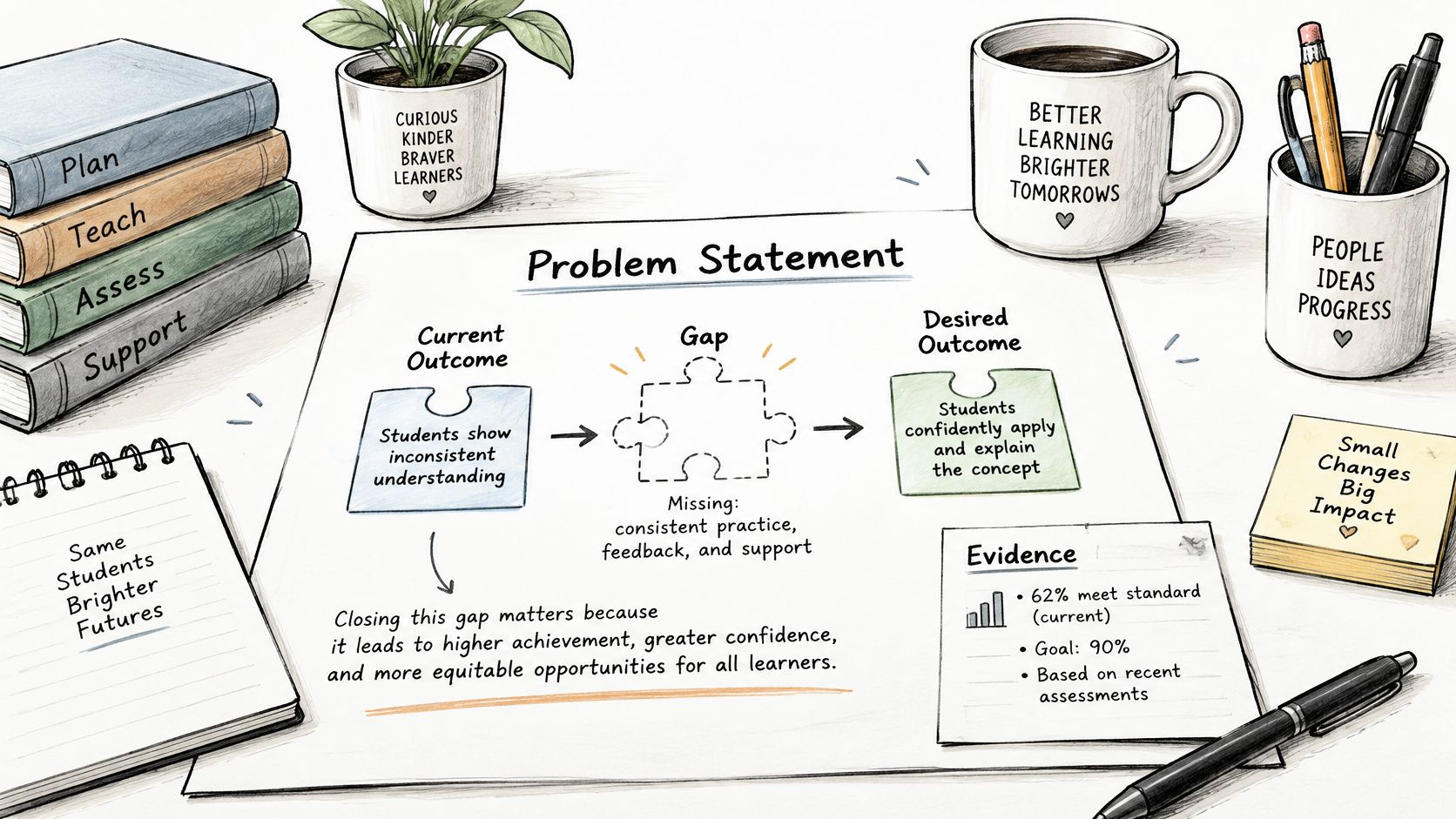
What the statement must accomplish
The University of Southern California's research-writing guidance identifies four purposes: establish importance, anchor research questions or hypotheses, define context and boundaries, and provide a framework for reporting results. Together, these functions explain why a problem statement does more than introduce a subject.
You'll use this reasoning in research proposals, theses, grant applications, business cases, and product briefs. The terminology changes, but readers still need to understand why the work deserves attention.
For entrepreneurs, a related challenge is distinguishing enthusiastic comments from evidence of a genuine customer need. Find Startup Idea's guide to turn polite interest into startup validation offers a useful way to examine that distinction before committing to a solution.
Practical rule: Make the condition observable, name its consequences, and identify what you still need to understand.
That's the practical definition of problem statement worth carrying into your work: not a declaration that something matters, but an explanation of what needs investigating and why.
The Five Parts Every Strong Problem Statement Needs
The Human Sciences Research Council guidance discussed in this academic paper on problem-statement construction recommends one or more concise paragraphs, no longer than one page, covering five components. Treat those components as an audit, not as headings you must force into the finished paragraph.
A short statement can contain substantial reasoning. Brevity comes from selecting relevant details, not removing the evidence that makes your claim credible.
Audit the content before polishing the prose
The five parts of a problem statement, weak versus strong
The stronger lines below are illustrative drafting examples, not established findings. Statements about student behavior, course practice, or missing studies would need verification before appearing in a real proposal.
| Part | Question it answers | Weak version | Strong version |
|---|---|---|---|
| Actual research problem | What condition needs work? | Students struggle with AI | Many first-year students submit AI-drafted essays that omit required source citations |
| Justification | Why does it matter now? | AI is popular | Course practice and current studies show unverified claims entering graded writing |
| Knowledge gap | What is missing? | More research is needed | Few studies measure how AI assistance changes argument quality in first-year essays |
| Methodological boundaries | What limits the case? | University students | First-semester undergraduates, one term, argumentative essays at one university |
| Beneficiaries | Who gains if it is resolved? | Everyone | Students who need fair assessment and instructors who need reliable evidence of learning |
Read across each row rather than copying the right-hand column. The improvement comes from naming something a reader could examine: missing citations, an identifiable student group, a defined assignment type, or an unresolved question.
Even the stronger examples need work. Many requires a supported account of scale, while few studies requires a literature review showing what was searched and what remains missing.
Make the parts work together
The actual problem establishes the condition. The justification explains why that condition deserves attention, while the knowledge gap identifies what your investigation could add.
Boundaries prevent the argument from expanding beyond what you can study. Beneficiaries explain who could use the findings, without promising that your project will solve every related difficulty.
A knowledge gap needn't mean nobody has published on your topic. It may concern a population, a method, conflicting explanations, or the application of existing knowledge to practice. For help connecting those relationships, use these conceptual framework examples to distinguish the problem from the concepts you'll examine.
Ask a stranger to read your draft and identify who is affected, what fails, where the case begins and ends, and who would benefit. If they must guess, add the missing detail.
All the components remain provisional when the justification lacks evidence. A complete-looking paragraph isn't necessarily a substantiated argument.
Problem Statement Templates for Academic, Business and UX Work
Templates help you organize your reasoning, but they can't supply it. Use them as starting frames, then replace assumptions with evidence from your own setting.
An academic reader may expect a literature gap. A manager may need an operational consequence, while a product team needs a clear account of a user's difficulty.
Match the structure to the decision
Problem statement structure by audience
These sample openings are hypothetical. The bracketed fields are places for your own verified details, and the other claims require supporting literature, records, or observations.
| Audience | Core structure | Sample opening |
|---|---|---|
| Academic research | Context, gap in the literature, population and scope, consequence, research question | Although generative AI tools are common in university writing, few studies measure how they change argument quality in first-year essays |
| Business case | Current process, pain point, affected team, cost of delay, success measure | The [team] spends about [hours] each week rechecking AI-drafted client emails, which delays replies beyond the agreed response window |
| UX and product | Stakeholders, operational context, failure or opportunity, scope, desired outcome | Freelance editors who draft reports in shared documents abandon the tone review step because it takes too long to finish before the deadline |
| Requirements engineering | Real-world situation, domain constraints, desired outcome, boundaries, measurable success | Writers need a readability check that runs inside their current editor, measured against a baseline on their own drafts before any redesign |
For academic work, move from context to the specific unresolved issue, then establish population, scope, and consequence. The research question follows from that argument; it doesn't replace it.
Check your department's format before deciding whether the statement needs its own subsection or belongs within the introduction. Also distinguish it from a thesis statement, which expresses an essay's central position; this guide to writing a thesis statement can help.
For a business case, use process records to establish the delay or rework before estimating its cost. If you're organizing the wider venture, Founder Connects explains how to create a foundational document for your startup, giving the problem a place within broader responsibilities and objectives.
Keep product problems solution-neutral
University of Toronto requirements-engineering material separates requirements, the desired outcomes, from domain properties, existing facts or constraints, and specifications, what a proposed system must do. This distinction prevents a preferred feature from masquerading as a user need.
Consider this revision:
Before: Users want better writing.
After: Freelance report writers struggle to maintain an agreed tone across shared drafts before client deadlines. Success would mean reducing tone-review time from the observed baseline to an agreed target while preserving meaning and factual accuracy.
The revised version names users, context, quality dimensions, and a measurement boundary without inventing a result. Record the baseline and validate the target with users before selecting a feature.
Even the requirements-engineering sample in the table deserves scrutiny: an in-editor check is justified only if the workflow constraint is established. Otherwise, it's already a design choice.
How to Draft a Problem Statement in Five Steps
Draft from evidence toward a claim, rather than writing an impressive claim and searching for support afterward. Keep your source notes beside the paragraph so you can check each assertion as you revise.
Use this visual as a reminder of the movement from a narrow setting to an evidence-based, researchable gap.
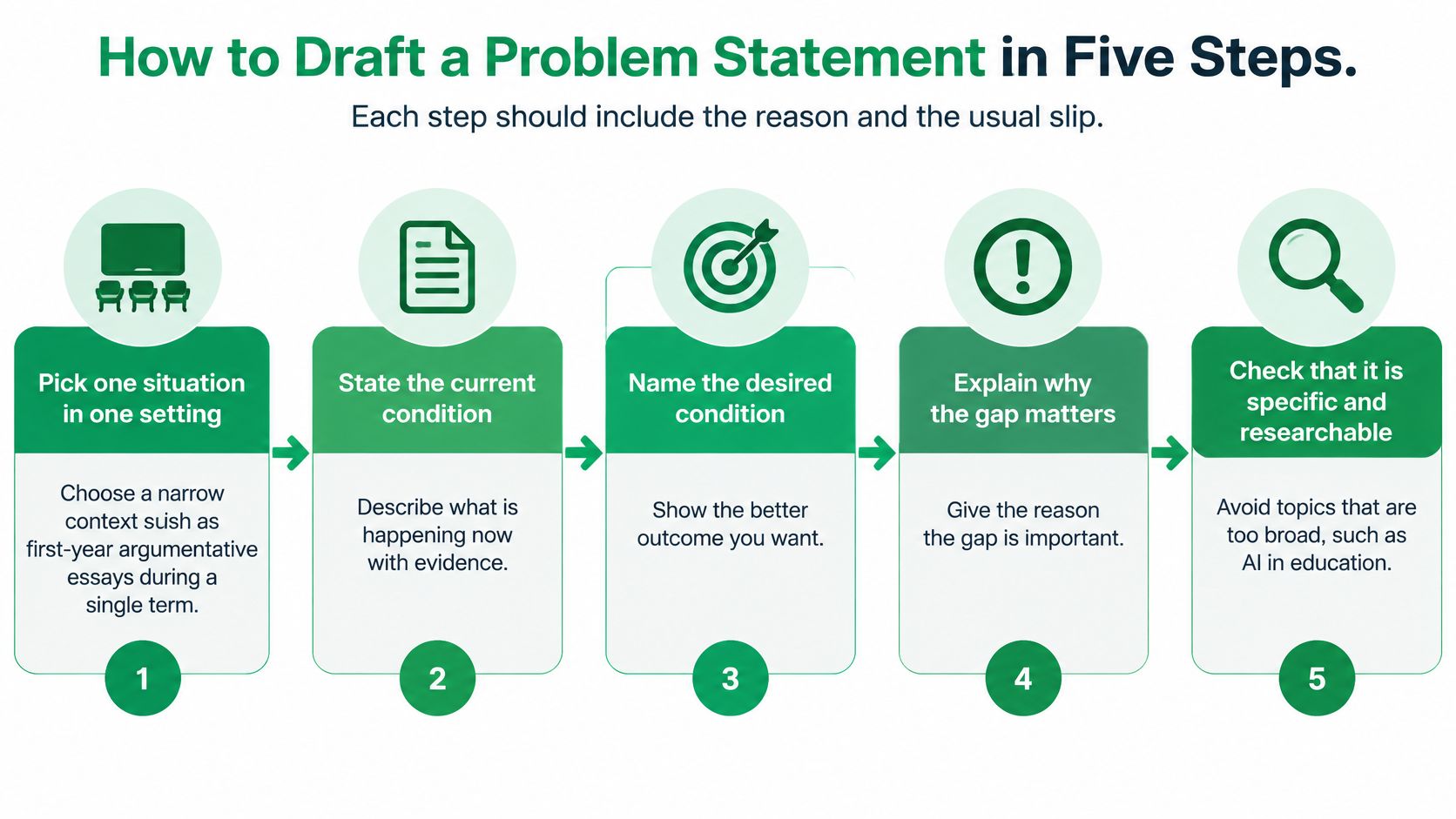
Build the argument in order
- Pick a situation in a defined setting.
Start with first-year argumentative essays during a particular teaching term, rather than AI in education. Narrowing gives you something you can investigate with available time, access, and records.
The usual slip is choosing a subject so broad that unrelated concerns compete for attention. If your paragraph covers citation, student motivation, teacher workload, and privacy, select the concern your project can address.
Add evidence and state its limits.
Use a relevant source, a documented count, or a recorded observation. UNESCO reported that a 2023 global survey of more than 450 schools and universities found fewer than 10% had institutional policies or formal guidance on generative AI, according to its announcement on regulating generative AI in schools.That supports a claim about a policy gap among the surveyed institutions at that time. It doesn't establish today's policy at your university, prove that every classroom lacked guidance, or demonstrate that absent policies caused citation errors.
Name the affected group, place, and period.
Specify whose work you're examining and under what conditions. A reader should be able to decide whether your evidence concerns their setting or a different population.Avoid adding decorative detail. Include a location or timeframe because it limits the claim, not because a template contains an empty field.
Contrast the current and desired conditions.
Write a sentence that makes the shortfall visible. In a hypothetical course review, submitted AI-assisted essays might lack traceable sources, while the course standard requires cited support and an account of the student's reasoning.Keep the desired condition outcome-focused. Requiring a particular app would describe an intervention rather than the underlying standard.
State the consequence and separate the response.
Explain the relevant cost, risk, delay, or missed learning. Then read the draft aloud and move proposed tools, training, or workflow changes into a separate purpose sentence.Don't assume the most serious possible consequence has occurred. If your evidence establishes extra checking time but not reduced learning, keep the claim about checking time.
Review before expanding the proposal
Keep a revision record as new reading changes your understanding. Note which claim changed and what evidence justified the change, rather than expecting a fixed number of revisions.
This video offers another way to approach the drafting process.
When you're ready to develop the wider document, use this guide to writing a research proposal to connect the problem with questions, methods, and feasible scope.
Mistakes That Weaken a Problem Statement and How to Fix Them
The most consequential mistake is describing a solution as though it were the problem. A chatbot is needed asks readers to accept a tool before you've established what users cannot accomplish.
In a hypothetical support-team review, a better starting point would be: support agents repeatedly answer billing questions, delaying responses to other requests. Whether a chatbot, clearer invoices, or another change would help remains open.
Diagnose the drafting fault
Common problem statement mistakes and their fixes
| Mistake | Why it weakens the statement | Fix |
|---|---|---|
| Describing the solution first | Readers accept the tool before they accept the need | State the gap first, then place the intended response in a separate purpose sentence |
| Writing a topic, not a problem | Nothing needs resolving, so nothing can be tested | Name the condition that fails and the group it fails for |
| Vague quantities such as many or some | Readers cannot judge the scale of the issue | Replace the word with a count, a range or a cited figure, and name its source |
| Overstated evidence | Claims outrun the data and invite rejection | Match each claim to a source, or label it clearly as an assumption to test |
| No named audience or setting | Readers cannot tell who benefits or whether the case applies to them | Add the affected group, location and time frame early in the paragraph |
| Mixing the problem with the purpose | Readers cannot separate what is wrong from what you will do | Keep the problem as a diagnosis and the purpose as the response to it |
A symptom also needs interpretation. Rising support requests could reflect confusing instructions, increased customer numbers, or a temporary outage; the count alone doesn't establish the underlying cause.
Don't replace uncertainty with an accusation. Users ignore instructions assumes motivation, whereas users leave the setup process before completing the required fields describes behavior you can investigate.
Separate what is wrong from what you'll do
The Rochester Institute of Technology problem-statement guide supports a useful distinction: the problem explains what is unresolved and why it matters; the purpose explains the investigation or response. Your purpose may develop after reviewing the literature, but a change of direction should be explicit.
Can the statement change later? Yes, refine it as you learn, but distinguish clarification from substitution. Narrowing an initial interest to citation failures is different from replacing that concern with a project promoting a preferred writing tool.
A revision should make your claim more faithful to the evidence, not merely more persuasive.
How much evidence is enough? A relevant study, cited figure, or recorded observation can support a provisional draft, but adequacy depends on the claim's breadth and stakes. An unsupported count isn't a finding; label it as an assumption or remove it.
For your repair pass, highlight solution words, importance adjectives, and unsupported assertions. Fix or cut each before polishing, using an editing and revising workflow that separates argument-level changes from sentence-level corrections.
Refining Wording and Drafting With AI Responsibly
Refine the language after the essential content is present. A smooth paragraph with an invented knowledge gap is less useful than a rough paragraph that accurately represents what you know.
UNESCO's 2023 Guidance for Generative AI in Education and Research recommends a human-centred, ethical, safe, equitable, and meaningful approach, including critical assessment of output accuracy, validity, and bias. For a writer, that means retaining responsibility for sources and judgment.
Make the wording easier to verify
Apply these language checks in order:
- Use a plain noun for the issue. Name missing citations or delayed approvals rather than problematic implementation dynamics.
- Name the affected group immediately. Replace users with the specific people your evidence concerns.
- Cut stacked hedges. May possibly appear to suggest usually needs fewer qualifiers, but keep uncertainty the evidence requires.
- Keep an idea per sentence. Separate the observed condition from the suspected explanation.
- Replace unfamiliar terminology. Explain specialist terms when your intended reader won't know them.
The visual below reinforces the distinction between improving expression and manufacturing support.
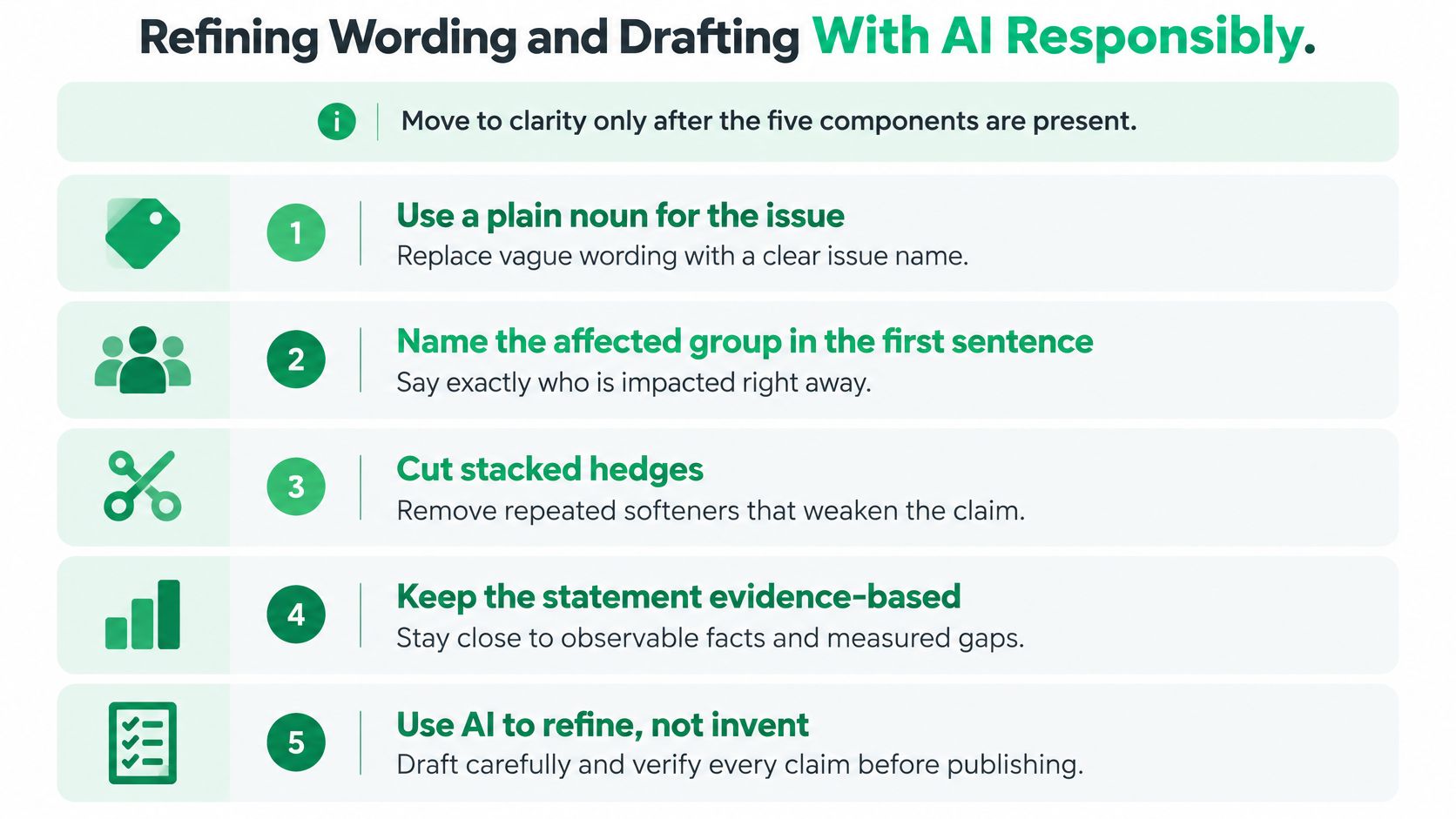
Ask AI to refine, not invent
A vague opening such as AI ethics is a concern needs an identifiable failure. Where local policy review confirms missing guidance, you could instead write: students in the course must decide how to disclose AI assistance without course-specific instructions.
That wording doesn't presume that all institutions lack rules or that uncertainty has already caused misconduct. It gives you a condition to document and a setting to investigate.
Boundaries can also involve age, privacy, and preparation: UNESCO's school-focused AI guidance recommends a minimum age of 13 for classroom AI use, alongside privacy safeguards and dedicated teacher training. This is guidance, not a universal legal age threshold.
Ask an AI tool to flag unclear sentences or identify missing context without adding facts. Then check generated claims against the original sources, restore your setting, and rewrite anything you couldn't explain in your own words.
Don't enter confidential records into unapproved systems. Disclose assistance when your institution, employer, or publisher requires it, and use this explanation of academic integrity to keep editing support distinct from misrepresented authorship.
Natural wording should preserve your evidence, uncertainty, and voice. It shouldn't conceal plagiarism or imply that machine-generated claims have been independently verified.
Test Your Problem Statement Before You Write the Rest
Test the statement before investing in the full essay, proposal, or project brief. Give it to someone who hasn't followed your drafting process and ask them to answer these questions:
- Affected group: Can you name who experiences the problem?
- Evidence: Can you identify the support showing that the condition is real?
- Success: Can you explain what an improved condition would look like?
- Solution language: Does the statement prescribe a tool or intervention before establishing the need?
You want clear answers to the first questions and no premature prescription in the last. If the reader struggles, repair the relevant component rather than adding a general paragraph about the topic's importance.
Check whether it can guide action
A usable statement should help you select a research question, study design, or requirement without a lengthy verbal explanation. Ask the reader what they would investigate next; an unrelated answer may reveal ambiguity in your wording.
You don't need certainty about every cause before beginning. You do need a clear distinction between observations, interpretations, and assumptions, with claims limited to what your evidence supports.
Keep authorship and any required disclosure in your hands. Your next step is to draft the paragraph, attach support to each substantive claim, and test it with a reader before expanding the document.
At PureWrite, we help you humanize AI-assisted drafts with natural, reader-friendly wording and quality analysis for readability and tone. Once your problem statement is clear and its claims are sourced, visit Pure Write to polish the prose while keeping your evidence and voice intact. Review every change and retain responsibility for authorship and any required AI disclosure.