Essay Paragraph Transitions: How to Plan and Revise
The most popular advice about essay paragraph transitions is also the weakest. Collect a handful of words like "however," "therefore," and "in addition," drop one at the start of each paragraph, and call the essay connected. That advice treats a reasoning problem as a vocabulary problem.
A connector can't invent a relationship that isn't there. If the next paragraph doesn't add, limit, contrast, or apply what came before, no familiar word will save the jump. Readers feel the gap even when the sentence sounds smooth.
You don't need a longer synonym list. You need a way to name the relationship, test whether a signal is required, and check any elegant bridge, including one an AI tool suggested, against the claim you mean.
Why Transitions Signal Logic and Not Just Flow
Flow is what readers notice. Logic is what you have to build.
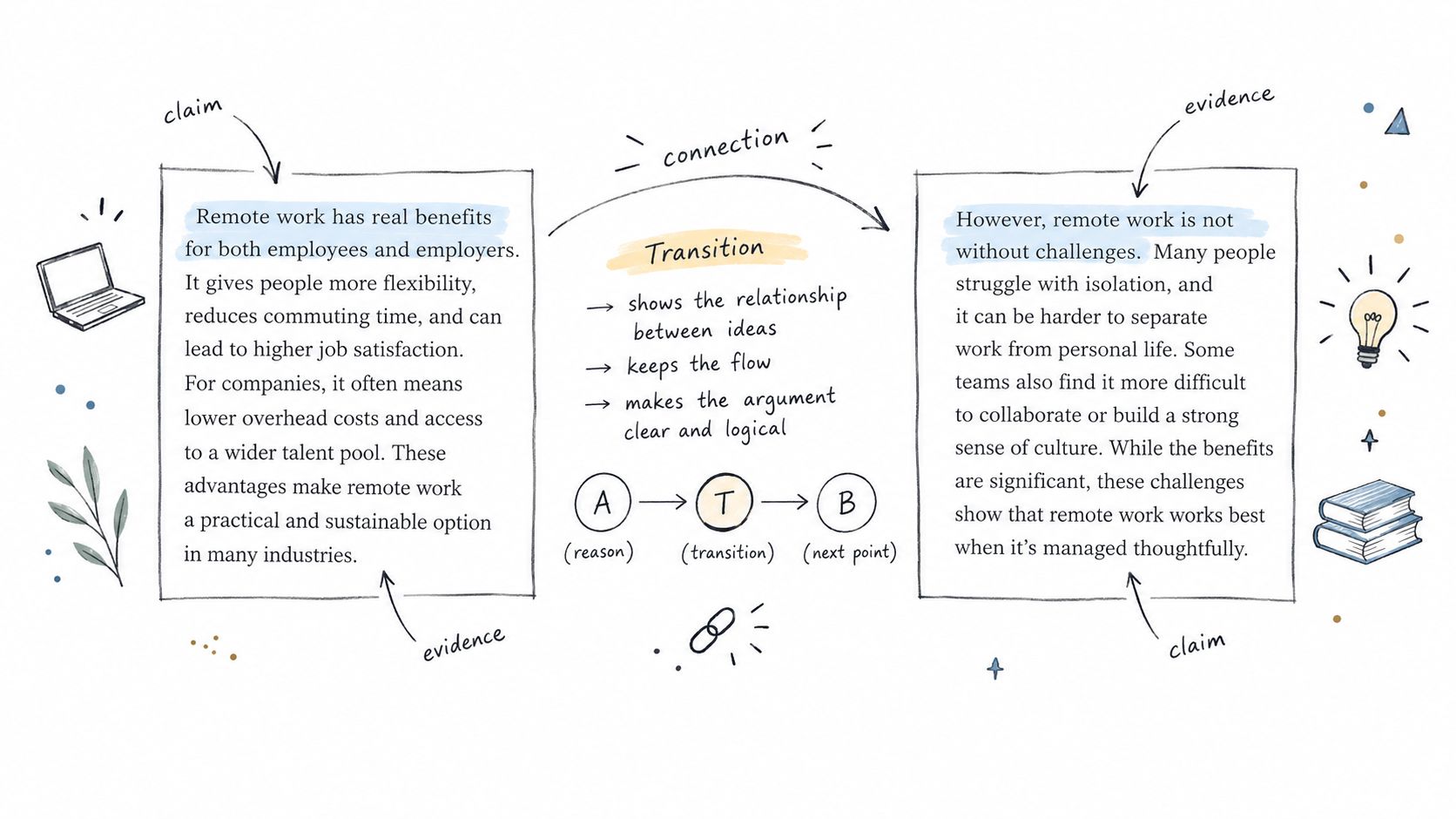
A paragraph transition is a small public claim about how two ideas relate. It can say the next paragraph adds evidence, sets up a contrast, draws a consequence, or shifts to a nearby topic. If that claim is false, the prose can still sound polished and still mislead.
Researchers have treated these signals as measurable features, not decoration. A study of graduate-student theses examined 646,659 words and identified 8,192 transition-marker uses, with frequencies normalized per 100,000 words so corpora of different sizes could be compared fairly, as reported in this analysis of graduate students' transition markers.
What those markers are doing
The markers weren't one vague bucket called "flow." They covered functions such as addition, enumeration, contrast, result, inference, summation, and transition.
That list is the useful part. Two paragraphs can sit next to each other for very different reasons. One pair stacks evidence. Another pair qualifies a claim. A third pair moves from a finding to what the finding implies. The same opener can't serve all three jobs.
A transition is only as good as the reasoning it represents. If you can't say the relationship in plain language, you don't have a bridge yet.
Why familiar words fail
"However" promises opposition. "Therefore" promises a result that follows. Use either one when the paragraphs don't do that work, and you've taught the reader the wrong map.
This matters for a thesis as much as for a blog section. A clear thesis statement gives each paragraph a job. The transition then shows how that job serves the larger point, rather than merely announcing that another paragraph has started.
For content creators, students, and marketers, the practical standard is function and placement. Ask what the next paragraph does to the previous claim. Add, contrast, consequence, or shift. Then judge the signal by whether it tells that truth.
How Many Transitions a Strong Essay Really Uses
Once you stop treating connectors as decoration, the next worry is quantity. Too few, and the argument feels like separate posts. Too many, and the draft sounds like a template.
Upper-level student writing offers a calibration point, not a rule. Researchers analyzing 100 essays from the Michigan Corpus of Upper-Level Student Papers, totaling 293,692 words, identified 6,924 transition-marker occurrences, an overall rate of 3.22 per 1,000 words, in this corpus study of advanced student essays.
What 3.22 actually means
In a 1,000-word academic essay, that rate is roughly three transition markers. It isn't a quota, and it isn't a quality score.
Genre changes the need. A process article may earn more sequence signals. A short opinion paragraph may need one sharp contrast and then get out of the way. Paragraph length matters too. Four long paragraphs can carry an argument with fewer markers than eight short ones that keep changing jobs.
Count the boundaries that need a signal, not the connectors you can sprinkle on top.
Under-connected versus over-signaled
Under-connected drafts make the reader rebuild the argument. The evidence paragraph ends, and the next one starts on a new claim with no shared term and no stated relationship. That's common in AI-assisted drafts that generate each section as a fresh answer.
Over-signaled drafts open every paragraph with "furthermore," "in addition," or "on top of that." The words are grammatical. The reasoning is repetitive. Readers stop trusting the signal because it no longer predicts a real move.
Use the benchmark as a review question. If a 1,200-word essay has almost no markers and the topic jumps, look for missing relationships. If it has a connector on every sentence, look for padding. Strong essay structure examples show the same pattern. The opening of a paragraph connects backward and then advances the thesis.
Frequency will never tell you whether "therefore" is earned. That's the next decision, and it happens before you pick a word.
Diagnosing the Relationship Before You Write the Bridge
A transition can sound polished and still send readers in the wrong direction. Before choosing a connector, work out how the new paragraph relates to the one before it. A useful bridge makes that logic visible; it cannot replace the logic itself.
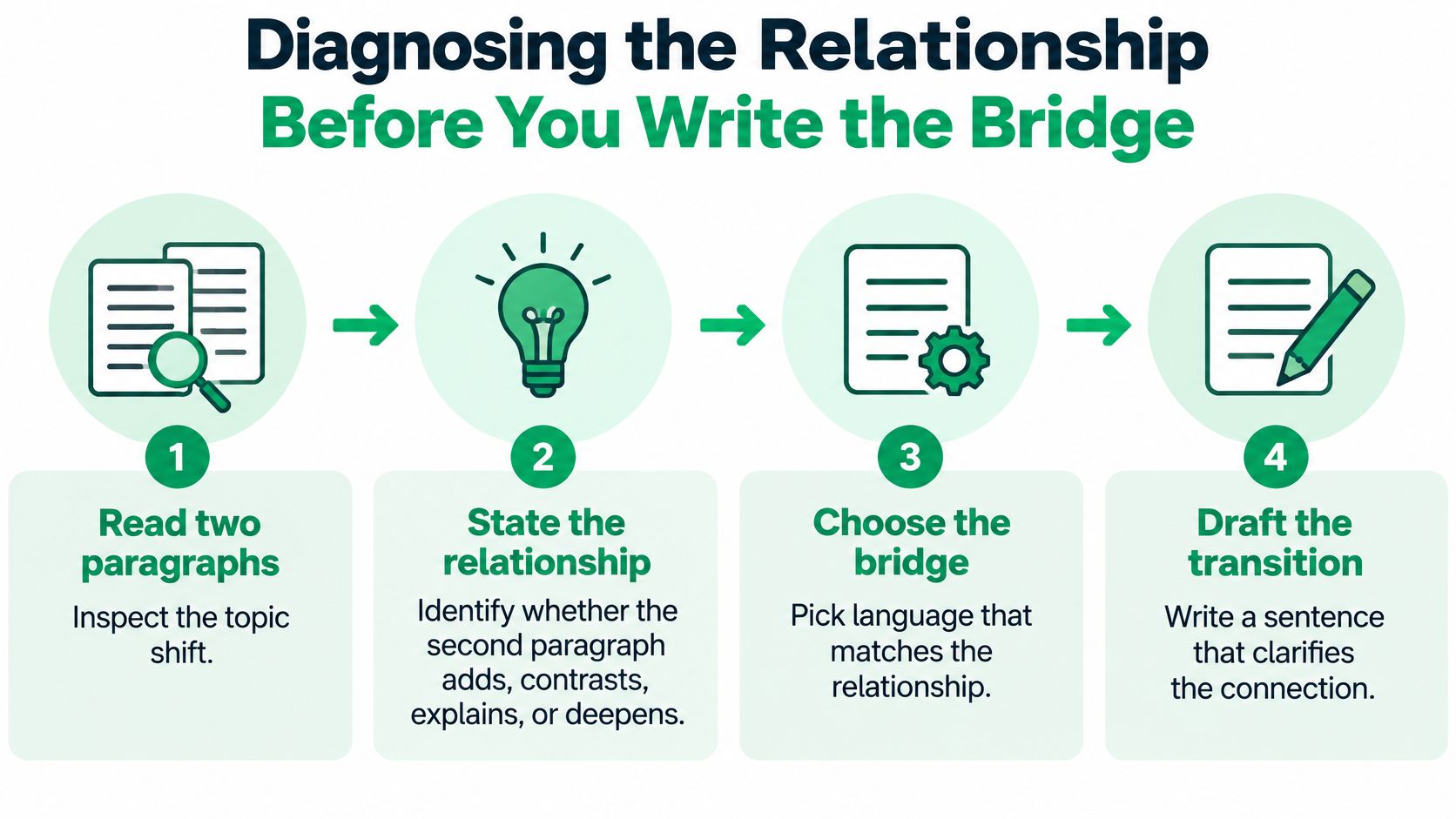
Audit each paragraph boundary in three steps. First, state each paragraph's main claim in one sentence. Then describe the relationship between those claims in plain language. Finally, decide whether the reader needs an explicit signal. This order keeps word choice from disguising a gap in reasoning.
The relationship may be contrast, cause, consequence, elaboration, sequence, concession, or a shift in scope. If the connection takes a full explanation, one transition word probably cannot carry it. Write a sentence that states how the next idea develops, limits, or redirects the previous one.
The deletion test
Remove the connector temporarily and reread the boundary. If the relationship becomes hard to follow, add a clear signal. If the paragraphs still connect through a repeated noun, a pronoun, or a sentence that carries the idea forward, the connector may be unnecessary. An unneeded “however” can make the ideas sound opposed when they are not.
Cohesion is the visible linking of language; coherence is the logic beneath it. A draft can repeat keywords and use smooth connectors without making a sound argument. That is why an AI-generated bridge still needs to be checked against the writer's reasoning.
A study of coherence devices in ten undergraduate thesis-background sections reports several categories, including repeated key nouns, pronouns, transition signals, and logical order. Its figures should not be read as a complete, mutually exclusive breakdown of all coherence devices. The more useful lesson for revision is that connectors are only one way paragraphs stay connected. The study of coherence devices supports looking beyond transition words when diagnosing a boundary.
Carry the concept, then signal
Suppose a marketing paragraph argues that shorter product pages make information easier to scan. If the next paragraph introduces calls to action, starting with "Calls to action matter" drops the shared idea. Instead, carry it forward: "That easier scanning solves the first usability problem, but it doesn't by itself persuade a reader to act." The repeated idea links the paragraphs, while "but" signals a limit. Now the discussion can turn to calls to action without implying they are merely more evidence for the first claim.
A short video lesson can help you hear how bridges work across a full essay before you revise your own paragraph boundaries.
When drafting an opening sentence, good paragraph starters can help you name both the idea carried forward and the new paragraph's purpose. If an AI tool suggests a bridge, write the relationship in plain language beside it. Keep the suggestion only if it expresses the connection you intended.
Choosing Transition Types and Sentence Templates
After the diagnosis, word choice is a matching problem. The University of Utah Writing Center groups expressions by the relationship they signal, which is a better editing method than an alphabetical list.
| Relationship | Example Expressions | Use It When the Next Paragraph |
|---|---|---|
| Comparison | similarly, likewise | Extends the same kind of claim with a parallel case |
| Contrast | however, nevertheless, in contrast | Introduces a competing limit, objection, or difference |
| Sequence | first, next, finally | Follows a real order in time or procedure |
| Cause and effect | consequently, therefore, thus | Shows a result that the previous evidence supports |
| Example | for example, specifically | Supplies proof or a concrete instance of the claim |
| Conclusion | in summary, to conclude | Pulls the argument together rather than adding a new claim |
"Moreover" belongs with addition. If the next paragraph disagrees, that word sends the reader the wrong way. Match first, then draft.
When one word isn't enough
The University of Texas at El Paso treats a transition as a word or phrase that links ideas within or between paragraphs, and a full sentence is often the clearer tool when the move needs explanation. See their guide to transitions.
Contrast template: "That [previous claim], however, creates [limitation]."
Remote work changes home life. That scheduling flexibility, however, can blur the line between work and personal time. The Purdue OWL approach of carrying a specific idea forward is what makes the second version hard to detach from the paragraph before it. Their transitions and transitional devices guidance is built on that carry-forward move.
Consequence template: "[Previous finding] means [result], so the next question is [new focus]."
Before: "Therefore, teams should buy new software." After: "Because the audit showed that staff lose hours to status meetings, the useful change is fewer meetings, not another tool." "Therefore" was doing work the evidence hadn't earned.
Scope-shift template: "[Previous point] answers [narrow question]. It doesn't yet explain [wider question]."
Before: "Also, college essays need a story." After: "A clear activity list can prove what you did. It still doesn't show a reader why that work changed how you think." Students shaping college essays with Mrs. College Counselor run into this exact jump, from résumé detail to reflection.
Build the sentence, don't decorate it
If the relationship is concession, say what you grant and what you still claim. "Although shorter pages scan faster, they can omit the proof a cautious buyer needs."
Vary the grammar while you do this. A bridge that is always "However, [noun] is important" becomes its own template. Compound and complex sentences let you attach the old idea and the new idea in one controlled sentence, which is often cleaner than a stack of connectors.
For marketers, the same templates work on service pages and articles. Name the relationship your reader must follow, then let the sentence say it. If a tool offers "in contrast" or "consequently," check that the next paragraph actually contrasts or causes something.
Revising Drafts and Avoiding Common Transition Mistakes
A weak bridge usually isn't missing a fancier word. It's announcing the wrong move, or announcing a move the reasoning never makes.
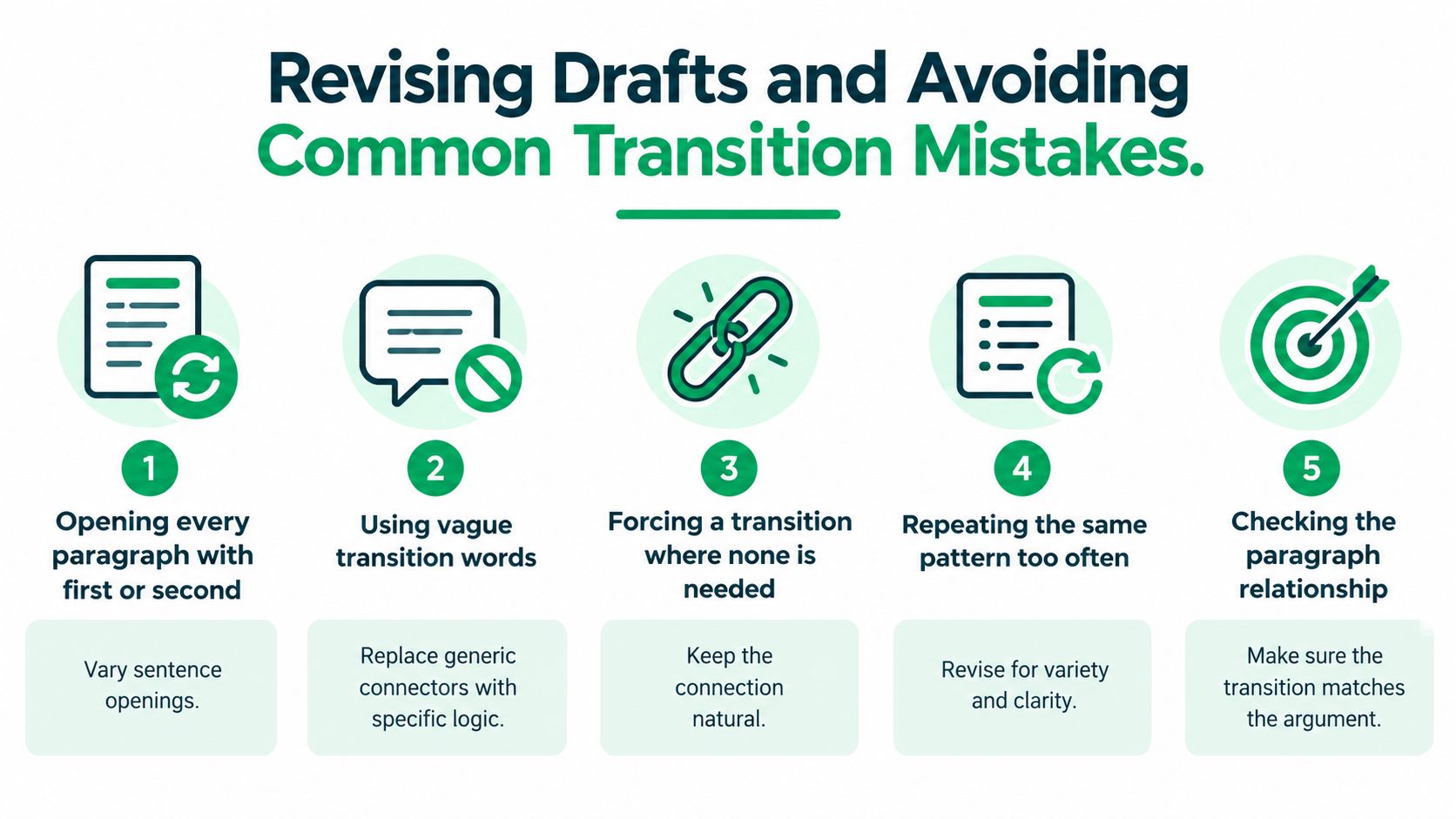
These are the patterns that show up after hundreds of drafts.
Sequence labels on non-sequence ideas. "First," "second," and "finally" at the start of every paragraph imply a procedure. If the essay is weighing tradeoffs, those labels flatten the argument into a list. Replace them with the actual relationship, or with a repeated noun and no label at all.
Addition words on opposing ideas. "Moreover, the policy failed" tells the reader you're adding support. If you mean a limit, "however" or a concession sentence is the honest signal.
Connectors stacked on a broken claim. "Thus, therefore, it is evident" doesn't repair a jump from a single anecdote to a broad causal claim. Fix the reasoning, then keep one accurate signal.
A polished line can still be false
Teachers in a recent study found AI-generated texts stronger in coherence, organization, and consistent transition devices, while qualitative research with Indonesian undergraduates found that students sometimes rejected AI-suggested transitions that disrupted their intended meaning, as discussed in this overview of essay editing and AI-assisted revision/02:_Part_Three_Editing___Grammar_Skills/2.03:_Unit_6_Essay_Introduction). Both findings can be true. Consistent devices can make organization look stronger while still missing your point.
Ethical revision means you keep the claim you can defend. If the tool writes "consequently" and your sources only show a correlation, change the verb. Don't keep the smoother sentence because it sounds finished.
Texas A&M's writing guidance recommends that each sentence carry old information and add new information, and it warns that missing transitions confuse readers while constant ones weaken the prose. Their paragraph advice for faculty and writers is a good second pass after you've fixed the boundaries.
If you can't predict the next paragraph from the transition, the transition is ornamental.
A short editing pass
- Label the pair. Addition, contrast, cause-effect, example, concession, or conclusion.
- Underline the carried concept. If nothing repeats, add the key noun before you add a connector.
- Replace vague starters. "Also" and "another point" rarely tell the reader the move.
- Cut repeats. Two contrast markers in one sentence usually mean one should go.
- Read the boundary aloud. Ask whether a skeptical reader would accept the relationship.
A 12-week experimental study reported that teacher comments on connectives produced significantly greater use of transition words than comparison instruction alone, which is a useful reminder that feedback beats collecting lists. The same research thread also shows why frequency isn't the finish line. One analysis of 555 cohesive devices in thesis abstracts found 59.1% lexical cohesion and 40.9% grammatical cohesion, with transition markers only one part of the mix, as summarized in this paper on cohesive devices.
When you revise an essay, track coverage at the boundaries and mark errors by type. Wrong relationship, or unnecessary repetition. A higher count isn't a better draft.
Comparing Revision Options and Where Pure Write Fits
You can revise transitions in more than one way. The right choice depends on how much of the reasoning you still need to own, and on how easy it is to see what changed.
Manual editing is the most accurate when the argument is still forming. You label each boundary, run the deletion test, and rewrite the sentence yourself. It's slower, and it's the right first pass on a thesis paragraph or a claim that could overstate your sources. Nobody else can know whether "therefore" matches your evidence.
Reviewing AI suggestions yourself is faster for a long draft. Ask the tool what relationship it sees between two paragraphs, then accept or reject the bridge. The risk is fluency. A suggestion can sound organized while upgrading a hedge into a cause, or smoothing over a paragraph that should have been cut. Treat every suggestion as a proposal, not a correction.
A dedicated revision tool sits between those two when the ideas are already yours and the prose needs to read more naturally. That is where we fit. At Pure Write, you paste a draft and get an instant look at naturalness and readability, then use Humanize when you want stylistic polish without handing the argument to a generator. Built-in AI detection and plagiarism checks are there so you can see how the text presents, not so you can disguise work that isn't yours.
What should stay in your hands
Accuracy of the relationship isn't something a tool can guarantee. If paragraph two limits paragraph one, no readability score can verify that. Preservation of your reasoning matters just as much. A humanizer should not swap your qualified claim for a cleaner, stronger one.
Transparency matters for students and for content teams. You should be able to point to what you argued, what you revised for clarity, and what you refused because it changed the meaning. That's ethical AI use. It isn't a way to submit generated analysis as if you did the thinking.
Use manual editing while the logic is unstable. Use suggestion review when you want options. Use a revision tool when the relationships are already true and you need the sentences to sound like a person wrote them. In every case, you remain the author of the connection.
Practice Prompts and Your Next Revision Step
Skill sticks when you practice on your own boundaries, not on a model paragraph.
Prompt 1, diagnose. Pick two adjacent paragraphs from a draft you're willing to change. Write one sentence for each claim. Then write the relationship in plain words: adds, contrasts, causes, limits, exemplifies, or shifts scope. If you can't name it, the bridge isn't the first problem.
Prompt 2, rewrite the false signal. Find a paragraph that opens with a stock transition such as "also." Decide whether the next paragraph actually adds support. If it doesn't, rewrite the opening so it carries one key noun and states the underlying move. Keep the rewrite even if it sounds less smooth.
Prompt 3, run the deletion test. Remove every transition marker from one section. Read it once. Put back only the signals whose absence made the relationship unclear. Leave the others out. This is how you learn that some connectors were habit.
Do these on a real piece, not a practice worksheet you'll never publish. A blog section, a discussion post, or the background of a paper will teach you more than a made-up pair of sentences.
One concrete next step
Open the draft you're closest to finishing. Mark every paragraph boundary with the relationship name, underline the concept that should carry forward, and rewrite any opener that predicts the wrong move. Then read the revised version for naturalness. If a sentence is accurate but stiff, polish the wording without changing the claim.
That order protects you. Logic first, signal second, style last. When an AI suggestion disagrees with the relationship you wrote in plain language, keep yours.
Pure Write helps you turn a stiff or AI-assisted draft into natural prose while you keep the relationships you argued, including the paragraph bridges you just revised. Paste a section, check readability, and use Humanize only where the logic is already sound. Try it on your next essay or article at Pure Write .