What Is Descriptive Writing? Examples, Techniques and Tips

Descriptive writing represents a person, place, object, condition or action through carefully selected details so the reader can picture it or understand it. You're probably staring at a sentence like "the office was nice" and knowing a reader can't see it yet.
That's the common trap. You add more adjectives, the sentence gets longer, and the image stays blurry. What you need isn't more decoration, it's better choices about which details to include, in which order, and when to stop.
What Descriptive Writing Means in Plain Terms
What is descriptive writing in practice? It's writing that gives a reader enough evidence to build a scene or judge a condition for themselves, instead of accepting your label for it.
A good description works like a camera lens. It frames one scene on purpose. It doesn't hand the reader a photo album of everything that was in view and hope something lands.
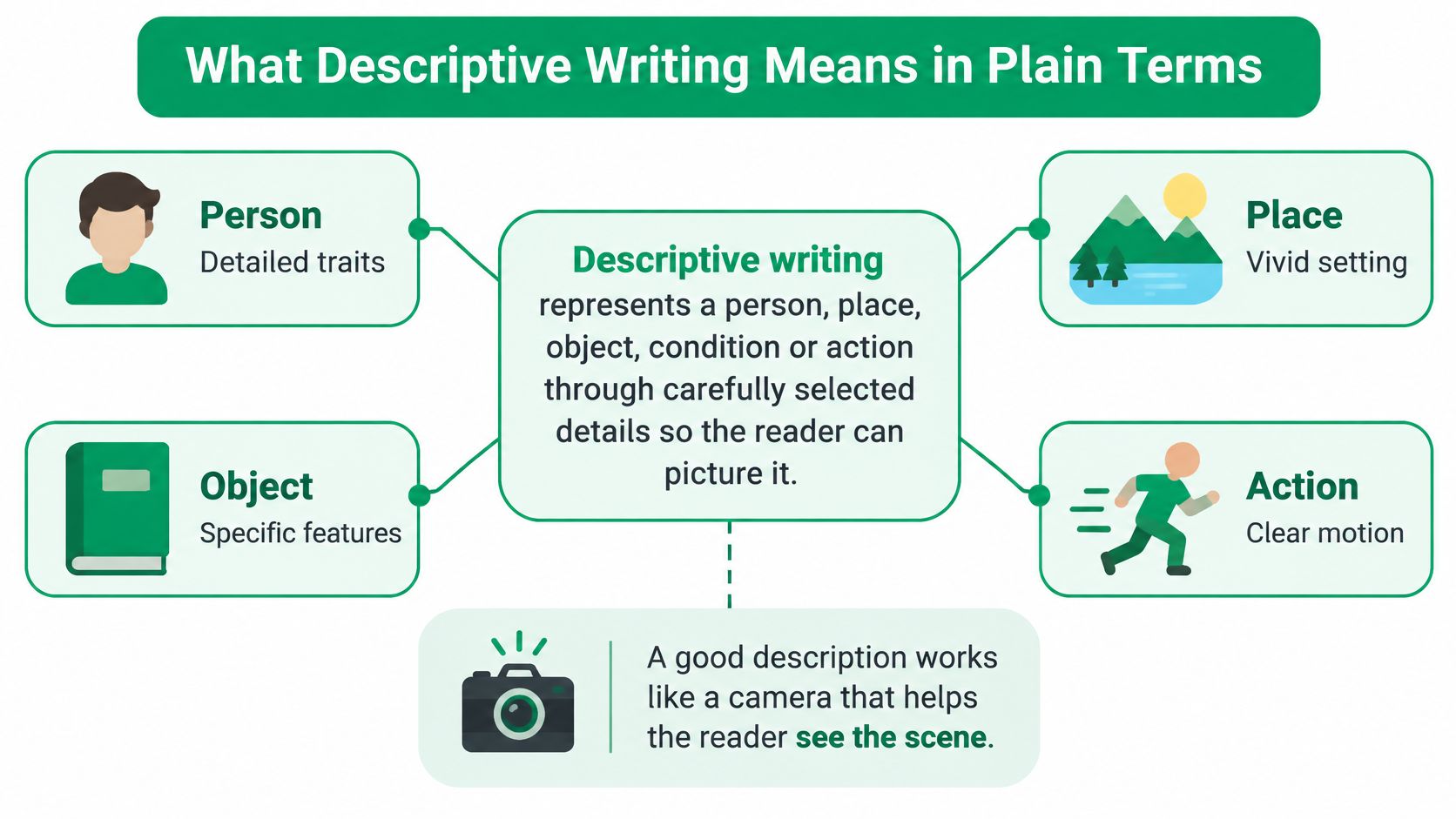
Every description needs three parts. Start with a clear subject, add concrete evidence from the senses, then use an organizing principle that decides which detail comes first.
Two Registers You Will Use
Artistic description aims for vividness and emotional impression. A travel piece about a street at dusk belongs here.
Scientific description prioritizes accurate, informative details and limits figurative language. A lab note, inspection report, or medical handover belongs here.
That distinction matters because the same sentence can succeed in one register and fail in the other. "The wound looked angry" might work in a memoir. In a handover note, a nurse needs color, size, and edges.
The sensory details classroom study at the University of Cebu Main Campus taught 60 Grade 12 STEM students either through sensory details or through lecture. Both groups improved between pretest and posttest, but the experimental group achieved a significantly higher posttest mean.
Use a simple test on any sentence you write. Could someone picture the subject, or verify it, from these words alone?
If the answer is no, you don't have a style problem. You have an evidence problem, and you fix it by naming something observable.
The Five Features That Make Description Work
Description isn't the accumulation of adjectives. It links observable attributes to one coherent viewpoint, mixing visual, auditory, tactile, olfactory, and movement cues as needed.
Research on lexical processing shows that concrete words activate meaning differently from abstract words and, particularly when readers engage in deeper processing, are more likely to elicit mental imagery. That's why "iron railing" builds a picture and "nice environment" doesn't.
Use this table as a checklist against your own draft.
| Feature | Strong Example | Weak Version |
|---|---|---|
| Sensory detail | The bread crust cracked under her thumb and smelled of toasted rye | The bread was delicious |
| Concrete nouns and specific verbs | The lighthouse's iron railing flaked rust onto the wet rocks | The lighthouse looked old |
| Dominant impression | The room felt cramped, low ceilings, one lamp, and air thick with dust | The room was uncomfortable |
| Spatial or sequential order | From the doorway, the desk sits on the left and a window fills the far wall | The office was nice |
| Controlled viewpoint | Seen from the pier at dawn, the town's roofs glow orange | The town looked beautiful from everywhere |
Sensory detail comes first because it supplies evidence. Look for sight plus at least one other sense when the subject allows it. "Delicious" tells a reader your conclusion, while cracked crust and toasted rye let them reach it.
Next, check your concrete nouns and specific verbs. Words like beautiful, nice, and messy usually signal a missing noun or a lazy verb. Replace "a beautiful building" with materials, dimensions, light, texture, and spatial relationships a reader could check.
A dominant impression gives those details a shared job. If a room should feel cramped, every detail should narrow the space or thicken the air. A cheerful detail that fights that impression weakens the paragraph, even if it's true.
Spatial or sequential order tells the reader where to stand and where to look next. Move left to right, doorway to far wall, or first step to last step. Without an order, readers get a pile of details instead of a place.
A controlled viewpoint holds that order steady. You can't describe a town "from everywhere" in one paragraph without confusing the reader. Pick the pier at dawn, stay there, and let the reader assemble the scene.
Use modifiers selectively, so every detail supports the mood, function, or argument of the passage.
Why Writers Use Descriptive Writing
You use description for different jobs, and the job decides your register. Identify the purpose before you draft, not after you've polished sentences that serve the wrong reader.
Five Purposes With Different Rules
- Making an unfamiliar subject understandable: A technical writer describes how a valve seats and seals so a new technician can picture the mechanism before touching it.
- Setting a mood: A travel writer describes a Lisbon tram at dusk, bells ringing on a steep street, to make you feel the city slowing down.
- Documenting a condition: A nurse describes a wound's color, size, and edges in a handover note, with almost no figurative language.
- Recording evidence for a decision: A property manager describes damp patches on a basement wall in an inspection report, where location and measurement matter more than atmosphere.
- Showing a product in use: A product page describes a ceramic mug's glaze and handle so a buyer can imagine holding it and decide if it fits their hand.
Notice how the nurse and the property manager need verifiable facts. The travel writer needs impression, and the product page needs both, because a buyer has to feel something and confirm a size.
Persuasion works the same way. You don't persuade by claiming an experience was great. You describe the experience closely enough that the reader feels its value and draws the conclusion themselves.
If you want that effect to sound like you and not like a template, study how tone and voice shape a reader's response before you choose your details. A formal report and a personal essay can describe the same room and still sound nothing alike.
Write one sentence before drafting. State why this description exists and who will read it, then cut any detail that doesn't serve that sentence.
Descriptive Writing in Action
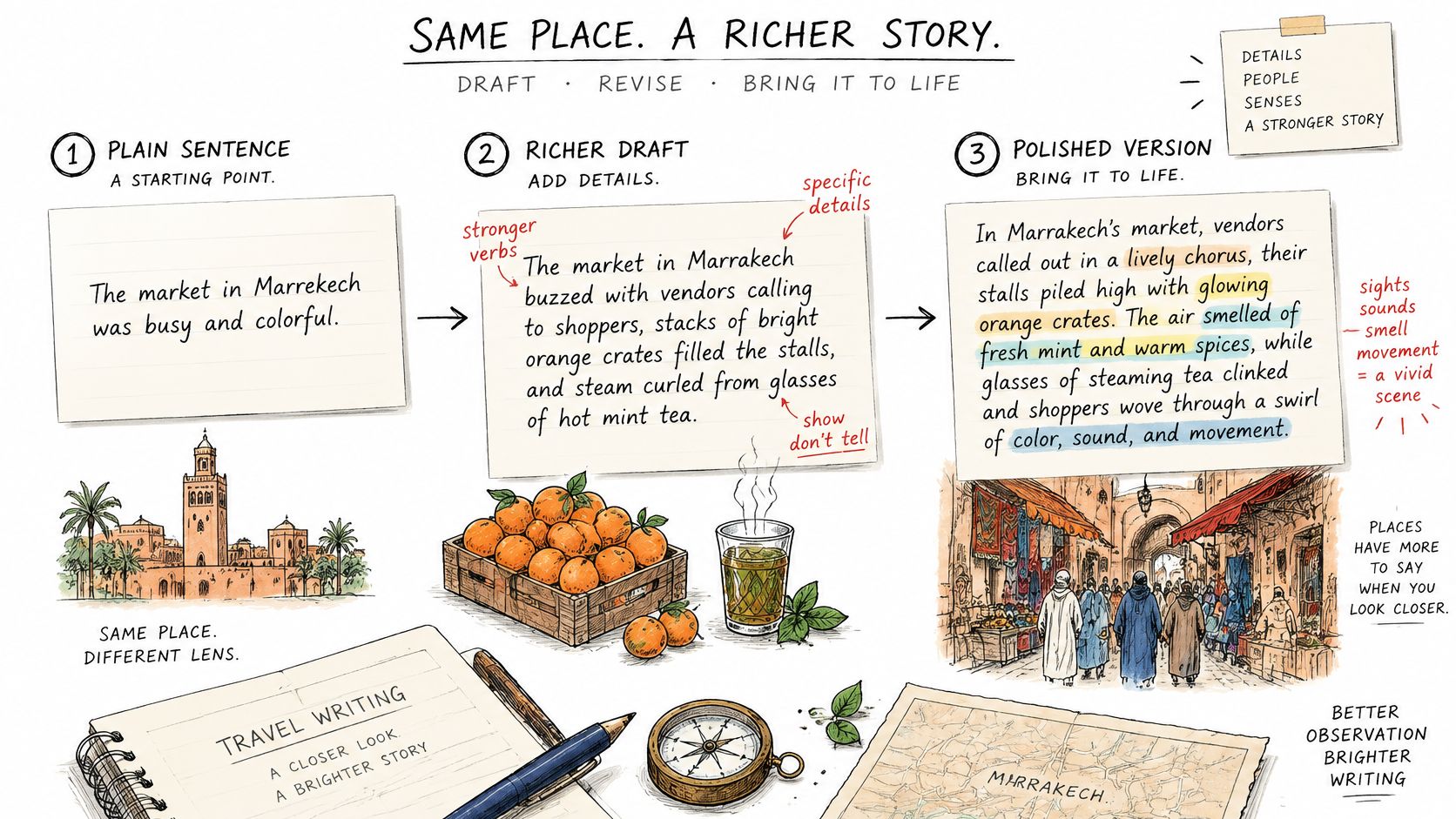
We'll work through three revisions using the same three moves. Name the vague word, replace it with a sense or a concrete noun, then choose the order of details.
This illustration shows that progression from a plain sentence to a polished one.
Travel Writing
Before: The market in Marrakech was busy and colorful.
After: Vendors shout over stacked orange crates while steam lifts from a cart of mint tea, and the air smells of cumin and diesel.
"Busy" became shouting vendors, and "colorful" became orange crates. The order moves from sound to sight to smell, so you enter the market the way a visitor would.
Product Description
Before: This ceramic mug is nice and sturdy.
After: The 350 ml stoneware mug has a matte glaze that feels slightly rough under the thumb and a handle wide enough for two fingers.
"Nice" disappeared, and "sturdy" turned into material, capacity, and grip. If you're writing pages like this often, a practical guide to writing product descriptions will help you keep that buyer focused detail consistent.
Workplace Report
Before: The warehouse was messy.
After: Pallets block half of aisle 4, and wet cardboard has slumped against the racking near the loading door.
"Messy" could mean anything, so a manager can't act on it. A blocked aisle and a named location tell the next person exactly where to go and what to clear.
Watch this short video walkthrough before you try the overload edit below.
When More Detail Hurts
Overloaded: The kitchen smelled of garlic, lemon, smoke, and soap, pans clattered and hissed, steam fogged the window, the tiles were cold, the sauce was sharp, and the cook's sleeves were wet.
That's nine sensations competing at once, so none of them registers. Cut it to the three that carry the impression of a rushed dinner service.
Focused: Garlic and lemon cut through the steam while pans clattered on the stove, and the cook worked with wet sleeves pushed to her elbows.
A detail earns its place only if it changes what the reader understands.
Techniques and Exercises to Sharpen Your Descriptions
A description works like a guided view: you choose what the reader notices first, what comes into focus, and what can be left out. The aim is not to record every detail. It is to select and order details that serve the paragraph's purpose. These four techniques pair with short exercises to help you practice that judgment.
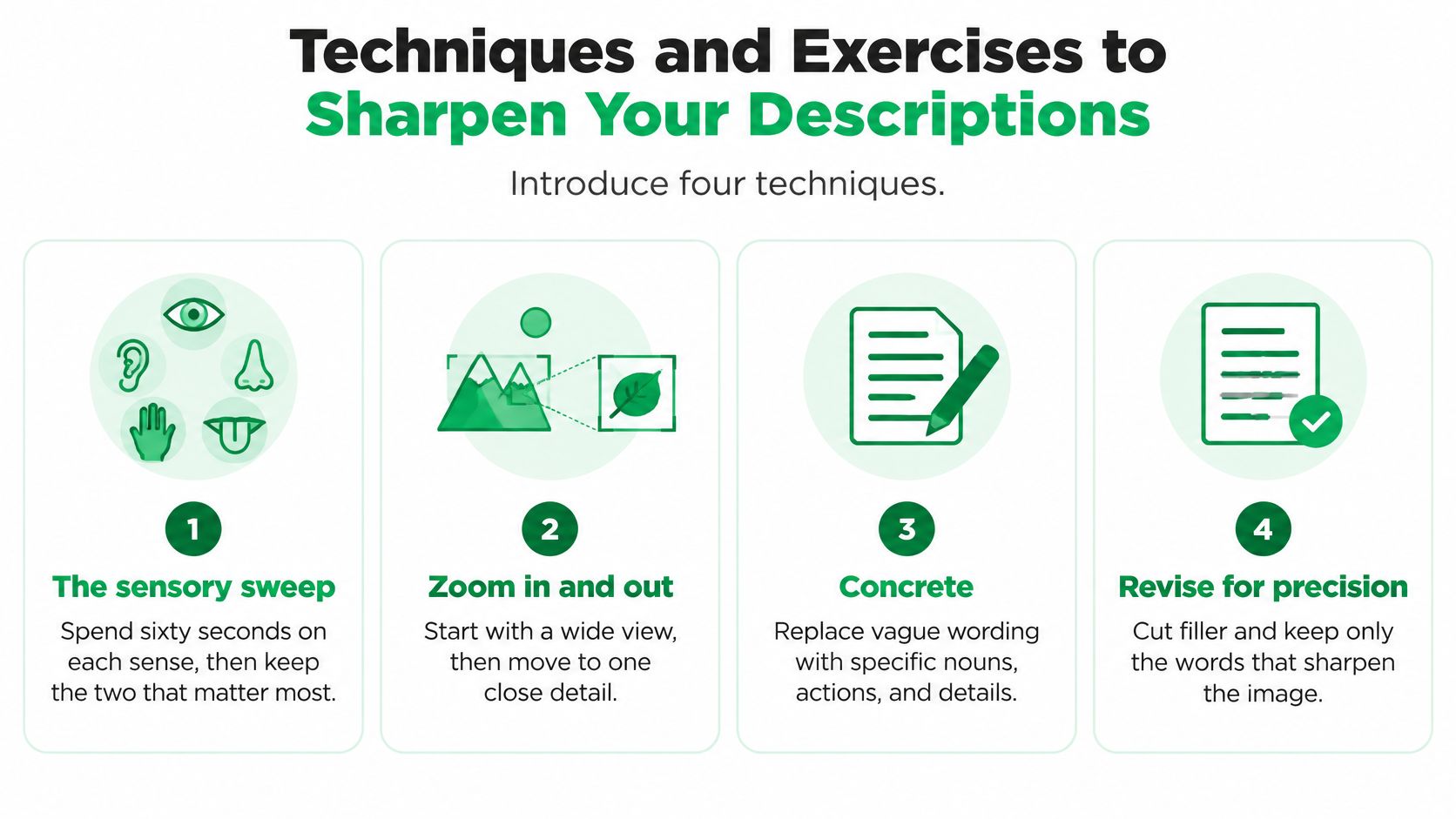
The Sensory Sweep
Spend sixty seconds on each sense while observing a subject. Write raw notes without judging or arranging them. Then choose the two senses that best support your purpose.
The notes are a supply, not a checklist you must empty into the paragraph. For a quiet library, a turning page may matter more than the smell of the room. For a busy kitchen, clattering pans might set the scene faster than a list of colors. Choosing a few details gives the reader a clear impression rather than a crowded inventory.
Zoom In and Out
Begin with a wide view that orients the reader, then move to one close detail that carries meaning. A harbor at dawn can narrow to a fisherman's cracked hands mending a net.
The wide view answers, “Where are we?” The close detail gives the reader something specific to remember. Starting with the hands may leave the setting unclear, while staying with the harbor alone can make the scene feel distant. Use the order that best serves your purpose, and make each shift feel like moving a camera from the whole scene to one telling detail.
Concrete for Physical Subjects, Analogy for Abstract Ones
Describe observable mechanisms directly. When explaining an idea such as grief, inflation, or momentum, connect it to a familiar image that helps readers picture what cannot be seen.
Concreteness describes how readily a word refers to something perceptible; imageability describes how easily it evokes a mental picture. Experimental psycholinguistic work on concreteness and imageability examines these related but distinct qualities. Related research suggests that attaching visual imagery can help readers remember abstract words more reliably than words they can already picture.
Keep comparisons purposeful. A cracked hand needs no decorative analogy, but an abstract idea may need one to become easier to grasp. Explore the main types of figurative language to choose a comparison that clarifies rather than distracts. The same care matters when you adapt video scripts for different channels: choose spoken or written details for the audience and moment, rather than carrying every captured detail into the script.
Revise by Marking Abstract Nouns
Circle abstract nouns in a draft, such as “tension” or “comfort.” Ask whether a concrete example or comparison would help the reader understand each one. Then check that the sensory details fit the viewpoint. A description from a child's perspective, for example, should not suddenly rely on observations the child could not make.
Five Exercises With Time Limits
- Room from the doorway: Spend ten minutes describing a room from left to right without leaving the doorway. The fixed viewpoint gives your details a clear order.
- Stranger through actions: Describe a stranger using only what they do. Leave out labels for personality or mood, and let the actions carry the impression.
- Adjective swap: Rewrite three abstract adjectives as concrete images a reader could sketch.
- Strict limit: Write an 80 word description, then cut anything that does not change the picture or support its purpose.
- Reader test: Give the paragraph to a friend and ask what they picture. Revise only the gaps their response reveals.
Choose one exercise each day for a week. Repeating the practice helps you notice details, decide which ones belong, and arrange them so the reader can follow your view.
Editing Descriptive Writing for Your Audience
Most weak descriptions fall into five groups. They're vague, overloaded, repetitive, culturally unclear, or dependent on adjectives.
Adding more senses fixes none of them. Research on EFL learners and descriptive writing describes the form as the detailed presentation of people, settings, or objects through visualization and sensory perception, while classroom studies report persistent problems with creative language and sensory detail use.
That finding points to the skill. You need to select details that support your subject, mood, and reader, then organize them so the order changes meaning.
Turn Diagnosis Into One Editing Action
Move from overall impression to close detail when you want a reader to settle into a scene. Use spatial order for places and objects, and lead with the most emotionally significant observation when a person's reaction matters most.
| Audience | Typical Risk | Editing Priority | Quick Check |
|---|---|---|---|
| Students | Listing every detail from a sensory checklist | Keep only details that serve the thesis or mood | Does each detail support the claim? |
| Freelance writers and bloggers | Stacked adjectives and repeated mood words | Replace weak modifiers with a precise noun or verb | Can you cut one adjective from every sentence? |
| Business professionals | Vague status words in reports | Replace them with observable, measurable facts | Could a colleague check each claim on site? |
| Content marketers | Generic benefit claims | Tie each detail to a real use or buyer question | Does this detail help a buyer decide? |
| Non-native English speakers | Literal translations of sensory idioms | Use common concrete words and shorter sentences | Would a reader from another language picture the same scene? |
Students, cut sensory lists that don't serve your thesis. A paragraph can mention smell, sound, and touch and still say nothing your argument needs.
Freelance writers, look for stacked adjectives first. "Dark, gloomy, depressing room" says one thing three times, while "a room lit by one lamp" shows it once and moves on.
Business professionals should swap status words like "concerning" or "suboptimal" for facts a colleague could verify on site. It's the same judgment you use to choose the right email tone for a reader, since both tasks ask who is reading and what they need to do next.
Marketers, tie each detail to a buyer question about size, fit, durability, or use. If a detail answers none of those, it's decoration your page doesn't need.
If English isn't your first language, prefer common concrete words over idioms that don't translate cleanly. Then run the draft through a structured editing and revising process so you fix selection and order before you worry about individual sentences.
Relevant specificity beats sensory overload every time. Three details your reader needs will outperform nine they don't.
Using AI Tools to Draft Description Without Losing Authenticity
The main risk with AI drafts isn't that they're obviously bad. It's that they default to generic adjectives and can invent sensory details you never observed.
Google Search Central guidance on generative AI content states that generative AI content is not automatically disallowed, but publishing many AI generated pages without adding value can violate Google's scaled content abuse policy, whether people or AI wrote them. Google also warns that language models predict likely word sequences rather than reliably retrieving facts, so you should manually fact check drafts before publication.
Follow an observe, polish, verify sequence. Write your observations first from firsthand experience, use a tool for structure or language polish, then check every detail against what you saw or can verify.
At PureWrite, we built a paste and click humanizer that refines clarity and rhythm while keeping your voice. Use that kind of pass to polish your own observations, as our guide to humanizing AI text explains, rather than asking a tool to invent a scene for you.
The same caution applies when you build comparison content from editable listicle pages for Shopify. Speed helps only if a person checks each claim, adds real product experience, and cuts filler that serves no buyer.
Don't treat detector scores as verdicts either. A 2025 study of AI detection tools summarized reported accuracy from 63% to 100%, false negative rates up to 36%, and false positive rates of 10% to 14%. Heavily edited, formulaic, or non-native English prose can be wrongly labeled as AI generated.
A later student assignment detection evaluation correctly identified only 63% of human written texts and just 24% of AI generated texts. Advertised accuracy doesn't transfer to every genre or language background.
Build your case on quality instead. Keep a distinctive point of view, verifiable evidence, concrete examples, and disclosure where an assignment or publisher requires it.
Start Your Next Description With One Paragraph
Choose an object within arm's reach right now. A mug, a set of keys, or a worn notebook will work.
Write a 120 word description of it. Use at least two senses, one spatial order, and one controlled viewpoint, and avoid any adjective you could replace with a stronger noun or verb.
Now run the reader test. Give the paragraph to someone who hasn't seen the object and ask them to sketch it.
Compare their sketch with the object and mark every gap. Revise only those gaps, because they show you exactly where your evidence ran out.
Repeat the exercise with a different purpose. Describe the same object as a product listing, then as a line in an inventory report, then as a detail in a story scene.
You'll feel the register change each time, and that's the whole skill. The subject stays put, but your selection, order, and limit shift to serve a new reader.
Run the final version through the audience checklist you've just used. If the picture is clear and the details are yours, you're ready for a second pass on clarity and readability.
Paste that paragraph into Pure Write and we'll help you polish its clarity, rhythm, and readability while keeping your observations and voice intact. You'll get a cleaner description that still sounds like you wrote it, because you did.