Bad Comparative and Superlative: Worse vs Worst Explained
The comparative of bad is worse, the superlative is worst, and badly takes the same forms; more bad, most bad, and badder are not standard forms for ordinary comparisons.
You're polishing a draft when a comparison suddenly sounds wrong. The meaning seems obvious, but choosing the right word requires more than remembering a list: you need to identify what you're describing and what you're comparing.
Why Bad Breaks the Comparison Rules
A client leaves a margin note beside your sentence: more bad? You reread The revised introduction is more bad than the original, knowing something needs changing but not quite seeing why.
The fix is The revised introduction is worse than the original. You're comparing the quality of the introductions, not adding a regular comparison ending to bad.
The challenge becomes clearer when you compare these patterns:
- A thing or state: The draft is bad describes the draft.
- An action: The writer explained it badly describes how the writer explained something.
- A comparison: A worse explanation and explained it worse use the same comparative form in different grammatical roles.
Emails, reports, product descriptions, and essays all contain comparisons. A malformed comparison can distract readers from an otherwise sound point, especially when you're asking them to trust a recommendation.
AI-assisted drafts need the same attention as human-written drafts. A fluent sentence can still contain an incorrect form, an unclear comparison, or an unsupported claim.
Your decision test: Identify what the word describes, then identify the comparison set.
That approach makes the bad comparative and superlative pattern useful in actual editing, rather than just something you can recite.
Bad, Worse and Worst at a Glance
| Word | Part of speech | Comparative | Superlative | Example |
|---|---|---|---|---|
| bad | adjective | worse | worst | This draft is worse than the first. |
| badly | adverb | worse | worst | She performed worst of all. |
| good | adjective | better | best | This version is better than the last. |
| well | adverb | better | best | She wrote better than her peers. |
Bad describes an undesirable quality or state. Its comparative and superlative forms change completely rather than keeping the original spelling.
Badly describes an action done unsuccessfully or poorly. Although its grammatical job differs, it uses the same comparison forms.
Use the Opposing Pair as a Memory Aid
Good describes a positive quality, so better and best provide a useful opposite pattern. Well, when it describes how someone does something, follows that positive pattern too.
Think of the pairs as opposing directions:
- Comparative: better versus worse.
- Superlative: best versus worst.
Merriam-Webster's guide to comparatives and superlatives classifies worse as the comparative of bad and worst as its superlative. These are standard forms, not stylistic alternatives to badder and baddest.
The table covers an irregular family, not the general system for every adjective. If similar word choices interrupt your editing, a reference for frequently misused words can help you separate a spelling problem from a grammar problem.
For ordinary degrees of bad, remember the whole pattern: bad → worse → worst. Don't build its comparison with more, most, -er, or -est.
How Regular Comparatives Are Built
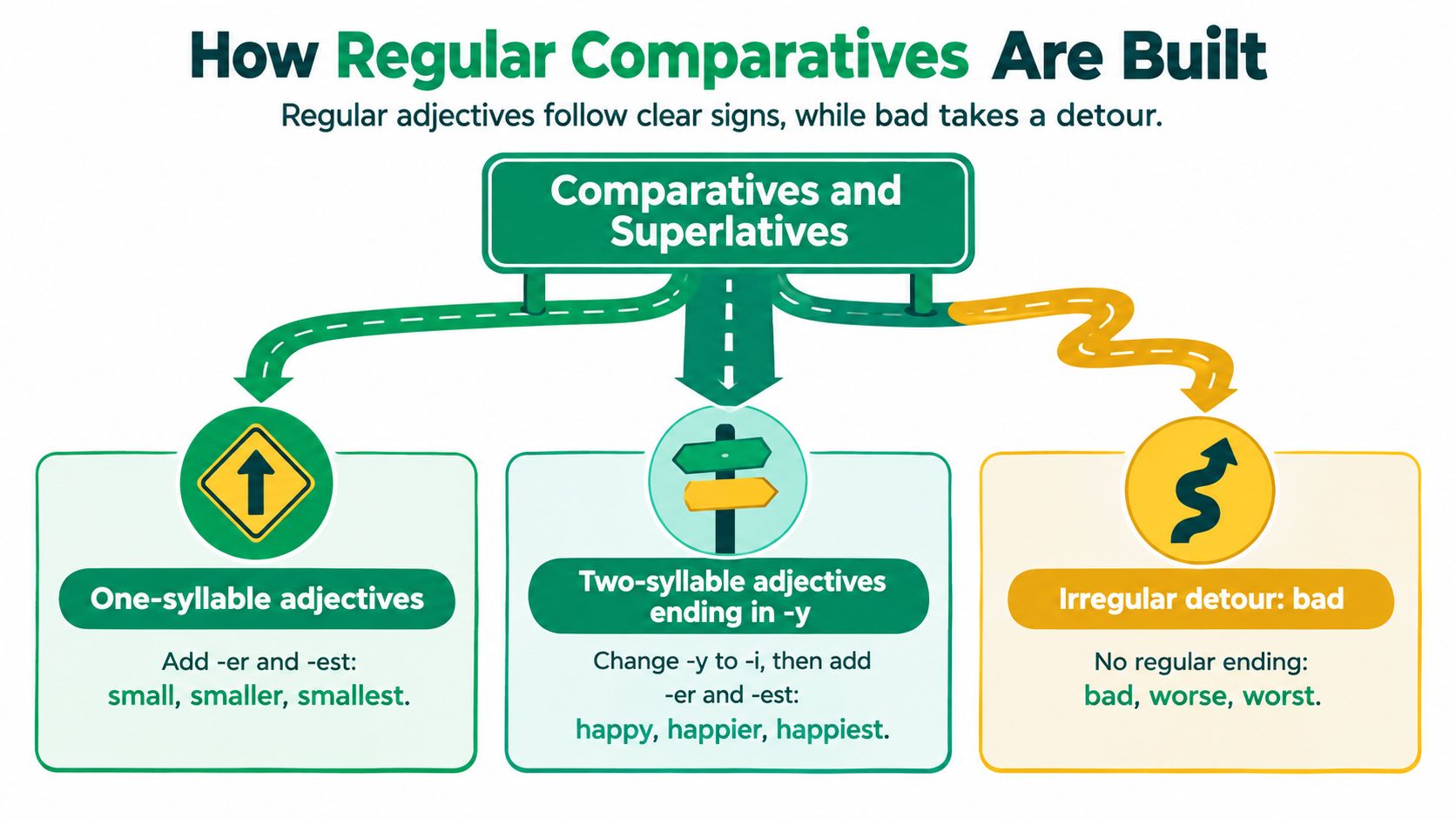
Regular adjectives follow a few clear road signs. Bad takes a detour, so the safest method is to test the word before you build the form.
Follow the Usual Pattern First
Start with the smallest words. One syllable usually takes -er and -est: small, smaller, smallest. If a two-syllable adjective ends in y, change the y to i first: happy, happier, happiest.
Many two-syllable adjectives with other endings prefer more and most, including careful and useful. Longer adjectives generally stay on that route.
| Pattern | Rule | Comparative | Superlative |
|---|---|---|---|
| One syllable | Add -er and -est | smaller | smallest |
| Two syllables ending in -y | Change y to i, add -er and -est | happier | happiest |
| Two syllables, other endings | Usually more and most | more careful | most careful |
| Three or more syllables | More and most | more beautiful | most beautiful |
The pattern is a guide, not a guarantee. Quiet can become quieter and quietest, so when a form sounds uncertain, check a dictionary rather than forcing the syllable count.
Recognize the Irregular Detour
Bad and good fail that first sorting test because their comparison forms replace the word instead of decorating it. According to Etymonline's history of worse, badder and baddest were once common but eventually lost ground to worse and worst.
That history explains an odd form in older literature or informal writing; it does not make badder the standard choice for a report or essay. For classroom practice, Kuraplan's classroom worksheet for teaching adjective forms offers a resource for working with these constructions, and basic grammar rules can connect adjective forms with complete sentence patterns.
Apply the regular pattern only after checking that the word isn't irregular.
Choosing Between Bad and Badly
Ask what the word describes before choosing its form. If it describes a person, thing, or state, use bad; if it describes how an action happens, use badly.
That question is more reliable than checking whether the word follows a verb. Some verbs connect the subject to a description rather than express an action.
| Sentence | Correct form | Role | Why |
|---|---|---|---|
| The draft is bad. | bad | Adjective after a linking verb | Describes the draft itself |
| I feel bad about the delay. | bad | Adjective after a linking verb | Describes the writer's state |
| The draft reads badly. | badly | Adverb describing how the draft reads | Describes the reading experience |
| The team performed badly. | badly | Adverb after an action verb | Describes how the team acted |
| This result is worse than the last. | worse | Comparative adjective | Compares two states |
| The team performed worse than last year. | worse | Comparative adverb | Compares two actions |
Identify the Meaning Behind the Verb
In The presentation seems bad, seems connects the presentation with a description. In The presenter explained it badly, badly describes the explaining.
Verbs such as is, seems, looks, sounds, and feels often work as linking verbs. Their role depends on the sentence, so don't automatically add -ly whenever a verb appears.
The BBC Learning English grammar guide also gives badly the irregular comparison forms worse and worst. This is why performed worse is correct even though performed bad would usually need revision in professional writing.
Changing an adjective into an adverb can change the meaning, not merely the level of formality.
For a closer look at this distinction, use the adjective-versus-adverb guide while checking what each modifier describes.
Make a Deliberate Choice With Feel
Use I feel bad about the delay when you mean that you regret it or feel unhappy. Bad describes your emotional state.
You'll also hear I feel badly in casual conversation. For professional and academic writing about regret, feel bad is the clearer standard choice; badly can instead suggest difficulty with the act of feeling or sensing.
Don't mechanically replace every adjective after a verb. Read for meaning first, then select the form.
Choosing Between Worse and Worst
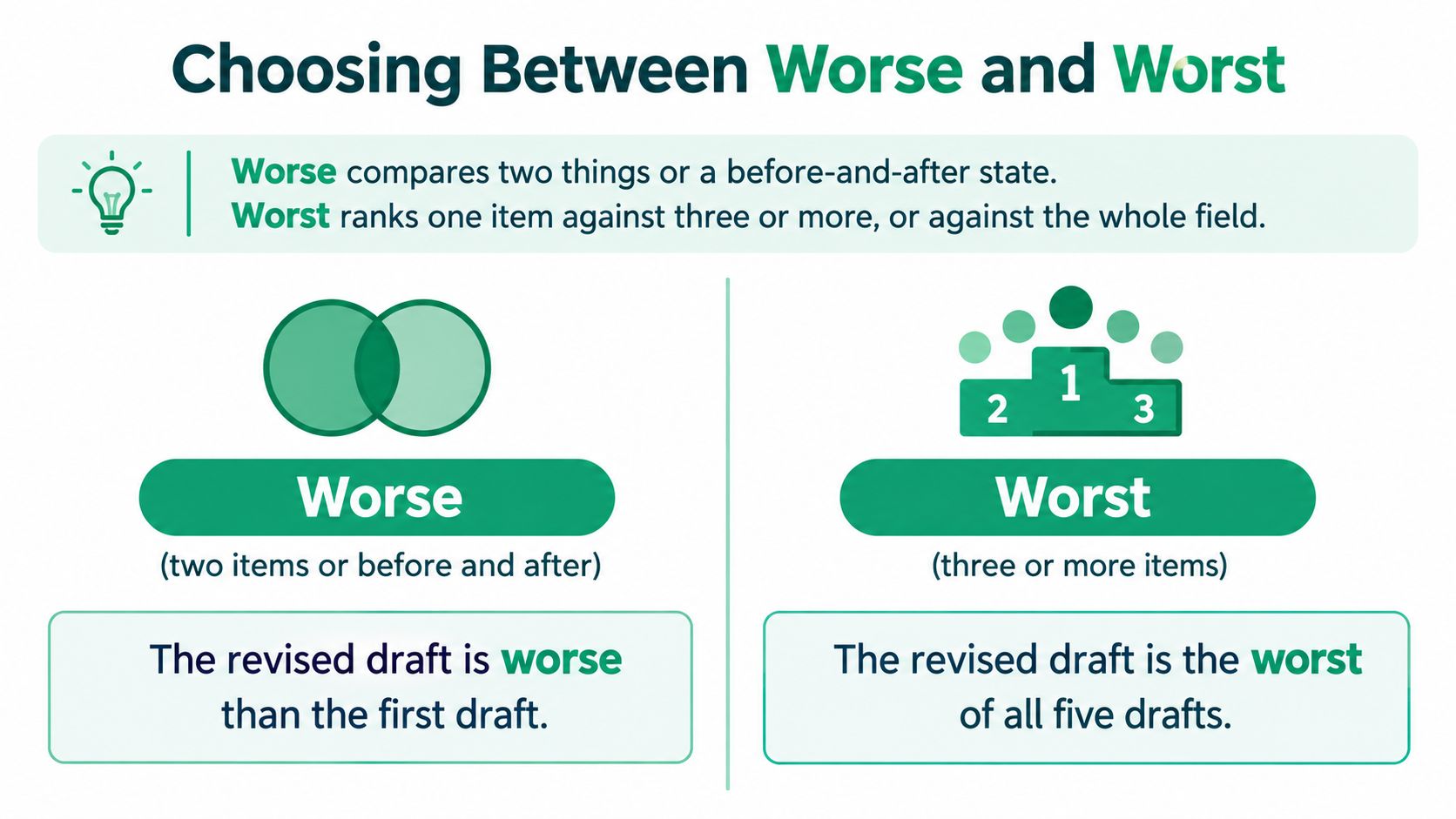
Worse makes a comparison between alternatives or states; worst identifies the lowest-ranked member of a relevant group. Compare The revised draft is worse than the original with This was the worst revision of the year.
The visual distinction is a useful starting point.
Define the Comparison Set
For conventional edited usage, choose worse for a head-to-head comparison and worst for the bottom rank across a larger group or the whole field. Cambridge's guide to worse and worst explains their different comparison structures, including two-way comparisons and superlative rankings across three or more possibilities.
Than often helps you recognize a comparative: The model performed worse than expected. But a sentence can leave the reference unstated when readers already understand it: After the update, performance became worse.
Use these questions while editing:
- Direct contrast: Is the revised version being compared with the original? Choose worse.
- Group ranking: Are you identifying the least successful version in the collection? Choose worst.
- Unclear scope: Can readers tell which versions belong in the comparison? Name the group.
The traditional choice is the worse of the two options, not the worst of the two options. You may hear the latter informally, but the comparative keeps a tightly edited comparison precise.
Check the Words Around Worst
Worst often appears with a determiner, a word such as the, my, or their: the worst error, my worst draft, their worst result. Don't add the after a possessive: my the worst draft is incorrect.
Fixed constructions behave differently. She performed worst of all doesn't need the, while expect the worst keeps it.
For teams writing technical documentation, the STE Guide's reference to approved vocabulary and word usage is a useful companion when checking terminology consistently.
For an additional spoken explanation, use this video.
Read your sentence aloud and ask what is being compared with what. If you can't answer, clarify the comparison before choosing the ending.
Common Mistakes and Why They Happen
More bad is an understandable mistake: you learn more careful and then apply the same construction to an irregular adjective. For ordinary degree, replace it with worse.
The British Council's comparative and superlative guidance lists bad → worse → worst among the irregular patterns. That exception explains why plausible-looking regular forms fail in standard prose.
| Incorrect | Correct | Why it fails |
|---|---|---|
| more bad | worse | Bad has an irregular comparative |
| most bad | worst | The superlative is worst |
| badder | worse | The regular -er ending isn't used with bad |
| baddest | worst | The regular -est ending isn't used with bad |
| more worse | worse | The comparative is marked twice |
| most worst | worst | The superlative is marked twice |
| worser | worse | Nonstandard in modern professional writing |
| the worst of the two options | the worse of the two options | Conventional edited usage reserves worst for a larger set |
Remove Duplicated Comparison Markers
More worse combines a comparative word with a form that is already comparative. Delete more, unless you intended a different construction such as much worse.
That distinction matters: much worse, slightly worse, and considerably worse are grammatical. Those modifiers explain the size of the difference rather than create the comparison again.
Likewise, most worst repeats the superlative marking. Use worst, then specify the group if the sentence needs a clearer boundary.
Separate Informal Voice From Accidental Error
You might encounter badder and baddest in dialogue, lyrics, or playful branding. They can be intentional voice choices, but they aren't neutral substitutes in an academic argument or business report.
Worser has a literary history and appears in Shakespeare's Antony and Cleopatra. Its presence in literature doesn't make it appropriate for modern professional prose.
Editing caution: Preserve intentional character voice, but don't mistake an accidental irregular form for personality.
Positive comparisons can cause similar uncertainty. A guide to good or well helps when your sentence describes successful performance rather than poor performance.
Finish with a targeted search for more bad, most bad, badder, baddest, worser, and worst of the two. Review each match in context instead of using an automatic replacement that could alter a quotation or deliberate voice.
Rewriting Real Sentences to Sound Natural
A useful correction preserves the writer's intended judgment. It shouldn't strengthen a claim, invent a comparison group, or make an emotional statement sound like a performance assessment.
These examples are hypothetical drafts from common writing situations. The corrections show when a word-level fix is enough and when the sentence needs clarification.
Match the Fix to the Writing Context
Email
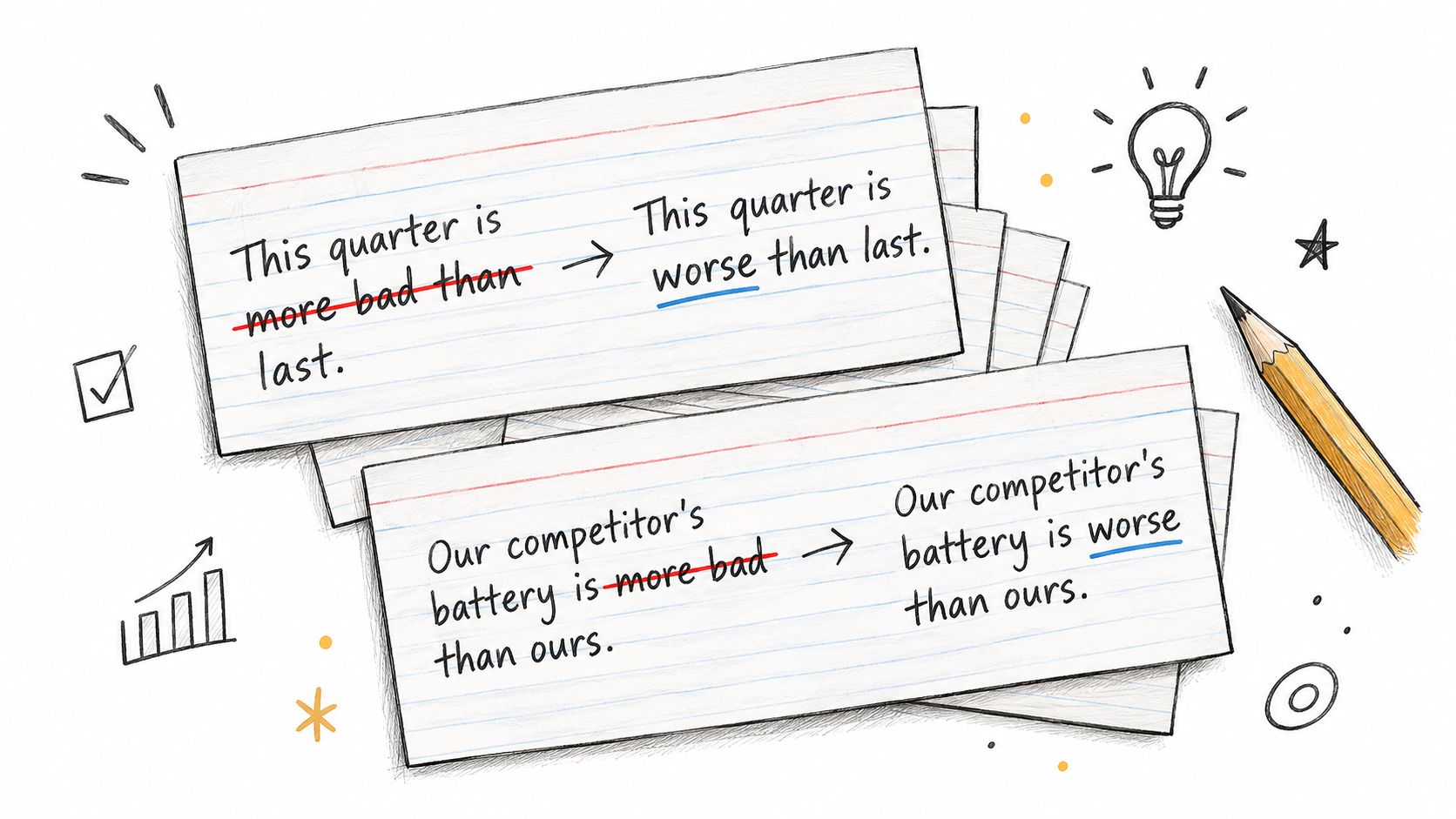
Before: This quarter is more bad than last.
After: This quarter is worse than last.
The change replaces a regular construction with the irregular comparative. For a business email, you may also need to specify whether you mean revenue, missed deadlines, or customer complaints.Product copy
Before: Our competitor's battery is the most bad in its class.
After: Our competitor's battery is the worst in its class.
The grammar fix supplies the superlative, but the claim still needs support. Publish it only if your evidence justifies that ranking and clearly defines the product class and test conditions.Essay
Before: The second study had the most bad methodology.
After: The second study had the weakest methodology of the three.
Assuming the essay evaluates that group of studies, weakest methodology names the specific weakness more naturally. The comparison set also makes the ranking explicit.Report
Before: Sales performed more badly in Q3.
After: Sales performed worse in Q3 than in Q2.
The revision uses the concise irregular comparative and supplies the reference period. Add that period only if it matches the author's intended comparison.Blog
Before: I felt badly after the launch.
After: I felt bad after the launch.
The adjective describes the writer's emotional state. If the intended meaning was poor performance, a different sentence, such as I handled the launch badly, would be necessary.
The index-card example below shows the simplest kind of repair.
Keep the Claim Under Human Control
When revising AI-generated copy, check whether the tool has added words such as ever, overall, or in its class. Those additions can turn a limited observation into a broader claim that your evidence doesn't support.
Use a sentence-correction workflow that checks grammar and meaning separately. First make the construction grammatical, then confirm that the revised statement says only what you can defend.
Prefer a concrete, supportable comparison over a stronger-sounding judgment.
Authentic writing doesn't require keeping every awkward phrase. It requires retaining your meaning, your evidence, and your responsibility for the published claim.
Practice Fix the Comparison
Choose your answers before looking at the key. For each sentence, identify what the missing word describes and whether the sentence makes a contrast or ranks an item within a group.
Try the Sentences
- The second option is ___ (bad/worse) than the first.
- This was the ___ (worst/worse) of the two drafts.
- She sang ___ (badly/bad) at the event.
- Our launch was the ___ (most bad/worst) in company history.
- I feel ___ (badly/bad) about the delay.
- She performed ___ of all the candidates (bad/worst/badly).
- Rewrite this sentence: The copy is more bad than the ad.
If you're building a study routine, Knobee AI's explanation of how active recall improves memory offers context for answering from memory before checking a reference. Here, make your choice and explain the reason aloud before reading the key.
Check Your Reasoning
- Worse. Than the first signals a direct comparison.
- Worse. The sentence compares a pair of drafts.
- Badly. The word describes how she sang.
- Worst. The sentence ranks the launch against company history.
- Bad. The adjective describes the speaker's emotional state.
- Worst. Of all the candidates establishes the full ranking group.
- The copy is worse than the ad. Replace the nonstandard comparative without changing the meaning.
If an answer surprised you, write a new sentence using that same pattern. Creating your own example helps you check whether you understand the decision, rather than merely recognize the answer.
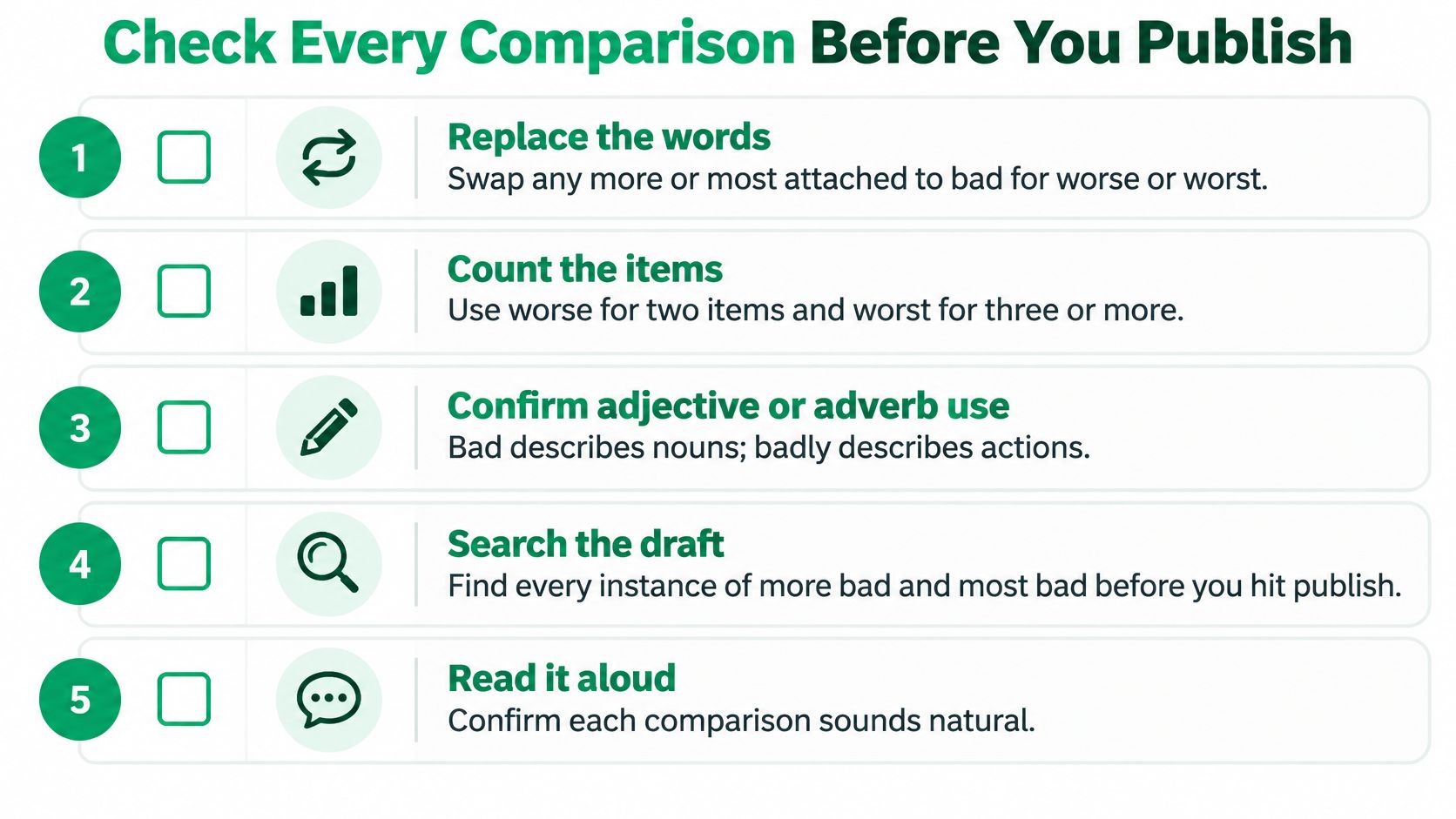
Check Every Comparison Before You Publish
A final pass should check both the grammar and the claim. A correctly formed superlative can still be misleading if you haven't defined or evaluated the relevant group.
Use a Focused Editing Checklist
- Replace malformed degrees. Change ordinary more bad and most bad constructions to the appropriate irregular form.
- Check the scope. Decide whether you're making a direct contrast or assigning a rank within a group.
- Confirm the grammatical role. Identify whether the word describes a thing, a state, or an action.
- Remove duplicated or nonstandard forms. Review more worse, most worst, badder, baddest, and worser.
- Read for meaning. Say the sentence aloud and make sure readers can identify the comparison.
Keep this visual checklist beside your final draft.
After the manual pass, use writing-tool suggestions selectively. Accept revisions that improve clarity, but reject changes that exaggerate your claim or flatten your voice.
AI assistance should support your judgment, not replace it. You remain responsible for facts, comparisons, and originality, and you should disclose assistance whenever your publisher, employer, or school requires it.
At Pure Write , we offer naturalness and readability analysis alongside tools for humanizing AI-assisted drafts. Try PureWrite on your next email, essay, or blog post to refine awkward comparisons and improve flow, then apply suggestions selectively so the meaning and voice stay yours.